An insurance adjuster's report is the adjuster's written account of a claim: who was assigned and when, when the insured was contacted and the property inspected, what caused the damage and how far it goes, the photographs that show it, and the estimate that prices it. A sample report, like the one below, reads as a narrative, but every section also carries a clock: the assignment time, the inspection check-in and check-out, and the capture time on each photograph. Read together, those times show how long the adjuster was on site, and that is the fairest test of a fee bill that charges by the hour. Botminds' Independent Adjuster Bill Review reads the report, the photographs and the check-ins together, so the hours billed are checked against the adjuster's own clock before the bill is paid.
The report, adjuster, firm and storm are fictional sample data from the solution. Rules on reports and photographs are linked to their sources.
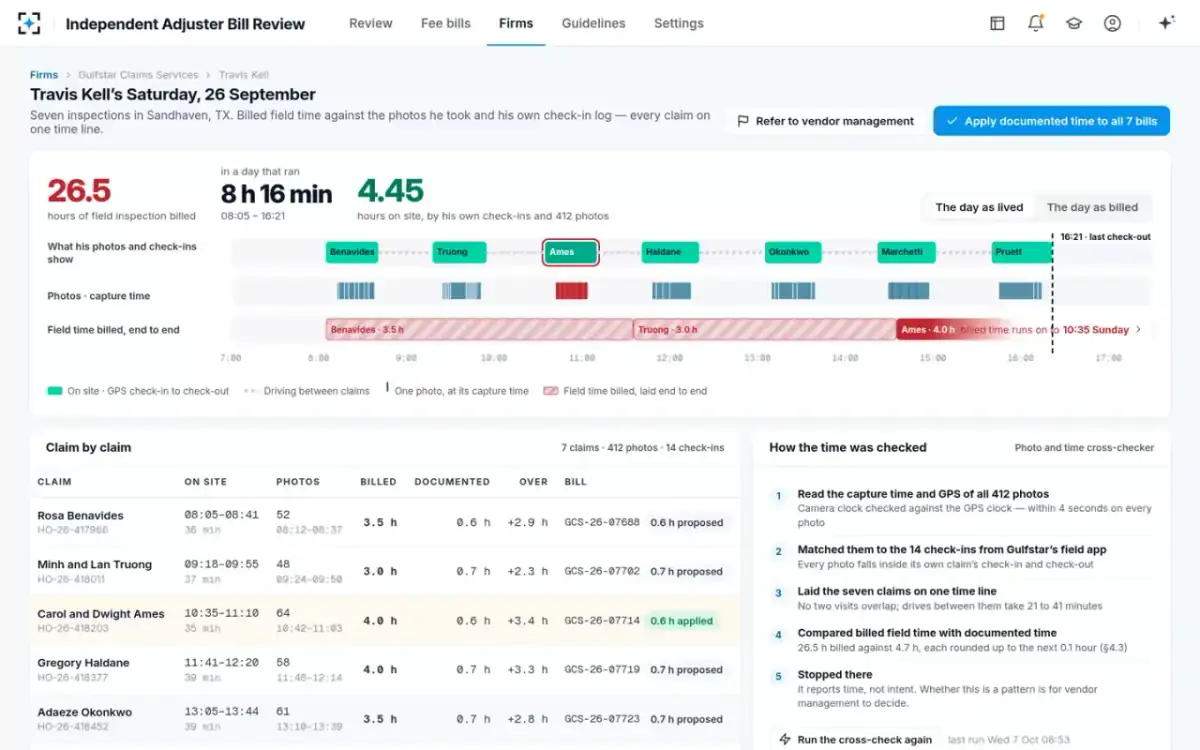
One adjuster's Saturday: the day as lived, and the day as billed
- On site at seven claims4.45 h on site
- Between visits3.8 h
- Benavides3.5 h
- Truong3.0 h
- Ames4.0 h
- Haldane4.0 h
- Okonkwo3.5 h
- Marchetti4.5 h
- Pruett4.0 h
What is an insurance adjuster's report?
It is the document that turns an inspection into a claim decision: the adjuster's observations, measurements, photographs and estimate, written for the examiner who will decide the claim. FEMA describes the inspection behind it for policyholders in one sentence: "Your adjuster will take measurements, photos and notes of the damage caused directly by the flood event during the initial visit to your property." The report is where those measurements, photos and notes arrive at the carrier.
Its standard is set by the adjuster's own ethics as much as by the carrier's guidelines. Florida's code for all adjusters requires truthful and unbiased reporting after a complete investigation, and adds a line that bears directly on the fee bill: an adjuster shall settle claims "without any compensation or remuneration to himself or herself except that to which he or she is legally entitled." The report and the bill describe the same visit, and they should agree.
A sample adjuster report, section by section
The sample is a first report on a hurricane claim, nine pages with 64 photographs, written by a field adjuster for an outside firm and sent to the carrier with a fee bill. On the left, what the report says; on the right, what its own timestamps and photographs say.
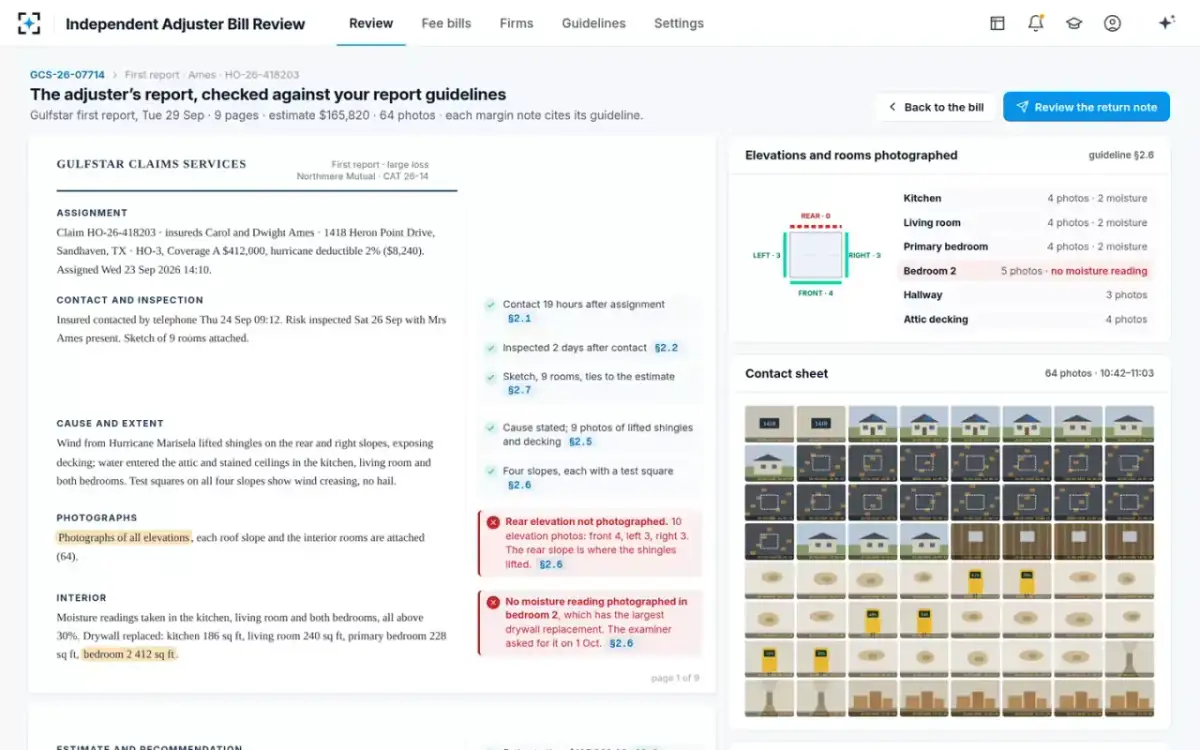
Sample adjuster report: what each section says, and what its clock says
Assignment
The report saysClaim HO-26-418203, Carol and Dwight Ames, 1418 Heron Point Drive, Sandhaven. HO-3, Coverage A $412,000, hurricane deductible 2% ($8,240). Assigned Wed 23 Sep 2026, 14:10.
The file showsAssignment time: starts the contact clock
Contact and inspection
The report saysInsured contacted by telephone Thu 24 Sep, 09:12. Risk inspected Sat 26 Sep with Mrs Ames present. Sketch of 9 rooms attached.
The file showsCheck-in 10:35, check-out 11:10 in the firm’s field app
Cause and extent
The report saysWind lifted shingles on the rear and right slopes, exposing decking; water entered the attic and stained ceilings in four rooms. Test squares on all four slopes show wind creasing, no hail.
The file showsNine photographs of the cause, each with its capture time
Photographs
The report says“Photographs of all elevations, each roof slope and the interior rooms are attached (64).”
The file shows64 photos, 10:42:17 to 11:03:05; front 4, left 3, right 3, rear 0
Interior
The report saysMoisture readings in the kitchen, living room and both bedrooms, all above 30%. Drywall replaced: bedroom 2, 412 sq ft, the largest.
The file showsBedroom 2: five photos, no moisture reading photographed
Estimate and recommendation
The report saysDwelling estimate $165,820, 312 line items; contents $21,640.50. First report dated Tue 29 Sep.
The file showsReport three days after inspection; estimate ties to the report
Most of the report holds up. The insured was contacted 19 hours after assignment, the inspection came two days later, the first report three days after that, the cause is stated with nine photographs, every roof slope has a test square, and the estimate ties to the report. Two sentences do not. "Photographs of all elevations" covers front, left and right but not the rear, which is the slope where the shingles lifted. And moisture readings "in both bedrooms" have no reading photographed in bedroom 2, the room with the largest drywall replacement, for which the examiner had asked on 1 October.
The report with a margin note against each guideline
The clock inside every adjuster report
Every modern inspection leaves timestamps the adjuster did not write by hand: the capture time and GPS position stored with each digital photograph, the check-in and check-out in the firm's field app, the times of calls and notes in the claim system. Florida's statute already treats photographs and video as investigation in their own right, allowing insurers to use electronic methods including "any method that provides the insurer with clear, color pictures or video documenting the loss".
Those timestamps form a clock that runs alongside the report. In the sample, the adjuster checked in at the Ames house at 10:35 and out at 11:10; his 64 photographs run from 10:42:17 to 11:03:05; his next check-in, at another claim on Bayshore Road, is at 11:41, and his first photograph there at 11:48. That is 35 minutes on site, documented by his own devices. The fee bill for the visit charged 4.0 hours of field inspection.
Independent Adjuster Bill Review on one visit: three clocks, one bill line
35 min
on site, from the field app’s check-in at 10:35 to check-out at 11:10
21 min
from the first photo, 10:42:17, to the last, 11:03:05
4.0 h
of field inspection billed for the same visit
0.6 h
allowed: 35 minutes rounded up to the next tenth of an hour
How long does a field inspection take?
There is no public standard, and there should not be one: a field inspection takes as long as the building, the damage and access require. A small interior water loss can be documented in half an hour; a large house with a damaged roof, four slopes and every room photographed can take far longer. A bill review that compares hours with an average for the task produces a number no firm will accept.
What there is, on every claim, is the adjuster's own trace of the visit. In the sample storm, seven large-loss inspections by the same adjuster on one day each took 35 to 41 minutes on site by his own check-ins. Whether that is long enough for a proper inspection is a question for the report review, and in the sample the report was mostly complete. Whether it supports 3 to 4.5 billed hours each is a question for the bill review, and it does not.
The same logic answers the question of a reasonable field time for a roof inspection. The carrier's guidelines can require every slope photographed with a test square, as the sample's do; the photographs then show when the roof was inspected and how long it took, and that, not a benchmark, is what the bill is tested against.
One adjuster's Saturday: billed hours against documented hours
A single visit can be argued: a long walk round the property before the first photograph, a conversation with the insured after the last. A whole day cannot. Laying every claim the adjuster billed that day on one time line is the fairest test, because it puts each bill in the only context that can contradict it.
Seven bills from one day, billed and documented
| Claim | On site, by check-ins | Photos | Billed | Documented, rounded up |
|---|---|---|---|---|
| Benavides | 08:05–08:41 · 36 min | 52 | 3.5 h | 0.6 h |
| Truong | 09:18–09:55 · 37 min | 48 | 3.0 h | 0.7 h |
| Ames | 10:35–11:10 · 35 min | 64 | 4.0 h | 0.6 h |
| Haldane | 11:41–12:20 · 39 min | 58 | 4.0 h | 0.7 h |
| Okonkwo | 13:05–13:44 · 39 min | 61 | 3.5 h | 0.7 h |
| Marchetti and Pruett | two visits, 81 min together | 129 | 8.5 h | 1.4 h |
| The day | 08:05–16:21 · 4.45 h on site | 412 | 26.5 h | 4.7 h |
Independent Adjuster Bill Review: seven inspections on one time line
Can photo time stamps prove time on site?
They can show that the adjuster was at the property during the span the photographs cover, and with check-ins they bound the visit. They cannot, alone, prove the visit was no longer: an adjuster can arrive before the first photograph and leave after the last. That is why the sample carrier's guideline pays documented on-site time, check-in to check-out, not the photo span, and why the solution's settings let a carrier choose which clock counts when the two disagree: photo capture time, the check-in log, or the later of the two.
Photo times are also only as good as the device clock. In the sample, the cross-checker compared each photograph's camera time with its GPS time and found them within four seconds on every photo; a camera set an hour wrong, or to another time zone, would fail that check and the time finding would not be raised. A carrier should expect the same from any tool before a single hour is cut.
Five ways the photo clock can mislead, and the check for each
When photo times are wrong, and how a fair review catches it
| What can go wrong | What it looks like | The check |
|---|---|---|
| The camera clock is wrong | Photos an hour off, or in another time zone | Compare camera time with GPS time on each photo; skip the finding if they disagree |
| Photos taken from somewhere else | Roof photos taken from the street, or by a drone operator | GPS position of each photo against the property, and who took it |
| Time on site before or after photos | A walk-round, a talk with the insured | Pay the check-in to check-out window, not the photo span, plus a tolerance |
| Work done off site | Writing the estimate, the sketch, the report | Billed separately at the desk rate, not as field time |
| A missing check-in | The field app failed to sync | Hold the time finding; let the firm restore the line with the log |
The fourth row matters most to adjusters. Estimating, sketching and report writing are real work done away from the property, and the sample bill pays them: 11.5 hours for an estimate of 312 line items and 4.0 hours for the first and final reports, at the desk rate. The finding is only that they are not field time. A review that confuses the two will cut legitimate work and lose the firm's trust on the first bill.
"It reports time, not intent. Whether this is a pattern is for vendor management to decide."
The photo and time cross-checker's own description of its finding, in the solution
What the reviewer writes back to the firm
The finding goes back as one line of the return note, with its section and evidence, alongside the report gaps. In the sample it reads: field inspection, $380.00 billed, $57.00 allowed, on site 35 minutes, 64 photos in 21 minutes, section 4.3. The two report gaps, the rear elevation and the bedroom 2 moisture reading, go in the same note with their sections, and the firm is invited to reply with any evidence the file did not hold.
Report gaps cost more than they seem to at the time. After Hurricane Isabel, FEMA's task force review of disputed flood claims found that almost half the policyholders who asked received more, and "In most cases, the additional funds were for repairing or replacing buildings or property not included in the initial adjuster's loss determination". A missing elevation is how that starts. What the first report must contain, and when it is due, is in the adjuster's preliminary report; the three layers of checks that apply to the bill are in the claims audit checklist for IA bills; the whole review is on Independent Adjuster Bill Review.
Questions people ask
What is an adjuster report for an insurance claim?
It is the adjuster's account of the inspection and the claim: assignment, contact, cause and extent of loss, photographs, measurements and the estimate, with a recommendation to the examiner who decides. The examiner, not the adjuster, decides what is paid.
What is a reasonable field time for a roof inspection?
No regulator publishes one; it depends on the roof's size, pitch, damage and access. A fair bill review does not use an average: it compares billed field time with the adjuster's own check-in, check-out and photograph times for that roof, plus a tolerance.
Can photo metadata be used against an adjuster?
It should be used as evidence of time and place, not of motive, and only from photographs the firm submitted to the claim file. A finding based on it should say what the photos and check-ins show, cite the guideline section, and allow the firm to answer with evidence the file lacked.
Does an adjuster bill for writing the report?
Usually yes, separately from field time. In the sample carrier's guidelines, estimating and report writing are billed at the desk rate, $75 an hour; only the time on site at the property is field time at $95.
Why do adjuster reports get returned?
Because a guideline is not met: a missing elevation or roof slope, no moisture readings where drywall is replaced, an estimate that does not tie to the report, a missing sketch, or work done without authorisation. In the sample storm, the share of reports returned ran from 7% at the best firm to 22% at the worst.