A Florida emergency adjuster license is a temporary licence the Department of Financial Services issues, after a catastrophe or emergency, to a person who is not a licensed Florida adjuster but has been certified as qualified by an authorized insurer, an eligible surplus lines insurer or a licensed independent adjusting firm working for one. It lasts up to six months, can be extended while the emergency continues, and covers only losses from the emergency it was issued for. The insurer or firm that certifies the adjuster takes on real duties: due diligence, supervision, and responsibility for the adjuster's acts. In a storm, when a carrier hands thousands of claims to outside adjusting firms, those duties meet the fee bills, because every bill names an adjuster whose licence the carrier or its firm vouched for. Botminds' Independent Adjuster Bill Review does not issue or verify licences; it puts every adjuster who bills on a storm in one list, bill by bill, which is what a licence check needs.
The rules below are quoted from Florida's statutes and the Department's rule, as displayed in October 2026, and linked where they appear. The firms and adjusters in the examples are fictional sample data from the solution.
From surge roster to paid bill: where the licence is checked
A person decides
Insurer or firm certifiesApplies online for each person, certifying them qualified after a due-diligence inquiry.
Never: Certify someone it has not checked for qualification, training and character
A person decides
Department issues the licenceIssues an emergency licence for the emergency, for up to six months, to a natural person.
Never: Work begins before the licence is issued
A person decides
Carrier assigns the claimAssigns through the firm; the claim must arise from the emergency the licence covers.
Never: A loss from a different event
A person decides
Adjuster contacts and inspectsGives the policyholder a name and licence number, and repeats them on every later contact.
Never: A contact without both
Agent
Bills and reports readEvery bill and report is tied to the adjuster named on it, by firm, across the storm.
Never: Judge a licence; that check stays with a person
A person decides
Compliance checks the rosterMatches the adjusters who billed against the licence and appointment log, by date.
Never: Pay work done outside a licence without a decision
What is an emergency adjuster license in Florida?
It is a licence the state may grant in a catastrophe to people who are not licensed Florida adjusters, so that claims can be handled faster than the regular licensing process allows. The statute sets the conditions: the Department may issue a licence, for the purposes and period it determines, to residents or non-residents at least 18 years old, with US citizenship or work authorization, "who are not licensed adjusters under this part but who have been designated and certified to it as qualified to act as adjusters" by an authorized insurer or by a licensed independent adjusting firm contracted with one.
The Department's rule fills in when it applies. An emergency exists when a sudden disaster has caused, or is about to cause, losses to insured Florida property so numerous and severe that claims may not be resolved quickly without emergency adjusters. The rule treats the words emergency and catastrophe in the statute as meaning the same thing, and when the Department decides an emergency exists, it opens the online application on its website.
A Florida emergency adjuster license in four numbers
6months
the longest an emergency licence runs before an extension
6months
each extension, granted only while emergency conditions still exist
18
the minimum age; US citizens or legal aliens with work authorization
1
emergency per licence: it covers losses from that event only
Who can certify an emergency adjuster in Florida?
Three kinds of entity: a Florida authorized insurer, an eligible surplus lines insurer, or a licensed independent adjusting firm. The statute names insurers and contracted firms; the Department's rule adds eligible surplus lines insurers, and defines an emergency adjuster as a person certified by any of the three as qualified to adjust claims under that insurer's policies.
The certification is the application. The insurer or firm submits form DFS-H2-495 online through its own appointing account, with the fee, and by doing so "certifies that the emergency adjuster applicant is qualified, thereby appointing the emergency adjuster applicant to represent" the certifier. The adjuster may be on the certifier's staff, an independent contractor, or an employee of a contractor; the rule allows all three. What it does not allow is starting early: "Adjusting work shall not begin until an emergency adjuster license has been issued."
What the certifying insurer or firm takes on
Certification is not paperwork; it transfers responsibility. Under the rule the certifier is bound by the emergency adjuster's acts in the same way as for any regularly licensed adjuster it appoints, until the appointment is terminated through the Department's system. The certifier must also have checked, before applying, and keep supervising after the licence is issued.
"…is responsible for assuring, by due diligence inquiry, that the emergency adjuster applicant is in fact qualified to adjust claims, has received training to adjust claims, and is of good and honest character."
Fla. Admin. Code 69B-220.001(3)(a)2, on the entity that certifies an emergency adjuster
The duty to supervise is written as an affirmative one, continuing after licensure. And every emergency adjuster must carry proof of authority to represent the certifier, and show it with a photo ID on demand to the insured, the insured's representative, a law enforcement officer or emergency management personnel.
For a carrier that hires firms, this creates two layers of answerability. Where the firm certified the adjuster, the firm is bound by the adjuster's acts under the rule; and the carrier answers to its policyholders and its regulator for every claim handled on its behalf, whoever handled it. Why the carrier remains answerable for outside work is set out in the staff adjuster definition, and who answers for an IA.
How long a Florida emergency licence lasts, and what it covers
Six months from issue, unless the licence states a shorter period, and the Department's stated policy is to keep it short: "Because emergency licensure is an extraordinary deviation from regular licensing procedures, it is Department policy to specify, as the duration of emergency licensure, the shortest possible time in each particular emergency." Extensions of up to six months each are granted only if the Department finds the emergency conditions still exist, on a new application from the entity.
Three limits travel with the licence. It is used only for losses directly resulting from the emergency it was issued for. It is issued only to natural persons, not firms. And the licensee accepts Florida's disciplinary jurisdiction and its courts for anything done under it, which continues after the licence expires.
A regular Florida adjuster licence next to an emergency one
Regular all-lines adjuster licence: The individual, with the fee
Emergency adjuster licence: The insurer or firm, certifying the person as qualified
Regular all-lines adjuster licence: Examination or an exemption, plus continuing education
Emergency adjuster licence: The certifier’s due-diligence inquiry into qualification, training and character
Regular all-lines adjuster licence: Continuing, with appointments renewed
Emergency adjuster licence: Up to six months, extensions of up to six months while the emergency lasts
Regular all-lines adjuster licence: All lines except life and annuities
Emergency adjuster licence: Losses directly resulting from the one emergency
Regular all-lines adjuster licence: The adjuster, the appointing entity and the firm’s primary adjuster
Emergency adjuster licence: The adjuster, and the certifier, bound by the adjuster’s acts
Must an adjuster give a licence number in Florida?
Yes, on residential property claims, at the inspection and on every contact after it. When the investigation involves a physical inspection, the licensed adjuster "must provide the policyholder with a printed or electronic document containing his or her name and state adjuster license number." Any later communication about the claim must also carry the name and licence number of the adjuster communicating.
The insurer must keep a list of every adjuster who communicates with the policyholder under those rules and provide it on request to the insured, the Office of Insurance Regulation or the Department (Fla. Stat. 627.70131(4)(a)). That list is the carrier's half of a roster check: it says which adjusters touched which claims. The fee bills are the other half: they say which adjusters the carrier was charged for.
What happens if an unlicensed adjuster works a claim?
For the person, it is unlawful; for the firm and the carrier, it is a finding. Florida's licensing law forbids anyone to act as an adjuster without a current licence and appointment (Fla. Stat. 626.112). An adjuster whose licence is revoked or suspended may not take part in any part of a claim, from estimating to settlement, and "A person who provides these services while the person’s license is revoked or suspended acts as an unlicensed adjuster." An emergency adjuster who misconducts can lose the privilege by order without notice or hearing, after which adjusting in the state is unlawful.
The firm's primary adjuster is exposed too: the Department may suspend or revoke the primary adjuster's licence if the firm employs or contracts anyone whose licence was denied, suspended or revoked (Fla. Stat. 626.8695(5)). And the carrier's exposure on emergency claims is priced higher than usual. Florida's Office of Insurance Regulation may fine an insurer up to $25,000 per non-willful violation, and $100,000 in aggregate for violations arising from the same action, on claims from a declared emergency, and fined 42 insurers in the first quarter of 2026 alone (OIR Insurer Compliance Report, April 2026). Those fines cover claims handling broadly, not licensing alone; they show what a file that cannot account for its adjusters costs.
Checking a surge roster against the bills
The cheapest licence finding is made before a bill is paid. A carrier that holds its list of adjusters who contacted policyholders, the firms' appointment and emergency licence lists, and the adjuster named on each fee bill can ask four questions of every bill: was the person licensed on the dates billed, was the loss from the emergency the licence covers, was the person appointed to the firm that billed, and is the person on the carrier's own list for that claim.
Seven checks for a surge roster in a Florida catastrophe
- Every adjuster on a bill has a licence
Regular or emergency, current on every date billed.
- Emergency licences match the event
The claim’s loss arises from the emergency the licence was issued for.
- The licence was issued before the work
No billed work dated before the issue date.
- The certifier is the billing firm, or the carrier
And the appointment had not been terminated.
- Name and licence number on each contact
Inspection document and later messages, per 627.70131(3)(b)–(c).
- The carrier’s adjuster list matches the bills
Every adjuster billed for appears on the claim’s list, and the reverse.
- Flood claims carry an FCN
Federal flood claims need an active Flood Control Number that belongs to the adjuster handling the claim.
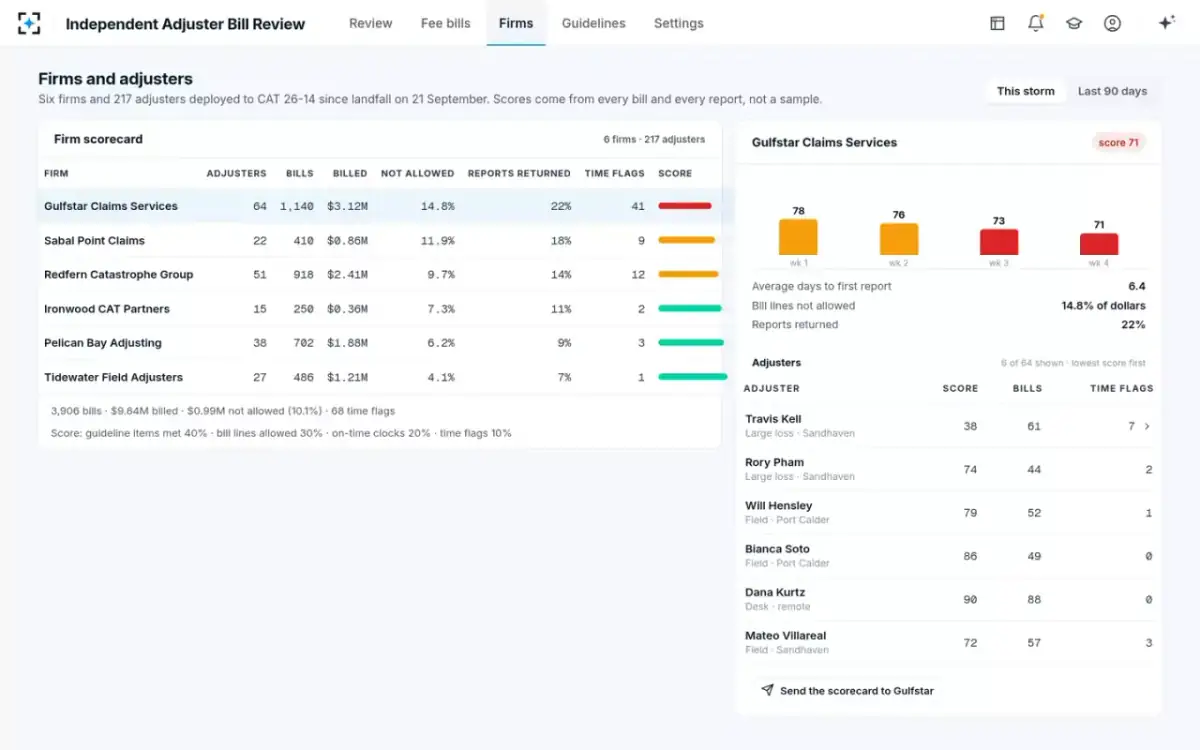
In a storm that brings 217 outside adjusters from six firms, as the solution's sample storm does, these checks are a list-matching exercise across thousands of bills. The bill review supplies one side of the match. In the solution, every bill is tied to the adjuster named on it, and the firm scorecard lists each firm's adjusters with their bills, scores and flags; the carrier's compliance team matches that list against the licence and appointment lists it holds. The solution does not query the Department's licensing system or judge whether a licence is valid.
Independent Adjuster Bill Review: every billing adjuster, by firm
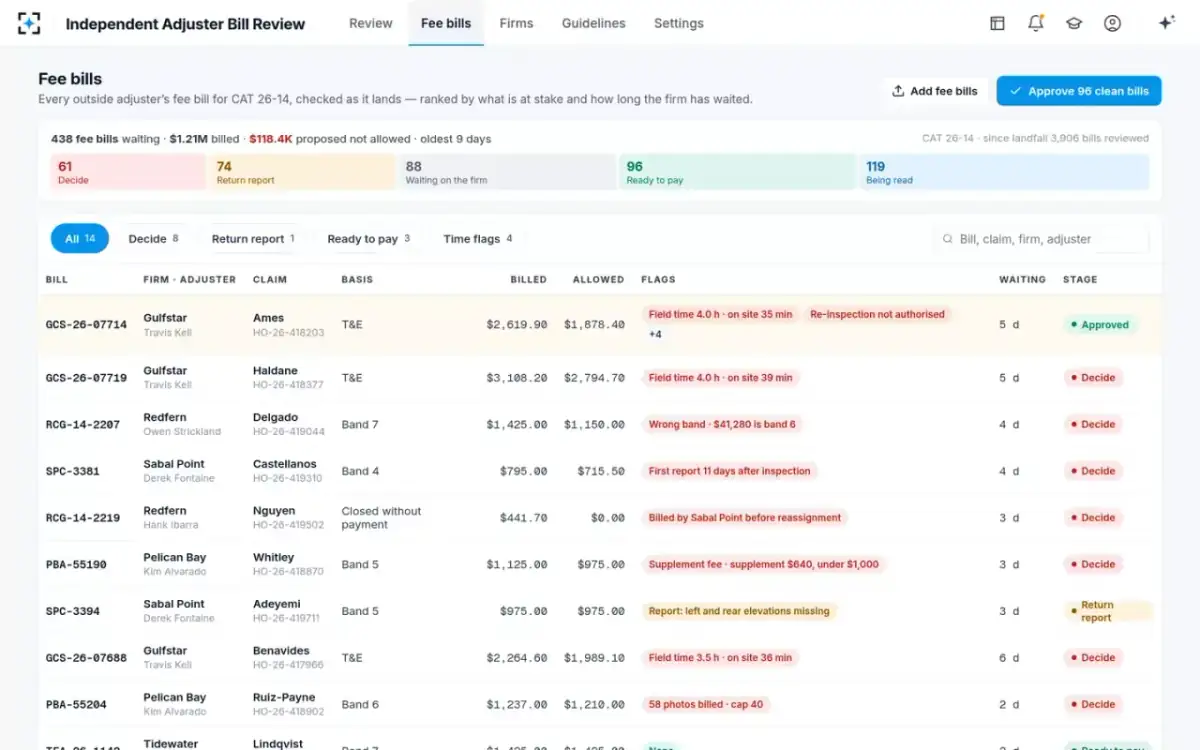
The bills also catch the assignment questions that sit next to licensing. In the sample queue, one closed-without-payment bill is flagged because another firm had billed the claim before it was reassigned, and is held at $0 until the firms' roles are settled. Those flags, and the others the queue raises, are set out in the claims audit checklist for IA bills.
Independent Adjuster Bill Review: a storm's bill queue, with an assignment flag among the fee findings
Why emergency licence rules vary by state
Because adjuster licensing is state law, and states relax it differently in a catastrophe. Reviewing the 2005 hurricane season, the GAO found that all the coastal states it contacted allowed emergency adjusters, and that the safeguards differed: "Florida, Mississippi, North Carolina, and Texas require that work performed by emergency adjusters be reviewed and certified by a sponsoring licensed adjuster or insurance company." Louisiana, which had no requirements for emergency adjusters that season, afterwards required only that they register a name and employer contact details.
The GAO's concern was that waivers and reciprocity let the weakest state's standard travel: "In the absence of adequate and consistent licensing requirements, reciprocity can reduce one state's level of oversight to the more limited standards of another." Its findings are nearly twenty years old, and Florida's rule has been rewritten since, most recently in 2023. The point that survives is practical: in a multi-state storm, a carrier's roster check has to apply each state's rule to each claim's location, not one rule to the whole roster. How catastrophe deployments are planned in the first place is covered in CAT adjuster deployment, and the review of every bill those adjusters send is on Independent Adjuster Bill Review.
Questions people ask
How do I get a Florida emergency insurance adjuster license?
Not by applying alone. An authorized insurer, eligible surplus lines insurer or licensed independent adjusting firm must certify you as qualified and submit the application, form DFS-H2-495, through its own account once the Department has opened emergency applications for the event.
How long does a Florida emergency adjuster license last?
Up to six months from issue, or less if the licence says so; the Department's policy is the shortest possible period. Extensions of up to six months each are granted while the emergency conditions still exist.
Can an emergency adjuster work any Florida claim?
No. The licence covers only losses directly resulting from the emergency it was issued for, and work may not begin before it is issued. A claim from a different event needs a regular licence.
Is an FL emergency adjuster license valid for flood claims?
The state licence is necessary but not sufficient. National Flood Insurance Program claims also need the adjuster to be registered with the NFIP with an active Flood Control Number, approved for the claim type, which a state emergency licence does not provide.
Who is responsible for an emergency adjuster's mistakes?
The adjuster, who accepts Florida's disciplinary and court jurisdiction; the insurer or firm that certified them, which the rule binds by their acts; and the carrier, which answers to its policyholders and regulator for every claim handled on its behalf.