NAIC model law state adoption charts, which the NAIC calls state pages, list all 56 of its members, the 50 states, the District of Columbia and five territories, and place each one in one of four columns for a given model: model adoption, previous version, related activity or no current activity. Each entry cites the state's statute, regulation or bulletin, with the years it was enacted and amended. The chart is the best free starting point for any multi-state insurance question, and a poor finishing point: it tells you where each state addressed the topic, as the NAIC's lawyers classified it on the page's date, not what each state's rule says today.
Reading those pages is the first step of most 50-state questions, including those handled by 50-State Regulatory Research, Botminds' solution in which agents read each NAIC model with each state's adoption, then the state's own codes, regulations and bulletins, and cite each state's answer for the analyst to accept and counsel to sign. The counts on this page are our counts of the NAIC's own pages as published on 27 October 2026.
"The NAIC’s interpretation may or may not be shared by the individual states or by interested readers."
NAIC Legal Division, introduction to every model's state page
What are the NAIC model law state adoption charts?
They are the state pages that close each entry in the NAIC's model laws publication. The NAIC describes that publication as giving "quick access to every NAIC Model Law, Regulation, and Guideline", and says "Included with every model is a state action page that cites each state's enacted model or similar legislation." Each page is a dated edition: the page for the property and casualty claims model we read is the Fall 2023 edition, the one for the insurance data security model is Summer 2026.
The pages state their own purpose plainly: to give readers "a starting point from which they may review how each state has addressed the model and the topic being covered". Rows run alphabetically through the 56 NAIC members, so a page covers more than the 51 jurisdictions most surveys use; American Samoa, Guam, the Northern Mariana Islands, Puerto Rico and the Virgin Islands have rows of their own. The NAIC's Legal Division decides which column each citation belongs in.
How to read the four columns, and what to do after each
Each column is a classification with a specific meaning, defined in a key on the page. The useful way to read it is as an instruction about where to look next.
The four columns of an NAIC state page, and the next step after each
Model adoption
What it meansThe state adopted the most recent version "in a substantially similar manner"; style and format may vary, and partial adoptions appear here with a note.
What to do nextRead the state's own text anyway. Substantially similar is not identical, and later statutes can override the adopted rule.
Previous version
What it meansThe state enacted an older version of the model and has not adopted the current one.
What to do nextCompare the older model text with the current one; the difference is often the answer.
Related activity
What it meansStatutes, regulations, bulletins or notices on the same subject that do not adopt the current model.
What to do nextRead the cited rule in full. It answers the question in its own words, which may differ from the model in every number.
No current activity
What it meansNothing on the topic as of the page's date, including states that repealed a law and states that never had one.
What to do nextCheck the date of the page, then the state's general statutes and bulletins; a gap may be the true answer.
The definitions carry their own caveats. Model adoption requires a state to have adopted the whole model, though not word for word: style and format may vary (state page key; what that allows is traced sentence by sentence in how states adopt NAIC model laws), and states that adopted only portions sit in the same column with a note: Kansas's claims regulation carries "(with exceptions)", Tennessee's data security statute "(portions of model)". Related activity is defined broadly enough to include "other administrative guidance such as bulletins and notices". And no current activity "includes states that have repealed legislation as well as states that have never adopted legislation", so the column cannot tell a state that never acted from one that changed its mind.
NAIC model law adoption by states: two models, two very different pages
The same chart format describes very different landscapes. The claims settlement model, whose current text dates from 1997, leaves more than a third of its rows empty; the data security model, from 2017, leaves almost none.
Two NAIC state pages, counted column by column (56 rows each)
The difference is not just adoption. On the claims page, the 12 related-activity rows include California, Texas, Illinois, Georgia, Maryland and Minnesota, large markets with their own claims regulations or statutes; the 21 empty rows include the District of Columbia, Massachusetts, Michigan and Wisconsin. On the data security page, nearly every member has done something: 28 adopted the model, including Puerto Rico, and 26 have related laws, among them New York's cybersecurity regulation and Florida's general data breach statute. Only American Samoa and the Northern Mariana Islands show no activity at all; West Virginia's row is marked "no current activity" yet lists older related laws, a reminder to read the citations and not just the label. The second page answers "who has rules on this?" almost completely; the first leaves more than a third of its rows for the reader to research from scratch. Which states have adopted that model, year by year, is the subject of what states have adopted the NAIC insurance data security model law.
What the chart cannot tell you
It cannot tell you what the rule says. Florida shows why. On the claims page, Florida sits in the Model Adoption column for its administrative rules, chapter 69O-166, with two statute sections, 626.9743 and 626.9744, listed as related activity (Model 902 state page). The statute that now sets Florida's acknowledgment clock, §627.70131, is not on the page at all, and it requires residential property insurers to acknowledge a claim communication "within 7 calendar days". A reader who infers the model's 15 days from Florida's adoption column is eight days late.
It cannot tell you what changed after its edition date. Washington is in the claims page's adoption column with its rules cited as "(1978/2013)", the years of enactment and latest amendment as the NAIC recorded them in 2023. Washington rewrote those rules again by an order effective 18 October 2026 (WSR 26-17-089), changing several clocks. Nothing on a Fall 2023 page could say so.
And it cannot stand as a legal reading. Every page carries the same disclaimer: "This chart does not constitute a formal legal opinion by the NAIC staff on the provisions of state law and should not be relied upon as such." The page adds that readers should consult state law for further details and for the most current information. Those are the NAIC's words about its own chart, and they are the right instructions.
How current is an NAIC state page?
As current as its edition date, which differs page by page, and only for the activity the Legal Division has recorded. The claims page we read is Fall 2023; the data security page Summer 2026, with Alaska and Missouri listed as 2026 adoptions. Adoption maps for newer topics carry a status date instead: the NAIC's map for its AI model bulletin is marked "Status as of October 8, 2026".
Even a dated map can lag a state's own index. The AI bulletin map lists Texas under insurance-specific guidance with its bulletin of 30 September 2020. On 12 June 2026 the Texas Department of Insurance issued a new bulletin, B-0003-26, "Use of artificial intelligence", setting out its expectations for governance, documentation and human review (TDI). The map dated four months later still cites the 2020 bulletin. A survey that took its Texas cell from the map would miss the state's current guidance.
NAIC AI model state adoption: 29 jurisdictions as of 8 October 2026
The NAIC's map of its Model Bulletin on the Use of Artificial Intelligence Systems by Insurers, adopted by the NAIC on 4 December 2023, lists 29 adopting jurisdictions as of 8 October 2026, including the District of Columbia and Puerto Rico, and four states with their own insurance-specific regulation or guidance: California, Colorado, New York and Texas (NAIC map). The most recent adoptions on the map are South Carolina's on 24 September 2026 and North Dakota's on 5 October 2026.
The instruments differ even where the model is the same: bulletins, a commissioner's memorandum, an administrative letter, a technical assistance advisory, a guidance document and an insurance notice. The map warns that it makes no judgement on whether a state's text contains every element of the model (NAIC map; read in full in the NAIC AI bulletin adoption map). How a state's version is read against the model is covered in how states adopt NAIC model laws, and what the bulletin itself requires in NAIC AI bulletin requirements.
Is an NAIC model law binding?
No. A model has force in a state only when the state enacts it as a statute, adopts it as a regulation or issues it as a bulletin, and then in the state's own words. Texas writes the limit into its Insurance Code: the department cannot hold an insurer to an NAIC rule or standard unless a statute expressly authorizes it (§36.004(a); quoted in how to find Texas insurance regulations). The NAIC itself describes its role as working through states' adoption of its models (NAIC), the process set out in how states adopt NAIC model laws.
This is why the adoption column is a pointer, not a citation. The text that binds is the state's, and the state may have changed numbers, units, scope or effective dates in adopting it. The model's own definitions are a further trap: the claims model defines "“Days” means calendar days", and a state that adopted it with business days changed every clock without changing a number.
State adoption of NAIC models for insurance: from chart to answer
Use the chart to sort the states into three reading lists, then read every state. For the claims model, the split across the 50 states and the District of Columbia looks like this.
The claims model's state page, as reading lists for the 50 states and DC
51 jurisdictions on the Model 902 page (Fall 2023)
- Adoption: read for edits · 23 · 45%
- Related: read the rule · 11 · 22%
- None: search the state · 17 · 33%
For the 23 adoption states, read the cited rule for edits to numbers, units and scope, and then check the state's statutes for anything that overrides it, as Florida's does. For the 11 related-activity states, read the cited rule as the answer; it is written in that state's words. For the 17 with no recorded activity, search the state's general unfair claims practices statute and its bulletins, and if nothing governs, record that, because "no rule found" is an answer the business needs. The same pattern, applied to one state's full stack of sources, is in how to find state insurance regulations in Texas.
How 50-State Regulatory Research uses the NAIC pages
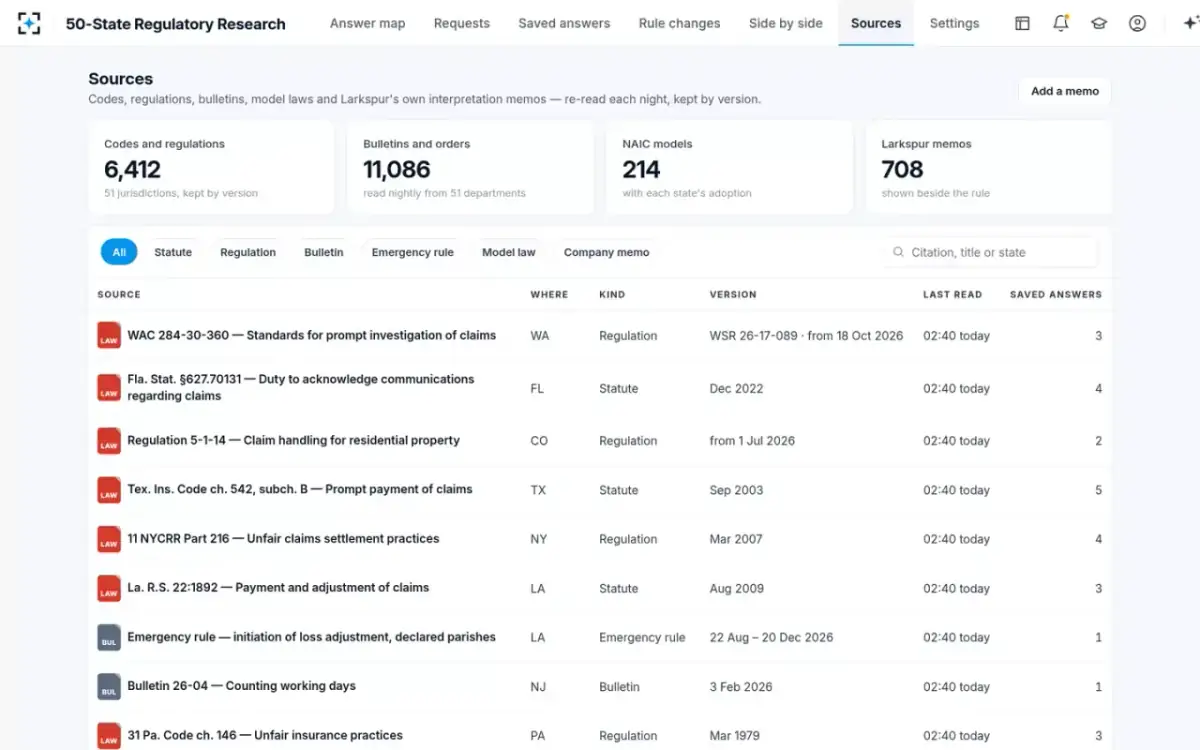
The solution treats NAIC models as one source among several, kept with each state's adoption, and never as a state's answer. Each state's cell must cite a passage from that state's own code, regulation, bulletin or order, in the version in force on the date asked; without one, the state shows "No rule found" rather than the model's number.
Sources, each with its kind and version: models sit beside state law, not in place of it
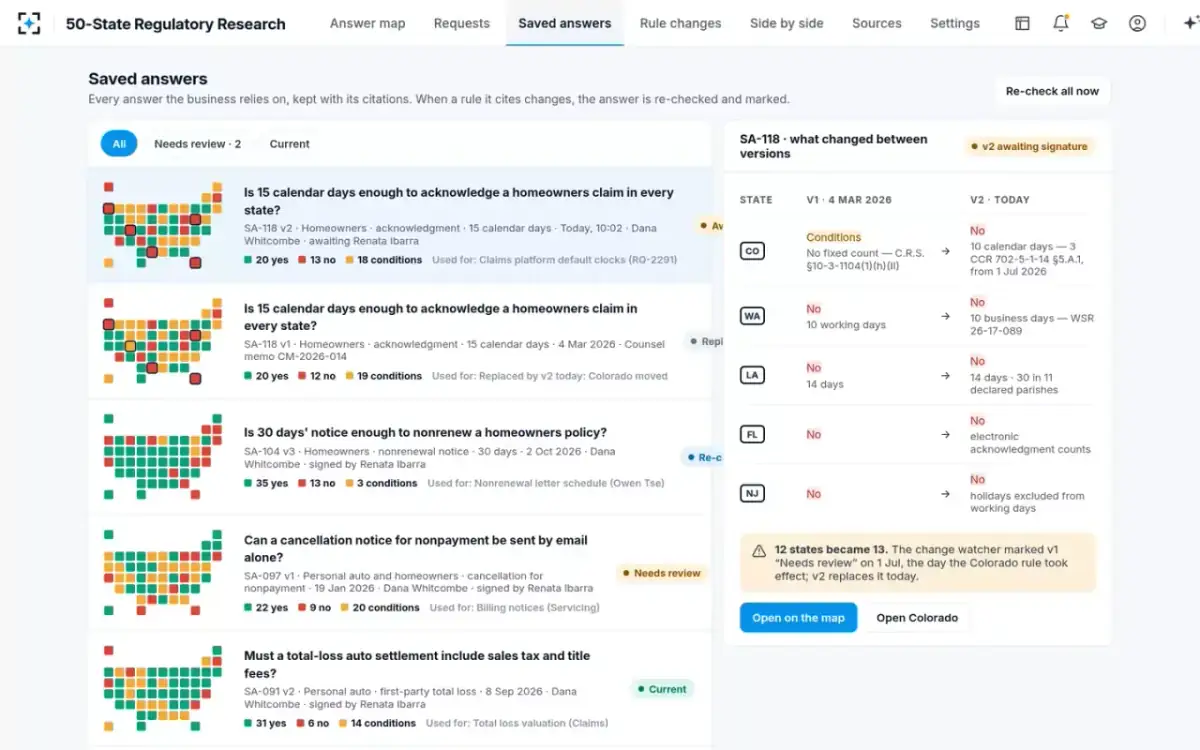
Saved answers record which sources they cite, so when a state's rule changes after the NAIC's page was printed, the answers that rely on it are found and re-checked, not discovered at the next survey.
Saved answers, and what changed between versions
Questions people ask
What is an NAIC model law?
A draft statute, regulation or guideline adopted by the NAIC's members as a template for states. It has no force until a state enacts or adopts it, usually with edits, and Texas law bars its insurance department from requiring compliance with an NAIC standard unless a statute expressly authorizes it.
Where do I find the NAIC state pages?
Each model's entry in the NAIC's model laws publication ends in a state page, published as a PDF on the NAIC's website. Check the edition date at the top of each page, which differs from model to model.
What does "related activity" mean on an NAIC chart?
The state has statutes, regulations or guidance on the same subject that do not adopt the current model. California and Texas are in that column for the claims settlement model; their own rules answer the question, in their own numbers.
How many states have adopted the NAIC data security model law?
The NAIC's Summer 2026 state page lists 28 jurisdictions in its Model Adoption column, including Puerto Rico, with Tennessee noted as adopting portions of the model. Twenty-six more members have related laws, including New York's cybersecurity regulation.
How many jurisdictions have adopted the NAIC AI bulletin?
Twenty-nine as of 8 October 2026, by the NAIC's map, including the District of Columbia and Puerto Rico. California, Colorado, New York and Texas follow their own insurance-specific rules or guidance instead.
Is the NAIC a regulator?
No. It is the standard-setting organisation of the states' chief insurance regulators, 56 of them, from the 50 states, the District of Columbia and five territories. Each state regulates through its own laws and department.