50 state survey tools come in four kinds: a memo from outside counsel, a ready-made survey in a legal research database, free public sources that your own team assembles into a chart, and software agents that read every state's text, cite it and check the citations. Each can produce a 51-row answer. They differ in three things a compliance team should care about more than speed: whether every answer states the version of the rule it relies on, whether the answer handles the exceptions that decide insurance questions, and whether anyone is told when a cited rule changes. The way to see the difference is to ask all four the same question.
This page does that with one claims question. The software example is 50-State Regulatory Research, Botminds' solution in which agents frame the question, read every state's codes, regulations, bulletins and orders, place each state yes, no or with conditions, check each citation against the version in force and re-check saved answers when a rule changes, while a compliance analyst accepts and counsel signs. Its figures are sample data on a fictional carrier; the state rules quoted were read on 27 October 2026.
The test question, framed so every tool answers the same thing
Is 15 calendar days enough to acknowledge a homeowners claim in every state?
- Line
- Homeowners, first party
- Clock
- Notice of claim to acknowledgment
- Company standard
- 15 calendar days
- As of
- 27 October 2026
The traps
- Florida: 7 calendar days for residential property insurers, shortened from 14 by the 2023 statute.
- New York: 15 business days, so a 15-calendar-day standard passes.
- Texas: the 15th day, but the 30th business day for an eligible surplus lines insurer.
- Washington: 10 business days; the wording changed from "working days" on 18 October 2026.
What are the 50 state survey tools, and what does each produce?
Each produces a different object, and the object decides how the answer ages. Outside counsel produces a signed memo: a reading of the law on a date, with counsel's judgment on hard points. A legal research database produces an editorial survey: a chart of citations and summaries compiled by the publisher's editors, updated on the publisher's schedule. Free public sources produce raw material: state codes and registers, department bulletins, the NAIC's state pages and indexes such as the Law Library of Congress's Guide to Law Online, which an analyst assembles into a chart. Software agents produce a cited answer per state, with the passage, the version and the arithmetic, and keep it as a saved answer that can be re-checked.
The question above is a good discriminator because the right answer depends on four things a summary tends to flatten: a statute that changed under the same section number, a regulation that counts business days, an exception for a class of insurer, and a wording change that took effect nine days before the as-of date.
Four tools on one question: the answers side by side
Run the question through each approach and the cells that diverge are the traps. The table describes what each approach characteristically returns on this question; any one provider may do better or worse, which is what the checklist further down is for.
One acknowledgment question through four kinds of 50 state survey tool
| Outside counsel memo | Database survey | Free sources, built in house | Agents that cite and check | |
|---|---|---|---|---|
| What you get | A signed memo with a table of states | A chart of citations and summaries per state | Your own chart, built from state and NAIC pages | A cited answer per state, saved and re-checkable |
| Who reads the 51 jurisdictions | Associates, reviewed by a partner | The publisher's editors, before you ask | Your analyst | A reading agent; a separate checking agent re-reads |
| Version and as-of date | The memo's date; versions if requested | The publisher's update date; check each state's entry | Whatever the analyst records | Stated on every state's answer |
| Florida's 2023 change | Caught if the memo post-dates it | Caught if that entry was updated | Caught if the analyst reads the statute, not the NAIC chart | Caught; the passage and its history are shown |
| Texas surplus lines exception | Included if the question was framed to ask | Kept only if the summary keeps it | Depends on the analyst | Placed as conditions if the carrier writes surplus lines |
| Washington's 18 Oct wording | Missed by any memo signed earlier | Caught at the next update | Missed unless someone watches the register | Read from the register; the saved answer re-checked |
| When a rule changes later | Nothing, until a new engagement | The entry updates; you are not told which of your answers moved | Nothing, until someone notices | Saved answers citing the rule are re-checked and marked |
| Who signs | Outside counsel | Nobody; it is research material | Your counsel, if the process requires it | Your analyst accepts; your counsel signs |
Two rows decide most buying conversations. "When a rule changes later" separates tools that produce a document from tools that keep an answer; only the second kind can tell you that a signed answer has gone stale. "Who signs" separates research material from a compliance position. A database survey is valuable research, but nobody at your company has signed it, and an examiner will ask who did.
The Florida row is the one with a regulator's record behind it. When Florida's Office of Insurance Regulation examined Hurricane Ian claims handled from September 2022 to December 2023, it tested acknowledgment against the 2022 text of the statute with its 14-day clock, the version in force for those claims (Tower Hill Prime report, 21 July 2025). Today the statute requires residential property insurers to acknowledge "within 7 calendar days". A tool that cannot give both versions, with their dates, cannot answer either the planning question or the exam question.
What drives the cost of each approach?
Each approach charges for a different unit, and the unit decides what a recurring question costs. We found no public source for market prices of 50-state surveys, so compare the drivers rather than the list prices.
Outside counsel charges for reading time on each engagement, so the cost recurs in full every time the question is asked again or a rule changes; a second memo on the same question is nearly the price of the first. A database survey is part of a subscription, so the marginal cost of a lookup is low, but the reading your own counsel does before relying on it is not, and nobody is paid to tell you when your saved answer went stale. The in-house route costs analyst and counsel time: our estimate for one insurance question by hand is about nine working days, most of it reading, plus the upkeep of every saved answer afterwards, which the Excel template guide prices term by term. Agents shift the cost from reading to review: in the sample queue the median request took 1.6 days from asking to answer, of which about 0.9 days was memo, review and counsel's signature.
The fair comparison is therefore per question over a year, not per survey: how many 50-state questions the business asks, how many it asks again, how many answers become system defaults, and how often the rules they cite change. A team that asks five questions a year and never revisits them is well served by counsel and a database. A team that answers 30 a month, as the sample analyst does, is paying for the same reading over and over.
How one rule change reaches each tool
Washington's 2026 rewrite of its claims rules shows the life of a change and where each tool picks it up. The commissioner filed the proposal on 5 May 2026, filed the adopted order on 18 August and set it to take effect on 18 October (WSR 26-17-089). For the 166 days between the proposal's filing and the effective date, the change was on the public record before it bound anyone.
Washington's claims-rule order, from proposal to force, and when each tool sees it
- ProposedProposed · 105 d
- Adopted, not yet in forceAdopted · 61 d
- In forceFrom 18 Oct
- Before the memo
- RightRight · 126 d
- Stale, unmarkedStale
- Before the order
- Order on the register, effective date knownFiled 18 Aug
- CurrentCurrent
A database survey sits between the two lanes: it picks the change up whenever the publisher updates that state's entry, which may be before or after 18 October, and it does not know which of your saved answers cited the old text. For the acknowledgment question the count did not change, so most answers survive. For the decision clock, which moved from fifteen working days after proof of loss to 30 calendar days after notification, every Washington cell had to change on the 18th.
Is there a free 50 state survey tool?
Yes: the primary sources are free, and so is the NAIC's index of them. Every state publishes its insurance code and, in some form, its regulations and bulletins. The NAIC publishes a state page for each model, listing each member's related citations with dates. Free sources are where every other tool's answer should be checked, but they are not a survey until someone reads them, and the index has limits worth knowing.
On the NAIC's state page for the property and casualty claims model, dated Fall 2023, Florida appears in the Model Adoption column for its administrative rules, with two other statute sections listed as related activity; the seven-day statute, §627.70131, does not appear on the page (NAIC state page, Model 902). A reader who takes "model adoption" to mean "the model's number" gets Florida wrong by eight days: the model allows 15 days, the statute seven. The chart says where to read, not what the law says, and its own disclaimer tells readers to consult state law for the most current information. How to use it well is the subject of NAIC model law state adoption charts.
Outside counsel and database surveys: when each is the right tool
Outside counsel is the right tool when the answer turns on judgment rather than text: a contested reading, a question governed by case law, a position the company may have to defend in litigation. A counsel memo carries a signature and a professional opinion that no database can. Its weakness is time: it is true as of its date and silent afterwards, and a second engagement is needed to learn that it has gone stale.
A database survey is the right tool for orientation: a fast view of which states have a rule on a topic, with citations to start reading from. Check the update date on every state's entry before relying on it, check whether the summary preserves exceptions such as surplus lines or catastrophe extensions, and treat it as research material that your own counsel reviews, not as your position.
50 state survey software and toolkits: what to ask before you buy
Ask for evidence on your own questions, not a demonstration on the vendor's. The checks below take an afternoon with any tool and separate the ones that keep answers from the ones that produce documents.
Questions for any 50 state survey tool or toolkit
- Does every state's answer show its passage, section and version?
A section number alone cannot be checked against an amendment.
- Can it answer as of a past date?
Ask for Florida acknowledgment as of 1 June 2022 and as of today. The examiner will ask the first; the business asks the second.
- Does it place exceptions as conditions?
Texas surplus lines, Florida's residential-only scope. A plain yes hides them.
- Does it count days on each state's calendar?
Business days in New York and Texas, with Texas's own state holidays.
- What happens when a cited rule changes?
Are the saved answers that cite it identified, re-checked and marked, and who is told?
- Who signs?
Your analyst and your counsel should, with the record kept. Research material without a signer is not a compliance position.
- What does it not read?
Case law, territories, emergency orders, company memos: ask which are in scope, and plan for the rest.
Which 50 state survey tool is best for insurance?
For insurance, the best tool is the one that keeps answers rather than documents, for the questions that recur. Most insurance compliance questions are counted rules in statutes, regulations and bulletins: days to acknowledge, days of notice, thresholds, filing deadlines. They recur across claims, product and servicing, they become system defaults, and they change by amendment. Those are the questions where an approach that states versions, places exceptions and re-checks on change pays off. Questions that turn on case law or a contested reading still belong with counsel, and a database survey remains a good place to start reading.
That is where Botminds' 50-State Regulatory Research sits. It reads codes, regulations, bulletins and orders, NAIC models and the company's own memos, which it shows beside the rule rather than in place of it. In the sample configuration the 50 states and the District of Columbia are in scope, with territories available. It does not read case law, give advice or send anything without counsel's signature.
The answer map: every state placed, cited and dated
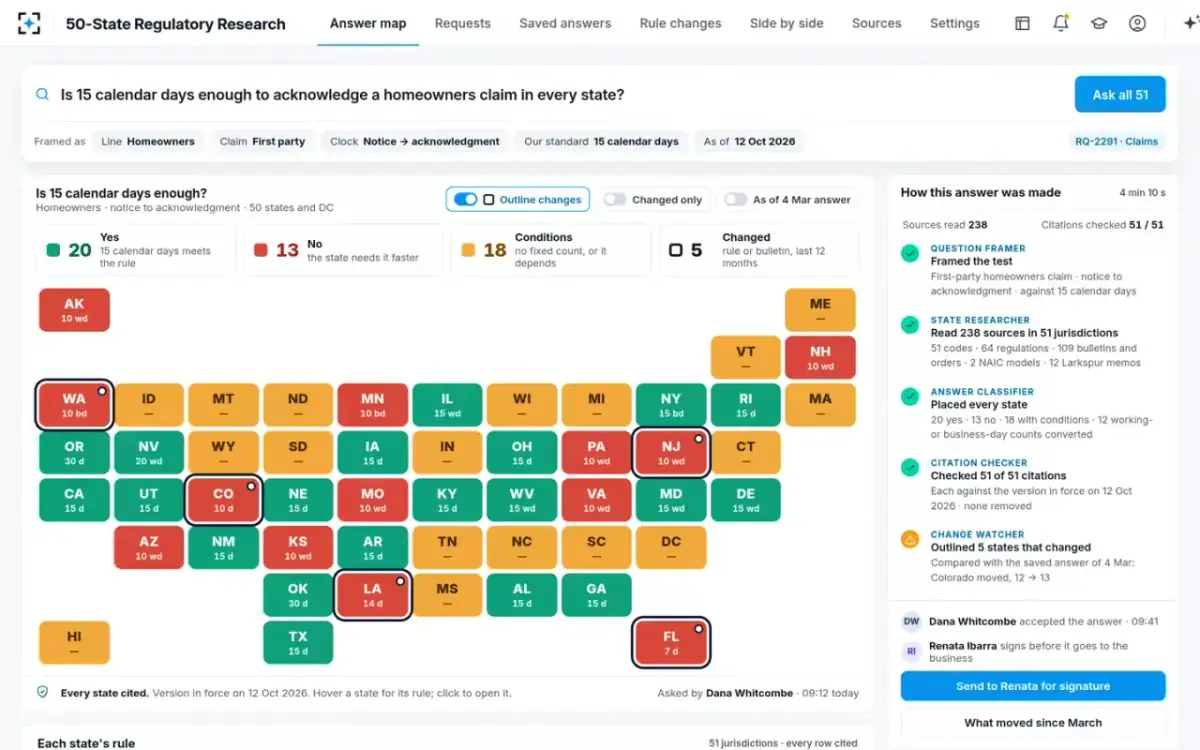
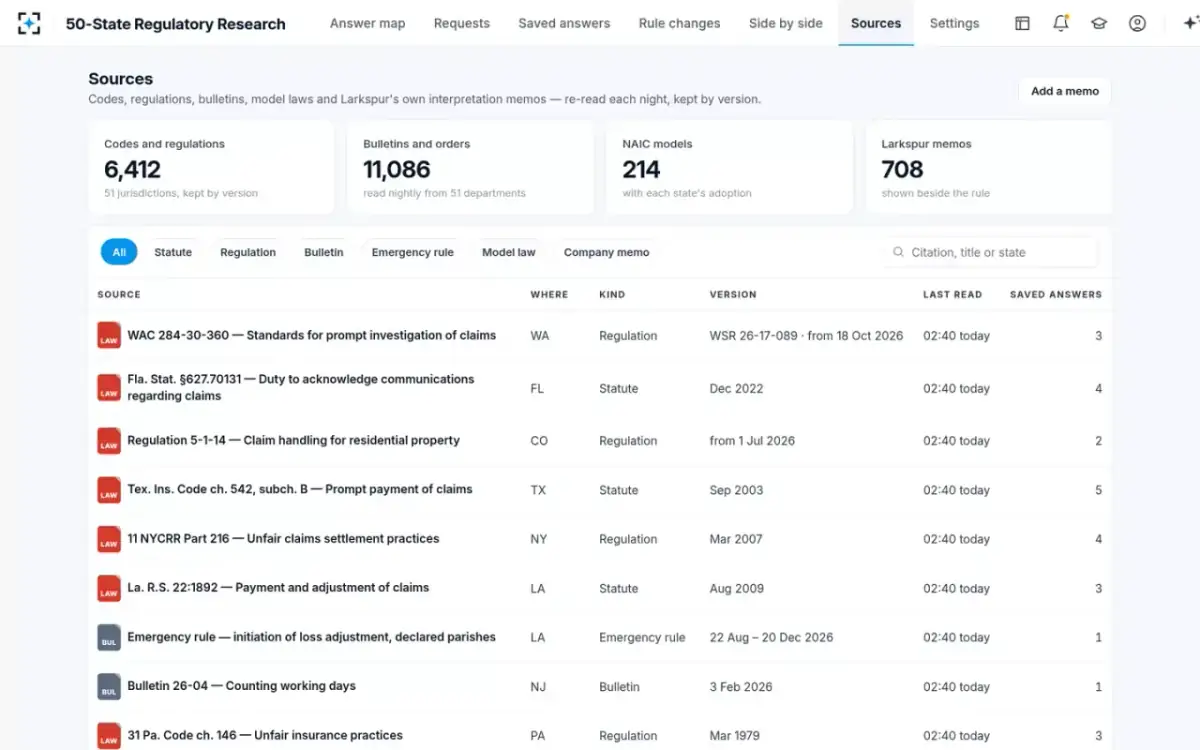
The library behind the answers is kept by version, so the as-of question can be asked of any saved answer. Each source carries its kind, its version and when it was last read.
Sources: codes, regulations, bulletins and memos, each with its version
For the build and upkeep effort of the in-house route, see the 50 state survey template in Excel; for how to score any tool's output, how to tell if each cell is right.
Questions people ask
Are there free 50 state survey tools?
The sources are free: state codes, registers and bulletins, the NAIC's state pages, and indexes such as the Law Library of Congress's Guide to Law Online. Turning them into a survey takes reading, which is the cost; our estimate for one insurance question by hand is about nine working days.
What is a 50 state survey toolkit?
Usually a template, a list of state sources and a method: the columns to fill, where each state publishes its rules, and how to record citations. A toolkit for insurance should add an as-of date, a version column and each state's business-day calendar.
Can a 50-state survey tool replace outside counsel?
For counted, statutory questions it can replace the reading, not the judgment. Questions governed by case law or a contested reading still need counsel, and in any tool the answer should be signed by your own counsel before the business relies on it.
How current are published 50-state surveys?
As current as the date on each state's entry, which is why that date matters more than the publication date. Washington's claims rules changed on 18 October 2026; any survey entry dated earlier describes the old text.
What does a 50-state survey need to be useful for insurance?
An as-of date, the version of each rule, the unit of days and the event that starts the clock, and exceptions written into the cell. Insurance rules turn on details such as Florida's residential-only scope and Texas's surplus lines clock.