A 50 state survey is a chart that answers one legal question for each of the 50 states, usually adding the District of Columbia and sometimes the territories, with the statute, regulation or court decision behind each state's answer. Businesses that operate nationally commission them whenever one rule must work everywhere: how long a notice period must be, which states cap a fee, how quickly a claim must be acknowledged. In insurance, a survey is usable only if every answer also says which version of the rule it read, the date the answer was true, and whether that state adopted the NAIC model or wrote its own rule, because the same model can say 15 days in one state and 7 in the next.
Answering one regulatory question for every state with the rule behind each answer is exactly what 50-State Regulatory Research does: Botminds' solution has agents read each state's codes, regulations and bulletins and return a map and a table, each state yes, no or with conditions, each cited to the rule in force, for a compliance analyst to accept and counsel to sign. This page explains the survey itself, with or without software. Its rules were read on 27 October 2026.
The size of a 50-state survey in insurance
51rows
in most surveys: the 50 states and the District of Columbia
56regulators
in the NAIC, counting five territories, each able to write its own rule
53rows
on the NAIC's own compulsory auto insurance chart, every one dated
29jurisdictions
had adopted the NAIC AI model bulletin by 8 Oct 2026, each in its own instrument
What is a 50 state survey in insurance?
It is a compliance answer to a business question, expressed state by state. Claims, underwriting, product and servicing teams ask compliance the same kind of question repeatedly: how many days do we have to acknowledge a claim, how much notice must a nonrenewal give, can a cancellation notice go by email alone. Each needs an answer in every state the company writes in, because insurance is regulated state by state and the NAIC's members are 56 regulators: one for each state, the District of Columbia and five U.S. territories (NAIC; the difference it makes to a count is shown in the NAIC AI bulletin adoption map).
People search for the same thing under other names: a 50-state chart, a state law comparison chart, a national survey of state laws. The format is constant: one row per jurisdiction, one answer per row, a citation for every answer. What separates a usable survey from a stale one is what else the row carries.
The anatomy of one 50 state survey answer
A usable answer carries seven things. The figure takes one real cell, Texas on a claim acknowledgment question, and shows each part with the reason it is there.
One cell of an insurance 50 state survey, part by part
Jurisdiction
Texas
One of 51 rows, or 56 if the survey covers every NAIC member.
Question, as framed
Homeowners, first party: notice of claim to acknowledgment, against a 15-calendar-day standard
The test every state is measured against; most disputes are about this line.
Answer and placement
Yes for an admitted insurer · Conditions if the carrier writes surplus lines
Yes, No, Conditions or No rule found; an exception makes it Conditions.
Citation and passage
Ins. Code §542.055(a): "Not later than the 15th day or, if the insurer is an eligible surplus lines insurer, the 30th business day…"
The words that decide the answer, not only the section number.
Version and model
Text as added by 2003 Act, effective 1 April 2005 · NAIC claims model: related activity only
Which text was read, and whether the state followed the model.
Count
Calendar days from notice; business days for surplus lines
The unit and the event that starts the clock.
As of, accepted, signed
27 October 2026 · accepted by the analyst · signed by counsel
The date it was true, and who stands behind it.
Most surveys stop after the citation. The last three rows are the ones insurance needs most. The version line is what lets anyone re-check the cell after an amendment. The model line tells the reader whether the state's text can be expected to track the NAIC's or not; in Texas it cannot, because the Insurance Code bars the department from requiring compliance with an NAIC standard unless a statute expressly authorizes it (§36.004). The as-of line is what makes the answer an answer about a date rather than an opinion about the law in general.
The NAIC's own 50-state charts: what a professional chart records
The NAIC publishes charts in exactly this format, and they show the habit that matters most. Its 2026 chart on compulsory motor vehicle insurance has 53 rows, the 50 states, the District of Columbia, Puerto Rico and the Virgin Islands, with columns for the citation, whether insurance is compulsory or optional, the fault system, the minimum coverage and the rules on notifying the state when a policy ends (NAIC chart PA-30). Above the table is a single sentence.
"The date following each state indicates the last time information for the state was reviewed/changed."
NAIC, State Insurance Charts, compulsory motor vehicle insurance (2026)
Every row on that chart carries its own date, not just the document. That is the right design: a survey is reviewed state by state, so it goes stale state by state, and a single date on the cover hides which rows were last read years ago. The NAIC's state pages for its models work the same way in a different form, citing each state's law with the years it was enacted and amended, and leaving the reader to check what has happened since.
Why insurance needs a different kind of 50 state survey
Because most insurance rules start as NAIC models and end as 51 different texts. The NAIC itself works mainly through states adopting its models (NAIC; how states adopt NAIC model laws), and each state adopts with its own edits, or writes its own rule on the same subject, or does nothing. On the NAIC's state page for its claims settlement model, 23 of 56 members are listed as adopting it, 12 have related rules only and 21 show no current activity (Fall 2023; our count). On the page for its data security model, 28 members adopted it (Summer 2026).
The edits are where surveys go wrong. Florida appears in the claims model's adoption column, yet its statute requires residential property insurers to acknowledge a claim communication "within 7 calendar days", not the model's 15. Washington adopted the same model and rewrote its clocks again from 18 October 2026, moving its decision deadline to 30 calendar days after notification of the claim (WSR 26-17-089). A survey built by reading the model and checking the adoption column would be wrong in both. How to read the NAIC's chart without falling into that is covered in NAIC model law state adoption charts.
50 state survey examples in insurance
Insurance surveys fall into two families: regulatory questions answered by statutes, regulations and bulletins, and liability questions answered by courts. The table shows typical examples of each and how each kind ages.
Common insurance 50 state survey questions, where the answer lives and how it ages
| Question | Where the answer lives | How it goes stale |
|---|---|---|
| How many days to acknowledge a claim? | Claims statutes and unfair claims settlement regulations | By amendment under the same section number; Florida went from 14 to 7 days |
| How much notice must a nonrenewal give? | Policy cancellation and nonrenewal statutes, by line | By statute, often with new content rules for the notice |
| When must a cybersecurity event be reported to the commissioner? | Data security laws, many based on NAIC Model 668 | By new adoptions; the NAIC dates two to 2026 |
| Which states have adopted the NAIC AI bulletin? | Bulletins and guidance documents | By new bulletins; 29 jurisdictions by 8 Oct 2026 |
| What are the minimum auto liability limits? | Compulsory insurance statutes | By statute; the NAIC dates each row of its chart |
| Is there a bad-faith claim for failure to settle? | Court decisions and some statutes | By new appellate decisions; harder to date |
| Which state's law governs a policy? | Choice-of-law decisions | By court decisions, case by case |
What is the difference between a statutory survey and a case law survey?
A statutory survey cites enacted text and can be dated precisely; a case law survey cites court decisions and summarises a body of reasoning that moves less predictably. Statutes and regulations change on known dates, through filed acts and rule orders, so a statutory cell can carry an exact version and as-of date and be re-checked when the register shows a change. Court-made rules change when a new decision is published, and a single decision may narrow a rule without overruling it, so case law surveys depend more heavily on counsel's reading.
Most insurance compliance questions are statutory: days, notices, thresholds, filings. That is fortunate, because those cells can be kept current mechanically, by watching registers and bulletins. Case law surveys, such as bad faith or duty-to-defend surveys, belong with counsel and with research services built around court decisions.
How to do a 50 state survey
Frame the question precisely, fix the scope, read every state's primary text, place and cite each state, record versions and the as-of date, then have it reviewed and signed. In more detail:
Frame. Write the question as a test every state can be measured against: line of business, claim type, the event that starts the clock, the company standard, calendar or business days, the as-of date. Scope. Decide 51 or 56 jurisdictions and which lines. Read. For each state, read the statute, the regulations, the bulletins and any orders that touch the question; NAIC state pages are a good index of where to start. Place and cite. Yes, no, conditions or no rule found, with the passage quoted. Date. Record the version of each passage and the survey's as-of date; Texas's department, for example, lists a proposal date, an adoption date and a later effective date for each rule, and one 2026 rule adopted in September takes effect on 1 January 2027 (TDI rules). Sign. An analyst accepts, counsel signs. A template for the grid and an estimate of the effort are in the 50 state survey template in Excel.
When is a 50 state survey out of date?
The day any rule it cites changes, for the rows that cite it. That is why the date per row matters more than the date on the cover, and why a survey should record which sections each row relies on: without that, nobody can tell which rows a new rule order touches. Washington's single order of August 2026 amended 15 sections of its claims rules effective 18 October; any survey row citing one of them needed re-reading that week.
A fixed review age is a useful backstop, not a substitute. Rules change on their own schedules, and an answer re-checked on a calendar can be stale for months between checks. Scoring each row on four tests, the passage, the version, the placement and the day count, is set out in how to tell if each cell is right.
Where 50-State Regulatory Research fits in survey work
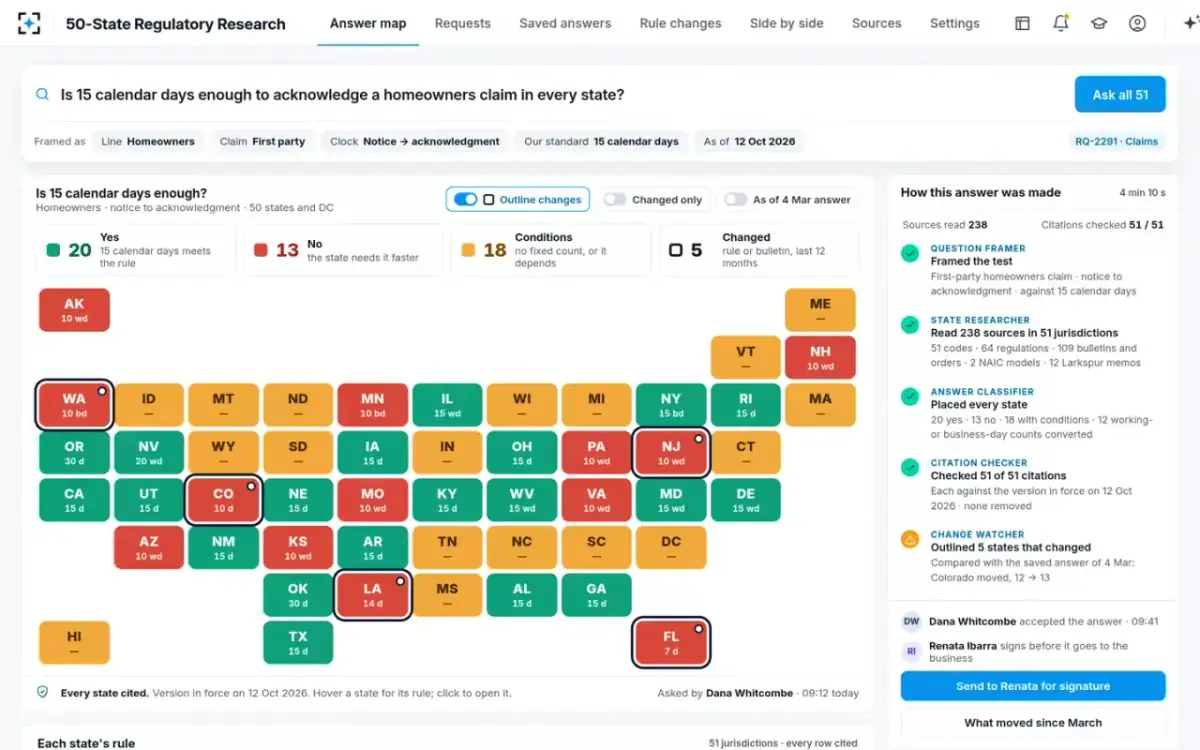
The solution produces the survey as a map and a table, with every state's answer carrying its passage, its version and the as-of date, and keeps it as a saved answer that is re-checked when a rule it cites changes. Company interpretation memos are shown beside the rule they interpret, never in place of it.
A 50 state survey as a map: every state placed, each with its rule
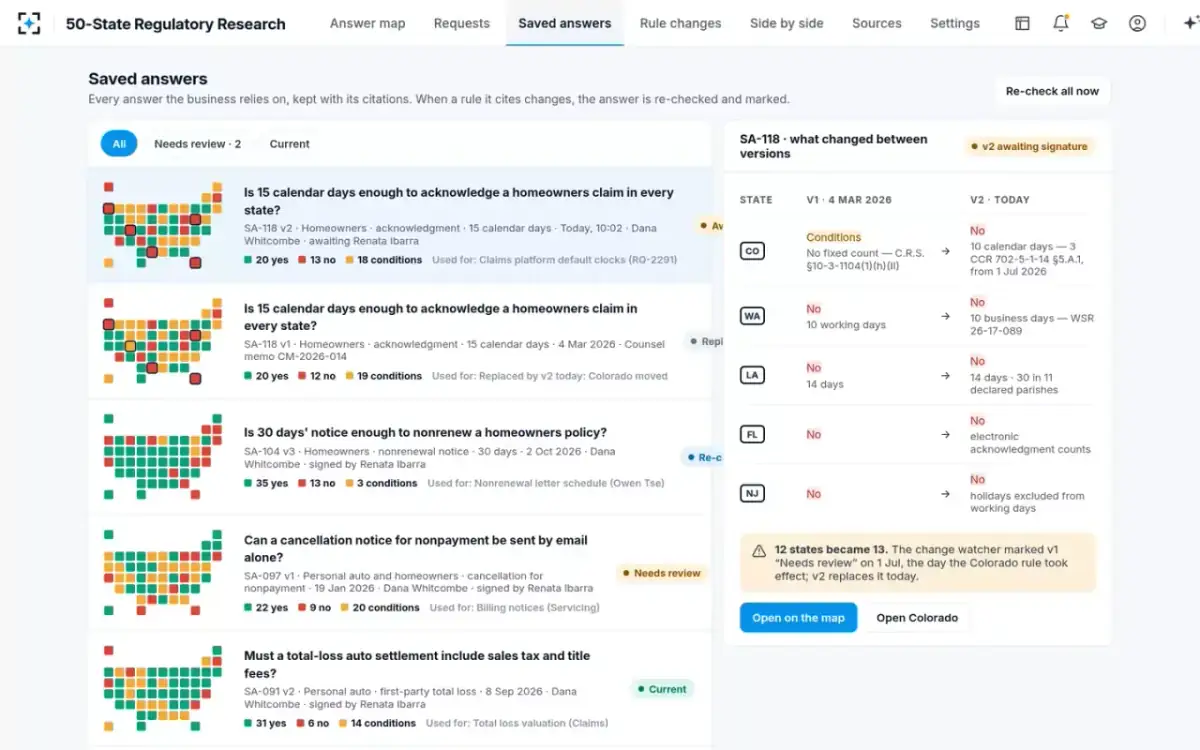
Saved answers make the survey a living record: each shows its versions, what it is used for, and whether it is current or needs review.
Saved answers: each survey kept with its versions and freshness
Questions people ask
Does a 50 state survey include the District of Columbia?
Usually, which makes 51 rows. Insurance surveys sometimes add the five territories that sit in the NAIC, for 56; the NAIC's own compulsory auto chart has 53 rows, adding Puerto Rico and the Virgin Islands.
Is a 50 state survey legal advice?
A survey states what each state's text says on a date; advice applies it to a decision. Many companies have counsel sign the survey before the business relies on it, and keep the business decision, which default to build, with the business owner.
What is a national survey of state laws?
Another name for a 50 state survey: one question answered for every state, with citations. The term is also used for published compilations covering many topics, which are useful for orientation but need checking against each state's current text.
How long does a 50 state survey take?
Our estimate for one insurance question by hand is about nine working days, most of it reading codes, regulations and bulletins. Keeping it current takes more over its life than building it, because every amendment to a cited rule needs a re-read.
Are NAIC charts 50 state surveys?
They are close relatives. The NAIC's state pages list each member's laws on a model, and its state insurance charts summarise a topic row by row with a review date per state, but both are research aids, not legal readings; the state pages say they should not be relied upon as a formal legal opinion.