A 50 state survey on insurance claims answers one claims-handling question for every state, such as how long an insurer has to acknowledge, investigate or decide a claim, with the rule behind each state's answer. Followed day by day, most of its life is spent reading: finding each state's statute and regulation, then the bulletins and orders that modify them, then doing the day-count arithmetic, and finally waiting for counsel. The question on this page is the one a claims platform team asks before it sets a default: is 15 calendar days enough to acknowledge a homeowners claim everywhere we write, and where isn't it?
The page follows that question twice through the same fictional carrier, Larkspur Mutual: once as a desk would answer it by hand, using our estimate of where the days go, and once through 50-State Regulatory Research, Botminds' solution in which six agents frame the question, read every state's codes, regulations and bulletins, place and check each state, and draft the memo, while the compliance analyst accepts and counsel signs. Larkspur, its people and every product figure here are sample data; the state rules quoted are real, read on 27 October 2026.
"Our new claims platform will default to 15 calendar days to acknowledge. Is 15 days enough everywhere we write? Where isn't it?"
Marcus Feld, VP Claims Operations at the fictional Larkspur Mutual, filing request RQ-2291
Monday 12 October, 09:12: the question arrives
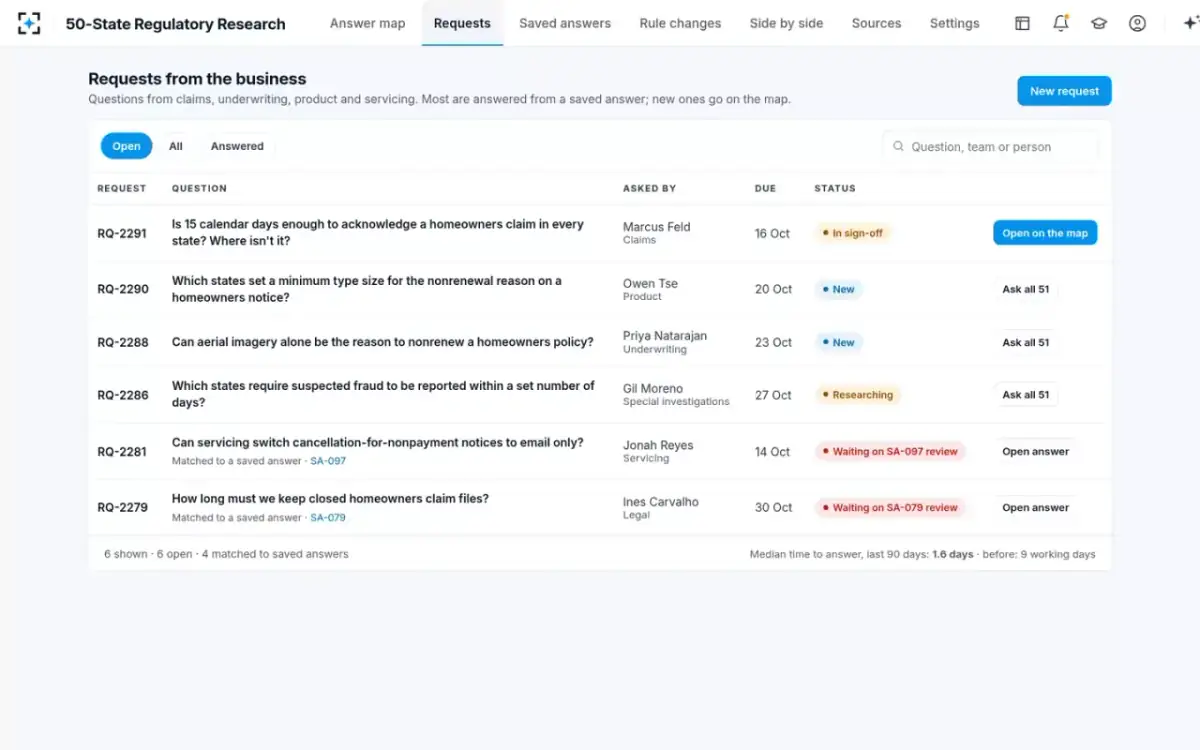
Marcus files request RQ-2291 at 09:12, due Friday 16 October. It joins a queue of questions from product, underwriting, special investigations, servicing and legal; two of those are already matched to saved answers and wait on their review. RQ-2291 is new. It looks simple, and the first half-day of any honest answer goes to making it precise.
Framed as a test every state can be measured against, the question reads: homeowners line, first-party claim, the clock from notice of claim to acknowledgment, against the company's standard of 15 calendar days, as of 12 October 2026. Each element closes a door. "First party" excludes third-party claimant rules. "Notice to acknowledgment" excludes the clock for replies to later communications and the clock for deciding the claim. "Calendar days" fixes the unit the business will build. And the as-of date fixes which version of every rule counts.
Where one 50-state claims question's days go, by hand and with the agents reading
- Ask½ d
- Read codes and regulations3½ d
- Bulletins and memos1½ d
- Place and count1½ d
- Versions1 d
- Sign-off1 d
- Agents0.7 d
- People0.9 d
Days one to five by hand: reading 51 codes, and why the code is not enough
By hand, the analyst spends most of the first week reading. For each state: find the claims statute and the unfair claims settlement regulation, find the acknowledgment clause, and copy the clause into a spreadsheet with its citation. Our estimate gives that three and a half days for 51 jurisdictions, and the states with two layers take the longest.
Texas is one of them. Its Insurance Code requires a first-party claim to be acknowledged not later than "the 15th day" after notice, or the 30th business day for an eligible surplus lines insurer (§542.055(a)), while its department's rule presumes an acknowledgment of other pertinent communications within 15 business days to be reasonably prompt (28 TAC §21.203(2)). The same statute answers the related question a claims team usually asks next: how long an insurance company has to investigate a claim in Texas. It must begin any investigation by the same 15th day, and request the items it needs.
Florida is the other kind of trap. Its statute requires a residential property insurer to acknowledge a claim communication "within 7 calendar days" (§627.70131(1)(a)), a clock that was 14 days before the 2023 amendment. An analyst working from a summary or an older memo writes 14. New York counts in business days, "within 15 business days" (11 NYCRR 216.4(a)); California in calendar days, no more than fifteen (10 CCR 2695.5(e)). By Friday the spreadsheet has 51 clauses and three units of time.
Days five to seven: bulletins, orders and the company's own memos
The second layer takes another day and a half by hand: each department's bulletins and emergency orders that touch claim acknowledgment, and the company's own interpretation memos. In the sample, Larkspur's counsel signed an answer to the same question on 4 March 2026 under memo CM-2026-014, and the analyst's first instinct is to start from it. That memo said 12 states needed a faster clock and 19 had conditions.
The register holds the trap the memo cannot. Washington's insurance commissioner filed a rule order on 18 August 2026, effective 18 October, that rewrote the state's claims rules, including the acknowledgment rule (WSR 26-17-089). For RQ-2291, dated 12 October, the earlier text applies: ten working days for an individual policy. From 18 October the rule says 10 business days. The count is the same, so the answer is the same, but the citation the business will see in the memo must be to the text in force on the as-of date, and the memo should warn that the wording changes in six days.
Days seven to eight: placing 51 states and doing the arithmetic
Placing each state yes, no or conditions against a 15-calendar-day standard is arithmetic, but arithmetic on each state's calendar. Washington shows the method. Notice received on Monday 12 October; ten working days later is Monday 26 October, day 14 on the calendar; a 15-calendar-day default lands on Tuesday 27 October, one day late. Washington is a no, by one day, and only if no state holiday falls in the window.
New York goes the other way. Fifteen business days from the same Monday is Monday 2 November, day 21, so a 15-calendar-day standard is a clean yes. Texas is a yes for an admitted insurer and conditions if Larkspur writes surplus lines, where the clock is the 30th business day. States whose rules set no fixed count, or whose count depends on holidays or an exception, go into conditions; a condition is never rounded up to a yes. The NAIC model, which counts "“Days” means calendar days", would be a yes, which is exactly why the model is not the answer for any state.
Day nine: versions, the memo and counsel's signature
The last two days by hand go to checking that every citation is to the version in force on 12 October, writing the memo for Marcus, and waiting for counsel to read it. Counsel's question is always the same: show me the section, and tell me if it changed since we last looked. With a spreadsheet of clauses and no version column, the honest answer is a re-read of the states that matter. The memo reaches Marcus in the second week, on or after his Friday due date.
The same question through 50-State Regulatory Research, minute by minute
Through the solution, the same request took 54 minutes from filing to sending, and most of those minutes were people's. At 09:12 Marcus's request sat in the queue beside the others from the business.
09:12: RQ-2291 in the queue of requests from the business
Dana Whitcombe, the senior compliance analyst, typed the question and pressed Ask all 51. The question framer produced the test in 0.7 seconds: homeowners, first party, notice to acknowledgment, 15 calendar days, as of 12 October 2026. The state researcher read 238 sources: 51 codes, 64 regulations, 109 bulletins and orders, two NAIC models and 12 Larkspur memos. The map filled as each state was placed.
09:13: the map fills as each state is placed
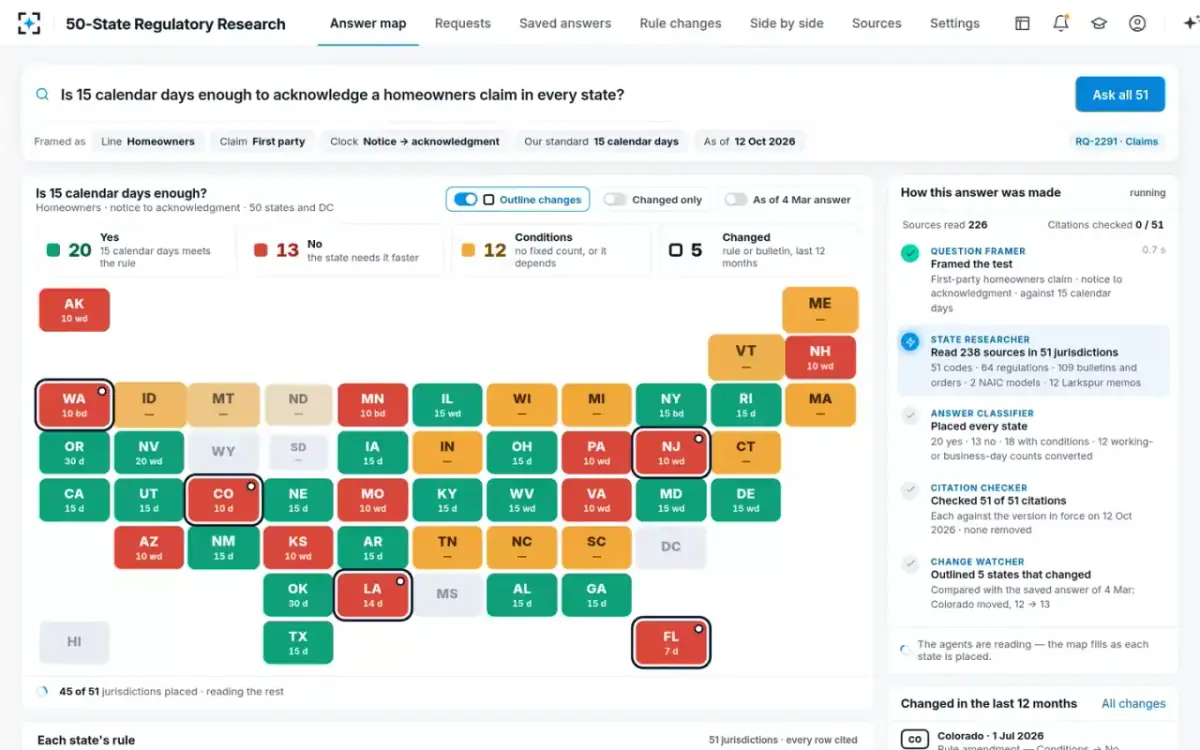
Four minutes and ten seconds after Dana asked, every state was answered: 20 yes, 13 no and 18 conditions, each tile carrying its rule in short, with five states outlined because their rule or a bulletin had changed in the last 12 months. The citation checker had re-read 51 of 51 citations against the version in force on 12 October and removed none. Dana opened the states that mattered, starting with Washington, whose page showed the passage, the day-14 arithmetic and the rule's history. She accepted the answer at 09:41 as saved answer SA-118, version 2.
Version 1 was the March answer. The change watcher had marked it "Needs review" on 1 July, the day an amended rule took effect in one state in the sample, moving that state from conditions to no. Version 2 laid out the difference state by state: twelve states that needed a faster clock had become thirteen. Version 1 was kept as replaced, not edited.
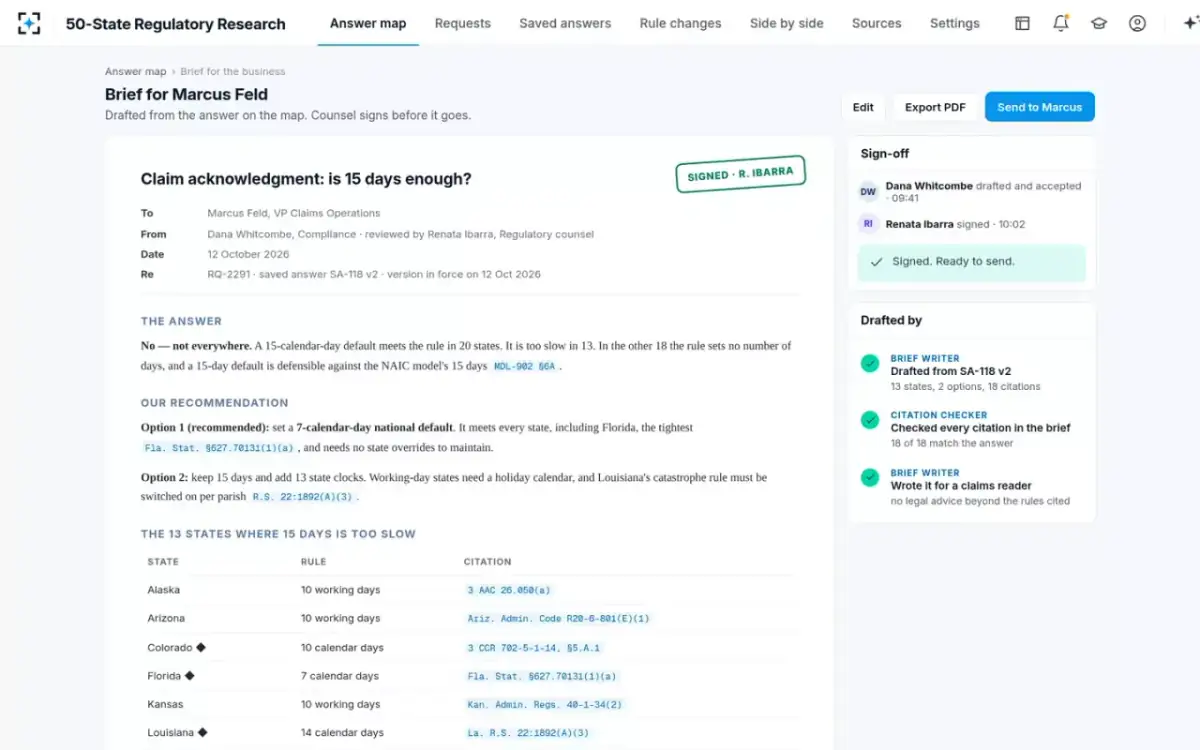
The brief writer drafted the memo to Marcus from the accepted answer: the short answer, option 1, a single faster national default, and option 2, keeping 15 days with state-specific clocks for the 13, with a citation beside every state. The citation checker confirmed 18 of 18 citations in the memo matched the answer. Renata Ibarra, regulatory counsel, signed at 10:02. Dana sent it at 10:06.
10:02: the memo for the business, signed by counsel
Where RQ-2291's 54 minutes went
The agents' share was the smallest. Most of the hour was the analyst reading the answer and counsel reading the passages, which is the part that should never be automated.
RQ-2291, 09:12 to 10:06: who spent the 54 minutes
Sample request RQ-2291 · 54 minutes
- Agents read, place, check · 4 min · 8%
- Analyst reviews and accepts · 25 min · 46%
- Counsel reads and signs · 21 min · 39%
- Send · 4 min · 7%
The by-hand estimate has the same final step, a day for the memo and counsel. What disappears is the week of reading and the day of version-checking, because the passages and versions arrive with the answer. The four people around the question each keep their own decision.
Four people around one claims question, before and with the agents reading
Today
Asks on Monday and waits most of two weeks for a memo, while the platform build waits with him.
With agents
Has a signed memo by mid-morning: a recommended default, the states that differ and a citation beside each.
Still theirs: The choice between the options.
Today
A week of reading 51 codes, a spreadsheet, and a memo that is stale by spring.
With agents
Reads 51 cited answers, opens the states that matter, checks the arithmetic and accepts.
Still theirs: Acceptance, and the duty to send a state back.
Today
Re-reads the statutes the analyst read, because the spreadsheet has no passages.
With agents
Opens any state to the highlighted passage, its version and its history, and signs.
Still theirs: The signature on the answer and the memo.
Today
Builds notice schedules on answers nobody re-checks.
With agents
Builds on saved answers that are re-checked whenever a rule they cite changes.
Still theirs: The duty to ask again when the product changes.
Insurance claim time limits by state: what the signed answer told claims
The signed answer told Marcus three things a claims platform needs. First, that a 15-calendar-day acknowledgment default fails in some states, Florida's seven calendar days for residential property insurers being the tightest of those quoted on this page. Second, that some states a quick read might misplace, such as New York, are a yes because they count business days. Third, that the answer has a shelf life: Washington's wording changed six days later, and any of the 51 rules can change again.
The rules quoted here are only the acknowledgment clock. The same platform will need the reply, regulator-response, investigation and decision clocks, which are compared for five rulebooks in claim handling guidelines by state. Who in the chain answers for each signature is set out in the CCO job description guide.
Questions people ask
What is a 50 state survey on insurance claims?
One claims-handling question answered for every state, usually with the District of Columbia, with the statute or regulation behind each answer. Common examples are the clocks to acknowledge, investigate, decide and pay a claim, which differ in number, unit and starting event from state to state.
How long does a 50 state survey take?
Our estimate for one claims question by hand is about nine working days, five of them reading codes, regulations, bulletins and orders. In the sample queue the median with the solution was 1.6 days, most of it people's review and counsel's sign-off.
How long does an insurance company have to investigate a claim in Texas?
It must begin any investigation not later than the 15th day after receiving notice of a first-party claim, or the 30th business day for an eligible surplus lines insurer (Ins. Code §542.055). It then has 15 business days after receiving all the items it requested to accept or reject the claim.
Do 50 state surveys on insurance coverage or policy wording work the same way?
Only when the answer is in statutes or regulations, such as required notices or mandatory policy provisions. Coverage questions that turn on court decisions, such as how a policy term is interpreted, need a case law survey and counsel's reading.
Why not just use the NAIC model's 15 days?
Because the model binds nowhere on its own. Florida's statute says 7 calendar days for residential property insurers, New York's regulation 15 business days, and Washington's rule 10 business days; a default set from the model fails in some of them.