To find state insurance regulations in Texas, read four layers in order: the Texas Insurance Code, published by the Legislature; the Texas Department of Insurance's rules, in Title 28 of the Texas Administrative Code and published through the Texas Register; the insurance commissioner's bulletins; and the commissioner's orders. Each layer is published in a different place, changes on a different schedule and dates itself differently. An answer that cites only the statute can be right about the statute and wrong about Texas, because the rule, a bulletin or an order may say something the statute does not.
The same four layers exist, under other names, in every state, which is why a 50-state answer takes so long by hand. 50-State Regulatory Research, Botminds' solution for multi-state insurance questions, has agents read each state's codes, regulations, bulletins and orders, cite the passage that governs on the date asked, and re-check saved answers when any layer changes, while the analyst accepts and counsel signs. This page follows one state, Texas, using its own published sources as read on 27 October 2026.
"…the official version of proposed and adopted rules are those filed with the Secretary of State, which is the repository of official TDI rules."
Texas Department of Insurance, on its proposed and adopted rules pages
How do you find state insurance regulations in Texas?
Start at the statute, then read down: the rules that implement it, the bulletins that explain or apply it, and the orders that set specific terms. The department's own legal page links all four: commissioner's orders, bulletins, the Texas Administrative Code and the Texas Insurance Code (TDI legal updates).
Texas's four layers of insurance law, and who writes each
A person decides
Legislature: the Insurance CodeStatutes by topic, such as chapter 542 on processing and settlement of claims. Published on the Legislature's statutes site; changed by acts with stated effective dates.
A person decides
Commissioner: rules in 28 TACRules adopted under the Code, such as §21.203 on unfair claim settlement practices. Proposed and adopted in the Texas Register; official text filed with the Secretary of State.
A person decides
Commissioner: bulletinsNumbered B-0001-26 onward each year: guidance, reminders, data calls and summaries of new laws, listed on TDI's bulletin index.
A person decides
Commissioner: ordersSpecific decisions with numbers, such as rate filings, plan limits and cease-and-desist orders, listed on TDI's orders page.
Agent
The researcher reads all fourFor a 50-state answer, every layer is read for the Texas cell, with the version and date of each passage recorded.
Never: answer from the statute alone when a rule, bulletin or order speaks to the question
Layer one: the Texas Insurance Code
The Code is the statute, organised by topic in chapters, and published on the Legislature's statutes site with the history of each section's enactments and amendments. For claims, the core is chapter 542, "Processing and Settlement of Claims". The Code also sets the department's powers: the commissioner may adopt rules "necessary and appropriate to implement the powers and duties of the department" (§36.001), and the department is subject to the state's Administrative Procedure Act for rulemaking (§36.101).
The Code also limits the role of NAIC models in Texas. The department "may not require an insurer to comply with a rule, regulation, directive, or standard adopted by the National Association of Insurance Commissioners" unless a statute expressly authorizes it (§36.004(a)). That is one reason Texas appears on the NAIC's state page for the claims settlement model under related activity rather than adoption, with its own rules cited: 28 TAC §§21.201 to 21.205 and §§21.2801 to 21.2816 (NAIC state page, Fall 2023).
Texas Insurance Code 542: what the prompt payment subchapter sets
Subchapter B of chapter 542 sets the clocks on a first-party claim. Not later than the 15th day after notice, or the 30th business day for an eligible surplus lines insurer, the insurer must acknowledge the claim, begin any investigation and request the items it reasonably believes it will need (§542.055). It must then accept or reject in writing "not later than the 15th business day after the date the insurer receives all items, statements, and forms required by the insurer to secure final proof of loss", or the 30th day if it has a reasonable basis to suspect arson, with one notice that more time is needed buying up to 45 days (§542.056). An accepted claim is paid by the fifth business day after notice of acceptance (§542.057).
Two provisions send the reader to other layers. A business day excludes weekends and the holidays Texas recognizes (§542.051(1); how an audit counts them is in Texas Insurance Code 542.060), and the Government Code lists Texas's holidays, including eight state holidays a federal calendar does not have (§662.003). And in a weather-related catastrophe or major natural disaster "as defined by the commissioner", the claim-handling deadlines are extended by 15 days (§542.059(b)); the statute leaves the definition to the commissioner. An insurer that misses the subchapter's deadlines owes interest on the claim as damages, generally at 18% a year, plus reasonable attorney's fees (§542.060). The subchapter does not apply to workers' compensation, mortgage guaranty, title, fidelity and surety, or marine insurance (§542.053).
Layer two: the department's rules in Title 28 of the Texas Administrative Code
The rules fill in what the statute leaves general, and sometimes say something the statute does not. On acknowledgment, the Code's 15th day applies to notice of a first-party claim, while the rule on unfair claim settlement practices addresses all pertinent communications and adds a presumption: "An acknowledgment within 15 business days is presumed to be reasonably prompt" (28 TAC §21.203(2)). The same rule requires a complete record of complaints for the preceding three years or since the last financial examination, whichever is shorter. A Texas cell that cites only chapter 542 misses both.
Rules have dates the Code does not. Under the Administrative Procedure Act a rule generally "takes effect 20 days after the date on which it is filed in the office of the secretary of state", unless a later date is set or an emergency allows an earlier one (Gov't Code §2001.036(a)). The department's rules pages list five dates for each rule project: proposal filed, proposal published, adoption filed, adoption published and effective date. One 2026 project shows how far apart they can be.
One Texas rule project, §§5.9970 and 5.9971 on consumer rights notices, from proposal to force
- Proposed, out for comment1 May–17 Sep · 140 d
- Adopted, not yet in force18 Sep–31 Dec · 105 d
For three months that rule was adopted, published and not in force. A survey dated in October that cites the new text is wrong for October; one that ignores it is wrong from January. The cell needs both versions and the date between them. TDI's rules pages listed 11 rule projects for 2025 and 14 for 2026 by late October (TDI rules; our count).
Layer three: the commissioner's bulletins
Bulletins carry the department's guidance and expectations, and they arrive often: 16 in 2025 and 8 in 2026 through September, numbered B-0001-25 onward (2025, 2026; our count). Their kinds differ. Some summarise new law, such as the 2025 bulletin on insurance legislation enacted in the 89th Legislature's regular session. Some are data calls. Some set out expectations on a subject, and some respond to an event.
Whether a bulletin binds is a question each one answers for itself. The July 2026 disaster bulletin reminded insurers of claims duties under chapter 542 and other law, but said of itself: "This bulletin does not create specific requirements." The June 2026 bulletin on artificial intelligence sets out how the department expects AI to be governed, says it will monitor AI use through examinations and product filings, and expects a person to review and agree with consequential AI decisions before action is taken (B-0003-26). Neither is a rule, but an examiner reading a file will read both.
Bulletins are also where Texas moves faster than national summaries. The NAIC's AI bulletin map, with status as of 8 October 2026, still cites Texas's 2020 AI bulletin; the June 2026 bulletin does not appear on it (NAIC map). A Texas researcher has to read TDI's own index, year by year.
Layer four: the commissioner's orders
Orders are specific decisions, each with a number and a date, and they set terms that no statute or rule states. The orders page lists, among others, the final order on the Texas Windstorm Insurance Association's policy maximum limits of liability (No. 2026-10172, 1 October 2026), the 2026 rate filing for automobile insurance through the Texas Automobile Insurance Plan Association (No. 2026-9983, 22 June 2026) and an emergency cease-and-desist order (No. 2025-9377, 27 June 2025) (TDI orders). Disciplinary orders and fraud dispositions are published separately.
For most claims-handling questions orders are not the governing layer, but for questions about residual-market plans, windstorm coverage limits or a specific company's obligations they are, and a survey that never opens them cannot answer those questions at all.
What does the Texas Department of Insurance do?
It writes the second, third and fourth layers and enforces all four. The commissioner adopts rules, issues bulletins and orders, and the department examines insurers, reviews product filings, licenses agents and adjusters, handles consumer complaints and publishes data sets. Its own AI bulletin lists the statutes it applies to AI use alone: chapters 541 on unfair trade practices, 542 on claims, 544 on prohibited discrimination, 560 on rates, 751 on market conduct surveillance and 401 on audits and examinations, among others (B-0003-26).
For a compliance researcher, the practical point is that TDI's website is the index to three of the four layers. Its rules pages carry the five dates per rule and link to the Texas Register; its bulletin index lists every bulletin by number and date; its orders page lists orders of interest. The Insurance Code lives on the Legislature's site.
How to research state insurance laws in Texas and keep the answer current
A Texas research routine for one insurance question
- Read the Insurance Code chapter, with its definitions
Chapter 542 for claims; note scope exclusions such as workers' compensation and the surplus lines clocks.
- Search 28 TAC for rules implementing it
For claims, §21.203 and the rules the NAIC cites, §§21.201 to 21.205 and 21.2801 to 21.2816.
- Read the bulletin index for the topic, year by year
Sixteen bulletins in 2025 and eight in 2026 to September; note which create requirements and which say they do not.
- Check the orders page for anything specific
Plans, limits, rates and company-specific orders.
- Record each passage's version and dates
For rules: proposal, adoption and effective dates, from TDI's rules page and the Texas Register.
- Count business days on Texas's calendar
Eight state holidays and three optional ones under Gov't Code §662.003.
- Watch for catastrophe extensions
§542.059(b) adds 15 days in a weather-related catastrophe or major natural disaster as the commissioner defines it.
- Re-check when any layer changes
A new rule, bulletin or order on the topic is a reason to re-read the answer, not only a new statute.
How to find state insurance regulations in California and Florida
The layers are the same; the places differ. In California, the Insurance Code is on the Legislature's California Legislative Information site, and the department's regulations are in title 10 of the California Code of Regulations: the fair claims settlement practices rules run from §2695.1, with acknowledgment due at once and in any case within 15 calendar days (§2695.5(e)). The department also issues bulletins; its 2022 bulletin on artificial intelligence is the one the NAIC's map cites for California.
In Florida, the statutes are on the Legislature's site, including the residential property claims statute, §627.70131; rules of the Office of Insurance Regulation are in chapter 69O of the Florida Administrative Code, where the NAIC's state page finds Florida's claims rules (69O-166). The Office of Insurance Regulation publishes its market conduct examination reports, such as its 2025 report on Tower Hill Prime's Hurricane Ian claims, which tested files against the version of the statute in force when they were handled (OIR). Doing this for 51 jurisdictions is what 50 state survey tools are meant to save.
How 50-State Regulatory Research keeps all four layers
The solution keeps every layer of every state in one library, by version: codes, regulations, bulletins and orders, emergency rules, NAIC models and the company's own memos. Each night it reads registers, bulletins and emergency orders from 51 departments, records each change with its filing and effective dates, and re-checks the saved answers that cite the changed section.
Rule changes from every department, matched to the answers they touch
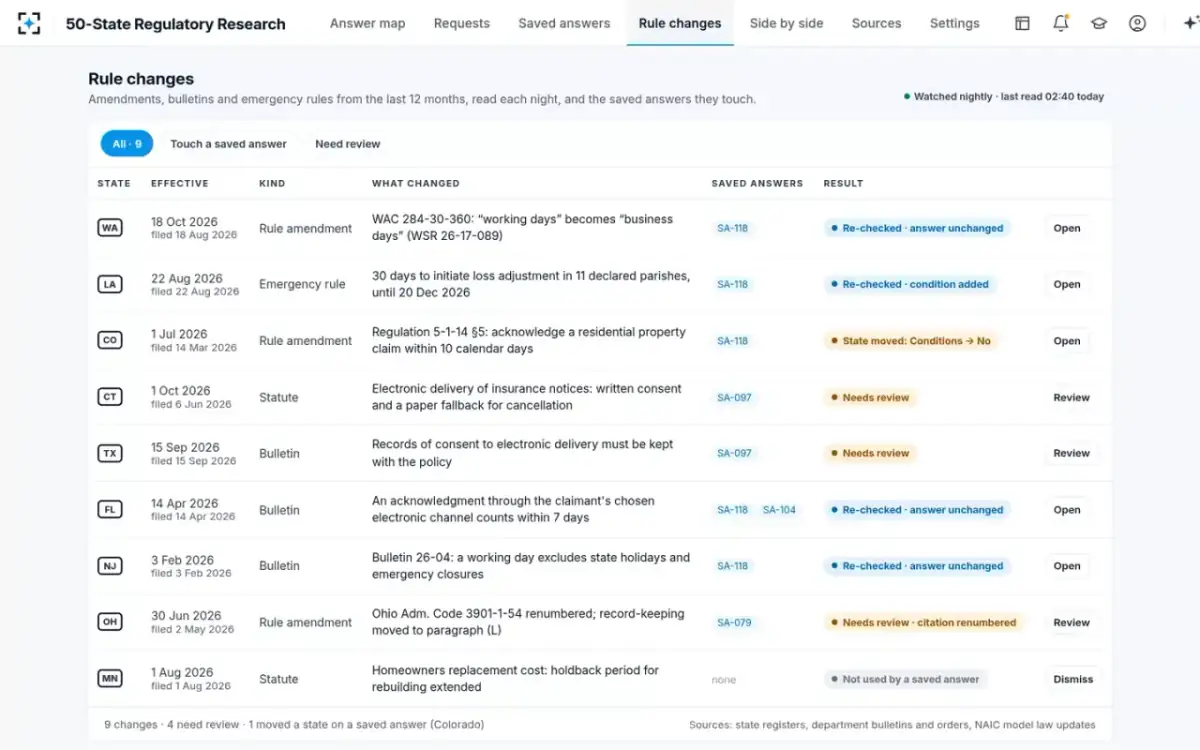
Its sources do not include case law, and it does not advise: every Texas cell carries its passage and version for the analyst to accept and counsel to sign. Whether each cell passes is scored in how to tell if each cell is right.
Questions people ask
Where are Texas insurance rules published?
In Title 28 of the Texas Administrative Code, with proposals and adoptions published in the Texas Register. TDI lists each rule project with its five dates on its rules pages, but says the official version is the one filed with the Secretary of State.
How long does an insurance company have to investigate a claim in Texas?
It must begin any investigation by the 15th day after notice of a first-party claim, or the 30th business day for an eligible surplus lines insurer (Ins. Code §542.055). It then has until the 15th business day after receiving all requested items to accept or reject, with one notice of up to 45 more days.
Are Texas Department of Insurance bulletins binding?
Each bulletin says what it is. Some summarise or remind insurers of binding law; the July 2026 disaster bulletin states that it does not create specific requirements. Rules in 28 TAC and the Insurance Code are binding.
When does a new TDI rule take effect?
Generally 20 days after it is filed with the Secretary of State, unless the rule sets a later date or an emergency allows an earlier one (Gov't Code §2001.036). The 2026 consumer rights notice rules were adopted in September and take effect on 1 January 2027.
Does Texas follow NAIC model laws?
Only where a Texas statute authorizes it. The Insurance Code bars the department from requiring compliance with an NAIC standard unless a statute expressly authorizes it (§36.004), and the NAIC's claims model page lists Texas under related activity, not adoption.