AI and insurance compliance meet first in research: the questions the business sends compliance every week, such as how many days a state allows to acknowledge a claim or what a nonrenewal notice must say, answered for every state. A language model can read 51 jurisdictions' codes, regulations and bulletins faster than any team, and that part is no longer the hard part. The hard part is that the same model can present a wrong answer with a confident citation, or a right citation to a version of the rule that was replaced last year. An AI research answer is safe to sign only when one agent reads, a different agent re-reads every citation against the text in force on the date asked, and a person accepts and counsel signs.
That is the design of 50-State Regulatory Research, Botminds' solution for multi-state insurance rule questions: six agents frame the question, read every state's sources, place each state yes, no or with conditions, check every citation, watch for rule changes and draft the memo, while the compliance analyst accepts and regulatory counsel signs. The examples below use the solution's fictional sample carrier, Larkspur Mutual; every product figure is sample data.
"For example, legal confabulations have been shown to be pervasive in current state-of-the-art LLMs."
NIST AI 600-1, Generative Artificial Intelligence Profile, July 2024, §2.2
What does AI change in insurance compliance research?
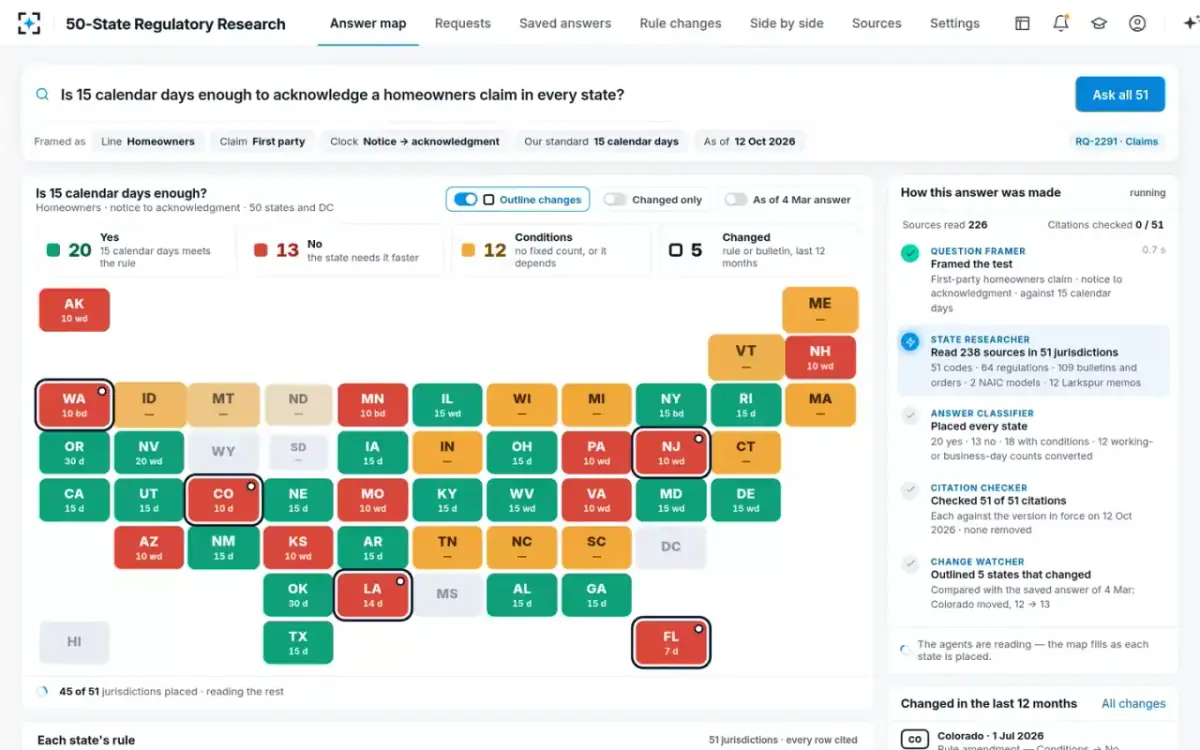
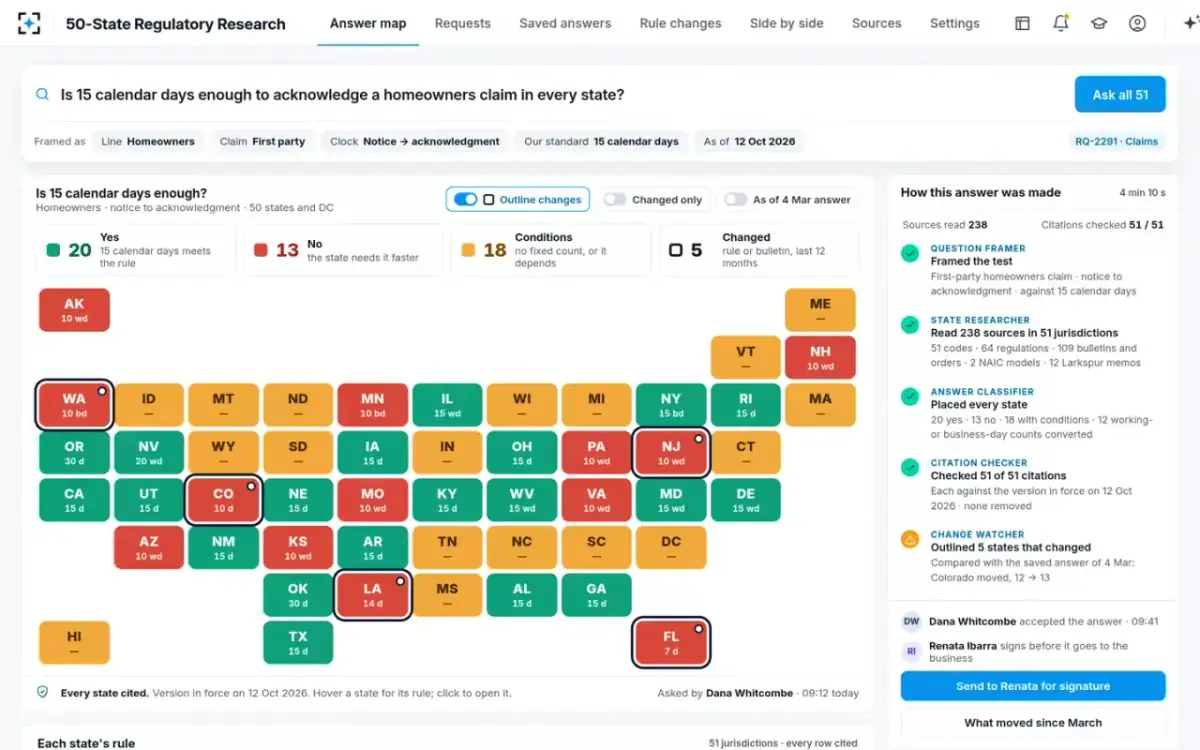
It moves the bottleneck from reading to checking. In the sample run, the question "Is 15 calendar days enough to acknowledge a homeowners claim in every state?" sent the agents through 238 sources: 51 codes, 64 regulations, 109 bulletins and orders, two NAIC models and 12 of the carrier's own interpretation memos. All 51 jurisdictions were placed and their citations checked in 4 minutes 10 seconds. By hand, the same reading is the largest share of an estimated nine working days.
The risk moves with it. When a person reads 51 codes, errors come from fatigue and are scattered. When a model reads them, errors come from the way generative models work, and they look exactly like correct answers. NIST's profile of generative AI risks names the pattern "confabulation": a model produces what is statistically likely given its training, and can add invented reasoning or citations that make a wrong answer look supported (NIST AI 600-1, §2.2). The lending version of the same problem is tested in ChatGPT for state law research. For a compliance team the consequence is specific: an AI answer with a citation beside it is not evidence that the cited text says what the answer says.
Can AI check its own citations?
Not in the same pass that produced them. A model asked to confirm its own answer is likely to repeat its own reading. Checking has to be a different task with a different input: take the cited section, open the text of that section as it stood on the as-of date, and confirm that the passage supports the placement. That is a re-reading against a source, not a second opinion from the same memory.
Six agents in 50-State Regulatory Research, and the two people who decide
Agent
Question framerTurns the plain-words question into a test: line, claim type, the event that starts the clock, the company standard, calendar or business days, as of a date.
Never: change the meaning without showing the framed test; if two readings are possible it shows both and asks
Agent
State researcherReads each jurisdiction's code, regulations, bulletins and orders, and the company's memos, and returns the governing passage in the version in force.
Never: answer from memory; no passage means "No rule found"
Agent
Answer classifierPlaces each state yes, no or conditions, converting working and business days on the state's own holiday calendar, with the arithmetic shown.
Never: round a condition up to a yes
Agent
Citation checkerRe-reads every state's answer against its passage and confirms the cited version is in force on the date asked.
Never: let an uncited answer reach the map; a removed answer is recorded
A person decides
Compliance analystReads the answers, checks the arithmetic on the states that matter, accepts or sends back.
A person decides
Regulatory counselSigns the answer and the memo for the business; nothing is sent before the signature.
The separation has a second benefit. Because the citation checker only confirms or removes, its work is countable. In the sample run it checked 51 of 51 citations against the version in force on 12 October 2026 and removed none; on the memo drafted afterwards it confirmed 18 of 18 citations matched the signed answer. A team evaluating any AI research tool should ask for those two numbers on its own questions, and for the record of what was removed and why.
The version problem: right section, wrong year
The most dangerous AI research error in insurance is not a fabricated statute; it is a real statute quoted as it read before an amendment. Insurance rules change by amendment far more often than by repeal, and a model's training text, or a database summary, can lag the current version by months or years. The section number stays the same, so the citation looks right.
Florida is the standard example. Its claims-communication statute, which applies to residential property insurers, now gives an insurer 7 calendar days to review and acknowledge a claim communication (§627.70131(1)(a); the exams that tested both versions are read in the Florida OIR market conduct exam). The earlier text allowed 14 calendar days. When Florida's Office of Insurance Regulation examined Tower Hill Prime's Hurricane Ian claims, handled between September 2022 and December 2023, it tested acknowledgment against the 2022 text with its 14-day clock and found 36 of 295 sampled claims late, an error rate of 12.2% (report of 21 July 2025). Examiners apply the version in force when the claim was handled; a research tool has to be able to do the same, in both directions.
Washington moved in October 2026. A rule order filed on 18 August and effective 18 October rewrote the state's claims standards, including the clock for accepting or denying a first-party claim, which now runs 30 calendar days from notification of the claim instead of fifteen working days after proofs of loss (WSR 26-17-089). In Texas, a state agency's rule generally takes effect 20 days after it is filed with the secretary of state (Gov't Code §2001.036(a); the dates are traced in how to find Texas insurance regulations), so a rule can be adopted, published and still not in force. An AI answer that does not state its as-of date cannot be checked against any of this.
What do regulators expect when insurers use AI?
That the insurer governs it, documents it and keeps people accountable for decisions it supports. The NAIC's model bulletin on insurers' use of AI systems asks for a written program covering AI systems that make or support decisions in regulated insurance practices (NAIC model bulletin; its requirements, section by section); the NAIC map showed it adopted in 29 jurisdictions as of 8 October 2026, with California, Colorado, New York and Texas following their own insurance-specific rules or guidance (NAIC map).
Texas restated its position on 12 June 2026, after the map's last Texas entry. Bulletin B-0003-26 tells regulated entities that decisions made or supported by AI must meet the same legal standards as any other, and adds: "If a regulated entity uses AI to make a consequential decision, TDI expects a person to review and agree with all decisions before action is taken." It also says TDI will monitor AI use through examinations and product filings, and expects entities to produce their procedures and protections on request.
Whether a research tool sits inside a carrier's AI program is the carrier's call, but the answer it produces often becomes a claims default or a notice template that touches every policyholder in a state. Treating it as a governed AI system, with an inventory entry, an owner and a human sign-off, costs little and answers the examiner's first question. What such a system's inventory entry should hold is set out in an AI use case inventory template.
Using AI for compliance: a chat assistant against checked agents
The useful comparison is not AI against people; it is an AI that answers against an AI that cites, checks and hands over. A general chat assistant can be a good first reader. It is a poor system of record. The difference shows up row by row on any 50-state question.
The same 50-state question, asked of a chat assistant and of checked agents
General chat assistant: The model's training text, plus whatever is pasted into the prompt.
Checked agents: A passage in a library of codes, regulations, bulletins, orders, NAIC models and company memos, kept by version.
General chat assistant: Generated with the answer; may name a real section with old or wrong text.
Checked agents: Extracted from the passage, then re-read by a separate checker against the version in force on the as-of date.
General chat assistant: Usually resolved into a confident yes or no.
Checked agents: Placed as conditions, or shown as "No rule found"; two possible readings are shown and the analyst chooses.
General chat assistant: Counted on a generic calendar, if at all.
Checked agents: Converted on each state's own holiday calendar, with the arithmetic on the state's page.
General chat assistant: Nothing happens; last month's answer stays in the chat.
Checked agents: Saved answers citing the changed section are re-checked that night and marked for review.
General chat assistant: None built in.
Checked agents: The analyst accepts; counsel signs; the memo cannot be sent before the signature.
Texas shows why the "where the answer comes from" row matters. Its Insurance Code gives an insurer until "the 15th day" after notice of a first-party claim to acknowledge it (§542.055(a)), while the department's rule, about pertinent communications generally, presumes an acknowledgment within 15 business days to be reasonably prompt (28 TAC §21.203(2)). Both are real, both say 15, and they answer different questions. A reader that blends them gets the arithmetic wrong without ever citing anything false.
The agents at work: the map fills as each state is placed
Legal research AI tools: what to test before you buy
Test on your own questions, with answers your counsel has already signed, and plant the traps that matter in insurance. A vendor demo on its own sample, including the one on this page, proves only that the interface works.
Seven tests for an AI-powered legal research tool in insurance compliance
- Ask a question whose answer changed this year
Washington's claims clocks from 18 October 2026 are a ready one. The tool should cite the new text for a later as-of date and the old text for an earlier one.
- Ask for a state with no rule on point
The right output is "No rule found" or conditions, not an answer borrowed from the NAIC model.
- Ask a question with two readings
Notice of claim or proof of loss? The tool should show both framings and ask, not pick one silently.
- Open every citation
Each should open to the highlighted passage and name its version. A section number alone is not a citation.
- Check a business-day count across a state holiday
Texas keeps state holidays such as 2 March and 21 April that a federal calendar does not.
- Re-run an old answer as of its old date
The tool should reproduce the answer your counsel signed then, and show what moved since.
- Ask who can send the answer
Nothing should reach the business before a named person accepts it and counsel signs.
What should a pilot of AI for insurance compliance research measure?
Measure what counsel changed, not how fast the agents ran. Speed is the easy number: in the sample run the agents took 4 minutes 10 seconds for 51 jurisdictions, and any serious tool will be fast. The numbers that decide whether answers can be signed are about errors and their handling, and a pilot should collect them on 20 or 30 questions the team has already answered.
Five counts are enough. Citations the checker removed, and why: a checker that never removes anything is not checking. Cells counsel changed after acceptance, split by the four tests of passage, version, placement and day count, which shows where the reading is weak. States placed as "No rule found" or conditions that counsel agreed with, which shows whether the tool is honest about gaps. Saved answers re-opened by a later rule change, and how many days after the change's effective date. And the time from question to signed answer, with the agents' share separated from the people's. Scoring each cell against those tests is set out in how to tell if each cell is right.
Where AI research agents fit, and where they do not
Botminds' 50-State Regulatory Research fits questions answered by statutes, regulations, bulletins and orders across the 50 states and the District of Columbia, especially the counted ones: days, notices, thresholds and filing requirements. In the sample configuration territories are off by default and can be added. It reads the company's own interpretation memos and shows them beside the rule they interpret, never in place of it, so an out-of-date memo is visible.
Every state answered and cited, with how the answer was made
It does not fit questions that turn on case law, such as bad-faith standards, choice of law or the duty to defend, because its sources are codes, regulations, bulletins, orders, NAIC models and memos rather than court decisions. It gives no legal advice: the memo writer adds nothing beyond the rules cited, and counsel signs before anything goes out. And it does not replace the reading counsel does on a disputed point; it puts the passage, the version and the arithmetic in front of counsel so that the reading starts from the text. The alternatives to software are compared in 50 state survey tools compared.
Questions people ask
Is AI allowed in insurance compliance work?
Yes, but under the same legal standards as any other method. The NAIC's model bulletin, adopted in 29 jurisdictions as of 8 October 2026, asks insurers to govern AI that makes or supports regulated decisions, and Texas expects a person to review and agree with consequential AI decisions before action is taken (Bulletin B-0003-26).
Can AI check its own citations?
Not reliably in the same pass, because a model confirming its own answer tends to repeat its own reading. A separate check that re-opens the cited section, in the version in force on the as-of date, and confirms the passage supports the answer is the safer design.
What is an AI-powered legal research tool?
Software that uses language models to find and summarise legal text. For insurance compliance the useful kind answers from a library of current and past rule versions, cites the passage for every answer, states its as-of date, and leaves acceptance and signature with people.
Can AI replace a compliance analyst?
It replaces the reading, not the judgment. In the sample run the agents read 238 sources in about four minutes, and the analyst still decided whether to accept the answer and which states needed a second look, and counsel still signed.
What should an AI tool do when it cannot find a rule?
Say so. A state without a governing passage should show "No rule found" rather than the NAIC model's number or a guess. Many states have not adopted a given model, so the gap is often the true answer.
Does a research tool need to state an as-of date?
Yes. Rules change by amendment under the same section number: Florida's acknowledgment clock went from 14 to 7 calendar days, and Washington's decision clock changed on 18 October 2026. An answer without its date cannot be checked against either.