ChatGPT is good for some legal research chores, such as explaining a concept or drafting from verified material, but a general chatbot is the wrong tool for state lending-law research, because the work depends on three things a chat answer does not reliably give: the current text of each state's controlling section, the date that text took effect, and a passage behind every answer that a reviewer can check. Studies of large language models on legal questions find invented or wrong answers at high rates, and the models often do not signal when they are wrong. Botminds' State Lending Law Research uses language models in a different arrangement. Each state is read by its own agent from a rule library kept by section and version, a second agent checks every answer against its passage, and counsel reviews the result.
The same question, asked of a chat assistant and of research agents
General chat assistant: What the model absorbed in training, plus whatever a web search returns.
Research agents with a rule library: The state's statute, rule or guidance, kept by section and by version.
General chat assistant: May reflect an older version; training data has a cut-off date.
Research agents with a rule library: Each section compared with its current version every night.
General chat assistant: Rarely given, and not tied to the date of your question.
Research agents with a rule library: Answered "as of" a stated date; recent changes flagged.
General chat assistant: Plausible-looking citations that may not exist or may not say what is claimed.
Research agents with a rule library: Every answer carries its passage; no passage, no answer.
General chat assistant: Compresses them into a summary, often with "varies by state".
Research agents with a rule library: One reader per jurisdiction, each with its own answer and passage.
General chat assistant: None built in; the user must verify everything.
Research agents with a rule library: A separate agent reads each answer back against its passage and removes what is unsupported.
General chat assistant: A conversation.
Research agents with a rule library: Every question, passage, verdict and review on the record.
Can ChatGPT do fifty-state legal research?
It can produce an answer that reads well, which is part of the risk. The best published evidence is a study by researchers at Stanford and Yale. They asked large language models specific, verifiable questions about federal court cases and found that "legal hallucinations are alarmingly prevalent, occurring between 58% of the time with ChatGPT 4 and 88% with Llama 2" (Dahl et al., Large Legal Fictions, 2024). The same study found that the models "often fail to correct a user's incorrect legal assumptions" and "cannot always predict, or do not always know, when they are producing legal hallucinations".
Court cases are not state statutes, and models have improved since. The failure modes still apply to state law: the answer depends on text the model may never have seen accurately, the model may answer confidently regardless, and a question that assumes something false ("since Texas caps late fees at $15…") tends to get an answer that accepts the assumption.
How often legal AI answers are wrong or unsupported, in two studies
Why does ChatGPT make up citations?
Because it is built to produce likely text, not to look things up, and a citation is text like any other. The US National Institute of Standards and Technology calls the failure confabulation, "a phenomenon in which GAI systems generate and confidently present erroneous or false content", and says it is "a natural result of the way generative models are designed: they generate outputs that approximate the statistical distribution of their training data" (NIST AI 600-1, July 2024). A section number in the right format, for the right state, is exactly the kind of output that statistical pattern produces whether or not the section says what the answer claims.
The same report warns that models may produce "confabulated logic or citations that purport to justify or explain the system's answer, which may further mislead humans into inappropriately trusting the system's output". For a compliance reader that is the trap: the citation is what makes the answer look checked. In state lending law the risk is sharper than in case law, because the right section can exist and still be the wrong version. A model that cites a real Florida section with last decade's amount has produced a citation that passes a glance and fails the statute.
Can you ask ChatGPT whether a case or statute is real?
No; asking the model to verify itself is not verification. The best-known demonstration is Mata v. Avianca, where lawyers filed a court submission citing judicial opinions that did not exist. One of them had asked ChatGPT "Is Varghese a real case" and "Are the other cases you provided fake". The court found that ChatGPT "responded that it had supplied 'real' authorities that could be found through Westlaw, LexisNexis and the Federal Reporter", and the lawyer later said the chatbot told him the case "does indeed exist". The court imposed a $5,000 penalty (Mata v. Avianca, S.D.N.Y., June 22, 2023).
There is nothing inherently improper about using a reliable artificial intelligence tool for assistance. But existing rules impose a gatekeeping role on attorneys to ensure the accuracy of their filings.
Mata v. Avianca, Inc., No. 22-cv-1461 (S.D.N.Y. June 22, 2023), opinion and order on sanctions
The court's point carries over to compliance. The tool is not the problem; an unverified answer is. Verification means opening the source outside the model, in its current version, and reading the operative words. A research tool can make that fast by putting the passage beside the answer and having a second step check one against the other. It cannot make it unnecessary.
Retrieval helps, but it does not make an answer right
Giving a model the sources reduces errors without removing them. A preregistered evaluation of commercial legal research tools that retrieve documents before answering found that "hallucinations are reduced relative to general-purpose chatbots (GPT-4)", but that the tools tested "each hallucinate between 17% and 33% of the time" (Magesh et al., 2024). The authors conclude that the evidence informs "the responsibilities of legal professionals in supervising and verifying AI outputs".
The lesson for fifty-state work is about architecture, not about which model is used. Retrieval decides what the model reads. It does not check whether the answer says what the passage says. A design that can be trusted adds three things: the right version of the right section for each state, an independent read-back of every answer against its passage, and a person who reviews the result. When the statute is unclear covers the fourth: what the system does when the text does not give a clear answer.
Six ways a chat answer to a state-law question goes wrong
The errors follow a pattern, and each has a matching control. The table lists the ones that matter most for lending-rule questions, with what catches each. None of them depends on how capable the model is. They come from how the answer is produced.
Failures of a chat answer, and the control that catches each
| Failure | What it looks like | What catches it |
|---|---|---|
| Invented citation | A section number that does not exist, or exists and says something else. | No answer without a passage from the rule library; the passage is shown, not paraphrased. |
| Old version | A cap that was correct two years ago. | Sections kept by version and compared nightly; every answer dated. |
| Wrong arithmetic | "Greater of" read as "lesser of", or a percentage applied to the wrong amount. | The cap worked out on a stated reference payment, then read back against the passage. |
| Accepted false premise | The question's mistaken assumption is built into the answer. | The question is restated with its facts before any state is answered. |
| Lost conditions | The amount survives; the grace period, written-agreement rule or frequency tier does not. | The read-back checks amount, condition and delay separately. |
| Lender ignored | A state cap applied to a bank that exports its home rate, or the reverse. | Scope set by where the lender is licensed; applicability goes to counsel. |
Indexed caps make the "old version" row worse. California's limit on consumer loans of $2,500 to $9,999 is "36 percent per annum plus the Federal Funds Rate", with the rate read on the first day of the month before the loan is made (California DFPI). A model trained on last year's text may describe the rule correctly and still give the wrong number for this month. How often do state lending laws change covers this in detail.
What existing rules expect from AI used in compliance work
No regulator has issued rules on AI tools for legal research, but the existing ones apply. The US Treasury notes that firms use AI for "risk management, regulatory compliance, customer service, and back-office operations", and that use cases should be checked "for compliance with existing laws and regulations before deployment" (Treasury, December 2024). The GAO found that the federal financial regulators using AI to flag errors in filed data "were not using AI to make decisions autonomously or relying on it as a sole source of input" (GAO-25-107197).
That sets a minimum. Whatever tool produces a state-law answer, the lender remains responsible for it, and a person must be able to check it. A chat transcript gives that person nothing to check except the claim itself. A cited passage, a dated version and a read-back verdict do.
How the answer was produced, step by step, with times
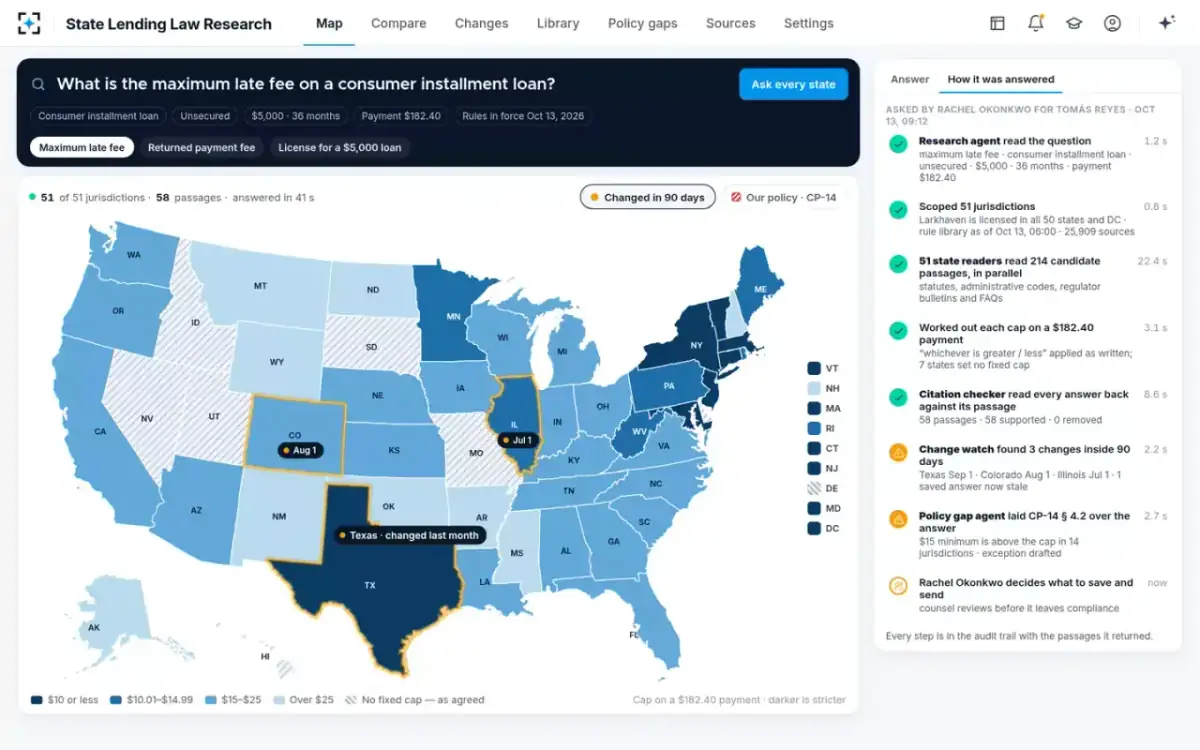
Look at the citation checker's line. The answer is checked by a second agent against its passage, which a chat answer cannot be.
Is Claude or Gemini better than ChatGPT for legal research?
For state lending-law research, which model you use matters less than how the answer is produced. We found no government, academic or non-profit study that compares current models on state lending statutes. The studies that exist found failures across every model they tested: in the federal case-law study, hallucination rates ran from 58% to 88% across the models tested, and the purpose-built tools in the second study used retrieval and still erred. Swapping one general assistant for another changes the rate, not the kind of failure.
The things that change the kind of failure sit outside the model: a rule library kept by section and version, one reader per jurisdiction, a separate check of every answer against its passage, a way to stop when the text does not settle the question, and a person who signs. State Lending Law Research uses language models inside that arrangement. A team comparing assistants should compare those controls first and the models second.
Where a chat assistant still helps the compliance team
General assistants are useful for work that does not need a citation: drafting a memo from an answer that has already been verified, explaining a concept to a new analyst, or turning a reviewed table into plain language for a product team. The risk comes from using them as the source of the answer. If an analyst has to check every sentence against the statute anyway, the assistant has not saved the research time. It has only made the output look finished.
What any tool must do before its state-law answers are relied on
- Show the passage, not just the citation
A reviewer should see the operative words without leaving the answer.
- Answer as of a date
State the version of each section used, and flag changes since.
- Answer every jurisdiction separately
Fifty-one answers with fifty-one passages, not a summary with exceptions.
- Check itself independently
A separate step compares the answer with the passage and removes what is unsupported.
- Stop when there is no source
Say the library holds no passage, rather than answering from memory.
- Keep the record
Who asked, what was read, what was removed and who reviewed it.
The State Lending Law Research page shows these controls on one question, from the question to counsel's signature. Test it on questions your counsel already answered describes how to test any tool, including this one, on your own past work before relying on it.
Questions people ask
Is it safe to use ChatGPT for legal research at a lender?
Not as the source of an answer. Published studies find high rates of invented or wrong legal answers, and the models often do not signal uncertainty. Use it for drafting from material that has already been verified, not for finding what a state allows.
How do I verify citations from an AI legal research tool?
Open the cited section in its current version, find the quoted words, and check the amount, the condition and the delay separately. A tool that shows the passage and its version makes this a one-minute check. A tool that shows only a section number makes it a fresh piece of research.
Can ChatGPT read a statute accurately if I paste it in?
Pasting the text removes the invented-citation risk but not the reading risk. The model can still swap "greater of" for "lesser of" or drop a condition such as a 12-day wait, so the answer still needs checking against the passage. You also have to be sure the pasted text is the current version.
Does ChatGPT know about recent changes to state lending law?
Not reliably. A model knows what was in its training data up to a cut-off date, and web search finds pages, not versions. Oregon's opt-out from interstate rate exportation for consumer finance loans took effect in 2026, for example (CRS, May 2026), so a model trained earlier would describe Oregon as it was.
Should a compliance team ban ChatGPT?
A ban is rarely needed; a rule about what it may be used for is. Drafting from answers already verified, summarising a reviewed table and explaining concepts carry little risk. Finding what a state allows, citing a section or answering as of a date should come from a source a reviewer can open.