AI for compliance officers is most useful where the work is finding and transcribing, and least where it is judgment. At a national consumer lender, state-law questions usually come from product, collections or licensing. A compliance analyst researches them, in-house counsel reviews the answer, and a chief compliance officer owns the policy it ends up in. Licensing keeps the state relationships and the exam calendar that the answers feed. Each of those people decides something different, and fifty-state work is slow mainly because the question passes between them several times without its sources. Botminds' State Lending Law Research gives every person in that chain the same cited answer. This guide takes each role in turn, sets out what it decides, and describes how its week changes.
Five people around one fifty-state question
Today
Researches dozens of state questions a week from statutes, alerts and old answers. One state takes minutes; fifty take a day or more.
With agents
Asks once, reads fifty-one cited answers, and spends the time on the states where the text is unclear or two sections conflict.
Still theirs: What is saved, what is sent, and which states go to counsel.
Today
Reviews uncited summaries and has to re-read the statutes behind them before signing.
With agents
Opens any state to the highlighted passage and the read-back verdict, and reviews the judgment calls rather than the transcription.
Still theirs: Preemption and applicability, ambiguous text, and every policy exception.
Today
Waits days for an answer and gets a table with no dates, so builds the fee schedule on the strictest state to be safe.
With agents
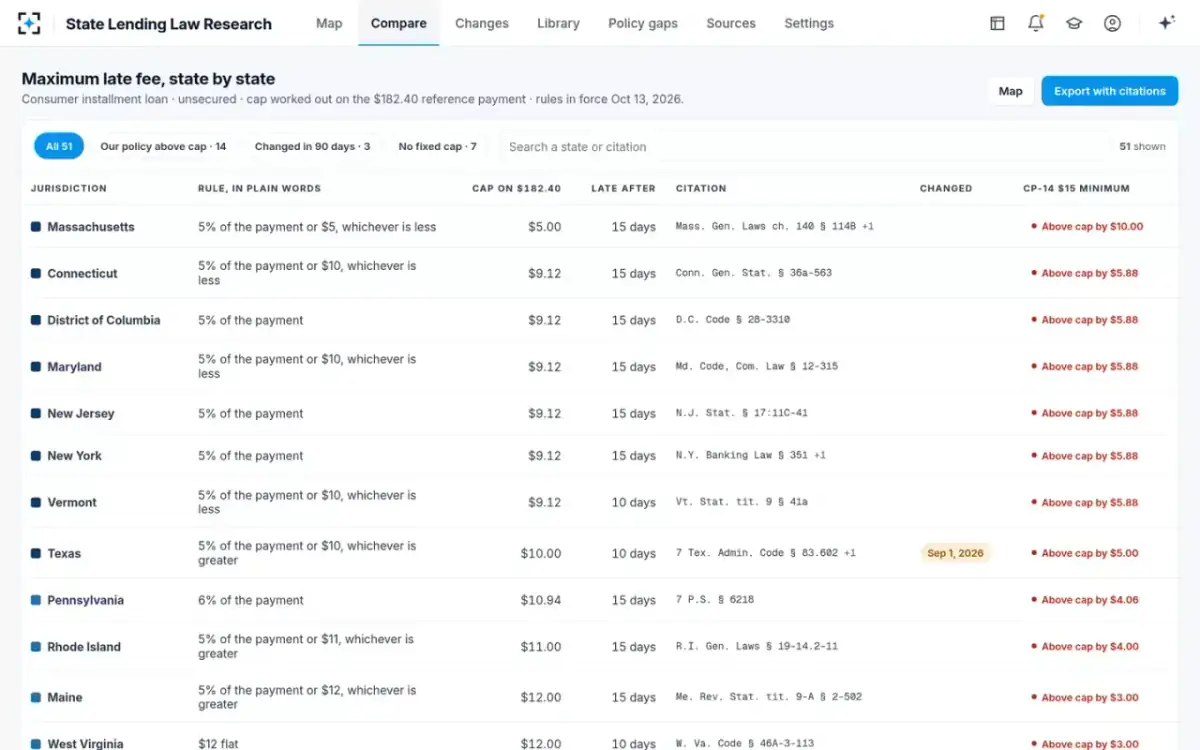
Gets a reviewed state-by-state table with the cap for each state and a drafted rule for the states where the standard fee does not fit.
Still theirs: The fee and the product design.
Today
Hears about a rule change from an alert, and later from an examiner.
With agents
Sees each change on the topics the team watches, with its redline and what it touches, down to the licensing calendar.
Still theirs: Licences, regulator relationships and exam preparation.
Today
Pays outside counsel for surveys and cannot say which policies rest on which version of a statute.
With agents
Owns a policy whose state exceptions are listed, cited and signed, and flagged when a rule underneath them changes.
Still theirs: The compliance programme and its budget.
Where a fifty-state answer loses its time: between the desks
Most of the elapsed time sits in the handoffs. Product asks in a message. The analyst starts a spreadsheet, reads fifty-one jurisdictions, and emails a table. Counsel asks where row 23 came from, the analyst finds the statute again, and the table goes back. Product receives an answer without dates. Licensing hears about it, if at all, months later. Each step is reasonable, but the sources do not travel with the answer, so every reader has to rebuild them.
The people are not cheap, which makes this costly. In the Bureau of Labor Statistics' May 2025 occupational survey, the credit intermediation industry employed 19,850 compliance officers at a mean of $94,090 a year, and 7,760 lawyers at a mean of $233,110 (BLS OEWS, May 2025). An hour of counsel spent re-finding a statute the analyst already read costs about two and a half analyst hours.
The people a state-law answer passes through, by the numbers
19,850
compliance officers in US credit intermediation, mean wage $94,090 a year
7,760
lawyers in the same industry, mean wage $233,110 a year
2.5×
counsel's mean hourly wage ($112.07) against a compliance officer's ($45.24)
One late-fee question across the desks, in the sample run
A person decides
Product asksThe product manager asks for one late fee to print on every contract for a new installment loan.
Agent
Fifty-one readers answerThe question is restated with the loan facts and answered state by state, each cap worked out on the reference payment and cited.
Never: answer a state without its passage
A person decides
The analyst decidesShe reads the map, opens the states that changed, and decides what to save and whom to send it to.
Agent
The policy is checkedThe fee policy is compared with every state's cap, and an exception for the states it breaks is drafted.
Never: edit a policy document
A person decides
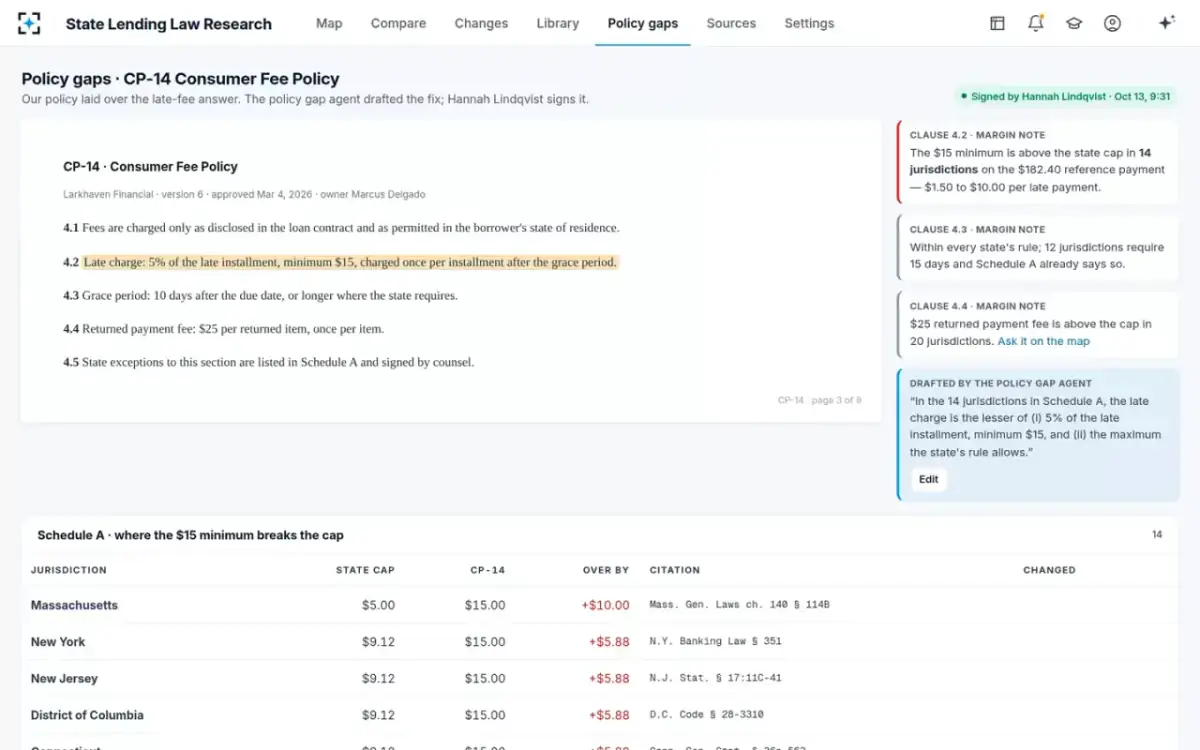
Counsel reviews and signsCounsel reads the answer, the per-state table and the drafted exception, and signs the exception.
What does a compliance analyst do at a bank or lender?
On state-law questions, the analyst's work is mostly locating and transcribing, and the judgment is a small part of it. Finding the controlling section in each state, reading it, working out the cap, checking for amendments and building a cited table takes most of a working day per fifty-state question. Deciding which states are unclear, which need counsel and what to tell product is the valuable part, and it gets the least time. In the solution's sample, the persona answers 30 to 40 state-law questions a week, not all of them fifty-state, and says she can do Texas in ten minutes and the other fifty take two days.
Where the analyst's hours go on one fifty-state question (our estimate)
By hand · about 7.5 hours
- Finding each state's section · 40%
- Reading it and working out the cap · 27%
- Checking for amendments · 13%
- Building the cited table · 13%
- Checking our policy · 7%
With the solution · about 40 minutes
- Reviewing sections found · 15%
- Reviewing caps · 15%
- Reviewing changes · 15%
- Reviewing the table · 16%
- Checking our policy · 39%
With the solution, the proportions reverse. The share of the analyst's time spent on the lender's own policy, which is the judgment, goes from a small part of a long day to the largest part of a short one. The analyst still decides what is saved, what is sent and which states go to counsel. What a fifty-state survey costs turns these hours into a cost a finance team can check.
Counsel's question: if it isn't cited to the section, is it an answer?
Counsel reviews the answer and signs any exception, and the review is only as fast as the citations allow. Given an uncited table, counsel has to re-read the statutes behind it to check it. Given an answer with the passage highlighted and a second reader's verdict beside it, counsel can spend the review on what only counsel can decide: whether a state's rule reaches this lender, what an ambiguous sentence means, and whether to accept an exception.
The responsibility stays where it was. As a Federal Reserve examiner wrote, "although a financial institution may hire a reliable vendor, the institution remains responsible for ensuring that the output from vendor-provided systems and services meets regulatory requirements" (Consumer Compliance Outlook, 2019). That is why the solution makes counsel's review a required step before an answer leaves compliance. When the statute is unclear covers what the agents pass to counsel instead of guessing.
What counsel signs: the exception, with the per-state table attached
Product's question: what can I print on every contract?
Product wants one rule it can implement, and a fifty-state table is not that rule. What it needs is the standard fee, the states where it does not fit, and what to charge there. Answers that arrive late and undated tend to produce a cautious design: the fee is set at the strictest state's cap everywhere, and the lender gives up revenue in states that allow more. Answers that arrive the same morning, reviewed, with a drafted exception, let product keep a standard fee and cap it state by state.
What product reads: the reviewed table, with the cap for every state
Licensing and the CCO: who hears when the rule changes?
The licensing manager and the CCO make fewer decisions on any single question, but both need to know when a rule changes. The licensing manager holds the licences and the exam calendar. An exam starts with the lender's policy and ends with the statute, so a change to a watched topic matters to licensing as soon as it is published. The CCO owns the policy and the outside-counsel budget, and is accountable for a change process that examiners review through its records. The OCC's handbook names "project management tracking records, applicable committee meeting minutes, adopted policies and procedures related to the change" among the evidence examiners may review (OCC).
Each part of a fifty-state answer, and who owns it
| Part of the answer | Who prepares it | Who decides or signs |
|---|---|---|
| The question and the loan facts it assumes | Analyst, from product's request | Analyst |
| The passage and cap for each state | Agents, one reader per jurisdiction | Analyst reviews; ambiguous states go to counsel |
| Read-back against each passage | A separate checking agent | Logged; any removed sentence is kept on the record |
| Whether a state's rule reaches this lender | Analyst flags it | Counsel |
| The state exceptions to the fee policy | Agent drafts them | Counsel signs; the CCO owns the policy |
| Who is told when a cited section changes | Agents compare versions nightly | Each answer's owner; licensing for its calendar |
Will AI replace compliance officers and analysts?
Nothing in the evidence points that way; what changes is where their hours go. The regulators that examine lenders are the clearest example. When the GAO reviewed AI use at the federal financial regulators, Federal Reserve officials said AI had "improved examiners' productivity by allowing them to focus on supervisory priorities and more complex tasks", and at the SEC "subject matter experts review flagged trades to determine if further investigation is warranted" (GAO-25-107197, May 2025). The machine reads and flags; a person decides.
The legal position points the same way. A lender cannot hand its accountability to a tool: as the examiner quoted above put it, the institution "remains responsible" for the output of the systems it uses. That keeps a named person at each decision in the table above, and it makes the analyst's judgment more valuable, not less. What does shrink is the transcription. On our estimate for one fifty-state question, the analyst's hours fall from about seven and a half to under one, and the share spent on the lender's own policy, the judgment, rises from 7% to 39%.
How can AI be used in compliance at a lender?
In compliance, AI does best at reading large volumes of text and data and flagging what a person should look at. Treasury's 2024 review of the sector found AI "widely used" for anti-money-laundering and sanctions compliance, "including analyzing large sets of data, detecting anomalies, flagging suspicious activities, and verifying customer identities" (US Treasury, December 2024). State lending-law research fits the same pattern: thousands of sections, a few that answer the question, and a judgment at the end.
The uses differ in how much a wrong answer costs and how easily it is caught. A missed transaction flag is caught, if at all, by the next review. A wrong state cap is printed on every contract in that state until someone reads the statute again. That is why research tools need controls that monitoring tools can live without: the passage behind each answer, the version of the text it read, an independent check, and a way to say "the text does not settle this". The GAO notes that the regulators themselves "primarily oversee AI using existing laws, regulations, guidance, and risk-based examinations", so the controls a lender needs are the ones its examiners already look for.
What should compliance officers look for in an AI tool?
Look for a tool whose every answer a person can check in a minute, and that knows when not to answer. Demonstrations are built to impress; the questions below separate a tool a compliance officer can rely on from one that produces text for someone else to verify. Ask them of any vendor, including this one.
Questions to ask before buying AI for compliance officers
- Does every answer show its passage?
The operative words of the statute or rule, not a section number alone, beside the answer.
- Which version of the text did it read?
Answers dated "as of", with sections kept by version so a later change can be matched.
- Who checks the answer?
A separate step that reads each answer back against its passage and removes what it does not support.
- What happens when the text is unclear?
A flag with both readings, sent to a named person, rather than a confident yes or no.
- Is it scoped to where you lend?
Jurisdictions, products and the reference loan set once and applied to every question.
- Does it reach your own policies?
A comparison of each answer with the policy clauses it affects, drafted for counsel and never edited silently.
- Will it run on your past answers first?
A pilot on questions counsel already signed, with measures agreed before it starts.
Across all five roles, the solution takes over finding and transcribing and leaves every decision with a named person. The State Lending Law Research page follows the same question through the screens, and Where your fee schedule breaks state law shows the exception list counsel signs.
Questions people ask
Who should own state law research at a lender?
Usually compliance, with in-house counsel reviewing and signing anything that becomes policy. Product, collections and licensing ask the questions, but the answers need one owner and one library, or the same question is researched three times.
Does a fifty-state research tool replace outside counsel?
It replaces the parts of a survey that are locating and transcribing. Novel questions, litigation risk and preemption opinions still need lawyers, and they are quicker to give when the state text is already cited.
Is AI allowed in bank compliance work?
No federal rule prohibits it, and existing rules apply to it. The GAO found that the federal financial regulators oversee AI mainly through existing laws, guidance and risk-based examinations. Treasury recommends that firms review each AI use for compliance with existing law before deploying it.
Can AI draft compliance policy changes?
It can draft them; a person should approve them. In the solution's sample, an agent drafted a late-fee exception for 14 jurisdictions and counsel signed it nineteen minutes after the question was asked. The agent cannot edit the policy document itself.
How long does it take a compliance team to start using an AI research tool?
Plan on a pilot before any rollout: our suggested plan is four weeks, two replaying questions counsel already signed and two running beside the team on live ones. The measures and the decision rule should be written down before the first question.