The maximum late fee allowed by law in Florida on a consumer finance loan is $15: a licensee under the Florida Consumer Finance Act may charge a delinquency charge of up to $15 on a monthly payment that has been in default for at least 12 days, provided the charge was agreed in writing before it is imposed. Semimonthly and biweekly payments have lower caps. Those terms come from section 516.031 of the Florida Statutes. A number like that can still be misapplied on its way into a lender's fee policy, and most errors happen in the steps between the statute and the contract. This guide follows the $15 through those steps and names the check at each one. Botminds' State Lending Law Research runs the same steps for every state at once, with the passage kept next to every number.
Florida's late-fee rule, from section 516.031(3)(a)9
$15
maximum delinquency charge on a payment due monthly
12days
in default before the charge may be imposed
$7.50
semimonthly, or biweekly with two payments due in the month
$5
biweekly, in a month with three payments due
What is the maximum late fee allowed by law in Florida?
The statute allows "a delinquency charge for each payment in default for at least 12 days if the charge is agreed upon, in writing, between the parties before imposing the charge". The cap then depends on how often payments fall due: "For payments due monthly, the delinquency charge for a payment in default may not exceed $15. For payments due semimonthly ... $7.50. For payments due every 2 weeks ... $7.50 if two payments are due within the same calendar month, and may not exceed $5 if three payments are due within the same calendar month" (Fla. Stat. § 516.031(3)(a)9).
Two other parts of the same section limit what else a lender can charge. Beyond interest, delinquency and insurance charges, "further or other charges ... may not be directly or indirectly charged, contracted for, or received as a condition to the grant of a loan", with a short list of exceptions such as up to $25 for a credit investigation and a $25 annual fee on a line of credit. And overcharging is treated as usury: "Any charges, including interest, in excess of the combined total of all charges authorized and permitted by this chapter constitute a violation of chapter 687 governing interest and usury, and the penalties of that chapter apply."
In the event of a bona fide error, the licensee shall refund or credit the borrower with the amount of the overcharge immediately but within 20 days after the discovery of such error.
Fla. Stat. § 516.031(3)(a)9
That sentence makes the cost of a wrong number concrete. A fee schedule that charges $16 instead of $15 is a usury matter under Florida law, and once a lender knows of the error the clock for refunds is 20 days.
What fees can a Florida consumer finance lender charge besides the late fee?
Only the ones section 516.031 lists; every other charge "as a condition to the grant of a loan" is barred. The list is short and specific, which makes it a good test of a fee schedule: any line on the schedule that is not on the statute's list is a problem in Florida, whatever it is called. The same section bans two practices outright. A licensee "may not require a borrower to pay a prepayment penalty", and may not "induce or permit any borrower to split up or divide any loan" to earn a greater finance charge.
Every charge the Florida Consumer Finance Act allows, and its limit
| Charge | What the statute allows | Condition attached |
|---|---|---|
| Interest | 36% a year on the first $10,000 of principal, 30% on the next $10,000, 24% up to $25,000 | Simple interest, not add-on; a blended single rate is allowed |
| Delinquency (late) charge | $15 monthly · $7.50 semimonthly · $7.50 or $5 biweekly | Payment in default at least 12 days; agreed in writing first |
| Bad check charge | The greater of $20 or the bank's actual charge to the lender | Only when the borrower's payment is dishonoured |
| Credit investigation | Up to $25 | To reimburse part of the cost of checking the applicant |
| Line-of-credit fee | $25 a year | On the anniversary date of the account |
| Third-party costs | Brokerage fee, title insurance, property appraisal | Loans or lines over $10,000; paid to a third party for an actual expenditure |
| Taxes and filing fees | Intangible tax, documentary excise tax, public filing fees | Actually and necessarily paid out |
| Collection costs | Attorney fees and court costs; repossession and sale expenses | As a court determines; actual and commercially reasonable |
| Refinanced interest | No more than 60 days of unpaid interest from the prior loan | When a new loan pays off the old one |
| Prepayment penalty | Not allowed | The borrower may pay early at any time |
What is the maximum interest rate in Florida?
For most lenders it is 18% a year simple interest; for a consumer finance licensee it is up to 36% on the first $10,000. Florida's general usury statute declares usurious any loan "at a higher rate of interest than the equivalent of 18 percent per annum simple interest" (Fla. Stat. § 687.02). On loans above $500,000 that limit falls away, and only the criminal usury rates apply: charging more than 25% a year "willfully and knowingly" is a misdemeanor, and more than 45% is a felony (§ 687.071).
The consumer finance licence is what lifts the 18% limit for small loans. Section 516.02 bars anyone lending $25,000 or less from charging more than 18% "except as authorized by this chapter or other statutes of this state", and a loan with a greater charge than the chapter allows "is not enforceable in this state" (§ 516.02). The general usury sections also exclude loans made under an FHA insurance commitment, a VA guaranty or a federal agency's commitment to buy the loan (§ 687.03(2)). So the Florida rate question has four answers before any arithmetic: licensee, general lender, large loan or federally backed mortgage.
Florida's interest ceilings, by lender and loan
36%
consumer finance licensee, on the first $10,000 of principal (30% and 24% on higher tiers, up to $25,000)
18%
general usury limit, simple interest, on loans up to $500,000
25%
above this, charged knowingly, criminal usury begins: a misdemeanor, and a felony above 45%
$500k
above this loan size, only the criminal usury rates limit the interest
The six steps between the statute and the contract
The $15 passes through six steps before it reaches a borrower's account, and it can go wrong at each one. The flow below names each step and who does it. In State Lending Law Research, agents handle the reading, the arithmetic and the read-back, and people keep the judgments and the signature.
The life of one number: Florida's $15, from section to signature
Agent
Find the sectionThe Florida reader locates § 516.031(3)(a)9 in the current statute and returns the passage, not a summary of it.
Never: answer without a passage
Agent
Keep the conditionsIt carries the 12 days in default, the prior written agreement and the payment-frequency tiers along with the $15.
Never: drop a condition to shorten the answer
A person decides
Confirm the rule reaches the lenderCounsel confirms the lender is a Florida licensee making a chapter 516 loan, not a bank exporting another state's rule.
Agent
Work it out on the paymentThe cap is applied to the reference payment and frequency. For a monthly payment, it is $15 whatever the payment size.
Never: round or recalculate a quoted amount
Agent
Read it backA separate checker compares the plain answer with the passage: the amount, the condition and the delay.
Never: add a source the reader did not use
A person decides
Fit it to the policy, and signThe house fee rule is compared with the cap; counsel signs any state exception before it goes into contracts.
Steps one and two: the passage, with its conditions
The first step goes wrong when the source is a summary. A survey row reading "FL: $15" is correct, but it leaves out the 12 days, the written agreement and the frequency tiers, and each of those decides whether a particular fee is lawful. The fix is to keep the passage with the number from the start. Anyone can then see that the cap belongs to "each payment in default for at least 12 days", and a product with biweekly payments can see that its cap is $7.50 or $5.
Conditions are also where a house policy and a state rule part company quietly. A policy that says "late charge after a 10-day grace period" is lawful in a state that allows the fee after 10 days and unlawful in Florida on days 11 and 12. The sample lender's fee policy deals with this by setting its grace period at "10 days after the due date, or longer where the state requires". That wording only works if the state's delay is known for each state.
The same steps in the product, each with its time and what it found
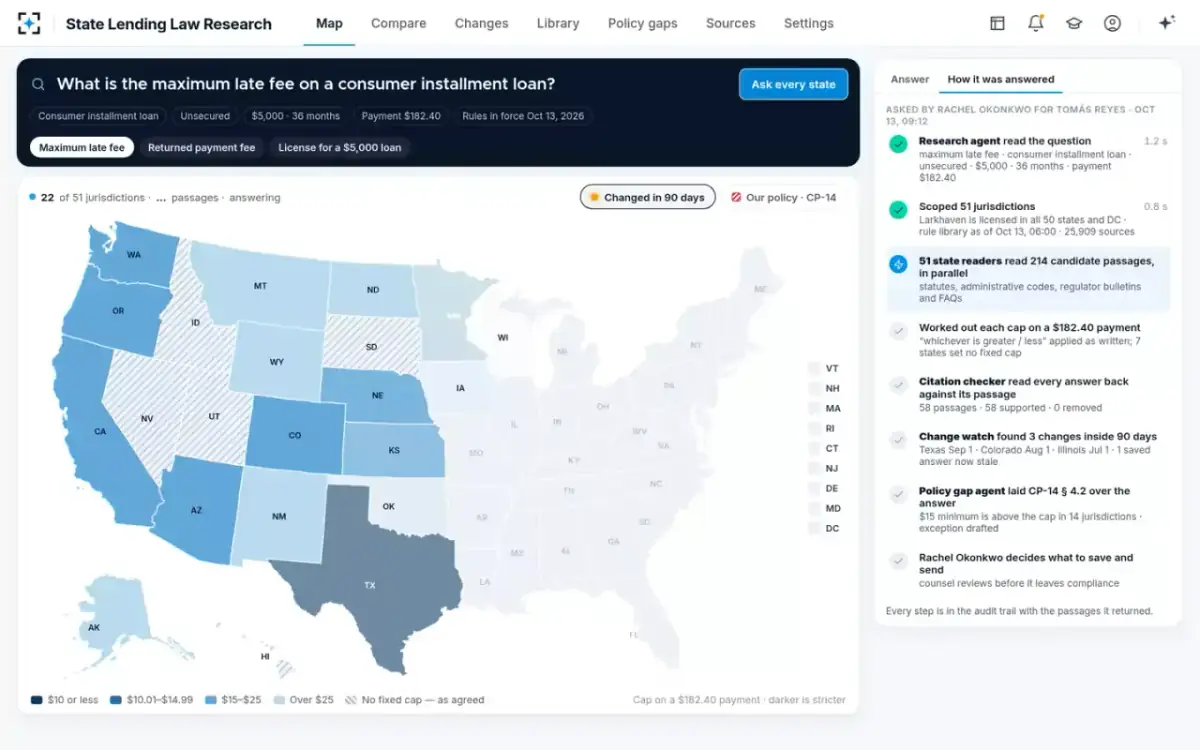
Look at the order of the panel. The reading, the arithmetic and the read-back come first; the last step is always a person's.
Step three: does the rule reach the lender?
Florida's $15 binds a lender only if chapter 516 applies to it. The chapter requires a licence to "engage in the business of making consumer finance loans". It also bars any other lender from charging more than 18% a year on loans of $25,000 or less "except as authorized by this chapter or other statutes of this state" (Fla. Stat. § 516.02). A licensee may lend "any sum of money up to $25,000" under section 516.031. A loan above $25,000, or one made by a bank, falls under different rules.
For a national bank, the answer comes from its home state. The OCC treats late fees as interest under 12 U.S.C. 85, so the bank may charge Florida borrowers the late fee its home state allows (12 CFR 7.4001). The same $15 is therefore a hard limit for one lender and has no effect on another. That is a judgment for counsel, and Are banks exempt from usury laws? sets out the branches.
Step four: a flat cap meets a percentage fee
A flat cap and a percentage fee cross at a particular payment size, and the reference payment decides which side of it an analysis lands on. Many fee policies charge a percentage with a minimum, such as "5% of the late installment, minimum $15". Against Florida's flat $15 for monthly payments, that rule is lawful up to a $300 payment, where 5% equals $15. Above $300 the percentage takes over and the fee goes past the cap. An analysis run on a $182.40 payment passes Florida. The same policy on a $10,000 loan over 36 months at 18% a year, a payment of about $362, charges about $18 and fails.
A 5%-minimum-$15 fee against a flat $15 cap, by payment size
This is why the reference loan is part of the question and not a detail. In the sample run of State Lending Law Research, the settings fix the product, the amount, the term and the payment: an unsecured installment loan of $5,000 over 36 months at $182.40 a month. The research agent then worked out each cap on the $182.40 payment. Ask the same question on a larger product and every percentage-based cap in the country moves, while Florida's stays at $15. A saved answer has to record which payment it assumed, or it will be reused for a product it does not fit.
Step five: reading the answer back against the passage
A second reader catches what the first one paraphrased. The read-back step compares the plain answer with the passage on three points: the amount, the condition and the delay. It also removes any sentence the passage does not support. In the sample run, a checker read every one of 58 cited passages back against its answer and all 58 were supported, so nothing was removed. That count describes one sample question. On another question, removals are what show that the check is working.
The value at each step, and how it goes wrong
| Step | What the value looks like here | The usual failure |
|---|---|---|
| Statute | "may not exceed $15", for "each payment in default for at least 12 days", agreed in writing beforehand | Reading an older version of the section, or a summary of it |
| Conditions | $15 monthly · $7.50 semimonthly · $7.50 or $5 biweekly · 12 days | Keeping the amount and dropping the delay or the frequency tier |
| Lender | Chapter 516 licensee, loan up to $25,000 | Applying it to a bank, or ignoring it for a licensee lending above 18% |
| Payment | $15 on any monthly payment, whatever its size | Testing only one payment size against a percentage policy |
| Read-back | Amount, condition and delay match the passage | No independent check: the reader marks its own work |
| Policy | Late charge capped at $15 in Florida; fee only after day 12 | An exception drafted but never signed, or signed and never put into the contracts |
Step six: the policy line and the signature
The last step turns the answer into a decision, which is why a person takes it. If the house rule exceeds Florida's cap for some payments or frequencies, the fix is usually a state exception: "in Florida, the late charge is the lesser of the policy amount and $15, charged only after 12 days in default". In the sample run, the agent that compares policy with state law drafts such exceptions and does not edit the policy itself. Counsel reviews the draft and signs it, and the signed exception is kept with the state answer and its passage.
The record is useful later as well as at signing. If Florida amends section 516.031, the exception, the saved answer and any contract template that relied on the old text should all be flagged, not just the research note. Where your fee schedule breaks state law covers building the exception list across every state, and How often do state lending laws change covers what happens when the text under it changes.
A state at a click: the plain answer, the arithmetic and the quoted rule
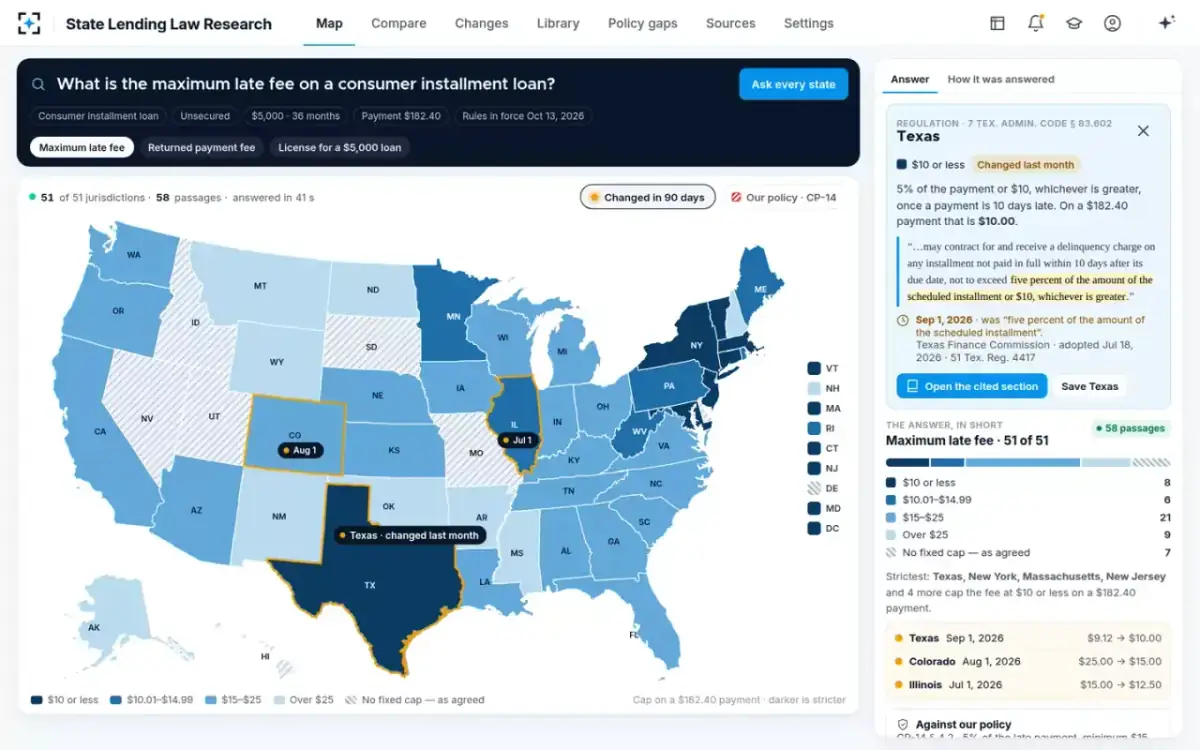
Questions people ask
Can a Florida consumer finance lender charge a late fee on day 10?
Not under section 516.031(3)(a)9, which allows the charge only for a payment "in default for at least 12 days" and only if the charge was agreed in writing beforehand. A policy with a 10-day grace period therefore needs a Florida exception for days 11 and 12.
Is Florida's $15 late fee in addition to the interest cap?
Yes. The statute lists delinquency charges alongside interest and insurance charges as permitted. Any charge above the combined total the chapter allows is treated as a violation of Florida's usury chapter.
What happens if a lender overcharges by mistake?
For a bona fide error, the statute requires the licensee to refund or credit the overcharge "immediately but within 20 days after the discovery of such error". Finding the error quickly is what limits the cost. The State Lending Law Research page shows how a changed or misread rule is flagged.
What is the Florida Consumer Finance Act?
It is chapter 516 of the Florida Statutes, which section 516.001 names the "Florida Consumer Finance Act". It requires a licence to make consumer finance loans and lets a licensee lend up to $25,000 at rates above Florida's general 18% limit.
Does Florida's $15 late-fee cap apply to car loans?
Not to a car bought on a retail installment contract from a dealer, which falls under chapter 520 and its own charges. The $15 cap binds chapter 516 consumer finance loans. A bank lending in Florida may instead charge what its home state allows.
Can a Florida consumer finance lender charge a prepayment penalty?
No. Section 516.031(6) says a licensee "may not require a borrower to pay a prepayment penalty" for paying all or part of the principal early. A fee schedule built for a national product that includes one needs a Florida exception.