Late fee limits by state are set loan type by loan type, and there is no national late fee for consumer installment loans. Each state that regulates the charge writes its own rule, and the rules differ in four ways at once: the amount, the form of the amount (flat, a percentage, or the greater or lesser of the two), how many days late a payment must be before the fee is allowed, and which loans the rule covers. Rate caps vary even more. For a national lender's compliance team this means that "what is the most we can charge?" has dozens of different answers. Each answer is only as good as its citation and the date it was last checked. Botminds' State Lending Law Research is built for this kind of question: it asks every state at once, works each cap out on the lender's own reference payment, and cites every answer to the section it comes from.
One $500 loan, many legal maximums: state APR caps from 16% to 305%
Why no single late fee works in every state
A uniform fee breaks wherever a state is stricter than the fee, and a national fee schedule has to clear the strictest state. That is the arithmetic a product team runs into the first time it tries to print one late fee on every contract. Set the fee high enough to matter in the states that allow $25 or more and it breaks the cap in the states that allow $10. Set it at the lowest cap and the lender gives up revenue in most of the country. The usual answer is a house rule with a schedule of state exceptions, which only works if someone knows exactly where each state's line sits.
The variation is documented, not anecdotal. When the Conference of State Bank Supervisors surveyed the consumer-loan laws of the 50 states and DC, every entry verified by the state's own regulator, it found that "no state has a minimum loan amount, and the maximum ranges from $1,500 to $92,500", that 7 states require an in-state physical presence and that 13 states' laws reach commercial small-business lending (CSBS, February 2020). The same survey covers "statutorily mandated loan terms and limits on fees and charges", the part of the law a fee schedule has to clear.
Rate caps show the spread most clearly, because one organisation has charted them on a common loan. The National Consumer Law Center found that "45 states and DC cap the rate on a $500, six-month loan; 43 states plus DC do for a $2,000, two-year loan; and 42 states plus DC do so for a $10,000, five-year loan" (NCLC, December 2025). The median cap in states with one falls as the loan grows, from 39.5% on the $500 loan to 34% on the $2,000 loan and 27% on the $10,000 loan. A product that changes size changes its legal ceiling, state by state.
Four ways a state writes a late-fee rule
A late-fee rule is defined by four things: the amount, its form, the delay before it may be charged and the conditions attached. A table that keeps only the amount drops the other three, and those three are often where a fee goes wrong. The form matters most for arithmetic. "5% or $10, whichever is greater" and "5% or $10, whichever is less" give very different fees on the same payment, and which one applies depends on the exact words of the rule.
The same question, four different shapes of answer
| What varies | What the rule can say | Why a summary loses it |
|---|---|---|
| Amount and form | A flat dollar cap; a percentage of the late installment; or the greater or the lesser of the two. | On a $182.40 payment, 5% is $9.12. "Greater of 5% or $10" allows $10.00; "lesser of" allows $9.12. |
| Delay before the fee | A payment must be late for a stated number of days, such as 10, 12 or 15. | A policy grace period shorter than the state's makes the fee unlawful on the days between. |
| Frequency of payment | Separate caps for monthly, semimonthly and biweekly payments. | A biweekly product read against the monthly cap is overcharged twice a month. |
| Conditions | The fee must be agreed in writing; once per installment; not on a payment late only because of an earlier late fee. | A lawful amount charged without the written agreement, or charged twice, is still a violation. |
Florida is a useful example because its rule is precise. Section 516.031 allows "a delinquency charge for each payment in default for at least 12 days if the charge is agreed upon, in writing, between the parties before imposing the charge". The charge "may not exceed $15" for monthly payments, $7.50 for semimonthly ones, and for payments every two weeks $7.50 or $5, depending on whether two or three payments fall in the same calendar month (Fla. Stat. § 516.031). The same section caps interest at 36% a year on the first $10,000 of principal, 30% on the next $10,000 and 24% up to $25,000. A one-line summary such as "Florida: $15" is right about the amount and wrong on three of the four things that make a fee lawful. One late-fee cap, from Florida's statute to your fee policy follows that number through every step to a signed policy.
One state's late-fee rule, in four numbers
$15
most a Florida consumer finance lender may charge on a late monthly payment
12days
a payment must be in default before the charge is allowed
$7.50
cap on a semimonthly payment, or a biweekly one with two payments in the month
$5
cap on a biweekly payment in a month with three payments due
Is there a legal limit on late fees for every kind of loan?
No. Whether a late fee has a legal limit, and who sets it, depends on the product and the lender before it depends on the state. A state's consumer finance or small-loan act usually sets the limit for installment loans by licensed lenders. Sales financed by the seller, such as a car bought on a retail installment contract, often sit in a different chapter with different charges. Some mortgages and all credit cards answer to federal rules first. A fifty-state answer that mixes these products gives a product team the wrong number for some of its loans.
Florida shows the split inside one state. A chapter 516 consumer finance licensee may charge $15 on a late monthly payment. A motor vehicle retail installment contract falls under chapter 520 instead, which caps the finance charge by the age of the car, from "$10 per $100 per year" on a current-model new car to "$17 per $100 per year" on a used car more than four years old (Fla. Stat. § 520.08). A lender outside both chapters falls back on the general usury statute, under which interest above "the equivalent of 18 percent per annum simple interest" is usurious on loans up to $500,000 (Fla. Stat. § 687.02). Three chapters, three answers, one state.
Who sets the late-fee limit depends on the loan before the state
| Product | Where the limit usually comes from | An example of the rule |
|---|---|---|
| Installment loan from a state-licensed lender | The borrower's state consumer finance or small-loan act | Florida: $15 on a monthly payment, only after 12 days in default |
| Car or goods bought on a retail installment contract | The state's retail installment sales act, often a separate chapter | Florida ch. 520 sets finance charges per $100 by vehicle age |
| High-cost mortgage (HOEPA) | Federal Regulation Z, on top of state law | No more than 4% of the past-due payment, and only after 15 days |
| FHA-insured or VA-guaranteed mortgage | The federal program rule, on top of state law | 4% of a payment more than 15 days late |
| Credit card | Federal Regulation Z for penalty fees | A late fee must meet 12 CFR 1026.52(b) |
| Loan from a national or state bank | Often the bank's home state, which it may export | See the preemption branches before reading any state cap |
Mortgage late fee laws by state, and the federal 4% rules beneath them
For many mortgages, a federal rule sets a 4% ceiling and a 15-day wait before any state's rule is read. On a high-cost mortgage under HOEPA, a late charge "may not exceed 4 percent of the amount of the payment past due", and it may be imposed "only if the payment is not received by the end of the 15-day period beginning on the date the payment is due" (12 CFR 1026.34(a)(8)). An FHA-insured mortgage may provide for "a late charge, not to exceed four per cent of the amount of each payment more than 15 days in arrears" (24 CFR 203.25), and the VA allows "a late charge not in excess of an amount equal to 4 percent of any installment paid more than 15 days after due date" (38 CFR 36.4212(d)).
The arithmetic shows why the form of a rule matters more than its headline. On a $1,800 mortgage payment, 4% allows $72. On the $182.40 installment payment used throughout this guide, the same 4% would allow $7.30, less than half of Florida's flat $15 for a consumer finance loan. State mortgage rules then sit on top: a state may set a lower percentage, a longer wait or a dollar cap, so a mortgage servicer's fifty-state answer is the stricter of the federal program rule and each state's. Credit cards work differently again. Their penalty fees answer to a federal rule, 12 CFR 1026.52(b), which says a card issuer "must not impose a fee for violating the terms" of the account unless the amount meets its limits (12 CFR 1026.52).
Rate caps run from 16% to 305% on the same small loan
On a $500 six-month loan, the legal maximum APR runs from 16% in North Carolina to 305% in Mississippi, and two states set none. The chart above takes a selection from NCLC's state list. Ten states sit at exactly 36%, the level the fact sheet calls "a widely-accepted maximum rate for small loans". The upper end runs through Texas at 116%, Virginia at 129% and Ohio at 145%. Rates also move differently as the loan grows. The $10,000 five-year loan is capped in fewer states, at a lower median.
Two kinds of caps need watching more than the rest. Tiered caps, like Florida's 36%, 30% and 24% bands, give a blended maximum that depends on the principal, so the answer for a $5,000 loan is not the answer for a $15,000 one. Indexed caps move without any change to the statute. California's Financing Law limits loans of $2,500 to $9,999 to "36 percent per annum plus the Federal Funds Rate", read from the Federal Reserve's H.15 release on the first day of the month before the loan is made (California DFPI). Washington's general usury limit is the higher of 12% or four points over the 26-week Treasury bill (RCW 19.52.020). A table of these states built in January can be wrong by March. How often do state lending laws change looks at how a saved answer ages.
Rates are not the only thing that differs by state. The returned-payment fee, the fee for a payment by phone, the prepayment penalty and the right to cure before repossession each have their own fifty-state map, and a product team usually needs several at once. The library in the sample run of the solution keeps separate saved answers for the maximum late fee, the grace period before a late fee, the maximum returned payment fee and the APR on a $2,000, 24-month loan, each cited state by state.
Are late fees interest? Two answers in federal law
It depends on which law is asking. For the federal Truth in Lending disclosure, a late fee is not a finance charge. For the National Bank Act's rate rule, it is interest. The difference decides whether a state late-fee cap binds a given lender at all, which is why it matters for any fifty-state answer.
The same late fee, read by two federal rules
Truth in Lending (Regulation Z): The finance charge excludes "charges for actual unanticipated late payment, for exceeding a credit limit, or for delinquency, default, or a similar occurrence."
National Bank Act (12 CFR 7.4001): "Interest" under 12 U.S.C. 85 includes, among other things, "late fees, creditor-imposed not sufficient funds (NSF) fees ... overlimit fees, annual fees".
Truth in Lending (Regulation Z): A late fee does not enter the disclosed APR.
National Bank Act (12 CFR 7.4001): Not a disclosure rule. It decides which state's law sets the permitted charge.
Truth in Lending (Regulation Z): None. A state cap on late fees still applies to the lender it covers.
National Bank Act (12 CFR 7.4001): A national bank may charge the late fee its home state allows, to borrowers in other states.
Truth in Lending (Regulation Z): Every creditor that discloses under TILA.
National Bank Act (12 CFR 7.4001): National banks, and by a parallel statute state banks; not state-licensed lenders.
The OCC's definition was upheld by the Supreme Court in Smiley v. Citibank (1996), a case about late fees on credit cards that South Dakota law allowed and California borrowers challenged. The rule has a limit that a fifty-state table must respect: the federal definition "does not change how interest is defined by the individual states ... solely for purposes of state law". So a state-licensed installment lender is not helped by it, and a bank's answer depends on its home state's rule. Are banks exempt from usury laws? works through who the lender is before any state's cap is read.
Reading a fifty-state late-fee table on your own payment
A cap expressed as a percentage, or as the greater or lesser of a percentage and a dollar amount, has no single value. It has a value on a particular payment. A fifty-state table is useful to a product team only when every cap is worked out on the same reference loan, so that "5% or $10, whichever is greater" and "$12 flat" can be compared. The solution keeps that reference loan in its settings and works every state's cap out on it.
The late-fee answer as 51 rows, each cap worked out on one payment
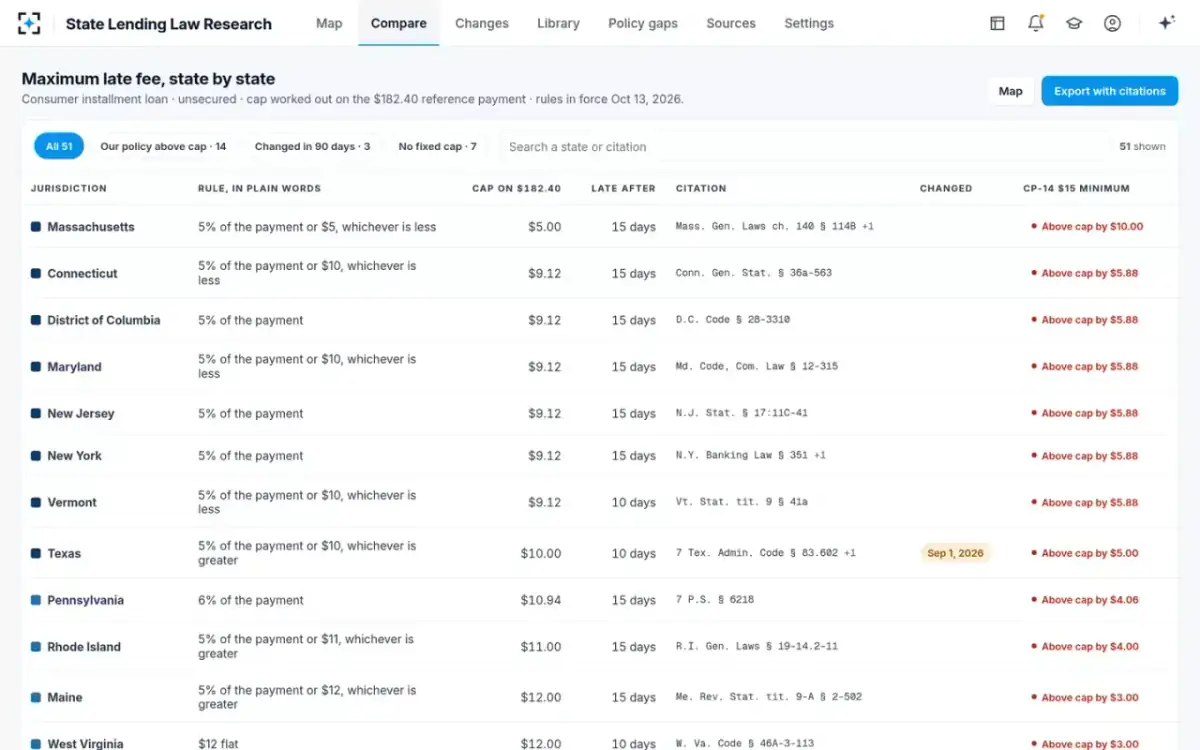
Look at the rule column. Two rows can show the same cap from rules with different wording, and only the wording tells you what happens on a larger payment.
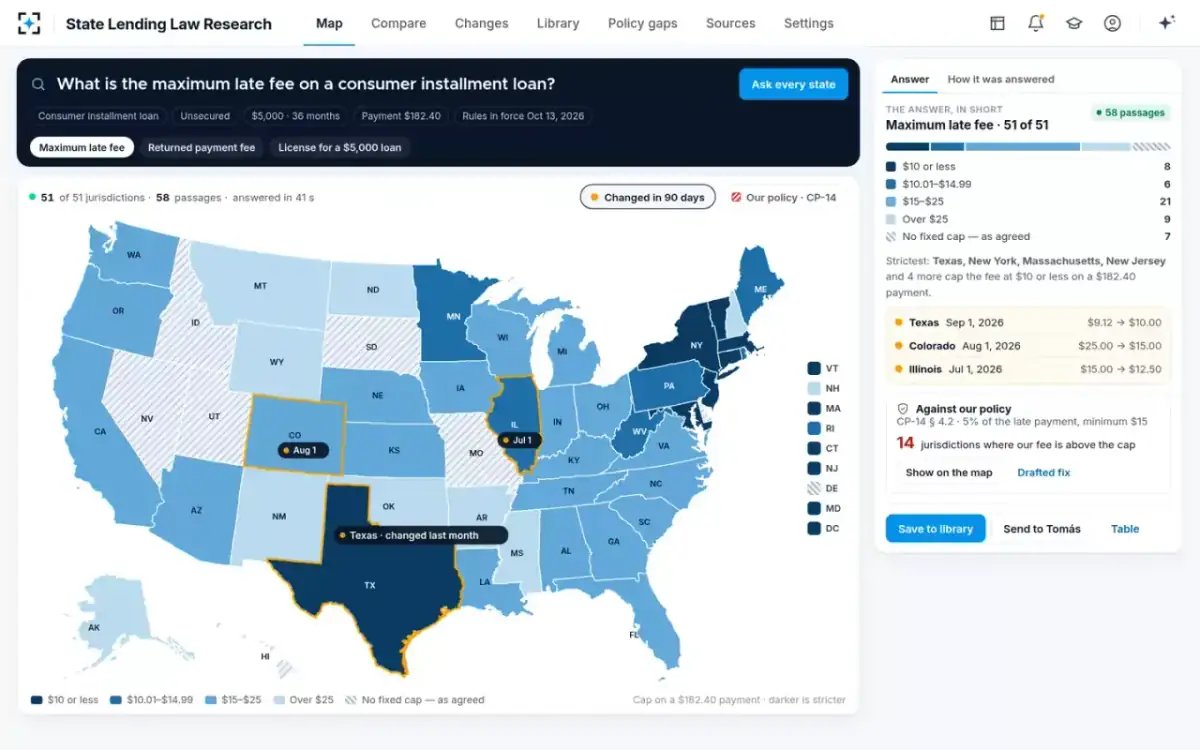
In that sample run, a question about the maximum late fee on a consumer installment loan ($5,000 over 36 months, payment $182.40) came back in 41 seconds for all 51 jurisdictions. Eight capped the fee at $10 or less on that payment, six between $10.01 and $14.99, 21 between $15 and $25, nine above $25, and seven set no fixed amount beyond what the contract states. Every cap carried its passage, and a separate checker read each answer back against it: 58 passages, 58 supported. Those figures describe the sample, not any real state's law. The method is what transfers: the same payment, the exact wording, a citation per state.
State Lending Law Research: the answer as a map, coloured by how strict each state is
Keeping a fifty-state table true after it is built
A fifty-state table goes out of date from the moment it is saved. States amend statutes and administrative rules on their own calendars, indexed caps move with market rates, and a court decision can change which state's law applies. We found no government or academic source that counts how often state consumer-lending rules change, so a compliance team cannot plan on a known rate of change. It has to watch every section it relies on.
Five habits that keep a state-by-state answer usable
- Cite the section, not the summary
Every row names the statute or rule section and quotes the passage, so a reviewer can check it in a minute.
- Date every answer
Record the date the rules were read ("rules in force on") as well as the date the answer was saved.
- Keep the arithmetic with the cap
Store the reference payment and the "greater of / lesser of" working, so the cap can be recomputed for a new product.
- Record who the lender is
A national bank, a state bank and a licensee can get three different answers to the same question.
- Watch the sections, not the topic
When a section you cited changes, every saved answer and policy that rests on it needs to be marked for review.
The State Lending Law Research page shows how the answer, its citations and the change watch fit together. Late fees are one question among many that a compliance team answers each week. They show the problem clearly because their caps are small, precise numbers, and charging more than the cap leads to refunds.
Questions people ask
Which states have a 36% interest rate cap?
On NCLC's December 2025 chart for a $500, six-month loan, ten states sit at exactly 36%, among them Illinois, Iowa, Oregon and South Dakota, while Maryland sits just below at 33% and Massachusetts, West Virginia and Washington just above. The list changes with the loan size, so check the chart for the amount and term you lend.
Is a returned payment fee limited the same way as a late fee?
Often not. Where a state limits it, the returned-payment or NSF fee usually sits in a different section, with its own amount and conditions, so it needs its own fifty-state answer. Florida's consumer finance act, for instance, allows a bad check charge of "not more than the greater of $20" or the bank's actual charge to the lender. For national banks, the OCC's definition of interest names creditor-imposed NSF fees alongside late fees.
Can one fee schedule cover every state?
Only as a house rule with a list of state exceptions. A single uniform fee has to sit at or below the lowest state cap on every payment size the product uses. Most lenders instead set a standard fee and cap it, in the listed states, at the most each state allows.
Is a 5% late fee legal?
It depends on the cap it meets. Against a flat $15 cap such as Florida's for monthly consumer finance payments, 5% is within the limit on any payment up to $300 and above it on larger ones. On an FHA, VA or high-cost mortgage, 5% is over the federal 4% ceiling on every payment.
Can a lender charge a late fee the day after the due date?
Not where a rule sets a waiting period. Florida's consumer finance act requires a payment to be in default for at least 12 days, and the federal mortgage rules above wait 15 days. A policy grace period shorter than the state's makes every fee charged in between unlawful.