A 50-state survey of consumer finance laws sets out, for every state and DC, what a consumer lender must do and may charge, and the one most compliance teams start from is the free, regulator-verified survey kept by the Conference of State Bank Supervisors. It stops at the statute, though, and a lender's own questions start where it stops. A fifty-state survey done in house costs the analyst hours to find, read and tabulate fifty-one jurisdictions, plus counsel's review, plus the cost of doing it again when a rule changes. By our estimate, one fifty-state question takes an experienced analyst about seven and a half hours by hand before counsel sees it. At Bureau of Labor Statistics wages loaded for benefits, that is close to $500 of analyst time per question. A team answering a few such questions a week spends the equivalent of a full-time compliance officer on transcription. We found no government, academic or non-profit benchmark for these hours or for outside counsel's price, so this guide gives a method rather than a figure. Botminds' State Lending Law Research is priced against the same method.
The annual return on fifty-state research, as a sum you fill in
Analyst hours released
Q × (h₀ − h₁) × analyst rate
Q fifty-state questions a year; h₀ hours each by hand, h₁ with agents; loaded hourly rate.
Compliance, from a month of logged questions
Counsel hours released
Q × (c₀ − c₁) × counsel rate
Review time per answer before and after the passages arrive with it.
Legal
Surveys not bought
n × invoice
Outside surveys you would otherwise commission, at your own invoices.
Finance, from last year's legal spend
What it costs to run
− subscription − setup − review
The solution, the setup work, and the review time you keep.
Procurement and compliance
What is a 50-state survey?
A 50-state survey is a table that answers one legal question for every state, usually with DC, and cites the law behind each answer. In consumer lending the question is typically a licence trigger, a rate cap, a fee limit or a required notice. Surveys come from three places: regulators and their associations, which publish a few broad ones; outside counsel and research services, which sell them; and the lender's own compliance team, which builds the ones nobody else has for its product. They share one weakness, which is that each answer is only as current as the day its state was last read.
What does the CSBS 50-state survey of consumer finance laws cover?
It covers who needs a consumer loan licence and what the licence demands, state by state. The survey "identifies state licensing and lending requirements for 'consumer loans,' however that may be defined by state statutes", including "which business activities trigger a consumer loan license and whether the statute applies to commercial lending", "major license requirements, statutorily mandated loan terms and limits on fees and charges". Its information "has been reviewed and verified by the appropriate state regulatory authority" (CSBS, 50-State Survey of Consumer Finance Laws). When it launched in 2020, CSBS reported that 29 states managed consumer loan licences through NMLS (CSBS, February 2020).
Its limits are stated just as plainly. "Payday, title lending, retail installment lending, and other more targeted license types are not included in the research", and state information is refreshed once a year. A lender that sells a retail installment product, or needs this month's cap under an indexed rule such as California's 36% plus the federal funds rate (California DFPI), has to go past it. So does any team that needs the cap worked out on its own payment, or a passage counsel can sign against.
The CSBS survey and an answer built for your product
CSBS 50-state survey: Fixed: licensing triggers, licence requirements, loan terms, fee limits.
A cited answer for your product: Whatever product, collections or licensing asks this week.
CSBS 50-state survey: Consumer loans as each state defines them; not payday, title or retail installment.
A cited answer for your product: Your product, set by its reference loan: amount, term, payment.
CSBS 50-state survey: Each state's regulator.
A cited answer for your product: Your analyst and counsel, against the passage.
CSBS 50-state survey: Updated annually.
A cited answer for your product: As of the date asked; cited sections watched for changes.
CSBS 50-state survey: The rule as written.
A cited answer for your product: The cap worked out on your payment, with "greater of" or "lesser of" applied.
CSBS 50-state survey: Free to read.
A cited answer for your product: Analyst and counsel hours, or a tool, as priced below.
How much does a 50-state survey cost? Why there is no public price
Nobody publishes what this work costs, so a team has to measure its own. The figures quoted in the market come from vendors' customer surveys, and the regulators' own burden estimates cover filings and disclosures, not legal research. What can be sourced is the hourly cost of the people who do the work. The volume and the hours per question have to come from the team's own records. That is why this guide states its method first and its illustration second.
Compliance costs are mostly people, and they weigh most on small institutions. A Federal Reserve Bank of St. Louis study of community banks found that "compliance expenses for personnel were, by far, the largest category in all size groups", and that banks under $100 million in assets spent 8.7% of noninterest expense on compliance against 2.9% at banks of $1 billion to $10 billion (St. Louis Fed, 2016). Fifty-state research is that kind of cost: skilled hours that do not grow less with practice, because every new question means the same fifty-one jurisdictions again.
What an hour of the work costs, from federal wage data
$45.24
mean hourly wage, compliance officers in credit intermediation, May 2025
$112.07
mean hourly wage, lawyers in the same industry
70%
wages as a share of total compensation, private industry, June 2026
$65 · $160
loaded hourly cost of each: wage divided by 0.70
How to do a 50-state survey in house, and how long each step takes
Price one question first, then multiply by volume. Our estimate splits the analyst's work into five tasks: finding each state's controlling section (about three hours), reading it and working out the cap (two), checking for recent amendments (one), building the cited table (one) and checking the lender's own policy against it (half an hour). With the solution, the first four become review of work already done, about six minutes each, and the policy check takes about fifteen minutes.
One fifty-state question: analyst hours and loaded cost (our estimate)
| Task | By hand | With the solution |
|---|---|---|
| Finding each state's controlling section | 3.0 h · $194 | 0.1 h · $6 |
| Reading it and working out the cap | 2.0 h · $129 | 0.1 h · $6 |
| Checking for recent amendments | 1.0 h · $65 | 0.1 h · $6 |
| Building the table with citations | 1.0 h · $65 | 0.1 h · $6 |
| Checking our own policy against it | 0.5 h · $32 | 0.25 h · $16 |
| Analyst total | 7.5 h · $485 | about 0.65 h · $42 |
| Counsel review | your figure × $160 | your figure × $160 |
The tasks shrink by different amounts. Finding and transcribing almost disappear. Checking the policy, the part that needs judgment, shrinks least, because it should. A tool that claimed to cut that line to zero would be claiming to take a decision that belongs to the analyst and counsel. Who answers a fifty-state question sets out who keeps which decision.
Volume decides the answer more than any hourly rate
The cost per question is modest. The annual cost depends on how many fifty-state questions the team answers, and most teams have never counted them. The persona in the solution's sample answers 30 to 40 state-law questions a week across product, collections and licensing, and only some of those are fifty-state. Count a month of your own before using the formula. In practice the honest input is "questions where we needed every state", not "questions about state law".
Analyst hours a year on fifty-state questions by hand, by weekly volume (our estimate)
At four fifty-state questions a week, the analyst time comes to about $93,000 a year, roughly the mean annual wage of a compliance officer in credit intermediation ($94,090 in May 2025). That is a full role's worth of hours spent finding and transcribing. With the solution, on our estimate, the same four questions a week take about 125 analyst hours a year, and the largest share of those goes on checking the policy.
The hidden line: answering the same question again
The formula above counts new questions. Most teams also re-answer old ones, either because nobody can find the earlier answer or because nobody trusts it any more. Both are symptoms of the same gap: answers kept without dates or citations cannot be reused safely. A library of saved answers, each marked current or stale, turns some of those repeats into reuse. In the sample, the team's library holds 186 saved answers, and the one on whether a $5,000 unsecured loan needs a state licence has been reused 12 times.
Add a refresh term if your team re-answers questions on a schedule: the share of saved answers re-checked each year, times the hours per check. With section-level change tracking, only answers whose cited text actually changed need re-checking. How often do state lending laws change covers how they are flagged.
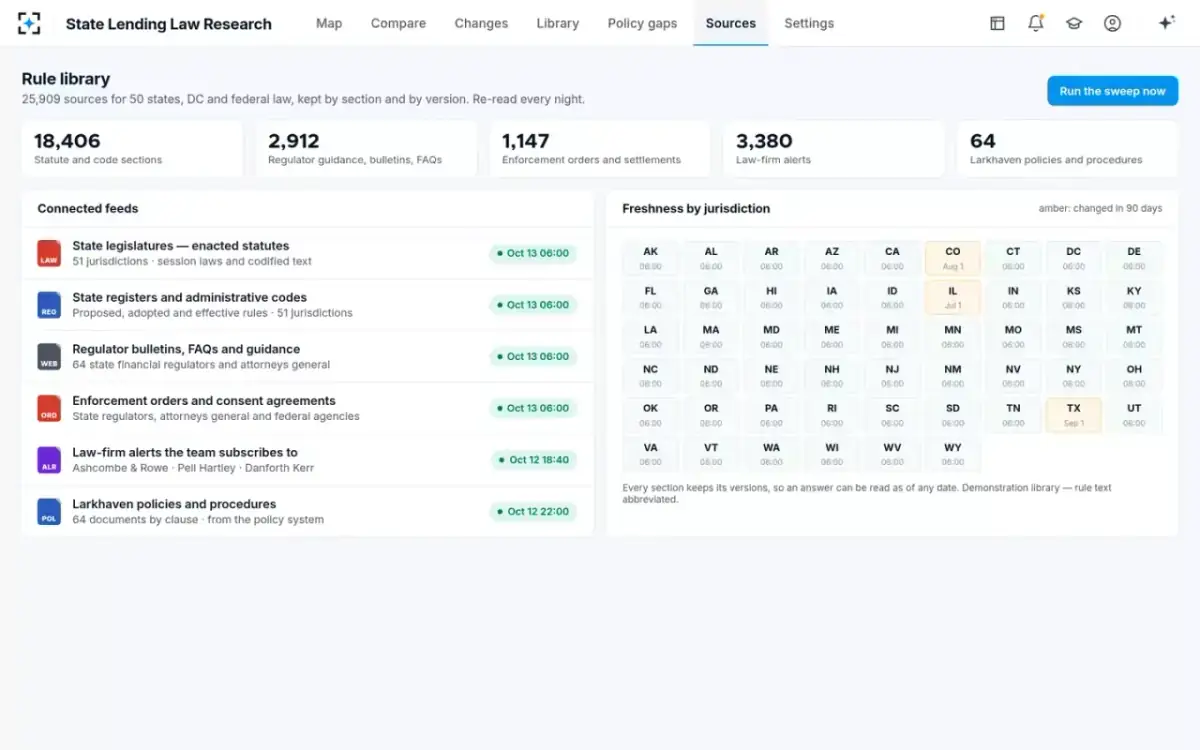
The rule library behind every answer, kept by section and by version
Build, buy or commission: choosing how to get a 50-state survey
The cheapest source that answers your actual question is the right one, and for most questions that is not the same source twice. For licensing triggers in standard consumer lending, start with the CSBS survey; it is verified by the regulators and costs nothing. For a novel or contested question, such as whether a partnership program's loans are made in the borrower's state, commission outside counsel, because what you are buying is an opinion. For the routine, recurring questions in between, the fee caps, grace periods and notice periods on your own products, the cost is analyst time, and that is where the arithmetic above applies.
A research tool belongs only in that middle band, and it should be judged there. Ask whether it answers your product's question rather than a generic one, cites a passage for each state, dates its answers and flags the states it cannot settle. Botminds' State Lending Law Research is built for that band: questions a compliance team asks every week, answered for every state at once, with counsel's review kept in the process.
What to measure in the first month
The return is easy to measure because every term in the formula can be counted. Log every fifty-state question for a month: who asked, how long the analyst spent and how long counsel spent. Run the same month with the solution and log the same three numbers. The difference, priced at your loaded rates, gives the first two terms. Last year's invoices for outside surveys give the third. Test it on questions your counsel already answered sets out a pilot that produces those numbers along with an accuracy check.
Count one thing that does not appear in the formula: how often an answer changed a decision. A survey that arrives after the fee schedule is set has no effect on it. The sample on the State Lending Law Research page went from question to signed exception in nineteen minutes, before the product team had moved on.
Questions people ask
Does the CSBS survey cover usury limits?
CSBS publishes state interest-rate information alongside the survey, covering "maximum rates, penalties, and exceptions to interest rate limits", with links and citations to the full statutes. Like the survey, it describes the rule; working the cap out on your own loan is left to you.
Is it cheaper to have outside counsel do 50-state surveys?
Use your own invoices; we found no government, academic or non-profit benchmark. Outside counsel makes sense for novel or contested questions. Routine questions, such as fee caps and notice periods, are the ones where in-house cost per question matters most, because they come up every week.
Does a 50-state survey include DC and the territories?
Most cover the 50 states and DC; territories are often left out. The CSBS survey covers all 50 states and Washington, DC, as does NCLC's chart of state rate caps. A lender licensed in a territory should check that its survey includes it.
How often should a 50-state survey be updated?
Whenever a section it cites changes, which no fixed schedule captures. CSBS refreshes its survey annually, but an indexed cap such as California's moves monthly, and a court ruling can change whose law applies on any day.
Can AI produce a 50-state survey?
It can do the reading and the arithmetic if each state's answer carries its passage and is checked against it. In the solution's sample run, a late-fee question came back for all 51 jurisdictions in 41 seconds, with 58 of 58 cited passages supported on read-back. Counsel still reviews the answer before it is used.