Banks are largely exempt from state usury laws, though no state law grants the exemption: federal statutes do. Whether a state's usury limit or late-fee cap applies to a loan depends first on who makes the loan. A national bank may charge the interest its home state allows to borrowers in any state, and "interest" here includes late fees. A state-chartered, FDIC-insured bank has the same power by statute unless the borrower's state has opted out. A state-licensed nonbank lender has no such power and must meet each borrower's state law. So the same fifty-state question has three sets of answers. Botminds' State Lending Law Research reads and cites the state rules. This guide covers the step before that: deciding which of those rules reach the lender at all.
Which state lending laws apply? Start with who the lender is
Who makes the loan, and in whose name?
National bank or federal savings association
Rate and fee caps come from
Interest, including late and NSF fees, at the rate its home state allows, charged to borrowers anywhere.
Still subject to
State contract, tort, criminal, debt-collection, property and tax law. Any other state law unless it "prevents or significantly interferes" with a banking power.
12 U.S.C. 85 · 12 CFR 7.4001, 7.4008 · Cantero (2024)
State-chartered, FDIC-insured bank
Rate and fee caps come from
Its home state's rate, exported to other states, under DIDMCA section 521.
Still subject to
The borrower's state where that state has opted out under section 525: Iowa, Colorado (enforcement enjoined while the case is reheard) and, from 2026, Oregon for consumer finance loans.
12 U.S.C. 1831d · CRS LSB11433 (2026)
State-licensed nonbank lender
Rate and fee caps come from
The borrower's state: its licence requirement, its rate cap, its fee caps and its conditions.
Still subject to
Everything. No federal rate rule lifts a state cap for a licensee, so each state where it lends is a separate answer.
Each state's consumer finance or small loan act
A bank and a nonbank together
Rate and fee caps come from
Depends on who is the true lender, which federal rule no longer settles; and on valid-when-made rules for loans the bank sells.
Still subject to
State true-lender challenges. Congress voided the OCC's 2020 true-lender rule in 2021.
Pub. L. 117-24 · 12 CFR 7.4001(e), 331.4(e)
The first question in any fifty-state answer is who the lender is
Federal law gives banks a way out of most state rate limits, and gives licensed nonbanks none. A compliance team therefore has to place the product on the tree before it reads any state's cap. Skip that step and either the analysis is wasted (a national bank that will never be bound by the cap) or it gives false comfort (a partnership program assuming a bank's exportation covers it).
The difference has grown in importance. State-licensed companies are a large part of consumer credit: CSBS counts more than 34,700 companies holding a state licence and another 7,500 with a federal registration, and state-licensed mortgage companies alone originated $1.2 trillion, 61% of US mortgage originations, in 2025 (CSBS Annual Report 2025). In May 2025 the CFPB rescinded its 2022 interpretive rule on state enforcement of federal consumer law, while stating that it was "not altering, limiting, or affecting the authority of States to take any action authorized by any separate provision of State or Federal law" (90 FR 20565). State law and state enforcement are where the risk now sits for most nonbank lenders.
Branch 1: national banks export their home state's rate, late fees included
A national bank may charge interest at the rate its home state allows, whatever the borrower's state says. Section 85 of the National Bank Act lets it "charge on any loan ... interest at the rate allowed by the laws of the State, Territory, or District where the bank is located", or one point over the 90-day commercial paper discount rate if that is greater (12 U.S.C. 85). The OCC's rule defines interest broadly, to include "late fees, creditor-imposed not sufficient funds (NSF) fees ... overlimit fees, annual fees, cash advance fees, and membership fees" (12 CFR 7.4001(a)). The Supreme Court upheld that definition in 1996, in a case where California cardholders challenged late fees that the bank's home state allowed (Smiley v. Citibank).
For loans not secured by real estate, the OCC goes further. Its rule lets a national bank lend "without regard to state law limitations concerning" licensing, "the terms of credit", "disclosure and advertising", "disbursements and repayments" and "rates of interest on loans". The same rule names the state laws that still apply: "(1) Contracts; (2) Torts; (3) Criminal law; (4) Rights to collect debts; (5) Acquisition and transfer of property; (6) Taxation; (7) Zoning" (12 CFR 7.4008(d)–(e)). That second list matters to collections teams: a state's rules on how a debt may be collected can still reach a national bank's borrower.
What did Cantero v. Bank of America decide, and what does it leave to the states?
Outside the rate rule and the OCC's lists, preemption depends on the facts, and there is no bright line. In Cantero v. Bank of America (2024) a unanimous Supreme Court held that the National Bank Act preempts a state law only if it "prevents or significantly interferes with the exercise by the national bank of its powers", under the standard of Barnett Bank, and it rejected a test "that would preempt virtually all state laws that regulate national banks" (Cantero, 602 U.S. 205).
A court applying that standard must make a practical assessment of the nature and degree of the interference caused by a state law.
Cantero v. Bank of America, N.A., 602 U.S. 205 (2024)
For a bank's compliance team, Cantero means that state law research cannot stop at "we are a national bank". A state rule on escrow interest, on notice before a fee, or on a disclosure the OCC's list does not cover may still apply, case by case. The answer to "does this state's rule bind us?" becomes an assessment that counsel signs, built on a cited reading of the state text. That reading is the part a fifty-state research tool can do, and the assessment stays with counsel. When the statute is unclear covers how that handoff should work.
Branch 2: state banks borrow the same power, unless the borrower's state opts out of DIDMCA
A state-chartered, FDIC-insured bank may also charge its home state's rate across state lines. Section 521 of DIDMCA, codified at 12 U.S.C. 1831d, lets it charge "notwithstanding any State constitution or statute which is hereby preempted" the greater of one point over the discount rate "or ... the rate allowed by the laws of the State ... where the bank is located" (12 U.S.C. 1831d). Section 525 lets a state opt out for loans "made in" that state, and that is where the branch splits.
The DIDMCA opt-out, as of the CRS's May 2026 analysis
3states
exercising the opt-out: Colorado, Iowa and, from April 2026, Oregon for consumer finance loans
2-1
Tenth Circuit panel vote (November 2025) that a loan is made in Colorado if the borrower is there; since vacated
Apr 2
2026: rehearing en banc granted; the district court's injunction against Colorado stays in effect meanwhile
The live dispute is Colorado's. In 2023 Colorado opted out "with respect to consumer credit transactions in the state" and announced it would enforce its rate limits on out-of-state state banks lending to Colorado borrowers. A district court enjoined that in 2024. A Tenth Circuit panel reversed 2-1 in November 2025, and on April 2, 2026 the full court granted rehearing, vacating the panel decision, so "the district court's preliminary injunction remains in effect" (CRS, May 2026). The CRS adds that Rhode Island "is also considering DIDMCA opt-out legislation". We found no en banc ruling as of late October 2026. A saved answer about Colorado therefore has to say which version of the law it assumes. How often do state lending laws change covers how to keep an answer like that marked for review.
Branch 3: licensed lenders live inside each state's law
A state-licensed nonbank lender gets no federal rate preemption, so every borrower's state applies in full: whether a licence is needed, the rate cap, the fee caps, the delay before a late fee and the conditions on each charge. This is the branch where a fifty-state question has fifty-one answers. It is also where the consequences of a wrong answer land, because a state regulator can order refunds. In June 2026 California's DFPI ordered Navitas Credit Corp. to pay a $4 million penalty for unlicensed lending and to "refund money to borrowers who were charged excessive interest on loans of less than $5,000" made between March 2018 and June 2026 (DFPI, June 2026).
The same late-fee question, answered on each branch
| Lender | Whose late-fee rule binds a borrower in another state | What the research must cover |
|---|---|---|
| National bank | The bank's home state, because the late fee is interest under 12 U.S.C. 85. | The home state's rule, plus any state rule outside the rate power that may survive a Cantero assessment. |
| State bank | Usually the bank's home state; the borrower's state if it has validly opted out for that loan. | The home state, the opt-out states, and the status of the Colorado litigation. |
| Licensed nonbank | The borrower's state, in every state where it lends. | Every jurisdiction in scope: the full fifty-state answer. |
| Partnership program | Contested: the bank's state if the bank is the true lender; otherwise the borrower's. | Both, and the facts a court would weigh on who the lender really is. |
In which circumstances do state usury laws not apply?
State usury laws give way wherever a federal statute sets the rate instead, and banks are only the best-known case. Federal savings associations have their own exportation clause: they may charge "at the rate allowed by the laws of the State in which such savings association is located" or one point over the discount rate, "whichever is greater" (12 U.S.C. 1463(g)). Federal credit unions have the opposite arrangement, a federal ceiling. The Federal Credit Union Act sets a rate that "may not exceed 15 per centum per annum" unless the NCUA board sets a higher one (12 U.S.C. 1757), and in February 2026 the board kept its temporary 18% ceiling in place until September 10, 2027 (NCUA, February 2026).
Two exemptions turn on the loan rather than the lender. Section 501 of DIDMCA says state laws "expressly limiting the rate or amount of interest, discount points, finance charges, or other charges" do not apply to loans "secured by a first lien on residential real property" made after March 31, 1980, unless the state opted out by April 1983 (12 U.S.C. 1735f-7a). And states write exemptions into their own usury statutes. Florida's 18% general limit does not apply to loans made under an FHA insurance commitment, a VA guaranty or a commitment by Fannie Mae, Ginnie Mae or Freddie Mac to buy the loan (Fla. Stat. § 687.03(2)).
Where a federal or state rule sets the rate instead of the usury statute
| Lender or loan | What sets the maximum rate | Source |
|---|---|---|
| National bank | The rate its home state allows, charged anywhere; late and NSF fees count as interest | 12 U.S.C. 85; 12 CFR 7.4001 |
| FDIC-insured state bank | Its home state's rate, unless the borrower's state opted out under section 525 | 12 U.S.C. 1831d |
| Federal savings association | Its home state's rate, or one point over the discount rate if greater | 12 U.S.C. 1463(g) |
| Federal credit union | A federal ceiling: 15% by statute, 18% by NCUA board action until September 10, 2027 | 12 U.S.C. 1757; NCUA |
| First-lien residential mortgage | No state rate limit, unless the state opted out of DIDMCA section 501 by 1983 | 12 U.S.C. 1735f-7a |
| State-licensed nonbank | The borrower's state, in full: licence, rate cap, fee caps and conditions | Each state's consumer finance act |
The pattern matters for research. When a state usury limit "does not apply", it is usually because something else sets the limit, not because there is none. A federal credit union lending at 20% in a state with a 36% consumer cap is still over its own federal ceiling. A national bank's home-state rate still has a statute behind it. A fifty-state answer should record which rule it treated as controlling for each lender, so the reader can tell an exemption from a gap.
Partnership loans and the gaps between the branches
When a bank originates a loan that a nonbank markets, services or buys, the branches overlap, and federal rules settle less than they used to. In October 2020 the OCC adopted a rule saying a national bank was the true lender if it was named in the loan agreement or funded the loan. Congress disapproved it in June 2021, and the rule "shall have no force or effect" (Pub. L. 117-24). Who the lender is in a partnership is again a question for courts and state regulators, decided on the facts.
What survives is the valid-when-made rules, which deal with transfer, not with who the lender is. The OCC's says interest permissible under section 85 "shall not be affected by the sale, assignment, or other transfer of the loan" (12 CFR 7.4001(e)). The FDIC's says permissibility "is determined as of the date the loan was made" and is not affected "by a change in State law, a change in the relevant commercial paper rate after the loan was made, or the sale, assignment, or other transfer of the loan" (12 CFR 331.4(e)). They help a buyer of a bank's loan. They do not make a nonbank's own loan a bank loan.
Before reading any state's cap, settle these five facts
- Charter of the lender of record
National bank, federal savings association, state bank (FDIC-insured or not), credit union, or licensee.
- Where the bank is located for this loan
Its home state sets the exportable rate; branch and loan-decision locations can complicate the answer.
- Who really bears the economics
If a nonbank buys most of the loans or takes most of the risk, expect a true-lender question.
- Whether the borrower's state opted out
Iowa, Colorado and Oregon, with Colorado's reach under review by the Tenth Circuit.
- Whether the product is secured by real estate
The OCC's non-real-estate list in 12 CFR 7.4008 does not cover mortgages, which have their own rule.
Where State Lending Law Research fits on the tree
The solution answers the state-law question for the jurisdictions in scope, cited to each section. It does not decide preemption, and it should not. Its settings record the facts every question assumes: the product, the reference loan and the jurisdictions where the lender is licensed. In the sample run, the fictional lender Larkhaven Financial is a state-licensed installment lender in all 50 states and DC, so every state's rule applies and every one is answered.
Settings: what every question in State Lending Law Research assumes
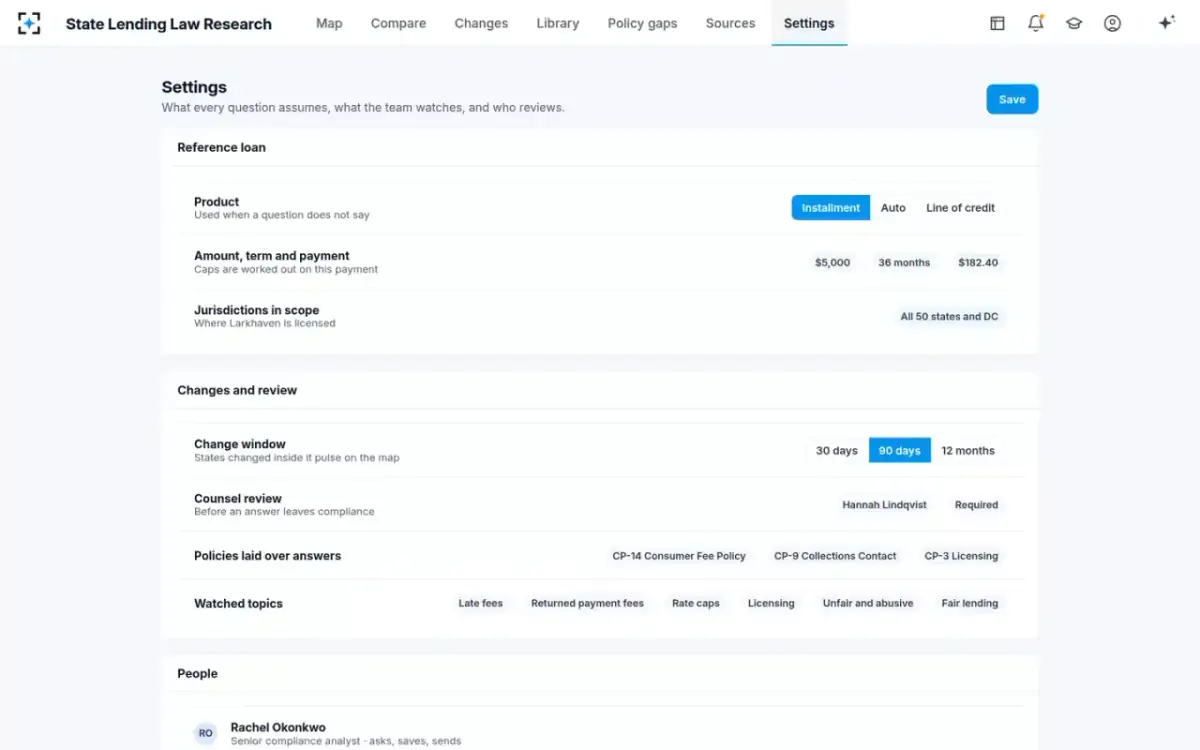
For a bank, the tree changes what is asked rather than how. A national bank's team might ask what its home state allows and then, for a particular product, which borrower states have a rule on a subject outside the OCC's list. A partnership program might ask the full fifty-state question because it cannot rely on exportation. Either way the answers carry their passages, so counsel's preemption memo and the state reading it rests on are kept together. The State Lending Law Research page shows the whole flow. Late fee limits by state shows what the licensee's branch looks like when every state is read.
Questions people ask
Can a national bank charge a late fee above the state limit?
Yes, if its home state allows that fee. Late fees are interest under 12 U.S.C. 85 as the OCC defines it, and the Supreme Court upheld that definition in Smiley v. Citibank. The fee must still be lawful under the home state's law.
Does 12 CFR 7.4008 preempt state licensing laws?
For a national bank's non-real-estate loans, yes: the rule lists state limits on "licensing, registration ... filings, or reports by creditors" as ones the bank may disregard. It gives nothing to a nonbank that buys or services those loans, which may need its own state licences.
What is interest rate exportation?
A bank charging borrowers in other states the rate its own home state allows. National banks have the power under 12 U.S.C. 85, and FDIC-insured state banks under 12 U.S.C. 1831d, subject to state opt-outs under section 525 of DIDMCA.
Do usury laws apply to credit cards?
A bank-issued card is priced under the bank's home-state rate, which it may charge cardholders anywhere. That is why Smiley v. Citibank turned on South Dakota law for California cardholders. Card penalty fees also answer to a federal rule, 12 CFR 1026.52(b), whatever the state.
Do usury laws apply to personal loans from online lenders?
If the lender is a state-licensed nonbank, yes: each borrower's state cap applies in full. If a bank originates the loan and a nonbank markets or buys it, the answer turns on who the true lender is, which no federal rule settles since Congress voided the OCC's 2020 rule in 2021.
Do usury laws apply to large business loans?
Often in a reduced form. In Florida, the 18% general limit stops at $500,000. Above that, a loan is usurious only above the criminal-usury rate, which starts at more than 25% a year and becomes a felony above 45% (Fla. Stat. § 687.071).