State laws change often enough that a saved answer to a state lending-law question is correct only as of the day its sources were read. State legislatures and regulators amend lending rules on their own calendars, and one Florida section alone has been amended four times since 2013. Some rate caps are tied to a market index and change without any amendment, and court cases can change which state's law reaches a loan. No government or academic source we found counts how often state consumer-lending rules change, so a compliance team cannot plan around an expected rate. It can only watch the sections it relies on. Botminds' State Lending Law Research does this for every section it cites: it compares each version nightly and marks any saved answer that relied on old text as stale.
One saved answer, two ways of finding out it went stale
- CurrentJun 2 – Jul 1
- Stale, and nobody knowsJul 1 – Oct 13
- CurrentJun 2 – Jul 1
- Marked stale, owner toldfrom Jul 2
How often do state lending laws change?
Often enough that any fifty-state answer older than a few months should be treated as unverified, and for indexed caps the period is shorter. We found no government or academic count of state lending-law changes; the federal rulebook, published in one register, is far easier to count than fifty legislatures and their regulators. A single section shows the pace. The history note under Florida's consumer finance rate section, 516.031, lists amending acts from 2013, 2018, 2022 and 2024 (Fla. Stat. § 516.031), so a Florida answer saved in 2017 has been overtaken at least three times. What can be described exactly is the ways an answer goes stale, and several of them involve no change to the statute at all.
Supervisors expect this to be managed. The OCC's handbook on compliance management says "management should have a process to identify laws and regulations applicable to the bank's activities and stay abreast of evolving regulatory requirements", with formality "commensurate with the bank's size, complexity, and risk profile" (OCC, Compliance Management Systems). For a multistate lender, part of that process is knowing which saved answers rest on which version of which state's text.
Five ways a saved answer goes stale, most without an edit
| How it changes | A real example | What the saved answer needs |
|---|---|---|
| The section is amended | Legislatures and regulators amend consumer finance acts and their rules on their own calendars, with their own effective dates. | The version and effective date of each cited section, compared against the current text. |
| A cap follows a market rate | California: 36% a year plus the Federal Funds Rate for loans of $2,500 to $9,999, reset monthly. | The month and index value the cap was worked out on. |
| A dormant trigger wakes | Washington: 12%, or 4 points over the 26-week T-bill when that is higher, which last happened in the early 1980s. | The trigger, written down, so the answer is rechecked if rates move. |
| A court changes whose law applies | Colorado's opt-out from rate exportation, enjoined since 2024 and now before the full Tenth Circuit. | The assumption the answer makes about the case, and a note to revisit it. |
| Federal guidance is withdrawn | The CFPB withdrew dozens of guidance documents on May 12, 2025, and rescinded its rule on state enforcement days later. | The guidance the answer cites, so a withdrawal reaches it too. |
When do new state laws take effect?
On the date each act names, or on a default date the state's constitution sets, and the two can be months apart from the day the law passed. Florida's constitution says "each law shall take effect on the sixtieth day after adjournment sine die of the session of the legislature in which enacted or as otherwise provided therein" (Fla. Const. art. III, § 9). Its regular session convenes in March in odd-numbered years and in January in even-numbered ones, so the enacted date, the default date and a date the act sets for itself can all differ.
For research the distinction is practical. An answer must apply the text in force on the date that matters to the loan, which is not always the date the question is asked. An amendment passed in spring with a later effective date means a saved answer is right today and wrong on a known future day, and the answer should carry both versions until then. Some amendments also say which loans they reach. When Florida amended its general usury limit in 1979, the statute said the change applied "only to loans, advances of credit, or lines of credit made on or subsequent to July 1, 1979", with defined exceptions for loans whose rate could later be adjusted (Fla. Stat. § 687.02(2)).
A cap pegged to a market rate moves without an amendment
California's cap on mid-size consumer loans moves every month even though the statute does not change. For consumer loans of at least $2,500 and under $10,000, a California finance lender "may not contract for or receive charges at a rate exceeding annual simple interest of 36 percent per annum plus the Federal Funds Rate". The rate is the one the Federal Reserve publishes in its H.15 release, "in effect on the first day of the month immediately preceding the month during which the loan is consummated" (California DFPI). A saved answer reading "36% plus the funds rate" is correct, but the number a product team actually needs is different for loans made in different months.
Washington shows the other kind of index, one that rarely moves. Its general usury limit is the higher of 12% or "four percentage points above" the 26-week Treasury bill yield (RCW 19.52.020). The state regulator explains that the bill rate "has remained below 8%, so that Washington State's maximum interest rate under the general usury law has effectively been 12%", and that in the early 1980s the limit briefly allowed more than 21% (Washington DFI). An answer of "12%" has been right for decades, and it needs a note saying when it would stop being right.
Three caps that change without a vote
36%+ FFR
California, loans of $2,500 to $9,999: the federal funds rate is read each month
12%floor
Washington's general limit: rises if the 26-week T-bill yield goes above 8%
3states
have opted out of rate exportation; one opt-out is before a federal appeals court
A pending court case can change whose law applies
Sometimes the state's text is clear but whether it reaches the lender is not. In 2023 Colorado opted out of section 521 of DIDMCA for consumer credit and announced it would apply its rate limits to out-of-state state-chartered banks lending to Colorado borrowers. Bank trade associations sued, and a district court enjoined the state in 2024. A Tenth Circuit panel reversed 2-1 in November 2025. On April 2, 2026 the full court granted rehearing and vacated the panel decision, and "the district court's preliminary injunction remains in effect" (CRS, May 2026). Oregon opted out for consumer finance loans in April 2026 and Rhode Island was considering it.
A saved answer on a Colorado rate question for a state bank is therefore conditional. It should say which reading of "made in" it assumes and that the case is pending, and someone should be told when the court rules. We found no en banc ruling as of late October 2026. Are banks exempt from usury laws? covers the branches that case affects.
Federal retreat moves more of the work to state law
Federal changes in 2025 removed sources that many saved answers cited and left more to the states. On May 12, 2025 the CFPB withdrew a long list of guidance documents, saying "such withdrawal is not necessarily final" (90 FR 20084). Days later it rescinded its 2022 rule on how far states may enforce the Consumer Financial Protection Act, adding that it was "not altering, limiting, or affecting the authority of States to take any action authorized by any separate provision of State or Federal law" (90 FR 20565).
A withdrawal can make an answer stale just as an amendment can. If a saved answer leaned on a federal bulletin to interpret a state fee practice, the answer needs review once the bulletin is gone. Some federal rules work the other way and fix the law at a date. The FDIC's rule says a state bank's permissible interest "is determined as of the date the loan was made" and is not affected "by a change in State law" (12 CFR 331.4(e)). So the "as of" date matters twice: once for the rule, and once for the loan.
How long a stale answer goes unnoticed
A stale answer goes unnoticed for as long as nobody compares its sources with the current text, and when answers are kept in email nobody does. The sample in the timeline above shows the pattern. A fictional lender saved a fifty-state late-fee answer on June 2. In the sample's demonstration rule text, three states changed their late-fee rules afterwards: Illinois on July 1, Colorado on August 1 and Texas on September 1. Kept in email, the answer would have stayed in use until someone happened to ask again, which in the sample was October 13. That is 104 days in which product decisions could rest on text that no longer applied.
What changed: each rule change on a watched topic, with its redline and what it touches
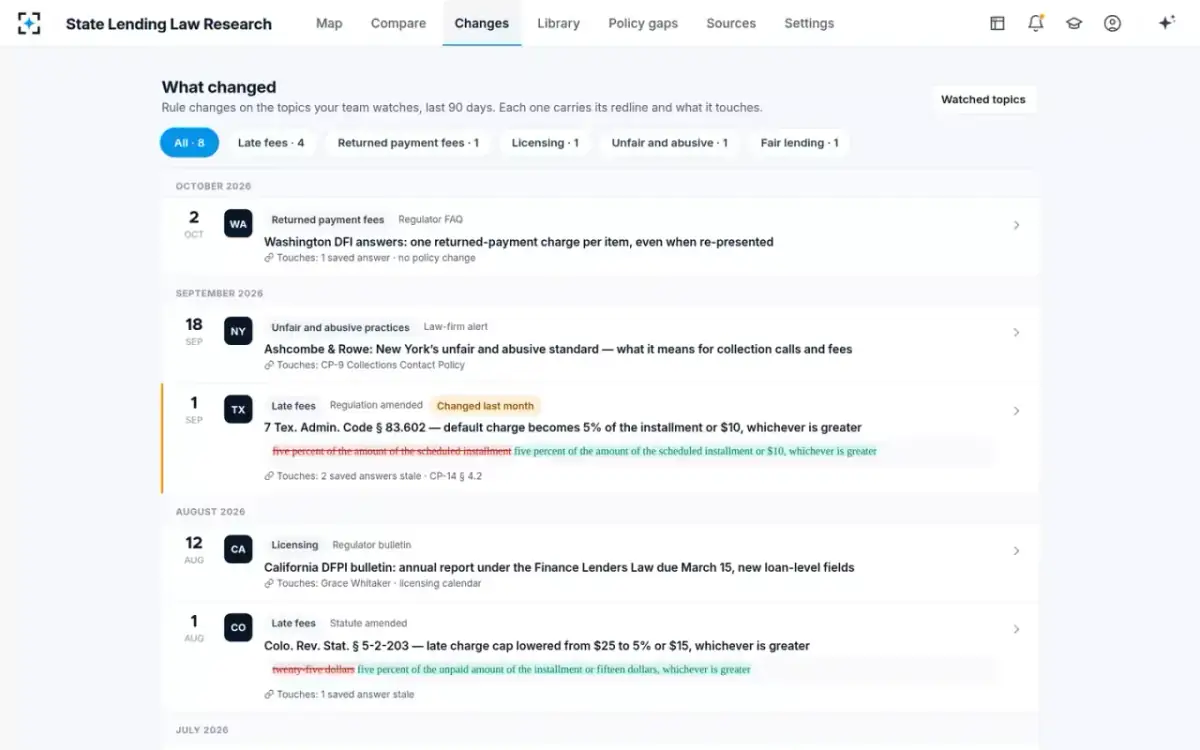
Look at the line under each change. A change matters to the compliance team because of what it touches, so that line is the important one.
In the solution, a check that runs each night compares every cited section's version with the current one. When a section changes inside the team's change window (30 days, 90 days or 12 months, set in the solution's settings), the state shows as changed on the map with its redline. Every saved answer and policy clause that relied on the old text is marked stale and its owner is told. The check does not edit a saved answer. A person refreshes it, and counsel reviews the new version before it leaves compliance.
Saved answers, with the one a rule change made stale
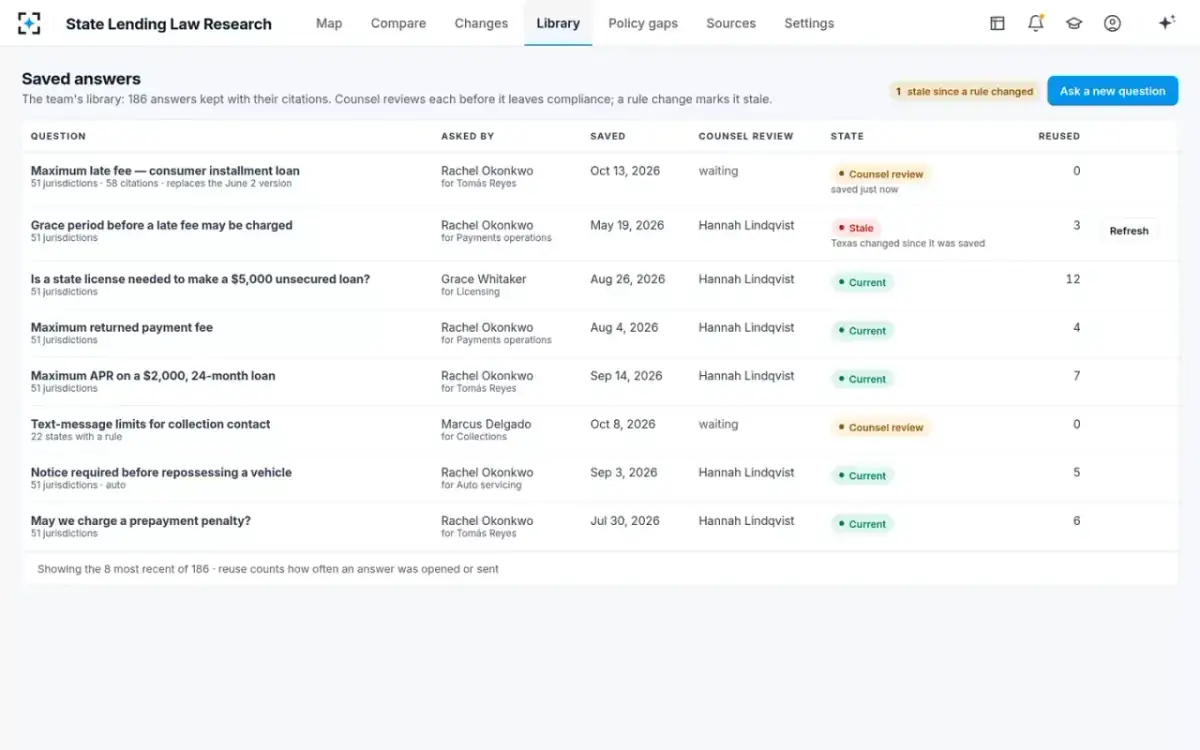
How do you keep up with changes in regulations and laws across fifty states?
By watching the sections your answers cite rather than the news about them. Topic alerts, newsletters and legislative trackers tell a team that something changed somewhere; they do not say which of its own answers, policies and contract templates relied on the old text. The work that keeps a multistate lender current is a short loop: know what you cite, compare it with the current version, and send each change to the owner of whatever rests on it.
From a changed section to a refreshed answer
Agent
Compare versionsEvery cited section, rule and guidance item is compared with its current version each night.
Never: treat a topic alert as a change to a section
Agent
Find what it touchesSaved answers, policy clauses and contract templates that cited the old text are listed with the redline.
Never: edit a saved answer itself
A person decides
The owner triagesThe analyst who owns each answer decides whether the change alters the result or only the citation.
A person decides
Counsel reviews the refreshA refreshed answer, and any exception that rests on it, is reviewed before it leaves compliance again.
The inventory is the hard part to start and the easy part to keep. A team that has never recorded which sections its answers cite has to rebuild that list once, from its saved memos, before any comparison can run. After that, each new answer adds its citations as it is saved. The OCC's handbook expects a process to "stay abreast of evolving regulatory requirements"; for a fifty-state lender the citation inventory is what that process runs on.
Give every saved answer an expiry condition as well as a citation
A citation shows where an answer came from. An expiry condition says when it stops being true. For most answers the condition is "the cited section changes". For indexed caps it is "the index moves", for Washington "the T-bill yield passes 8%", and for Colorado "the Tenth Circuit rules". If those conditions are written down when the answer is saved, keeping the library current becomes a matter of checking them rather than re-researching every question.
What to store with a saved fifty-state answer
- Rules in force on
The date the sources were read, separate from the date the answer was saved or sent.
- Section and version for every state
The citation and the version identifier, so a later change can be matched to it.
- Index and month for indexed caps
The value used and when it was read; recompute rather than reuse.
- Assumptions about pending cases
Which reading of a contested provision the answer applies, and the case to watch.
- Everything that relies on it
The products, policy clauses and contract templates built on the answer, so a change reaches them too.
- An owner
One person who is told when the answer goes stale and decides whether to refresh it.
Policies need the same treatment as answers. When the sample's Texas rule changed, the fee-policy clause that relied on the old cap was flagged along with the research. Where your fee schedule breaks state law covers that exception list, and the State Lending Law Research page shows the change watch working alongside the map.
Questions people ask
Is there a public database of state consumer finance law changes?
Not one that tracks changes as they happen. The Conference of State Bank Supervisors keeps a 50-state survey of consumer finance laws, verified by each state's regulator, and updates its state information once a year. An annual refresh is a good baseline but misses a mid-year amendment until the next edition.
Does Washington's usury rate change every month?
It can, but it has not in practice for decades. The limit is the higher of 12% or four points over the 26-week T-bill, and the state regulator notes the bill rate has stayed below 8%, so the limit has effectively been 12%.
Is the Colorado DIDMCA opt-out in force?
Colorado's opt-out law exists, but its enforcement against out-of-state state banks has been enjoined since 2024. The full Tenth Circuit agreed in April 2026 to rehear the case, and we found no ruling as of late October 2026.
How long is a saved fifty-state answer good for?
Until any section it cites changes, which has no fixed period. For an indexed cap such as California's 36% plus the federal funds rate, the number is good for one month of loans. For a stable text, it can last years, but only a comparison with the current version shows which case you are in.
Does a new state law apply to loans already made?
Usually it depends on what the act says. Florida's 1979 usury amendment applied only to loans made on or after July 1, 1979, with defined exceptions, and the FDIC's rule fixes a state bank's permissible interest "as of the date the loan was made". A saved answer should therefore record both the rules' date and the loans it covers.