Claim handling guidelines by state are the unfair claims settlement practices rules each state has adopted, usually modelled on the NAIC's Unfair Property/Casualty Claims Settlement Practices Model Regulation and then edited. Before any decision or payment, they set four communication clocks on a property or casualty claim: acknowledge the notice, reply to the claimant's other communications, answer the insurance department's inquiries and begin the investigation. The model gives 15 days to acknowledge. Florida gives residential property insurers 7 calendar days, New York 15 business days, and Texas and California 15 days counted differently. The same question has five answers, and only some of them are numbers you can compare.
Laying these clocks side by side for any set of states, against the NAIC model, is one of the jobs of 50-State Regulatory Research, Botminds' solution in which agents read every state's codes, regulations and bulletins and cite each state's answer, before a compliance analyst accepts it and counsel signs. The rules below were read at their official or Cornell LII sources on 27 October 2026. The payment and status-letter clocks are covered in a companion guide on prompt payment laws by state; this page stays with the clocks that run before a decision.
One claim, five rulebooks: how long each gives to answer
7calendar days
Florida gives residential property insurers to acknowledge a claim communication
15business days
New York gives to acknowledge a notice of claim, three weeks on the calendar
10business days
New York, and Washington since 18 Oct 2026, give to answer the regulator
21days
the NAIC model and California give to answer the department
What are claim handling guidelines, and where does each state keep them?
They are the minimum standards a state sets for investigating and settling claims, enforced through market conduct examinations and complaints. The NAIC's model regulation states its purpose as setting "minimum standards for the investigation and disposition of property and casualty claims arising under contracts or certificates issued to residents of the State". It is a model: it binds only where a state adopts it, and states keep their versions in different places.
New York's are in Regulation 64, 11 NYCRR Part 216. California's are the Fair Claims Settlement Practices Regulations in title 10 of the California Code of Regulations, §§2695.1 to 2695.14. Texas puts the core clocks in the Insurance Code, chapter 542, and its unfair claim settlement practices in the department's rule at 28 TAC §21.203. Florida's residential property clocks are in its statutes at §627.70131, alongside administrative rules in chapter 69O-166. Washington's are in WAC 284-30. The NAIC's own state page for the model, dated Fall 2023, places New York and Florida in its Model Adoption column and California and Texas under related activity only (NAIC state page); how to read that page is set out in NAIC model law state adoption charts.
Claim acknowledgement time frames by state: five rulebooks, four clocks
Side by side, the five rulebooks agree on the shape and disagree on almost every number and unit. The figure reads each clock from its own text; a dash means the rulebook sets no fixed count for that clock.
Four communication clocks in five claim handling rulebooks
| Rulebook | Acknowledge the notice | Reply to the claimant | Answer the regulator | Begin the investigation |
|---|---|---|---|---|
| NAIC Model 902Property and casualty; calendar days | Acknowledge the notice15 days · §6A | Reply to the claimant15 days · §6C | Answer the regulator21 days · §6B | Begin the investigationNo fixed count |
| FloridaResidential property insurers for the claim clocks | Acknowledge the notice7 calendar days · §627.70131(1)(a) | Reply to the claimantSame 7 days, any claim communication | Answer the regulator14 days for a complaint request · §624.307(10)(b) | Begin the investigation7 days after proof of loss · §627.70131(3)(a) |
| TexasFirst-party claims; surplus lines differ | Acknowledge the noticeThe 15th day · §542.055(a) | Reply to the claimant15 business days presumed prompt · 28 TAC §21.203(2) | Answer the regulatorNot set in ch. 542 or §21.203 | Begin the investigationThe 15th day · §542.055(a)(2) |
| New YorkRegulation 64; business days | Acknowledge the notice15 business days · 216.4(a) | Reply to the claimant15 business days · 216.4(b) | Answer the regulator10 business days for a claim inquiry · 216.4(d) | Begin the investigation15 business days · 216.5(a) |
| CaliforniaFair claims regulations; calendar days | Acknowledge the notice15 calendar days · 2695.5(e)(1) | Reply to the claimant15 calendar days · 2695.5(b) | Answer the regulator21 calendar days · 2695.5(a) | Begin the investigation15 calendar days · 2695.5(e)(3) |
Three patterns stand out. Florida is the strictest on the claimant side and folds acknowledgment and replies into one seven-day clock for "a communication with respect to a claim". New York runs every clock in business days, which makes its acknowledgment window the longest on the calendar and its regulator window, 10 business days, the shortest; the regulator clocks are drawn to scale in the department of insurance complaint response timeline. And Texas splits its clocks between a statute and a rule: the Insurance Code gives until the 15th day after notice to acknowledge, begin the investigation and request what the insurer needs, while the department's rule presumes an acknowledgment of other pertinent communications within 15 business days to be reasonably prompt.
Why "15 days" means three different things
Because the unit, the starting event and the scope all vary. "Fifteen" is calendar days in the model and California, business days in New York, and "the 15th day" in the Texas statute, which defines business days elsewhere in the same subchapter as days other than weekends and state-recognised holidays. From a notice received on Monday 12 October 2026, the model's and California's clocks end on Tuesday 27 October and New York's on Monday 2 November: the same number, six days apart.
The starting event moves too. Acknowledgment runs from notice of the claim; Florida's investigation clock runs from proof-of-loss statements; Texas's decision clock runs from receipt of everything the insurer asked for. Scope is the third variable: Florida's section defines an insurer as "any residential property insurer", Texas's prompt-payment subchapter excludes workers' compensation, title, mortgage guaranty, fidelity and surety and marine insurance (§542.053), and the model itself is not intended for workers' compensation, fidelity, suretyship or boiler and machinery claims. How business-day counting goes wrong in an audit of real files is shown in Regulation 64 New York.
Claims handling time limits by state: the decision clocks
After the communication clocks comes the decision: accept or deny, or explain why more time is needed. These numbers are the ones most often put in a single chart, and the least comparable, because each counts from a different event.
Days to accept or deny a first-party claim, and the event each clock counts from
Washington's line is new. Until 17 October 2026 the state allowed fifteen working days after fully completed and executed proofs of loss; since 18 October it allows 30 calendar days after notification of the claim (WSR 26-17-089). The number doubled, but the clock now starts at first notice rather than at proof of loss: on any claim where proof of loss arrives more than about nine days after notice, the new deadline comes earlier than the old one, and a chart that shows only the number would suggest Washington relaxed its rule.
Fair claims practices by state: what an examiner tests
Examiners test sampled claim files against the clock in force when each claim was handled, and they test the content of the communication as well as its date. Florida's report on Tower Hill Prime's Hurricane Ian claims is a clear record of both. Of 295 sampled claims, the examiners found acknowledgments outside the 14-day clock then in force and, separately, 10 claims, an error rate of 3.4%, where the acknowledgment was not responsive to the claimant's communication as §627.70131(2) requires (OIR report, 21 July 2025).
That second finding matters for anyone building a state-by-state table. Florida requires the acknowledgment to be "responsive to the communication" and, for a notification of claim, to provide claim forms, instructions and a telephone number unless the claim appears not to be covered. A table that records only "7 days" will pass a file that meets the date and fails the content. The NAIC model has a parallel duty to provide forms, instructions and reasonable assistance on notification, and counts compliance within 15 days as meeting its acknowledgment rule.
Insurance company deadlines by state move: what Washington changed
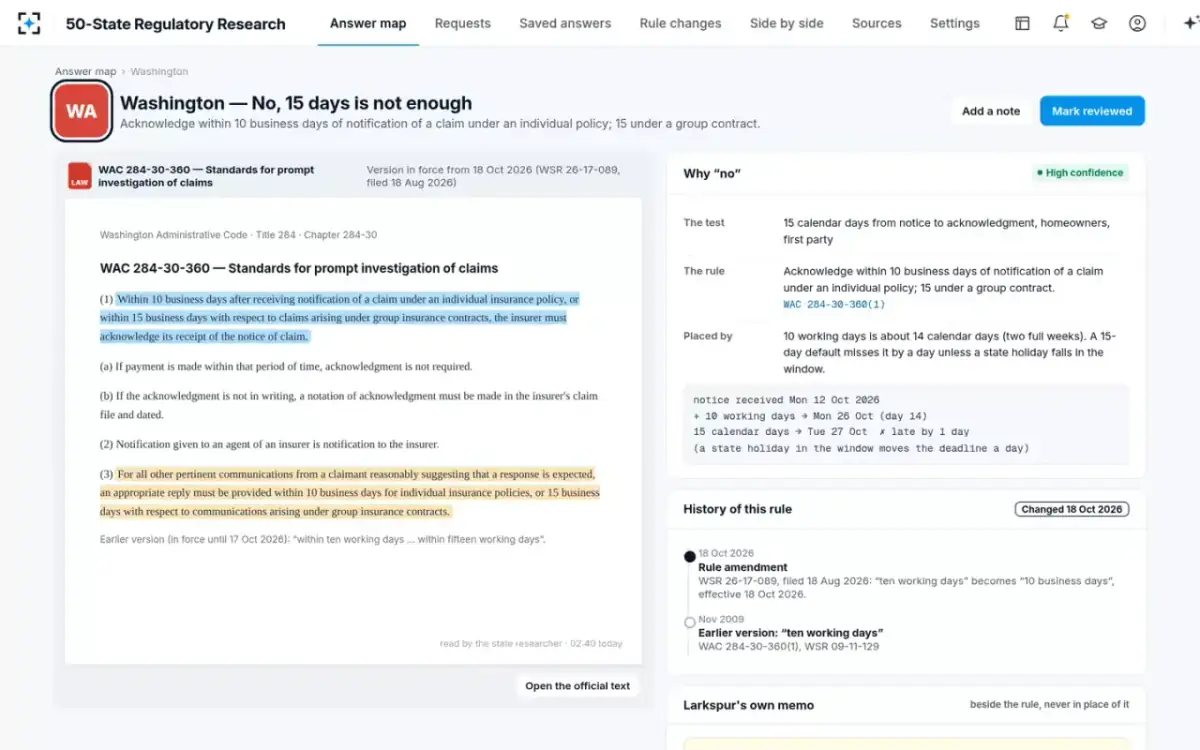
Washington's 2026 order shows how many clocks one rule change can move. Besides the decision clock above, it changed the time to answer the commissioner's inquiry about a complaint from fifteen working days to "10 business days after receipt of the commissioner's inquiry", now using the commissioner's electronic complaint system. The acknowledgment clock kept its count, 10 business days for an individual policy and 15 under a group contract, with "working days" replaced by "business days". The order amended 15 sections in all, filed 18 August 2026 and effective 18 October.
For a carrier with a state-by-state claim handling table, that is one row to rewrite and several cells to re-cite on one date, with the old values still needed for any file handled before it. Questions about which rules changed this year are the kind the solution's change view answers directly.
Only the states whose rule or bulletin changed in the last 12 months
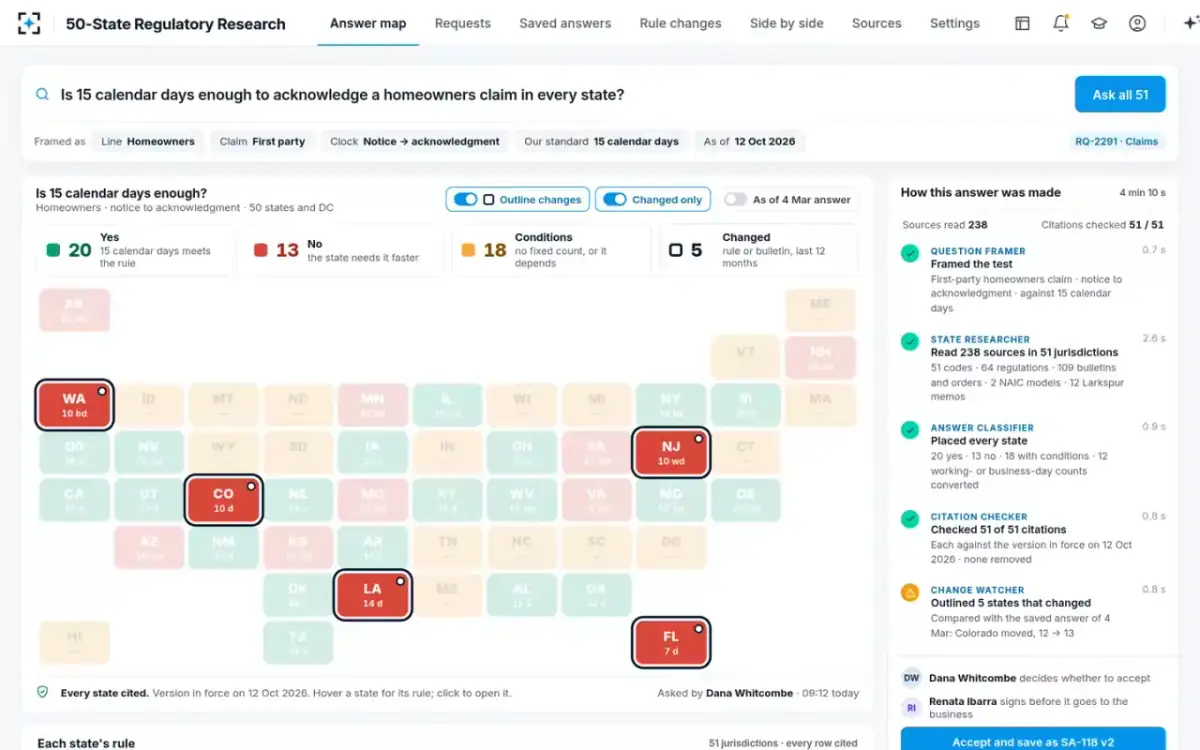
How to keep a state-by-state claim handling table current
Keeping a claim handling guidelines table defensible
- Record the unit and the starting event in every cell
Calendar or business days; notice, communication, proof of loss or receipt of requested items.
- Keep the scope beside the number
Residential property only in Florida; first-party claims and no workers' compensation in Texas's prompt-payment subchapter.
- Cite the rule that sets the clock, not the one that mentions it
Texas's statute and rule both say 15 about acknowledgment, in different units, for different communications.
- Keep the previous version with its end date
Examiners test files against the clock in force when they were handled.
- Record content duties next to time duties
Florida's acknowledgment must be responsive and carry forms and instructions.
- Watch the register, not only the code
In late October 2026 Washington's online code still printed the old acknowledgment text first, with the new one below it marked effective 18 October.
- Re-sign the table when a row moves
A new version with the change laid out, not an edit to the signed one.
Where 50-State Regulatory Research fits on claim clocks
The solution lays out claim-handling clocks for any states a team picks against the NAIC model, each cell cited and dated, and answers questions such as "is 15 calendar days enough to acknowledge a homeowners claim everywhere we write?" for all 50 states and the District of Columbia. Each state's page shows the governing passage, the version in force and the day-count arithmetic.
One state's clock, with the passage, the arithmetic and the rule's history
It reads statutes, regulations, bulletins and orders, not claim files: testing your own files against these clocks is a separate job. It gives no legal advice, and its answers reach the business only after the analyst accepts and counsel signs. A worked example of one claims question from request to signed answer is in the 50-state survey on insurance claims case study.
Questions people ask
How long does an insurance company have to acknowledge a claim?
It depends on the state and the line. The NAIC model allows 15 calendar days; Florida requires residential property insurers to acknowledge within 7 calendar days, New York within 15 business days, Texas by the 15th day after notice, and California within 15 calendar days (rules as of 27 October 2026).
Do claim handling rules use calendar days or business days?
Both. The NAIC model and California count calendar days, New York counts business days, and Washington counts business days for acknowledgment but calendar days for its decision clock since 18 October 2026. The unit has to be read from each state's text.
How long does an insurer have to answer a department of insurance inquiry?
The NAIC model and California allow 21 days, New York 10 business days for an inquiry about a claim, and Florida 14 days after a written request about a consumer complaint. Washington cut its complaint-inquiry clock to 10 business days from 18 October 2026.
Are claim handling guidelines the same for auto and homeowners claims?
Often not. Florida's seven-day clocks in §627.70131 apply to residential property insurers, so an auto claim needs a different rule. The NAIC model and most state regulations cover property and casualty claims generally, with separate sections for auto total losses.
Does the NAIC claims model apply in every state?
No. A model binds only where a state adopts it, often with edits. The NAIC's Fall 2023 state page lists 23 jurisdictions in its Model Adoption column, 12 with related activity only, including California and Texas, and the rest with no current activity on the model.
When did Washington change its claim handling rules?
By rule order WSR 26-17-089, filed 18 August 2026 and effective 18 October 2026. It amended 15 sections, including the decision clock, now 30 calendar days after notification of a claim, and the complaint-inquiry clock, now 10 business days.