The department of insurance complaint response timeline is set by state law and starts when the insurer receives the department's request: Florida allows 14 days for any consumer complaint, New York 10 business days for an inquiry about a claim, California 21 calendar days for an inquiry about a claim, and Texas 15 days, with a 10-day extension the department must grant on written notice. The same complaint therefore runs on different clocks depending on who sent it, and the clocks count differently: business days in New York, calendar days in California. The deadline is a calculation, not a setting, and the date that matters most is sometimes earlier still. Insurance Complaint Management, Botminds' complaint software, sets each clock from its rule and watches the file for an earlier date.
Four department clocks, by the words of each rule
14days
Florida · any consumer complaint, from receipt of the written request
10business days
New York · an inquiry about a claim
21calendar days
California · an inquiry about a claim
15 + 10days
Texas · any department inquiry, plus 10 on written notice
How long does an insurance company have to respond to a department of insurance complaint?
Between two and three weeks in these four states, but the exact time depends on the state, the kind of complaint and how the rule counts days. Florida's statute requires a response "within 14 days after receipt of a written request for documents and information from the division concerning a consumer complaint". New York's rule gives 10 business days to furnish the information requested about a claim. California's requires a complete written response "immediately, but in no event more than twenty-one (21) calendar days of receipt of that inquiry". Texas's statute requires a written response not later than the 15th day after the inquiry is received.
The department response clocks, side by side
| State | Time allowed | How days count | What it covers | Extension | Penalty in the rule |
|---|---|---|---|---|---|
| Florida | 14 days | Not stated as business days | Any consumer complaint the division asks about | Not provided in the statute | Up to $5,000 per violation (entity); $1,000 (individual) |
| New York | 10 business days | Business days | An inquiry from DFS about a claim | Not provided in the rule | Not stated in the rule |
| California | 21 calendar days | Calendar days; “immediately” first | An inquiry from the department about a claim | Not provided in the regulation | Not stated in the section |
| Texas | 15 days | Days after the inquiry is received | Any reasonable inquiry the department addresses to the company | 10 days, which the department must grant on written notice | Not stated in the section |
Other states set their own numbers, from Washington's 10 business days to Pennsylvania's 15 working days; they are listed with the consumer's side of the process in the department of insurance complaint form. A multi-state carrier has to hold all of them at once, and the four above are enough to show why that is hard.
Four clocks on one complaint, drawn to scale
Take a complaint received on Tuesday 17 March 2026, the date of the Florida referral in the solution's fictional sample, and run it through each state's rule. Florida's 14 days end on Tuesday 31 March. New York's 10 business days, skipping two weekends, end on the same day. California's 21 calendar days run to Tuesday 7 April, and Texas's 15 days to Wednesday 1 April, or Saturday 11 April with the extension.
One complaint received Tue 17 March 2026, on each state's clock
- 14 days, weekends included14 d
- Business days 1–33
- Weekend
- Business days 4–85
- Weekend
- Business days 9–102
- 15 days15 d
- Extension on written notice+10
- 21 calendar days21 d
Business days or calendar days: why New York's 10 can outlast Florida's 14
Ten business days always spans exactly two calendar weeks when no holiday falls inside it, so in an ordinary fortnight New York and Florida end on the same day. A holiday pushes New York's deadline back while Florida's stays put. Received on Thursday 19 November 2026, a complaint is due in Florida on Thursday 3 December; in New York, with Thanksgiving on 26 November counted as a non-business day, it is due on Friday 4 December.
A complaint received Thu 19 Nov 2026: calendar days until each deadline
The difference looks small and is the most common source of a wrong deadline on a multi-state team. A spreadsheet formula that adds 14 to every date will be right for Florida, a day early for New York in Thanksgiving week, and a week early for California. Early is safe; but a formula that adds 10 calendar days for New York, or treats California's 21 as business days, produces late answers that look on time to the team.
Which complaints each clock covers
The clocks also differ in scope, and the narrower ones only cover claims. New York's rule applies to "any inquiry from the Department of Financial Services respecting a claim"; California's to an inquiry from the department concerning a claim. Florida's covers any consumer complaint the division asks about, including billing, underwriting and service. Texas's covers any reasonable inquiry the department addresses to the company about its business or transactions.
So a New York complaint about a duplicate premium draft is not, by the rule's words, on the 10-business-day clock; a careful team answers by any date DFS gives in its request, and promptly. A sensible register records which rule set each deadline, so a complaint about billing in New York is not timed as if it were a claim, and a claim complaint is never left on a looser standard. The solution's clock settings name each source's rule with its citation for that reason.
When does the response clock start?
Every one of these clocks starts when the company receives the department's request, not when the complaints team opens it. Florida's runs from receipt of the division's written request, which goes to the e-mail address the insurer has filed with the department. New York's and California's run from receipt of the inquiry, and Texas's from the date the inquiry is received. A referral that sits a day in a shared mailbox, or a weekend in a general inbox, has lost that time already.
This is the most avoidable cause of late answers, and the one examiners can prove. The NAIC handbook's automation tip (2017 edition) has examiners compute the days from receipt to the final response for every complaint and flag those over the statutory standard. If the register records receipt as the day the team logged it, the company's own record understates the delay.
Department of insurance complaint response time in Florida
Florida allows 14 days from receipt of the division's written request, for any consumer complaint, with the answer in writing or electronically. The response must address the issues and allegations raised and include the requested documents, and the division may impose an administrative penalty of up to $5,000 per violation on a licensed entity and up to $1,000 per violation on an individual licensee. The Division of Consumer Services tells consumers it strives to resolve each issue within 30 days.
Two practical points follow from the statute's wording. The 14 days are not described as business days, so they include weekends and holidays. And because the request comes to the insurer's filed e-mail address, keeping that address monitored, and the escalation contact Florida also requires current, is part of meeting the clock.
NY DFS complaint response time limit
New York gives an insurer 10 business days, on receipt of an inquiry from DFS about a claim, to furnish the department with the available information requested (11 NYCRR 216.4(d)). The word "available" matters: the rule asks for what the insurer has, promptly, rather than a final resolution. An answer that says what is known and when the rest will follow meets the rule's terms better than a complete answer on day 12.
The same section requires the department that answers DFS to have authority to change the company's position, under a named corporate officer, and to keep a central log of all complaint activity. The clock and the log are designed to work together: the log is where the receipt date, the response date and the outcome are recorded.
Department of insurance complaint response time in California
California requires a complete written response to a claim inquiry from the department immediately, and in no case more than 21 calendar days after receipt. A complete response addresses every issue the department raised and includes copies of the documentation and claim files it requested. The section separately requires a complete response to a claimant's own communication within 15 calendar days, so a California claim complaint can carry two clocks at once.
Extensions: Texas's ten days, and everywhere else
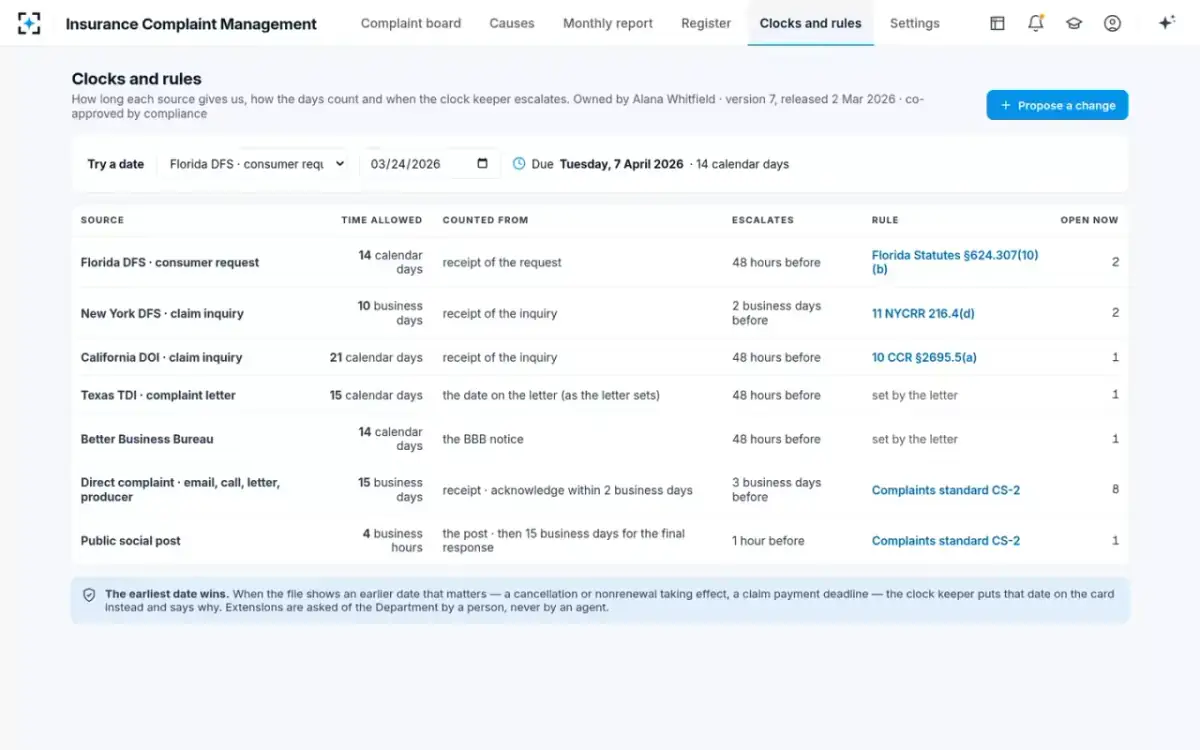
Texas is the clear case: if the department receives written notice from the insurer that it needs more time, it "shall grant a 10-day extension of the time to respond to the inquiry". Florida's, New York's and California's rules provide no extension in their text, so more time is a request to the department, granted or not. In the solution, the clock keeper never moves a deadline; extensions are asked of a department by a person, and the new date is recorded with the reason.
The earliest date wins: how Insurance Complaint Management sets the real deadline
The statutory deadline is the latest the department will accept; the customer's deadline can be earlier. In the solution's sample, Denise Albright's Florida referral arrived on 17 March and was due on 31 March, but a notice of cancellation for non-payment, caused by the insurer's own duplicate draft, would take effect at 12:01 a.m. on Sunday 29 March. Answering on day 13 would have met the statute and left her uninsured for two days. The clock keeper put 29 March on the complaint and said why; the response went out on day 7.
Clocks and rules in Insurance Complaint Management: each source’s time and rule
What a missed clock costs
In Florida, a fine per violation; everywhere, a finding the examiner can count. Departments record late answers too. In our analysis of the complaints the Texas Department of Insurance closed in 2025, 460 carried the disposition "Failure to Timely Respond", about 2% of the 22,564. Each is a record, in the regulator's own data, that a company did not answer on time.
Six habits that keep department answers inside the clock
- Log receipt the moment the request arrives
Every clock here runs from the company’s receipt, not the team’s.
- Record which rule set each deadline
A New York billing complaint is not on the claim clock; answer by the date DFS gives, and promptly.
- Count business days with a holiday calendar
Ten business days is 14 calendar days only in a week without holidays.
- Look for an earlier date in the file
A cancellation, nonrenewal or payment deadline can matter more than the statute.
- Ask for an extension in writing, early
In Texas the department must grant 10 days on written notice; elsewhere it is a request.
- Measure your own lateness the examiner’s way
Days from receipt to final response for every complaint, flagged against the standard.
The answer itself still has to be complete; a timely letter that skips an allegation fails a different test. How to build one is shown in the DOI complaint response letter sample, and where the receipt and response dates are kept in complaint register requirements for an insurance company.
Questions people ask
What is the Florida DFS complaint response time frame?
An insurer must respond within 14 days after receiving the Division of Consumer Services' written request, in writing or electronically, addressing every issue and allegation. The division can fine an insurer up to $5,000 per violation for failing to comply.
What is the NY DFS complaint response time limit?
For an inquiry from DFS about a claim, 10 business days to furnish the available information requested, under 11 NYCRR 216.4(d). For complaints that do not concern a claim the rule sets no period, so answer by any date DFS gives in its request.
What is the California department of insurance complaint response time?
For an inquiry about a claim, a complete written response immediately and in no event more than 21 calendar days after receipt, including the documents and claim files requested. A claimant's own communication must be answered within 15 calendar days.
Do weekends count in the response deadline?
In New York, no: the rule counts business days. In California, yes: it says calendar days. Florida's statute says 14 days without saying business days, so the cautious reading counts weekends.
Is the response deadline the same as the time to resolve the complaint?
No. The deadline is for the insurer's answer to the department; the department then reviews it. Texas closed its 2025 complaints a median of 84 days after receiving them, against a 15-day answer deadline.
What happens if an insurer misses the deadline?
Florida can impose an administrative penalty per violation, and examiners test timeliness as a standard of their own. Texas recorded 460 complaints closed in 2025 with the disposition "Failure to Timely Respond".