AI for complaint management at an insurer means software agents that do the reading, retrieval and drafting a complaint needs: decide whether a message is a complaint, find the policy and claim, set the deadline the regulator's rule requires, pull the records that prove what happened, draft an answer, work out the redress and spot when several complaints share one cause. What it should not do is decide what the company says, pays or admits. Complaint answers go to state regulators who judge them on accuracy and completeness, and the NAIC's model bulletin on AI asks insurers to weigh how far people stay involved in decisions that affect consumers. Insurance Complaint Management is Botminds' answer to that problem: six agents, each with a written limit, and a team lead who signs.
"the extent to which humans are involved in the final decision-making process"
NAIC Model Bulletin on the Use of AI Systems by Insurers, Section 3
The bulletin lists that as one of five things an insurer's controls over an AI system should reflect, alongside the nature of the decision, the potential harm to consumers, how explainable the outcome is and reliance on third parties. For complaint handling, it is a design question before it is a compliance one. A drafting tool that a handler reads and signs is a different risk from one that answers a regulator on its own.
What can AI do in insurance complaint management?
AI can take on the mechanical work that fills a handler's day: reading every channel, matching each complaint to a customer and policy, computing deadlines, gathering records and writing a first draft that points to them. Botminds' own estimate for one department complaint, made for this solution, puts handling at about five and three-quarter hours by hand and an hour and a quarter with the agents, most of the saving in record retrieval. It is an estimate for planning, not a measured result.
The more valuable thing is what no single handler can see: that the complaint on her desk is the fifth one from the same billing change in eight days, arriving through four channels. Complaint data is naturally multi-causal. In our analysis of the complaints the Texas Department of Insurance closed in 2025, 73% carried two or more reasons. A model that reads every complaint against every open and recent one can find a shared cause while the customers it reached are still reachable.
Insurance Complaint Management's six agents and the line each never crosses
Each agent in the solution does one job and carries a limit written into its configuration, and every decision with consequences ends with a person. That is the pattern to look for in any AI for complaint handling: narrow agents with stated limits, not one assistant that "handles complaints".
Insurance Complaint Management: six agents, each with a limit, and the person who signs
Agent
Complaint loggerReads department portals, the complaints mailbox, call notes, letters, producer email and public posts; decides complaint or request; finds the customer, policy, claim and department file number.
Never: closes or answers a complaint; an unclear case goes to a handler.
Agent
Clock keeperSets each deadline from the source’s rule, counts calendar or business days, and watches for earlier dates in the file such as a cancellation taking effect.
Never: moves a deadline; extensions are asked of a department by a person.
Agent
File gathererLists what needs proving and pulls the records that prove or disprove it: policy, billing entries, notices, claim and call notes, earlier complaints.
Never: changes a record; it only reads.
Agent
Response drafterWrites the answer to the department and the customer, point by point in the order raised, in plain words.
Never: sends, or admits more than the records show; every statement cites a record.
Agent
Redress calculatorWorks out what the redress policy owes, line by line, and who may approve the amount.
Never: pays; above the handler’s limit, the team lead approves.
Agent
Root cause finderCompares each complaint with open and recent ones, names a shared cause when enough match, sizes the customers affected and drafts the monthly report.
Never: names a person or confirms its own pattern; the conduct risk analyst confirms it.
A person decides
Complaints team leadReads the draft and the redress, approves and signs the department response; the conduct risk analyst confirms each cause.
Can AI decide whether a message is a complaint?
It can make the first call, but the definition itself contains judgment, so the unclear cases have to go to a person. The NAIC's model regulation on complaint records says so in its preface: "Differentiating an 'inquiry' from a 'complaint' will in many cases involve judgment, which we expect to be applied reasonably." Its example is a policyholder pointing out a misspelled name, who may be passing on information or may be aggrieved, depending on the words used.
The cost of a wrong call runs one way. A complaint logged as an inquiry never reaches the register, and examiners reconcile the register with the department's own list. A question logged as a complaint costs a few minutes. So the logger in the solution decides the clear cases, records the customer's own words, and sends anything ambiguous to a handler; no item is dropped. Before relying on any classifier, measure it on your own past complaints, the method set out in the insurance complaint categories list and, for banks, in testing AI complaint classification.
Deadlines: why the agent sets the clock and a person asks for more time
Deadline arithmetic is exactly what software should own, because it is rule-bound and unforgiving, and extensions are exactly what it should not, because they are a request to a regulator. Florida gives 14 days from the division's written request and allows a fine of up to $5,000 per violation for missing it (§624.307(10)(b)). Texas gives 15 days and must grant 10 more when the insurer sends written notice that it needs them (§38.001(c)). Sending that notice is a judgment about the complaint and the relationship with the department.
The useful AI behaviour is the one a tired handler misses: the earlier date. In the solution's sample, a Florida referral was due to the division on Tuesday 31 March, but the file held a notice of cancellation for non-payment taking effect on Sunday 29 March. The clock keeper put the earlier date on the complaint and said why. The full counting rules are compared in the department of insurance complaint response timeline.
An AI response to a complaint: every sentence tied to a record
An AI-drafted response is safe to sign only if each statement points to the record it rests on, so the reviewer can check the evidence instead of trusting the prose. Florida's statute sets the bar the draft must meet: the answer has to address the issues and allegations in the complaint and include the documents requested (§624.307(10)(b)). The NAIC handbook (2017 edition) asks examiners whether a response includes adequate documentation to support the company's position.
One department complaint through the agents, in seconds
0.8s
to log the referral and match the policy
2.4s
to pull six records from the file
5.1s
to draft seven statements, each citing a record
0.9s
to compute $60.00 redress within the handler’s limit
The sample shows what the citations are for. The draft states that the March instalment was drafted and settled on 2 March, drafted again on 3 March by a retry process that should have been switched off, returned by the bank, and charged a $25.00 fee. Each of those sentences links to a billing entry, a notice, a call note or a change record. The drafter's limit, never to admit more than the records show, cuts both ways: it states the error plainly where the records show one, and it does not speculate where they are silent.
The run on one complaint ends with a person
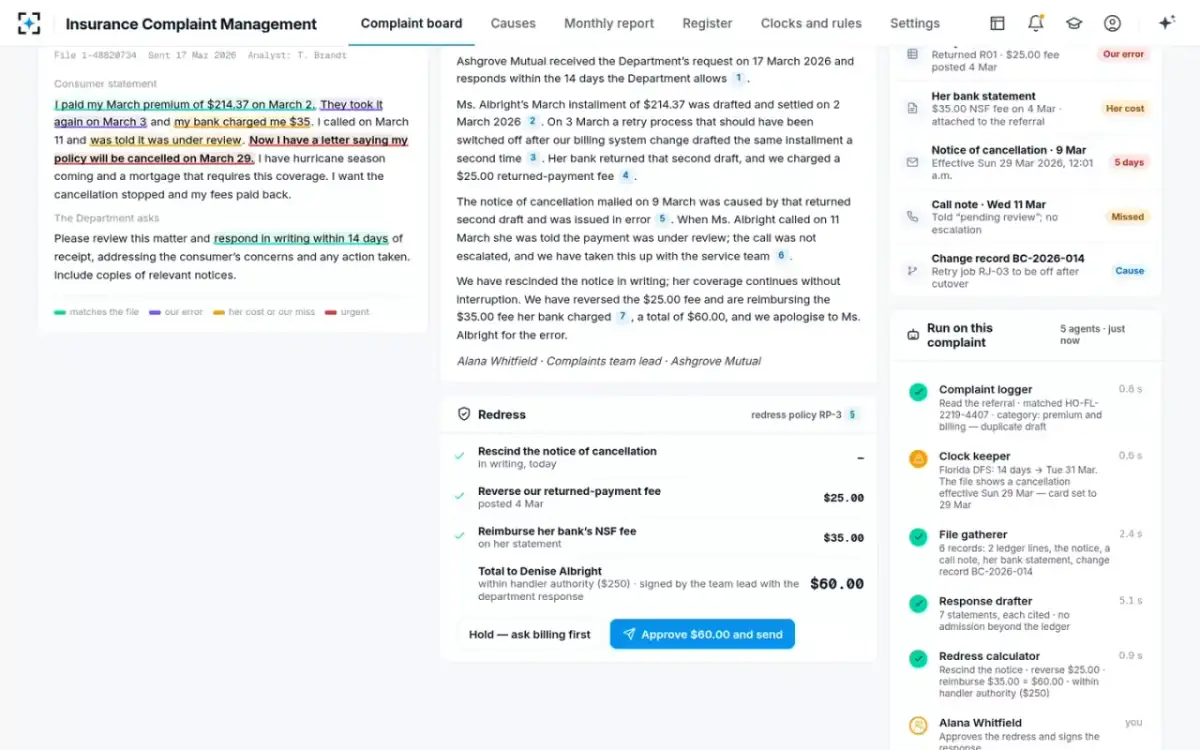
Redress: the agent does the arithmetic, people approve the money
Working out what a redress policy owes is calculation; paying it is a decision with an approval chain. In the solution, the redress calculator itemises what is owed under the carrier's policy and states who may approve it. A person approves every payment, and limits by role are settings that need a second person from compliance to change.
Who approves redress in the solution's sample settings
| Role | May approve up to | What the agent does | In the sample complaint |
|---|---|---|---|
| Complaint handler | $250 | Itemises fees reversed, bank fees on evidence and refunds, citing the redress policy | $60.00: a $25.00 returned-payment fee and a $35.00 bank fee |
| Complaints team lead | $2,500 | Routes anything above the handler’s limit to the team lead | Signed the department response with the redress |
| Head of complaints | No limit | Routes anything above the team lead’s limit | Not needed |
| Any role | — | Never pays; never changes a record | Payment went to the account on file after approval |
Root cause: what AI sees across complaints that one handler cannot
Root cause is where AI earns its place, because the signal is spread across channels and handlers. The NAIC handbook (2017 edition) tells department analysts to watch for spikes in complaints against the same company on the same practice "(e.g., 10 new complaints in a week)". An insurer that waits for its regulator to see the spike has already lost the chance to fix it quietly.
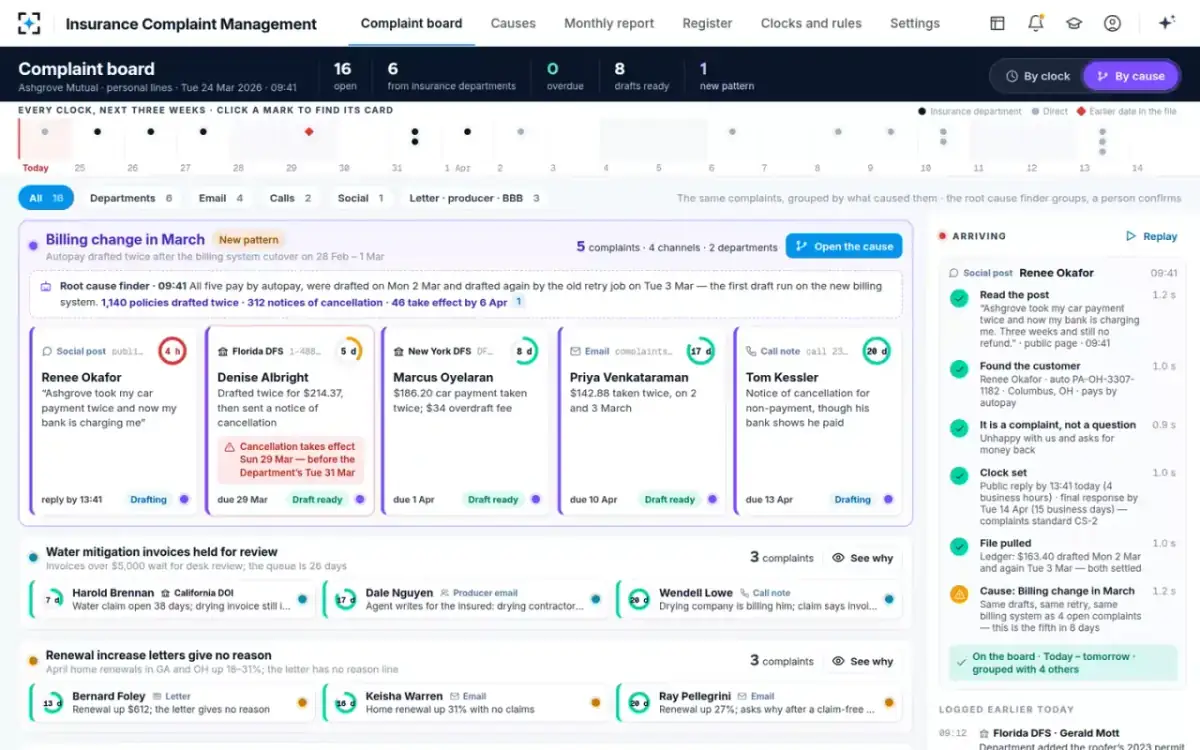
In the solution's sample, the fifth complaint about a duplicate autopay draft arrived as a public post. The root cause finder matched it to four open complaints from Florida DFS, New York DFS, email and a call: same drafts, same retry, same billing system. It sized the population from billing data: 1,140 policies drafted twice, 312 returned with a fee and a notice of cancellation, 46 cancellations about to take effect. Five customers had complained, 0.4% of those affected.
By cause: five complaints from four channels become one problem
How the NAIC AI bulletin applies to AI complaint handling
The NAIC's model bulletin expects insurers to keep a written program for AI systems that make or support decisions related to regulated insurance practices, and 29 jurisdictions had adopted it as of 8 October 2026 (NAIC map), with California, Colorado, New York and Texas on their own insurance-specific rules. The bulletin's list of life-cycle areas does not name complaint handling. But complaint records and complaint responses are governed by the unfair trade practice laws the bulletin says AI-supported decisions must meet, so the prudent reading is to bring complaint AI inside the program.
In practice that means the documentation the bulletin describes: an inventory entry, a description of what each agent does and does not decide, testing for errors before reliance, and the same diligence on a vendor's system as on one built in-house. Section 1.8 brings systems bought from vendors inside the program on the same terms as those built in-house, as the guide to the bulletin's requirements sets out section by section. A complaint tool whose limits are written into its settings, and whose every draft keeps its citations, gives a governance team most of that file already.
What to ask before buying AI for complaint handling
Ask for evidence on your own complaints, not a demonstration on someone else's. A credible vendor will run a sample of your past complaints through the system and show where it agreed with your handlers, where it did not, and why. The questions below separate a drafting assistant from a complaint system you can defend to an examiner.
Eight questions for any AI complaint management tool
- Does every sentence of a draft cite a record a reviewer can open?
If not, the reviewer is checking prose, and the department will check facts.
- Which decisions can it never make?
Sending, paying, moving a deadline, confirming a cause. Ask to see where those limits are configured.
- How does it decide complaint or inquiry, and where do unclear cases go?
A miss keeps a complaint off the register; ask for its agreement rate with your handlers on past cases.
- Can it read every channel you receive complaints through?
Department portals, mailboxes, call notes, letters, producers and public posts. A channel it cannot read is a channel you reconcile by hand.
- Are clocks set from rules you can see, with the citation?
Business days, calendar days, holidays and earlier dates in the file, each traceable to its source.
- Who can change a rule or a limit?
Changes should be versioned and need a second person, as in the solution’s settings.
- How is a pattern confirmed, and does it name a person?
A cause should be a process or system, proposed by the software and confirmed by a named analyst.
- Can it produce the register examiners ask for?
Line, nature, disposition and time to process for every complaint since the last examination.
Be equally clear on where it does not fit. The agents work only on what they can read, so a carrier that cannot give read access to billing and claim systems gets logging and clocks but not a cited draft. They do not decide coverage disputes, and a complaint that is really a lawsuit belongs with counsel. And a complaint tool does not replace the conduct committee: it gives the committee causes worth discussing a month earlier.
Questions people ask
Can AI write a response to a department of insurance complaint?
It can draft one, and a good draft answers each point in the order raised and cites the record behind every statement. A person should read and sign it: the response goes to a regulator, and in the solution's settings sending drafts without review is never allowed for department complaints.
What features matter in complaint management automation?
Reading every channel, deadlines set from cited rules, record retrieval, cited drafting, redress calculation with approval limits, root-cause grouping and an exportable register. The register matters most to examiners: NAIC model law asks for line of insurance, nature, disposition and time to process for every complaint.
Does the NAIC AI bulletin cover complaint handling AI?
The bulletin does not list complaint handling by name, but it covers AI systems that make or support decisions related to regulated insurance practices and says those decisions must meet unfair trade practice laws, which include complaint recordkeeping. It had been adopted in 29 jurisdictions as of 8 October 2026 (NAIC map).
What training do complaint handlers need to work with AI?
Mostly the skill of checking citations: opening the record behind each sentence and confirming it says what the draft says. Handlers also need to know which decisions the agents may never make, so they recognise when a case has been routed to them for judgment.
Can AI find the root cause of insurance complaints?
It can propose one by matching dates, systems, products and states across complaints, and size the customers affected from billing or claim data. A named analyst should confirm it; in the solution, a cause stays a proposal until the conduct risk analyst confirms it.