The complaint register requirements for an insurance company come from the NAIC's Unfair Trade Practices Act, which states adopt in their own words: an insurer must keep a complete record of every complaint received since its last examination, showing the total number, each complaint's line of insurance, its nature, its disposition and the time it took to process. The NAIC's companion model regulation sets out a suggested format in eight columns, adding the company function involved, the dates received and closed, whether a department sent it and the state it came from. Examiners reconcile the register against the department's own list, so the register is evidence, not a report. Insurance Complaint Management, Botminds' complaint software, builds that register as each complaint is logged.
"any written communication primarily expressing a grievance"
NAIC Unfair Trade Practices Act (#880), §4.L, defining a complaint for the register
What must an insurance company's complaint register contain?
Five things per the model law, for every complaint since the last examination: a total count, the line of insurance, the nature of the complaint, the disposition and the time to process. In the NAIC's Spring 2024 model the requirement is §4.L, headed "Failure to Maintain Complaint Handling Procedures"; in the 2008 printing the same paragraph was §4.K, and state statutes number it in their own way. Failing to keep the record is itself listed as an unfair trade practice.
The neighbouring paragraph matters as much. §4.K of the Spring 2024 model requires records to be kept so that data on complaints, claims, rating, underwriting and marketing are "accessible and retrievable for examination by the insurance commissioner", for at least the current calendar year and the two preceding years unless the state sets another period. A register that exists only as emails in a shared mailbox may hold everything and still fail that test.
The eight columns of the NAIC complaint record
The NAIC's Model Regulation for Complaint Records to be Maintained (#884) turns the five requirements into a format, first adopted in 1973 and last printed in 1992. Its Attachment A has eight columns, and its Section 4 lets a company refine or add to them as long as the minimum can be produced for the department within a reasonable time. Texas adopted the same eight columns in its rule, numbered 1 to 8.
The eight columns of the NAIC complaint record, with a sample entry
| Column | What it holds | Sample entry (fictional) |
|---|---|---|
| A · Identification number | A number for the complaint, plus the licence number of any agent, staff adjuster or independent adjuster involved | CMP-26-0415; no agent involved |
| B · Function and reason | The company function (underwriting, marketing and sales, claims, policyholder service, miscellaneous) and the reason within it | Policyholder service, miscellaneous: billing, duplicate premium draft |
| C · Line type | One of 14 lines, from automobile to mobile homeowners | Homeowners |
| D · Disposition | How the complaint was disposed of; the model gives examples such as corrective action taken | Corrective action: notice of cancellation rescinded, $60.00 refunded |
| E · Date received | The date the complaint was received | 17 March 2026 |
| F · Date closed | The date it was disposed of, by one action or the last of several | 24 March 2026 |
| G · Insurance department complaint | Whether it came from an insurance department | Yes: Florida DFS file 1-48820734 |
| H · State of origin | Ordinarily the complainant’s state of residence | Florida |
The sample shows a gap worth knowing about. The NAIC's reason list has no billing reason: a duplicate premium draft is neither "premiums and rating" in underwriting nor a "failure to respond" in policyholder service. A carrier has to decide where billing errors go and write it down, or two handlers will file the same complaint in two places. The full list, and how to measure whether handlers apply it alike, is in the insurance complaint categories list.
What is the NAIC definition of a complaint?
There are two NAIC wordings and a Texas refinement, and the register should say which one the company applies. The model law counts any written communication primarily expressing a grievance. The NAIC membership's definition, quoted in the handbook (2017 edition), is broader: any written communication expressing dissatisfaction with a regulated person or entity, including an oral complaint later converted to writing.
Three definitions of a complaint, and what each puts on the register
The narrower reading: Written communication primarily expressing a grievance
The broader or refined reading: Model 884 adds "insurance department complaint": a written communication about a complaint sent by the department
The narrower reading: Written communication expressing dissatisfaction with a regulated person or entity
The broader or refined reading: An oral communication later converted to writing also counts, so a detailed call note can be a complaint
The narrower reading: Unsolicited written communication about coverage in Texas, primarily expressing a grievance; e-mail and fax count
The broader or refined reading: Repeat letters on the same issue are one complaint; a misunderstanding cleared up promptly is not a complaint
The practical consequence is in the call centre. Under the handbook's wording, a call note that records a grievance in writing is a complaint for the register; under a strict reading of the model law it might not be. Since examiners apply the state's rule, and many will follow the handbook, the safer register logs written-up oral complaints and records how each was resolved.
Insurance complaint log requirements by state
States split three ways: some adopted the NAIC's record format, some wrote their own rule or bulletin, and some rely on the model law's general duty or on a separate rule of their own. On the NAIC's state page for Model 884, last updated in Fall 2022, eight states are listed as adopting the model and nine with related activity. Every other jurisdiction is marked "no current activity" for that model, which includes New York, California and Florida.
Where the NAIC complaint record format is law
8
states adopted Model 884: Arkansas, Connecticut, Illinois, Nebraska, New Jersey, New Mexico, Texas, Vermont
9
with related activity: Alaska, Colorado, Delaware, Iowa, Kentucky, Louisiana, Nevada, New Hampshire, Oregon
0
listed activity on Model 884 in New York, California or Florida
"No current activity" is easy to misread. It means the NAIC found no adoption of this particular model regulation, not that the state has no complaint record requirement. A state can carry the register duty in its unfair trade practices statute instead, as the model law does, and New York sets out its own requirement in its claims regulation, below. Any state-by-state table should be checked against the current statute before it is relied on.
Insurance complaint log requirements in New York
New York's rule is short and organisational: it requires a department, an officer and a log. The insurer's consumer services department "shall maintain an ongoing central log to register and monitor all complaint activity" (11 NYCRR 216.4(e)). The department must be designated to investigate and resolve complaints filed with DFS, must have authority to change the company's position in individual cases or in its practices generally, and must sit under a corporate officer whose name and title are given to the superintendent.
The word "central" does the work. A New York carrier whose claims, billing and producer teams each keep their own complaint lists does not have a central log, however complete each list is. And "monitor all complaint activity" implies more than a list of closed complaints: it implies the open ones, their status and what was done.
Texas: the most detailed register rule
Texas's rule, 28 TAC §§21.2501 to 21.2507, spells out what the model leaves open. The register covers complaints received "during the preceding three years or since the date of its most recent financial examination, whichever time period is shorter", kept on a calendar-year basis, with counts by line, function, reason, disposition, origin and dates compiled at least once a year (§21.2506). It may be electronic or paper, single or decentralised, as long as the department can be given a complete record on request.
The rule also settles details other states leave to judgment. The source column must, at minimum, flag any complaint that came from the Texas Department of Insurance or another insurance department. Any complaint involving an agent must carry an identifier for the placing or servicing agent. HMO complaints are covered by a different rule. And keeping the register does not waive any exception to public disclosure the law already provides (§21.2503).
How examiners test a complaint register
Examiners test completeness first, then format, then timeliness, and the first test is mechanical. The NAIC handbook (2017 edition) tells them to get the department's complaint data and the company's register, convert both to one format, and compare the complainant's name, claim number and policy number to find any department complaint the company did not log. Its advice on what to request is telling: "Do not specify which data to be supplied, but instead go with exactly what the regulated entity tracks."
What an examiner does with your complaint register
- Reconciles it with the department’s complaint list
By complainant name, claim number and policy number; a missing department complaint is a finding even if it was answered on time.
- Checks that direct complaints are there too
The handbook’s review covers complaints made to the company directly and those received electronically, not only department complaints.
- Checks the minimum fields
At least line of business, function and reason, per the handbook’s Standard 1.
- Computes days from receipt to final response
The handbook’s automation tip: compute the days for every complaint and flag those over the statutory standard.
- Samples complaints and reads the files
Whether each response was complete, documented and identified the remedy owed.
- Looks for patterns
Similar complaints recurring, and the complaint index and trends for up to three years.
The third test is where informal registers fail. A register that records the date the department's letter was answered but not the date the complaint was received cannot show time to process, and a register that records receipt by the complaints team rather than by the company starts every clock late. How each department's clock is counted is set out in the department of insurance complaint response timeline.
Insurance complaints register template: the minimum and what to add
A workable template is the eight columns plus the fields that make the register useful between examinations. The model invites additions, and Texas recommends that insurers use the NAIC's Complaints Database System codes for reasons, dispositions and complainant type, which makes the reconciliation with a department's data far easier. A spreadsheet can hold all of it; the hard part is keeping it complete.
Fields worth adding to the eight NAIC columns
- Channel
Department portal, e-mail, call, letter, producer, public post. It shows which channels a register is missing.
- The complainant’s own words
A short quotation, so the reason code can be checked later.
- Due date and the rule behind it
With the rule’s citation and how days are counted, so lateness can be proved either way.
- Date responded and who signed
Separate from the date closed, which can come weeks later when the department closes its file.
- Second and third reasons
Most complaints have more than one; in Texas’s 2025 data, 73% did.
- Confirmed by the department
Departments record a confirmed status; it drives the complaint index.
- Redress amount and cause
What was paid and the process or system cause, so the register feeds root-cause work.
How Insurance Complaint Management builds the register
The solution builds the register as complaints arrive rather than at exam time. The complaint logger reads each channel, decides complaint or request against the carrier's definition, and records the customer, policy, claim, any department file number and the complainant's own words. Each later step, by an agent or a person, is written to the complaint's history, so time to process, who signed and what was paid are recorded without a second entry.
Insurance Complaint Management logs a public post as a complaint, step by step
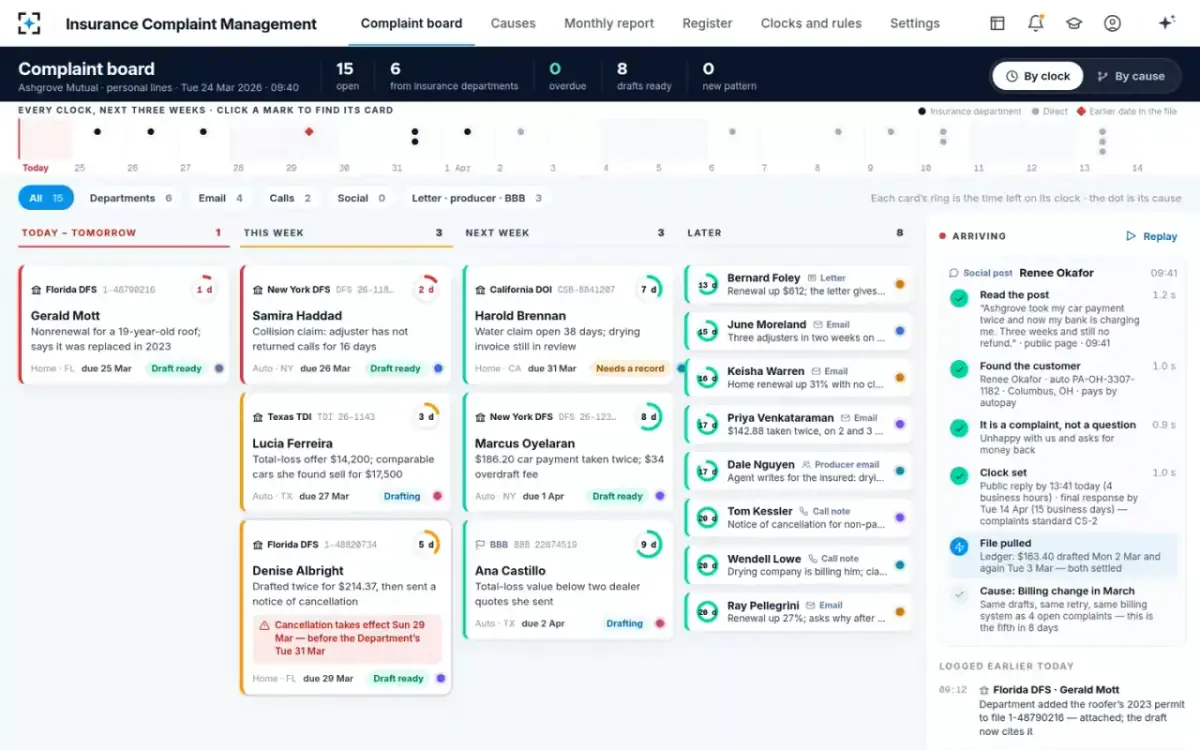
For an examination, the register exports for any period with the model law's five items and the eight columns, filtered by source and status. What the solution does not do is decide the carrier's definitions: what counts as a complaint, how billing errors are coded and how long the register is kept are the carrier's settings, set to its states' rules.
Questions people ask
Is there a complaint log template in Excel for insurance?
No official one is published for insurers in general, but NAIC Model 884's Attachment A is the template most state rules follow: eight columns from identification number to state of origin. Texas posts its own Complaint Record Form on the department's forms page.
How long must an insurer keep its complaint register?
The NAIC model law covers every complaint since the last examination and asks that complaint data be kept for at least the current calendar year and the two preceding years unless a state sets another period. Texas requires the preceding three years or the period since the last financial examination, whichever is shorter.
Do phone complaints go on the complaint register?
Under the NAIC definition quoted in the handbook (2017 edition), an oral complaint later converted to writing, such as a call note, counts. The model law's own wording is written communication, so the company's procedure should state which it applies.
Do social media complaints belong in the register?
The handbook (2017 edition) tells examiners to review a company's procedures for complaints received through social media where it is active. A post expressing a grievance that the company answers is safest logged.
Are complaints against agents recorded by the insurer?
Yes. The NAIC record includes the licence number of any agent or adjuster involved, and Texas requires an identifier for the placing or servicing agent on any complaint involving one.
Is an insurer's complaint register public?
Not as such: it is kept for the department and produced at examination or on request. Texas states that keeping it does not waive any exception to public disclosure provided by law, while departments publish their own complaint data.