Filing a complaint with the insurance commissioner works in New York more often than many people expect. In 2025 the Department of Financial Services, which regulates insurers in New York, closed 39,064 insurance complaints and obtained a positive outcome, such as an increased claim payment or reinstated coverage, for 10,336 of them, about one in four. It recovered more than $121 million for consumers and health care providers. The odds depend heavily on the kind of insurance: about 31% of prompt-pay complaints ended positively, against about 12% for life insurance. For the insurer, each complaint starts a statutory clock and lands in a register examiners read, which is the work Insurance Complaint Management, Botminds' complaint software, is built for. This guide is general information drawn from published figures, not legal advice.
New York's insurance complaints in 2025
39,443
insurance complaints received by DFS
39,064
closed during the year
26%
closed with a positive outcome for the consumer or provider
$121M
recovered on behalf of consumers and providers
Does filing a complaint with the insurance commissioner work in New York?
In about a quarter of cases it produces money or relief, and in every case it obliges the insurer to answer a regulator. DFS describes what "positive" means in its own words: the unit was successful in "obtaining monetary value or other relief – e.g., increased claim payments, reinstatement of lapsed coverage, payment for denied medical claims, or coverage for previously denied disaster-related claims" for approximately 26% of the consumers and providers who contacted it.
The other three quarters are not all failures. Many complaints end with an explanation that the policy was applied correctly, and the department's review of the insurer's answer is itself a check that the explanation holds. What a complaint cannot do is turn the department into the consumer's lawyer. The DFS complaint form asks the person filing to acknowledge that the department "is not my private attorney but represents the public in enforcing laws designed to protect the public from misleading or unlawful business practices."
Which NY DFS insurance complaints succeed most often
Prompt-pay complaints succeed most often and make up most of the volume. They concern New York's rule that health insurers pay undisputed claims within 30 days if submitted electronically and 45 days on paper, or ask for more information or deny within 30 days. Of the 23,298 prompt-pay complaints DFS closed in 2025, 30.9% ended positively. Auto and no-fault came next at 23.5%, then health and property and casualty at about 17% each, and life insurance at 11.7%.
Share of New York insurance complaints closed with a positive outcome, 2025
The nature of each complaint explains part of the spread. A prompt-pay complaint turns on dates and amounts: whether a claim was paid, asked about or denied inside the statutory window is something the record proves one way or the other. A life insurance complaint more often turns on what a policy or beneficiary designation says, where the department may agree the company read it correctly.
What New York's 2025 insurance complaints were about
Closed complaints by type (39,064)
- Prompt pay · 59.6%
- Auto and no-fault · 20.8%
- Health, property, life and other · 19.6%
How much a successful complaint recovers
Spread over the complaints that ended positively, New York's 2025 recoveries averaged about $11,700 each, and far more for property and life complaints. These are averages from DFS's totals, so a handful of large recoveries can move them, but they show why a complaint is worth filing when a claim payment is in dispute.
New York 2025: recovered per complaint with a positive outcome, by type
| Type of insurance | Positive outcomes | Recovered | Average per positive outcome |
|---|---|---|---|
| Prompt pay | 7,200 | $71.9 million | ≈ $9,990 |
| Auto and no-fault | 1,905 | $14.4 million | ≈ $7,560 |
| Health | 607 | $9.8 million | ≈ $16,150 |
| Property casualty and service contracts | 498 | $17.9 million | ≈ $36,040 |
| Life | 117 | $7.0 million | ≈ $60,100 |
| All insurance complaints | 10,336 | $121.2 million | ≈ $11,730 |
What DFS does with an insurance complaint
DFS sends the complaint to the insurer, the insurer must answer, and the department reviews the answer against the law and the policy. The complaint form warns that "we may send a copy of this form to the person or firm you are complaining about", so the account should be written for the insurer to read. For an inquiry about a claim, New York's rule gives the insurer 10 business days to furnish the information requested (11 NYCRR 216.4(d)).
The rule also shapes who reads the complaint at the insurer. Every insurer must have a department designated to investigate and resolve DFS complaints, with authority to change the position the company took in an individual case or in its practices generally, and a corporate officer responsible for it. A complaint therefore reaches someone who can reverse a decision, which is part of why it works. The insurer must also keep a central log of all complaint activity, the record examiners later reconcile against the department's list.
For health insurers, DFS also publishes the results. Its 2026 Consumer Guide to Health Insurers, built on 2025 DFS data, ranks companies by complaints upheld in favour of the member or provider, divided by premiums. That turns individual complaints into a public comparison, the same idea as the complaint index explained in what a good NAIC complaint index is.
How to file a complaint with the insurance commissioner
Complain to the company first, then file with the state regulator with documents attached. DFS's form instructions put it in that order: "File a complaint with the insurer, institution, or individual in question before filing a complaint with DFS." The form then asks what relief you are seeking, whether the policy is being cancelled, and when and how you complained to the company and what it said. The NAIC's consumer guidance adds a log of phone calls and photos where relevant.
What the New York form asks for, and why each item matters
- Proof you complained to the company first
Date, how you complained, who responded and what they said. The department will ask the insurer the same.
- The policy, account or claim number
It lets the insurer’s complaint department find the file the day the complaint arrives.
- Date of loss, service or transaction and the amount involved
The form asks for an approximate dollar amount; it frames what a positive outcome would be.
- The relief or resolution you are seeking
A specific remedy, such as reinstatement or payment of a named bill, is easier to grant than a general grievance.
- Whether the policy is being cancelled
The form asks directly, because a cancellation date can be earlier than any answer.
- Copies, never originals
Contracts, bills, cancelled checks and correspondence, as the form instructs.
Every state has its own regulator and form, and what each form does is set out in the department of insurance complaint form. In New York, DFS's health insurer guide gives the address for complaints about payment, coverage and premiums as dfs.ny.gov/complaint, and the telephone number (800) 342-3736.
Does filing a complaint with the insurance commissioner work in Florida?
Florida publishes no comparable outcome rate, but it states what the process promises and what it cannot do. Complaints go to the Division of Consumer Services of the Department of Financial Services, which tells consumers that "By statute, insurance companies/agencies have 14 days to respond to the Department once an insurance concern has been filed." and that it strives to resolve each issue within 30 days. It also says plainly that it cannot compel a company to pay a claim, refund a premium or reinstate a policy where the company has broken no law, rule or policy provision.
New York and Florida: what a complaint to the regulator sets moving
New York · DFS: 10 business days to furnish information on an inquiry about a claim
Florida · DFS Division of Consumer Services: 14 days from the division’s written request, for any consumer complaint
New York · DFS: Not stated in the rule; a late answer is a finding examiners can cite
Florida · DFS Division of Consumer Services: Up to $5,000 per violation for an insurer, $1,000 for an individual licensee
New York · DFS: A designated complaint department under a corporate officer
Florida · DFS Division of Consumer Services: The e-mail address the insurer files; a named contact for escalated complaints
New York · DFS: Outcomes and recoveries by type of insurance; a health insurer ranking
Florida · DFS Division of Consumer Services: A target to resolve within 30 days; no outcome rate found
New York · DFS: Act as the consumer’s private attorney
Florida · DFS Division of Consumer Services: Compel payment where no law, rule or policy term was broken
What the complaint sets moving at the insurer
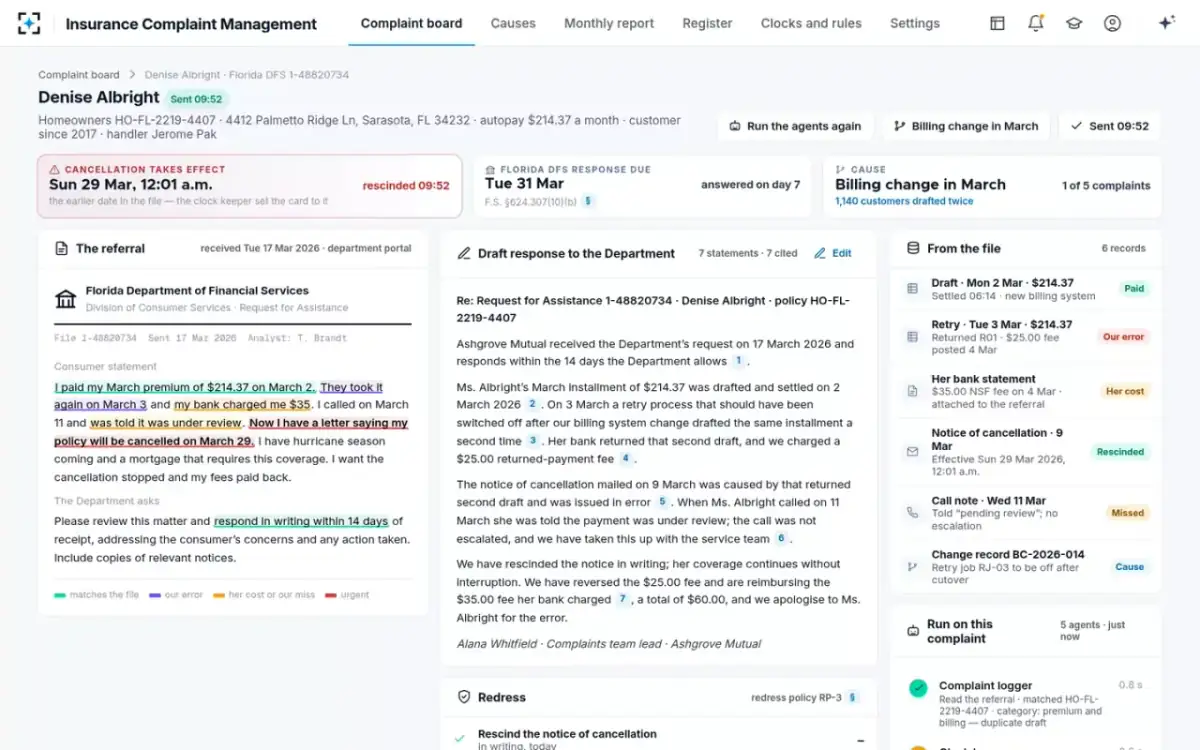
At the insurer, a department complaint is a deadline, a file to rebuild and an entry in the register, and handled well it can fix more than one customer's problem. Take the solution's sample, a fictional Florida homeowner, Denise Albright, who was drafted twice for her March premium, charged a $25.00 returned-payment fee by the insurer and $35.00 by her bank, and sent a notice of cancellation that would take effect before the department's deadline.
The response went out on day 7 of Florida's 14, with the notice of cancellation rescinded, both fees refunded and an apology for the error. Because the solution matched her complaint to four others about the same billing change, the insurer also found the 1,140 customers drafted twice and proposed remediation for all of them, including the 46 whose cancellations were about to take effect.
Insurance Complaint Management: answered on day 7 of 14, the cancellation rescinded
What a department complaint costs the insurer
The redress is often the smallest part of the cost. Botminds' estimate for this solution puts the handling of one department complaint by hand at about five and three-quarter hours, most of it spent pulling records, against about an hour and a quarter with the agents. Then there is the record it leaves. Examiners reconcile an insurer's complaint register against the department's list, and departments compute complaint indexes from confirmed complaints by line, which feed decisions about where to examine.
The larger cost is the complaint that is a symptom. A department complaint about one billing error may be the only visible sign of a defect that reached hundreds of customers who have not written in. In the solution's sample, five complaints represented 0.4% of the customers affected. Finding the other 99.6% before they become complaints is where the economics turn.
Where Insurance Complaint Management fits, for the insurer
For an insurer, the solution makes the outcome a regulator sees, a complete and timely answer, the default. It logs department complaints from every portal, puts each on its statutory clock, pulls the records, drafts an answer that cites them and works out the redress the carrier's policy allows; a team lead signs. For the person who filed, nothing changes except that the answer is complete and on time.
It does not decide the dispute. Whether a claim should be paid, a premium refunded or a policy reinstated stays with the people who own those decisions, and the response says only what the records support. The clocks the solution applies, state by state, are compared in the department of insurance complaint response timeline.
Questions people ask
How do I file an insurance complaint with NY DFS?
Complain to the insurer first, then file with DFS, online or on its paper Consumer Complaint Form, attaching copies of documents. DFS's health insurer guide gives dfs.ny.gov/complaint and (800) 342-3736 for complaints about payment, coverage and premiums.
How often does a complaint to NY DFS succeed?
In 2025, 26.5% of the insurance complaints DFS closed ended with a positive outcome, 10,336 of 39,064. Prompt-pay complaints did best at 30.9% and life insurance complaints worst at 11.7%.
Can the insurance commissioner force my insurer to pay a claim?
Not as a general rule. Florida's Division of Consumer Services says it cannot compel payment where the company has broken no law, rule or policy provision, and DFS's form says the department represents the public, not the individual as a private attorney.
How long does an insurer have to answer a complaint sent by the regulator?
In New York, 10 business days to furnish information on an inquiry about a claim; in Florida, 14 days from the division's written request for any consumer complaint. Florida can fine an insurer up to $5,000 per violation for missing it.
Should I contact the insurance company before filing a complaint?
Yes. The DFS form instructs consumers to file with the insurer first, and Florida's Division of Consumer Services asks consumers to give the company the opportunity to resolve the issue before submitting it.
Does a complaint to the regulator affect the insurance company?
Yes. It must be answered on a statutory deadline, entered in the complaint register examiners reconcile, and upheld complaints feed public rankings such as New York's health insurer guide, which divides upheld complaints by premiums.