The standard insurance complaint categories list is the NAIC's: every complaint is classified first by the company function involved (underwriting, marketing and sales, claims, policyholder service or miscellaneous), then by a reason within that function, such as delays, denial of claim or cancellation, and also by line of insurance and by how it was disposed of. Regulators code complaints the same way in the NAIC's Complaints Database System, and Texas recommends its four-digit codes to insurers. What the list does not settle is the complaint with several reasons, and that is most of them: in our analysis of the complaints Texas closed in 2025, nearly three in four carried two or more. Insurance Complaint Management, Botminds' complaint software, records every reason a complaint gives and groups complaints by shared cause, not only by category.
One year of Texas complaint coding, by the numbers
96
distinct reasons used on complaints closed in 2025
35
distinct dispositions recorded on the same complaints
73%
of 22,564 complaints carried two or more reasons
28%
carried three or more
What are the insurance complaint categories?
Insurance complaints are categorised on four axes: the function of the company involved, the reason within that function, the line of insurance and the disposition. The structure comes from the NAIC's model regulation on complaint records, first adopted in 1973, which requires that complaints "be classified by function(s) of the company involved", with separate classifications for underwriting, marketing and sales, claims, policyholder service and miscellaneous, and then by the nature of the complaint within each.
Texas wrote the same structure into its rule and made the order explicit: each complaint is classified hierarchically, a function first and then a reason (28 TAC §21.2504(c)). Line of insurance has 14 classes in the model, from automobile to mobile homeowners. Disposition is the outcome, and the model leaves its wording to the company, giving three examples: corrective action taken, no action deemed necessary and a satisfactory explanation given.
The NAIC list: five functions and their reasons
The full list fits on one table, and most carriers' dropdowns are a version of it. Its strength is that it separates what the company did (the function) from what went wrong (the reason), so "delays" in claims and "delays" in underwriting are counted apart. Its weakness is the catch-all "miscellaneous" in every function, where complaints that do not fit end up unanalysed.
The NAIC complaint categories: function first, then reason
| Function | Reasons within it | Count |
|---|---|---|
| Underwriting | Company underwriting · individual application underwriting · cancellation · rescission · nonrenewal · premiums and rating · delays · refusal to insure · miscellaneous | 9 |
| Marketing and sales | General advertising · mass marketing advertising · agent handling · replacement · dividend illustration · delays · misleading statement or misrepresentation · miscellaneous | 8 |
| Claims | Claims procedure · delays · unsatisfactory settlements · natural disaster adjusting · unsatisfactory settlement offers · denial of claim · miscellaneous | 7 |
| Policyholder service | Failure to respond · delays · miscellaneous | 3 |
| Miscellaneous | No reasons listed | — |
NAIC complaint reason codes and disposition codes
The NAIC's numeric codes live in its Complaints Database System, which state insurance departments have fed since October 1991, and they were rebuilt in 2008. The handbook (2017 edition) describes the new coding plan as changes to reason and disposition codes, new coverage, reason, disposition and subject codes, and a new "subject" field and "confirmed" field on the standard complaint data form. States converted over a five-year period from 2011 to 2015, and the handbook reports that all had converted by April 2016.
The code tables themselves sit with regulators: the handbook points them to the NAIC's regulator-only site for the coding guidance and the standard complaint data form. Insurers meet the codes through their departments. Texas recommends, but does not require, that insurers use the NAIC's four-digit reason codes and its disposition categories, and lists 15 recommended dispositions of its own, from "Claim settled" and "Nonrenewal notice rescinded" to "Question of fact", "Contract provision/legal issue" and "Company position upheld" (§21.2504(e)).
The older numeric codes still appear in the handbook as history. Before the new plan, a complaint counted as confirmed when its disposition was one of six codes, such as "1230 Claim Settled" or 1311 Company Position Overturned. Under the current plan the department records a separate confirmed status instead, which is why the disposition and the confirmed flag should be two fields in an insurer's register as well.
Most complaints have more than one reason: the Texas evidence
A single reason per complaint is the exception, not the rule. Texas publishes its complaints with every reason the department recorded, and of the 22,564 it closed in 2025 only 6,122, or 27%, carried just one. Forty-five percent carried two and 28% three or more. A register with one dropdown cannot hold that, so a handler picks one, and two handlers pick differently.
How many reasons Texas recorded on each complaint it closed in 2025
Which reasons travel together
The reasons that co-occur are predictable, which is why a multi-reason record is analysable rather than messy. The most frequent combination in Texas's 2025 file was claim-handling service with claim delays, on 4,169 complaints, and the next, on 2,424, added an unsatisfactory settlement offer. A policyholder who waited, felt ignored and then got a low offer has three grievances, and the one a handler picks decides which root-cause line the complaint feeds.
The reasons on Texas's 2025 complaints, share of complaints carrying each
Texas adds a third layer that the NAIC list lacks: a keyword. In 2025 the most common were the adjuster's handling, roofs, total losses, hail and water damage. That is the beginning of a cause, not a category, and it is the layer most carrier registers are missing.
Two handlers, one complaint, two codes: measuring whether coding agrees
Before a category report goes to a conduct committee, measure whether two people code the same complaints the same way. The standard measure is Cohen's kappa, which corrects raw agreement for the agreement two coders would reach by chance. A review in Biochemia Medica explains why the correction matters: percent agreement ignores guessing, and the author argues that a kappa under 0.60 shows the coders do not agree well enough to rely on their counts (McHugh, Biochemia Medica).
Two handlers code the same 100 past complaints: 72% agreement, kappa 0.59
| Handler A ↓ · Handler B →A ↓ B → | Claims handlingC | Premium and billingB | UnderwritingU | Policyholder serviceS | A’s totalAll |
|---|---|---|---|---|---|
| Claims handlingClaims (C) | 38 | 2 | 1 | 4 | 45 |
| Premium and billingBilling (B) | 3 | 17 | 1 | 4 | 25 |
| UnderwritingUnderwr. (U) | 1 | 2 | 12 | 0 | 15 |
| Policyholder serviceService (S) | 4 | 5 | 1 | 5 | 15 |
| B’s totalTotal | 46 | 26 | 15 | 13 | 100 |
Observed agreement72 of 100 on the diagonal = 0.72
Chance agreement(45×46 + 25×26 + 15×15 + 15×13) ÷ 10,000 = 0.314
Kappa(0.72 − 0.314) ÷ (1 − 0.314) = 0.59
Where they splitPolicyholder service: 5 of 15 agreed. The amber cells are the splits between a service reading and a billing or claim reading of the same complaint.
A team that sees 72% agreement usually stops there. Kappa says the coding is not yet reliable enough to rank causes, and the matrix says where: the policyholder-service row, where complaints with a billing or claim element land when a handler reads the tone rather than the substance. Allowing a second reason, and agreeing which one is primary, is the fix most teams need; a longer dropdown rarely is. The same test applied to an AI classifier is set out for banks in testing AI complaint classification, and it applies equally to agents coding insurance complaints, as discussed in AI for complaint management at an insurer.
Insurance complaint categories and definitions that hold up
A category scheme holds up when two people apply it the same way and when it maps to the regulator's own coding. That takes written definitions with examples, not labels. The checklist below draws on the NAIC model, the Texas rule and what the Texas data shows about real complaints.
Seven rules for a complaint coding scheme that survives an exam and a committee
- Code function first, then reason
The NAIC and Texas order. It keeps claims delays and underwriting delays apart.
- Allow more than one reason, and mark the primary
Nearly three in four Texas complaints in 2025 had two or more reasons.
- Keep disposition and confirmed status as separate fields
Under the NAIC’s current plan, departments record confirmed status apart from the disposition.
- Write a definition and two examples for every reason
Especially the catch-alls: a policyholder-service complaint about a duplicate draft is a billing complaint.
- Map your codes to the departments’ codes
Texas recommends the NAIC’s four-digit reason codes; matching them makes the exam reconciliation mechanical.
- Add a free cause field the categories cannot carry
Texas’s keywords (roof, hail, total loss) are a start; a system change or a letter template is a cause.
- Measure agreement every quarter
Two coders, a sample of past complaints, kappa. Below 0.60, fix the definitions before trusting the report.
From category to cause: an insurance complaint root cause analysis example
A category tells you where complaints land; a cause tells you what to fix, and they are different questions. In the solution's sample, a fictional personal lines carrier, five complaints over eight days all fell under the same coarse category, premium and billing. The category count rose by five, which no committee would notice. The cause was specific: after a billing system cutover, an old retry job drafted 1,140 autopay instalments a second time.
Insurance Complaint Management’s cause page: what five billing complaints share
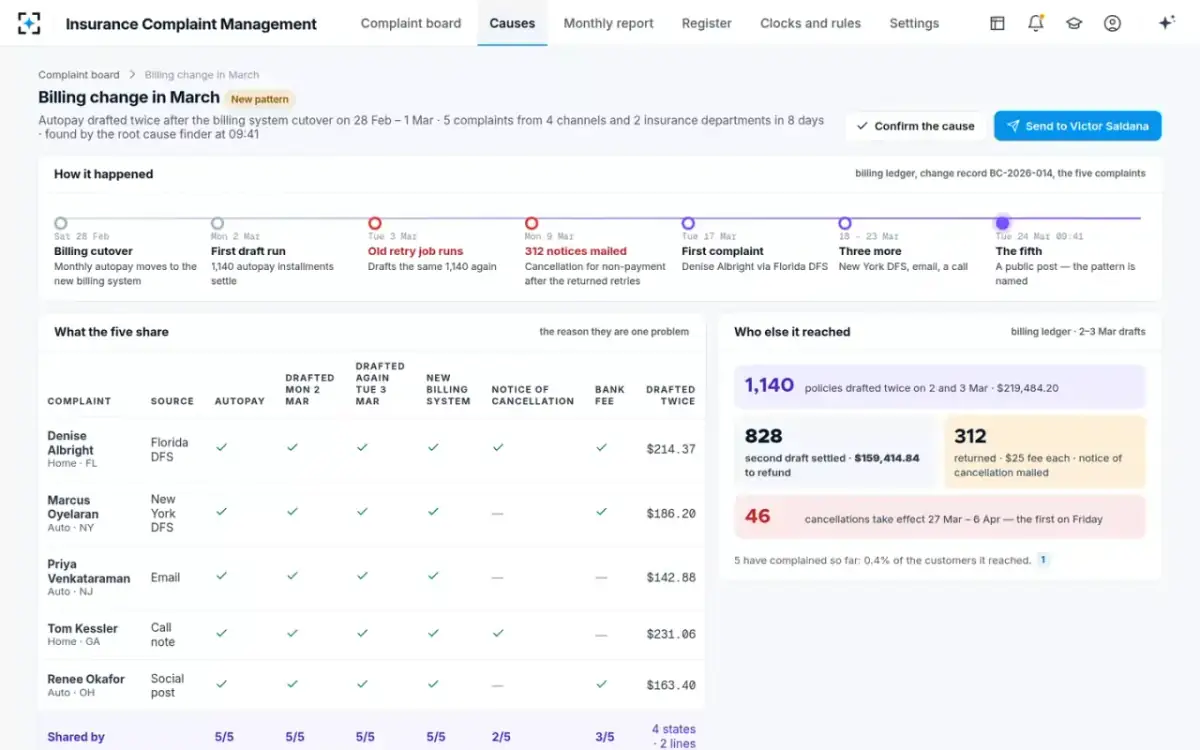
The root cause finder in the solution looks across categories for shared dates, systems, products and states, and names a pattern when enough complaints match: three in 30 days in the sample's settings. A conduct risk analyst confirms it, and it always names a process or system, never a person. The method for banks, with a regulator's view of systemic issues, is followed in an escrow complaints root cause case study.
Where Insurance Complaint Management fits in complaint coding
The complaint logger codes each complaint to the carrier's own scheme, keeping every reason the customer gave and the customer's own words, and routes unclear cases to a handler. Codes can be mapped to the NAIC function and reason structure for the register. The root cause finder then works on the layer the categories miss, and the monthly report ranks causes against the previous month for the conduct committee.
What the solution does not do is replace the carrier's definitions. The scheme, the threshold for naming a pattern and the look-back period are settings, changed with a second person from compliance. The test of agreement between handlers, or between handlers and agents, is the carrier's to run, and the solution's coding should be held to the same 0.60 bar as a person's.
Questions people ask
What are the main types of insurance complaints?
By NAIC function: underwriting, marketing and sales, claims, policyholder service and miscellaneous. By volume, claims dominate: in Texas's 2025 data, claim-handling service, claim delays and settlement offers were the three most common reasons.
Where can I find the NAIC complaint reason codes?
The numeric code tables and the standard complaint data form are published to regulators through the NAIC's regulator site; insurers usually receive them through their state departments. Texas's rule, 28 TAC §21.2504, prints the function and reason list in words and recommends the NAIC's four-digit codes.
What are NAIC complaint disposition codes?
They record how a complaint ended, such as claim settled, additional payment, company position upheld or question of fact. Texas recommends 15 disposition categories to insurers; the 1992 NAIC model only gives examples and lets companies use their own wording.
Can one complaint have more than one category?
Yes, and most do. Texas records every reason, and 73% of the complaints it closed in 2025 carried two or more; a register should allow several reasons with one marked as primary.
How many complaint categories should an insurer use?
Enough to map to the NAIC's 27 function-specific reasons, and few enough that two handlers agree. Agreement is measurable: if Cohen's kappa between two coders falls below 0.60, simplify or define the categories before adding more.
Is a complaint about an agent a separate category?
In the NAIC list it is a reason, "agent handling", under marketing and sales. Texas also requires the complaint record to carry an identifier for the placing or servicing agent whenever an agent is involved.