Root cause analysis on customer complaints means finding the one process step behind many complaints, sizing everyone it touched, and fixing the step and every account, not answering each complaint on its own. The CFPB’s examination procedures name the textbook case: whether “an information system coding error led to inaccuracies across a portfolio” (CMR 14). Botminds’ Complaint Management is complaint management software in which agents group complaints from every channel into themes, propose the likely cause with evidence, and hand it to the person who owns the process. This page follows one fictional batch through it: forty complaints, three channels, one escrow error.
The bank, the borrowers and every figure about them are sample data, invented for the solution’s demonstration, not a customer result. Kestrel Point Bank took over 6,214 mortgage loans from Brightwater Home Loans on 1 September. Its first escrow statements on those loans went out on 8 October. Complaint analysts will recognise what came next.
One servicing transfer, three complaint themes
| Theme | Complaints and channels | What the records showed | Where it went |
|---|---|---|---|
| Escrow shortage after transfer | 40 · 23 calls, 11 emails, 6 CFPB complaints | A tax instalment listed as due in the transfer file had already been paid by the prior servicer; the escrow analysis counted it twice on 1,140 loans. | ISS-2026-031 to the head of mortgage servicing; accepted |
| Late fee after payment sent to the prior servicer | 9 · three channels | Late fees charged inside the 60-day window after transfer, on payments sent to the old servicer on time; 212 loans, $9,540 to refund. | ISS-2026-032 to the same owner |
| Insurance placed after transfer | 8 · three channels | Insurance placed on transferred loans; still under watch, with no cause proposed yet. | A paid-insurance check added to boarding for future transfers |
How one escrow error reached the bank as forty separate complaints
It arrived the way most systemic errors do: through every door at once, in different words. Between 9 and 12 October, borrowers called the contact centre about a payment increase, emailed the servicing mailbox that their escrow analysis was wrong, and filed with the CFPB that they were being billed for taxes already paid. By 06:00 on Monday 12 October there were 19. On that Monday alone, 21 more arrived: 15 calls, 4 emails and 2 CFPB complaints.
In a team organised by channel, those forty complaints fall into three queues with three owners. The contact centre codes a call about a higher payment as a payment inquiry. The servicing desk sees an escrow dispute. Regulatory relations sees a portal complaint with a 15-day clock. Each queue holds a handful of something ordinary. That is why the CFPB’s 2025 report describes consumers “having to make repeated attempts to resolve escrow issues”, and notes that escrow problems “appeared to be especially frequent after servicing transfers” (CFPB Consumer Response Annual Report 2025).
The escrow batch on the morning it was flagged
40
complaints in the theme: 23 calls, 11 emails and 6 CFPB complaints
19 → 40
overnight growth, Monday 06:00 to Tuesday 06:00
37days
after the transfer with no escrow complaints at all, until the statements arrived
1,140
loans later found with the same false shortage
What do examiners expect from complaint root cause analysis?
They expect it to explain why a violation or error happened, to reach every consumer it touched, and to change the process that produced it. The CFPB’s procedures ask whether evaluations “include comprehensive root cause analysis to assess why a particular law violation or error occurred”, giving two examples: a system coding error “across a portfolio”, and “repeated data entry errors, in the absence of appropriate monitoring”. They then ask whether root cause is used in corrective action, and whether the bank provides “retrospective remediation to all consumers harmed” (CMR 14–15).
The UK conduct regulator, which reviewed complaint handling across banking groups, frames the core discipline in one line: root cause analysis must “distinguish between a symptom and the root cause of a complaint” (FCA, 2018). In its worked example, rising collection calls and arrears were the symptom, a payment system update that stopped standing orders being applied was the fault, and the root cause was governance: no senior owner of the update, and testing cut while the project ran late. The remedy reached every account paid by standing order since the update, not only those that complained. A US examiner reading a complaint file asks the same three questions: what failed, why it was allowed to, and who else it hit.
Step one: group complaints by what happened, and line them up with what the bank changed
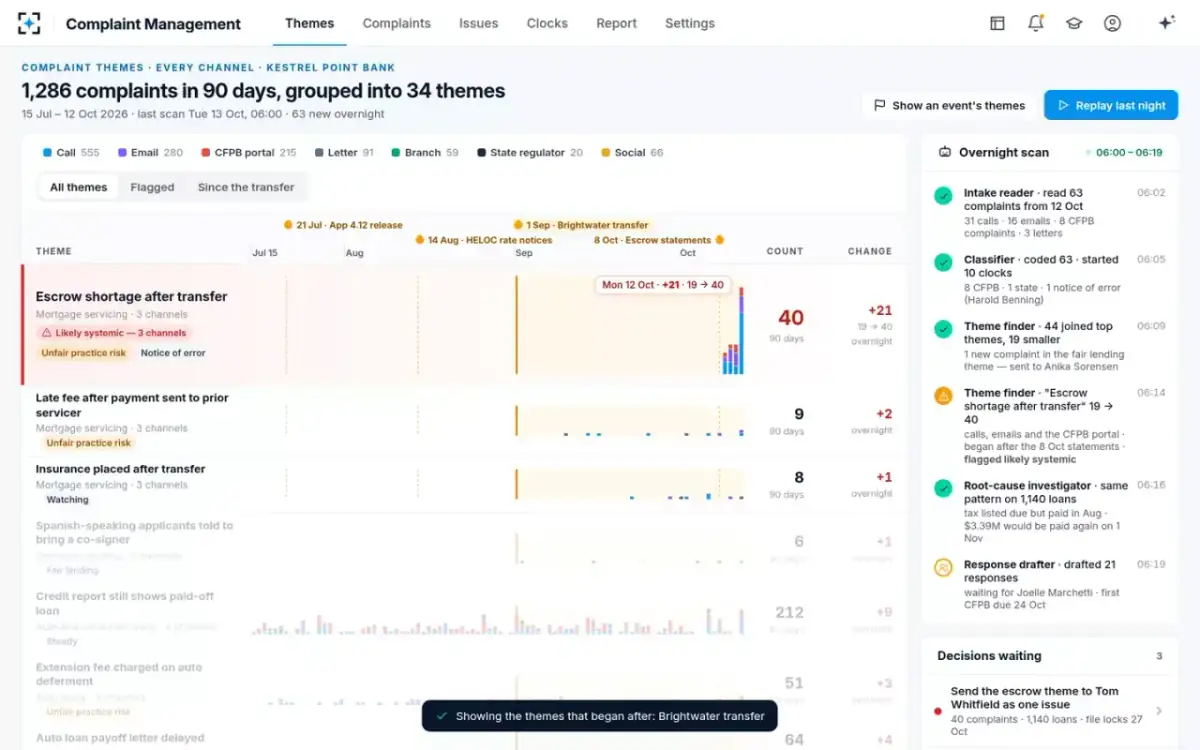
The first move in complaint root cause analysis is to stop counting by channel and category and start grouping by event. The solution’s theme finder groups complaints by what happened, not by the words used: “my payment went up”, “escrow shortage” and “you billed me for taxes Brightwater paid” land in one theme because they describe the same account event. Each theme is compared with its own 30-day baseline and drawn as a daily strip, coloured by channel.
Above the strips runs a band of operational events: the 21 July app release, the 14 August HELOC rate notices, the 1 September transfer and the 8 October escrow statements. The default setting looks for events in the 60 days before a theme began. Picking the transfer shows the three themes above, which began after it and nowhere else. Without the band, the escrow theme would be an unexplained spike; with it, the spike starts the morning after a known mailing.
Pick the transfer, and the themes that began after it stand out
Step two: compare the records that disagree, not the narratives
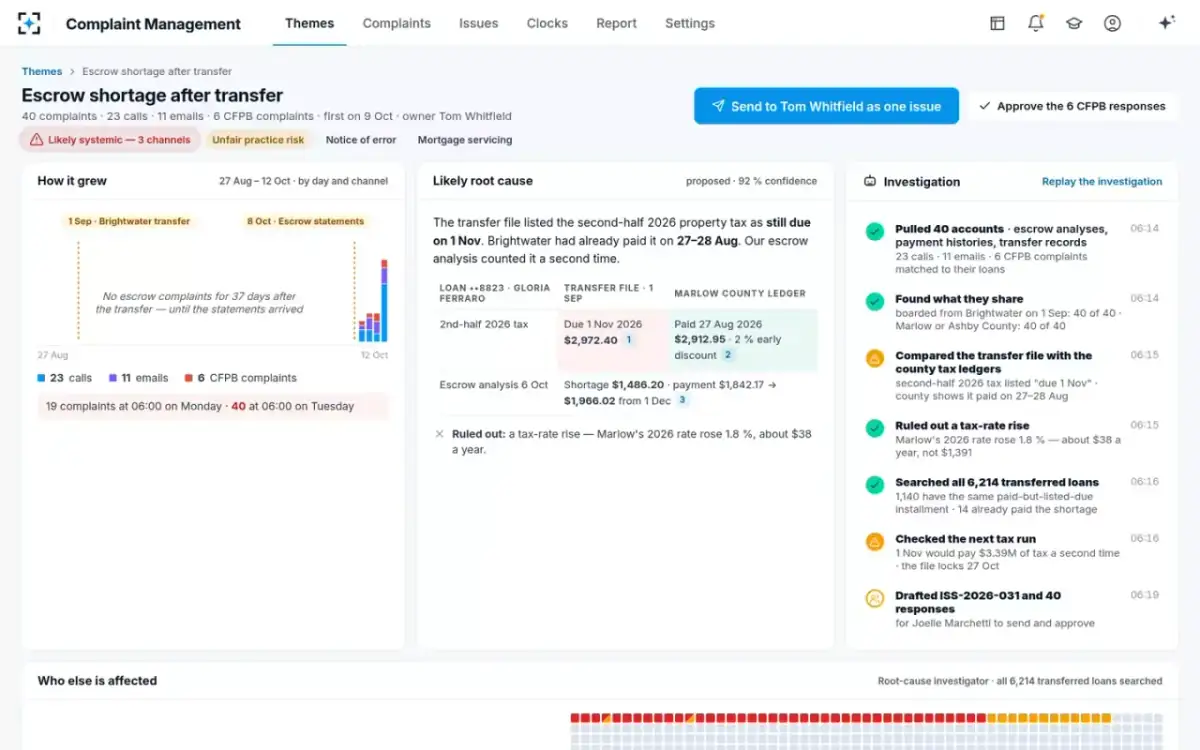
A complaint narrative tells you where to look; the account records tell you what happened. For a flagged theme, the root-cause investigator pulled the 40 accounts, their escrow analyses, payment histories and transfer records. All 40 had been boarded from Brightwater on 1 September, and all 40 were in Marlow or Ashby County. That narrowed the search to what the transfer said about county taxes, and the records disagreed.
One loan, two records of the same tax bill
Transfer file from the prior servicer: Due 1 November 2026, $2,972.40
County tax record: Paid 27 August 2026, $2,912.95, with a 2% early-payment discount
Transfer file from the prior servicer: Projected the payment as still to come and found a shortage of $1,486.20
County tax record: Nothing was due; there was no shortage
Transfer file from the prior servicer: Monthly payment up from $1,842.17 to $1,966.02 from 1 December
County tax record: The borrower held the county’s receipt for the August payment
Two features of the method matter more than the answer. The investigator cites both sides of every disagreement, so the person who decides can see the transfer file line and the county record together. And it tests the obvious alternative before proposing its cause: a rate rise would explain a higher payment, and the arithmetic rules it out. It never calls a cause confirmed; the cause stays proposed until its owner accepts it.
The finding fits what Regulation X expects of transfers. A transferee servicer must have policies to “identify necessary documents or information that may not have been transferred” (12 CFR 1024.38(b)(4)), and failing to transfer information accurately is itself a covered error under the notice-of-error rule (12 CFR 1024.35(b)(8)). The CFPB’s report says companies answering escrow complaints often attributed problems to “loan boarding, or prior servicers” and “in some cases admitted to escrow analysis calculation errors.”
Why do escrow payments go up after a servicing transfer?
Usually for legitimate reasons, a higher tax or insurance bill or a shortage spread over the next year, and sometimes because information was lost or misread in the transfer. A new servicer that changes the payment or the accounting method must send an initial escrow statement within 60 days of the transfer, and from then on runs the annual analysis that finds a surplus, shortage or deficiency (12 CFR 1024.17(e)–(f)). The analysis projects the year’s disbursements from the data it holds, so a tax bill wrongly shown as unpaid becomes a projected payment, and the projected payment becomes a shortage.
The rules on collecting a shortage set what the borrower sees. If the shortage is less than one month’s escrow payment, the servicer may leave it, ask for it within 30 days, or spread it over at least 12 months. If it is a month’s payment or more, the servicer may leave it or spread it over at least 12 months, and may not demand it in one sum. That is why a false shortage of $1,486 arrives as a payment rise of about $124 a month, and why some borrowers still pay it at once to make the increase go away.
For a complaints analyst the useful test follows from that mechanism. A real increase traces to a bill: the county rate, the insurer’s renewal premium. A transfer error traces to a line in the boarding data that no bill supports. Asking which of the two explains the increase, loan by loan, is faster than reading the forty narratives again.
The theme: how it grew, the likely cause, and each step of the investigation
Step three: size the affected population before the next disbursement
Root cause is only useful if it reaches everyone affected before the error repeats. The investigator searched all 6,214 transferred loans for the same pattern, a paid instalment listed as due, and found it on 1,140: 812 in Marlow County and 328 in Ashby. Together they had been billed $1.59 million of shortage that was not owed, $1,391 a loan on average. Fourteen borrowers had already paid the shortage in one sum, $19,870 to refund.
The bigger exposure was still ahead. The bank’s 1 November tax run would pay $3.39 million of tax a second time on those loans, and the disbursement file locked on 27 October. That date, not any complaint clock, set the pace of the investigation. A servicer must pay escrowed taxes “on or before the deadline to avoid a penalty” (12 CFR 1024.34(a)); paying a bill already paid is a different failure, but it is found the same way, by comparing the disbursement file with the county’s record.
Who else is affected: every transferred loan searched, not just the forty
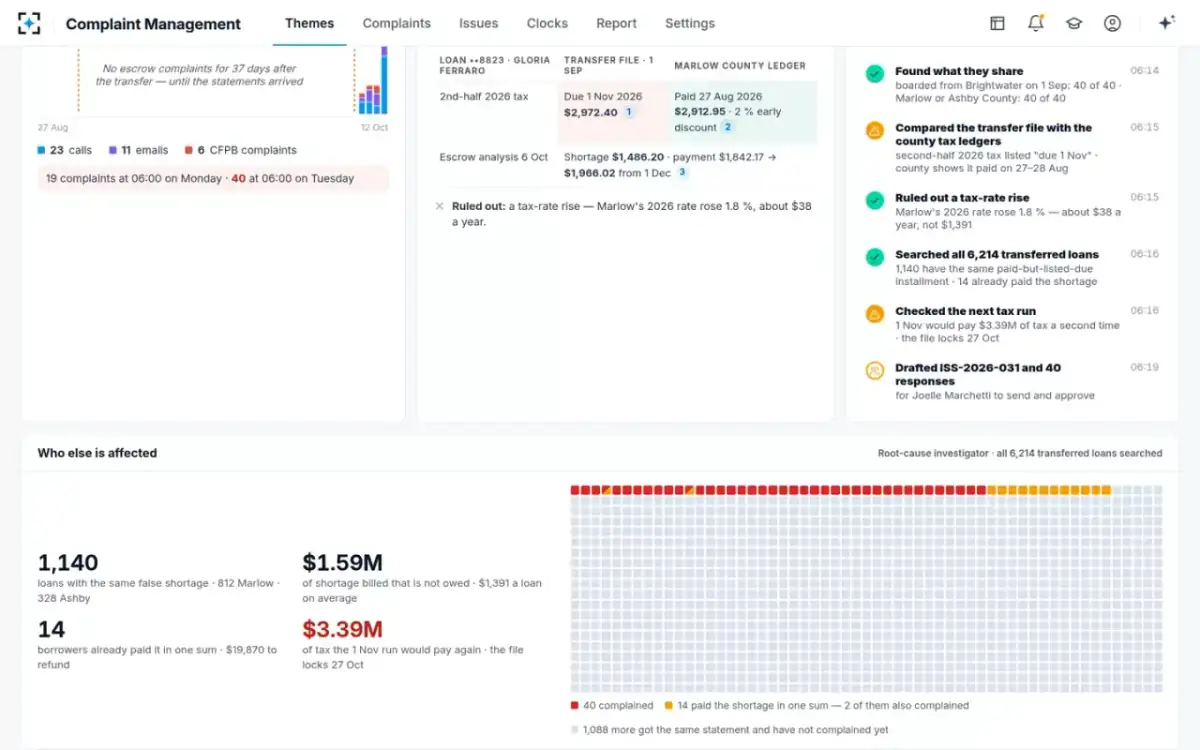
Of the 1,140, only 52 had complained or paid. The rest had not acted yet.
Step four: one issue to one owner, and remediation for every loan
Complaints staff do not own escrow analyses or tax runs, so the output of root cause is a hand-off. The complaints lead sent the theme to the head of mortgage servicing as one issue, ISS-2026-031: forty complaints linked, the cited evidence from the transfer file, county records and escrow analyses, and a five-step remediation plan with owners and dates. The first step was to stop the 1 November disbursement for the 1,140 loans before the file locked.
The agents could not take that step. They read loan, escrow, payment and transfer records and never change them; when a user asked the solution to hold the payment, it replied that the hold was the issue owner’s decision and added it to his plan. The owner accepted the issue, and the hold became his first action. That is the shape the CFPB procedures look for: root cause used “in corrective action”, and “retrospective remediation to all consumers harmed” (CMR 14–15), not just to the forty who wrote in.
Forty complaints become one accepted issue
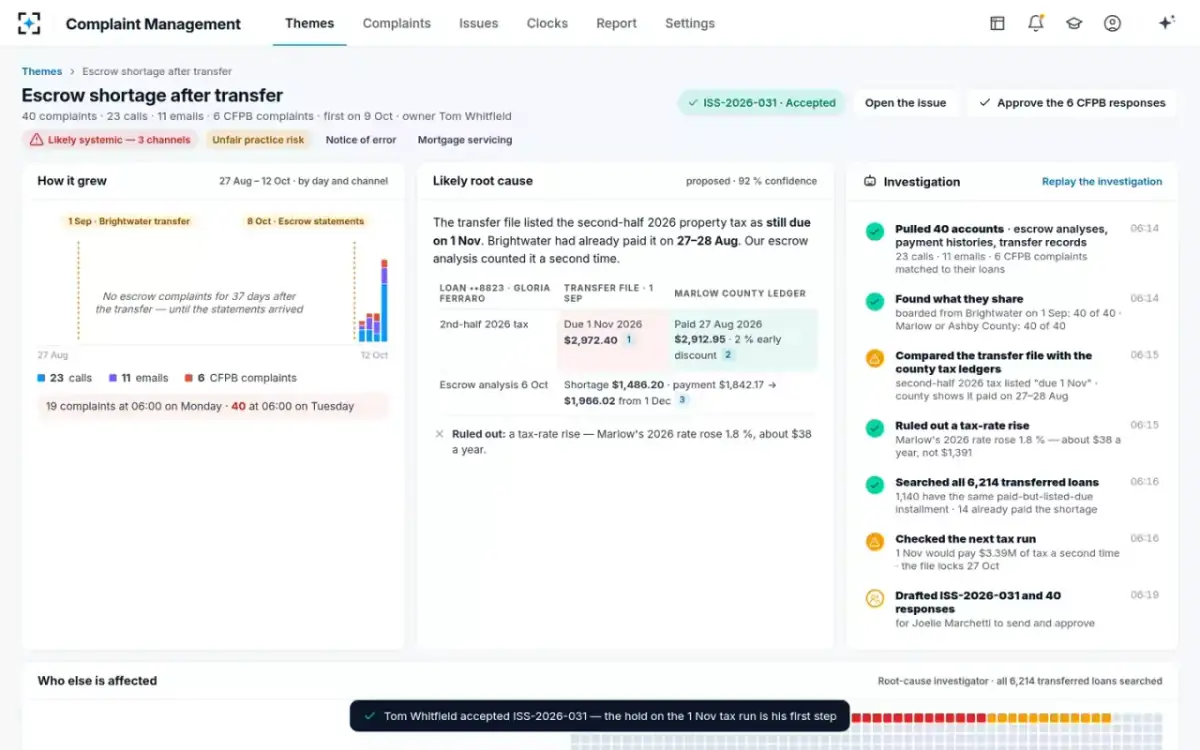
Acceptance also unlocked the responses. The drafted responses promised to stop the 1 November payment and keep the borrower’s monthly payment where it was. Until the owner accepted the issue, those commitments were marked as pending and “Approve and send” stopped on them. Once he accepted, the first CFPB response went out through the portal eleven days before it was due. How those drafts are built is the subject of complaint response letters.
Where the time goes in complaint root cause analysis, by hand and with agents
The case is fast because the slow step changes. By hand, the longest wait is not reading or writing; it is the weeks before anyone sees that complaints in different queues share one problem. The estimate below, from the solution’s own model, puts that wait at about a month, most often ended by a monthly or quarterly trend review.
Most of the delay is in seeing the pattern, not in answering complaints
| Stage | By hand, channel by channel | With the agents |
|---|---|---|
| Reading and coding each complaint | 2.5 days | about 0.1 day |
| Seeing that complaints across channels share one problem | 30 days | 1 day |
| Finding the cause and who else is affected | 10 days | half a day |
| Drafting factual responses from the account record | 5 days | 1 day |
| Approval and sending | 1 day | 1 day: a person still approves every response |
| Total | about 49 days | about 4 days |
In this sample, a month’s wait would have carried the investigation past the 27 October file lock and into the 1 November disbursement. The same lesson applies to the second transfer theme: nine complaints about late fees led to 212 loans charged late fees inside the 60-day window in which a payment sent on time to the old servicer “may not be treated as late for any purpose” (12 CFR 1024.33(c)(1)), and $9,540 to refund.
What are complaint root cause categories?
They are the kinds of failure a confirmed cause can be filed under, and a short, fixed list makes causes comparable across quarters. Six categories cover most of what complaint investigations find. The category matters less than the evidence, because each one is confirmed by a different record and fixed by a different owner, and a category named without its evidence is a guess.
Six complaint root cause categories, the record that confirms each, and who fixes it
| Category | Typical complaint symptom | Record that confirms it | Who owns the fix |
|---|---|---|---|
| System or coding error | Many accounts wrong in the same way at once | The rule or field in the system, tested against a sample of accounts | Technology owner of the system |
| Data conversion or servicing transfer | A spike starting after boarding, limited to transferred loans | The transfer file against the source record (county, insurer, prior servicer) | Servicing operations, with the boarding team |
| Process or control gap | The same error, sporadic, across teams | The procedure and the missing check | The process owner |
| People and training | Errors clustered by branch, team or new hires | Call recordings, notes and coding by employee | The line manager, with training |
| Third-party provider | Complaints naming a vendor, a collector or a payment app | The vendor’s own records and the contract | The vendor manager |
| Product, policy or disclosure design | Customers surprised by a term the bank applied correctly | The disclosure and the customer’s path to it | The product owner, with compliance |
The escrow case sits in the second row, and its root cause, in the FCA’s sense, sits a level deeper: the boarding process had no check that a tax instalment listed as due had not already been paid. That is why the lasting fix was a boarding check, not a correction to 1,140 escrow analyses alone.
What this complaint root cause case teaches about systemic issues
Four practices made the difference, and none depends on this particular error. Group complaints by event across channels, so a problem is counted once. Keep a calendar of operational changes beside the complaint data, because most systemic errors begin with a change the bank made: a transfer, a mailing, a release, a rate notice. Compare the records that disagree and test the obvious alternative before naming a cause. And size the population against the next operational deadline, not the complaint clock.
The fix that lasts is upstream. After the case, a check for paid instalments and insurance was added to boarding for every future transfer, the kind of change in “policies, procedures, training, monitoring” the CFPB procedures ask root cause to produce. The board report for October then listed the issue as found, owned and being fixed; the complaint KPIs a board should see shows how to report it. The Complaint Management page has the full story, screen by screen.
Questions people ask
How do you know a complaint theme is systemic rather than a busy week?
Compare it with its own baseline and look across channels. The solution’s defaults flag a theme that doubles within 24 hours or spans three or more channels with at least ten complaints in seven days; both are settings. A spike that starts right after an operational event is the strongest single signal.
Do you have to remediate borrowers who never complained?
The CFPB examination procedures ask whether remediation reaches all consumers harmed by a particular violation, so the population, not the complainants, sets the scope. In this case that meant 1,140 loans, not 40.
Who should own a complaint root cause investigation?
The complaints function finds and evidences the pattern; the owner of the process accepts the cause and the fix. A cause proposed by complaints staff or agents stays proposed until that owner signs it.
What is the difference between a symptom and a root cause?
The symptom is what customers experienced, such as a higher payment or a late fee; the root cause is why the bank’s process allowed it. In the FCA’s example, wrongly charged arrears were the symptom and a poorly governed system update was the cause. Fixing the symptom refunds this month’s customers; fixing the cause protects next month’s.
How do you check that a root cause fix worked?
Watch the theme after the fix and re-check a sample of accounts. The FCA’s example monitored calls, complaints and social media after the change and added a manual check on a sample of affected accounts. In the solution, the theme keeps its 30-day baseline after an issue is accepted, so a recurrence shows as a new rise.