An AI complaint response is safe for a bank to send only when every fact in it comes from the account record, the content a rule requires is checked, and a named person approves it. A response to a customer complaint should state, in plain language, what the bank found in the account records, what it will do and by when, and how to reach someone. Where a rule applies it must also carry set content: a Regulation X answer that finds no error must give the reasons and the borrower’s right to request the documents relied on, and a Regulation E answer must explain the findings in writing. Botminds’ Complaint Management includes a response drafter, one of six agents, that writes each response from the account record in the bank’s approved templates, cites every fact, marks any promise that depends on an open issue, and sends nothing without approval. This page takes that one step in depth, and ends with what a buyer should ask of any AI complaint response tool.
Drafting is hard for a reason that has little to do with prose. A good answer needs the facts of one account, the template the bank approved for that kind of complaint, the content a rule demands, and an accurate statement of what the business has agreed to do. Template text alone supplies only the second, and a general-purpose AI writer supplies only fluent prose. Neither is where the violations are prevented.
How the response drafter builds one letter
Agent
Read the complaintTakes the borrower’s own words and what they ask for, as noted by the intake reader, each with its sentence.
Agent
Pull the recordReads the account, escrow analysis, payment history and transfer records the investigation relied on.
Never: change an account or a payment
Agent
Fill the approved templateWrites what we found, what we will do and when, and how to reach us, in the bank’s template for that issue, a citation on every fact.
Agent
Mark the commitmentsHighlights any promise that depends on an open issue, until the issue owner accepts it.
Never: promise a refund amount the owner has not accepted
A person decides
Edit, approve, sendAn analyst checks citations, tone and required content; the complaints lead approves and sends it the way it came: portal, letter or email.
What should a complaint response letter include, rule by rule?
The required content depends on what the complaint is, and the clock it started. The table sets out the main cases. A response that meets the strictest one that applies will usually meet the others, but the strictest is not always the same rule.
Required content of a complaint response, by rule
| Situation | The response must include | Rule |
|---|---|---|
| Reg X notice of error, error found | The correction, its effective date, and contact information including a telephone number. Any other errors found in the investigation are corrected and described too. | 12 CFR 1024.35(e)(1) |
| Reg X notice of error, no error found | A statement that no error occurred, the reason or reasons, the right to request the documents relied on, how to request them, and a telephone number. | 12 CFR 1024.35(e)(1)(i)(B) |
| Reg E EFT error, no error or a different error | A written explanation of the findings and the right to request the documents relied on; copies promptly on request. | 12 CFR 1005.11(d) |
| Reg Z billing error | If the error occurred, a correction and a correction notice; if not, an explanation of the reasons and, on request, copies of documentary evidence of the debt. | 12 CFR 1026.13(e)–(f) |
| Response to a regulator about a complaint (banks over $10B) | The steps taken to respond, responses received from the consumer, and follow-up actions taken or planned. | 12 U.S.C. 5534(b) |
| New York servicer, any written complaint | The correction and contact details, or the results, reasons, right to documents and contact details. | 3 NYCRR 419.6(e) |
The CFPB’s examination procedures add a standard that applies to every response, regulated clock or not: whether responses “are prompt and complete, and based on a thorough investigation of the facts” (CMR 14). Its 2025 report adds a practical point: companies “sometimes refer to documents in their responses, but do not attach the corresponding documents as expected” (CFPB, 2025).
Why is “no error found” not an adequate response?
Because it states a conclusion without the reasons the rules require, and usually because the template, not the investigation, wrote the answer. Federal Reserve examiners cited institutions for failing to give an adequate written explanation of Regulation E findings, “using generic language, such as ‘no error.’ These violations were the result of insufficient templates generated by the institution’s dispute tracking system” (Consumer Compliance Outlook, 2026). The same examiners found vendor-generated notices that “did not include required information” and banks that could not show when oral notices were given.
The lesson is not to abandon templates. Approved templates are how a bank keeps tone, disclosures and contact details consistent, and in the solution they are versioned and approved by the complaints lead; the sample bank’s escrow template is version 6, approved on 2 June. The lesson is that a template is a frame. The facts that answer the complaint have to come from the account, and someone has to be able to see where each one came from.
The same escrow complaint, answered from a template and from the record
Template answer (illustrative): We have reviewed your account and your escrow payment reflects a projected shortage.
Answer drafted from the record: Your second-half 2026 Marlow County tax was paid by your prior servicer on 27 August [1]. The records we received at transfer still listed it as due [2], and our escrow analysis counted it twice [3]. The $1,486.20 shortage is our error.
Template answer (illustrative): No error occurred. No further action is required.
Answer drafted from the record: We will not pay this tax again on 1 November. We will send a corrected escrow statement by 30 October.
Template answer (illustrative): Your new payment is effective as stated.
Answer drafted from the record: Your monthly payment stays $1,842.17; the change to $1,966.02 will not happen.
Template answer (illustrative): Please contact us with any questions.
Answer drafted from the record: Each numbered fact links to the county record, the transfer file and the escrow analysis; the escrow team’s number and hours are given.
The hard part is the promise, not the prose
The riskiest sentence in a complaint response is a commitment. “We will refund the fee”, “we will not pay this tax again”, “your payment stays the same”: each binds the bank, and each is usually in the gift of someone outside the complaints team. A response that promises a fix the business has not agreed, and then does not happen, turns a complaint into a misrepresentation, the territory of the prohibition on deceptive acts and practices (12 U.S.C. 5531).
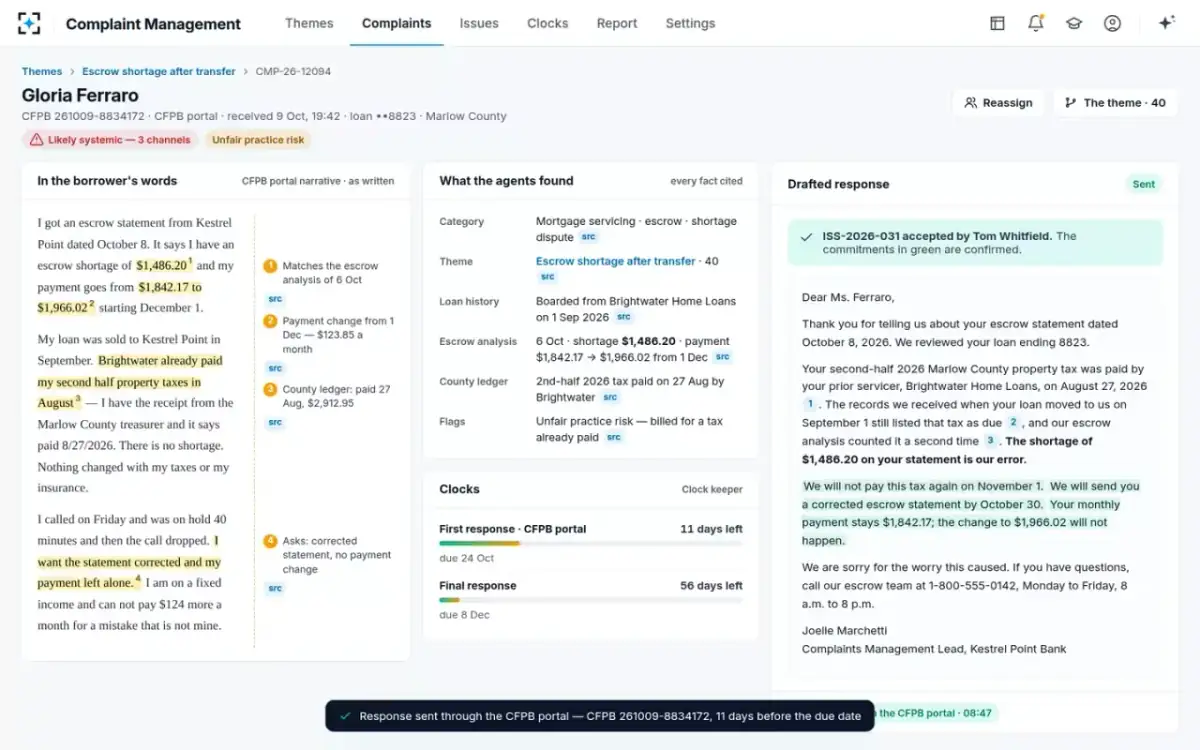
The response drafter handles this with a rule rather than judgment. A commitment that depends on an open issue is highlighted in yellow and stays marked until the issue owner accepts the issue. If the complaints lead presses “Approve and send” first, the send stops with the message “The commitments are not confirmed yet.” The drafter also never promises a refund amount the issue owner has not accepted. In the sample case, the escrow responses waited on the head of mortgage servicing accepting ISS-2026-031, which included stopping the 1 November tax run.
A drafted response: borrower’s words, cited findings, clocks, and commitments waiting on the owner
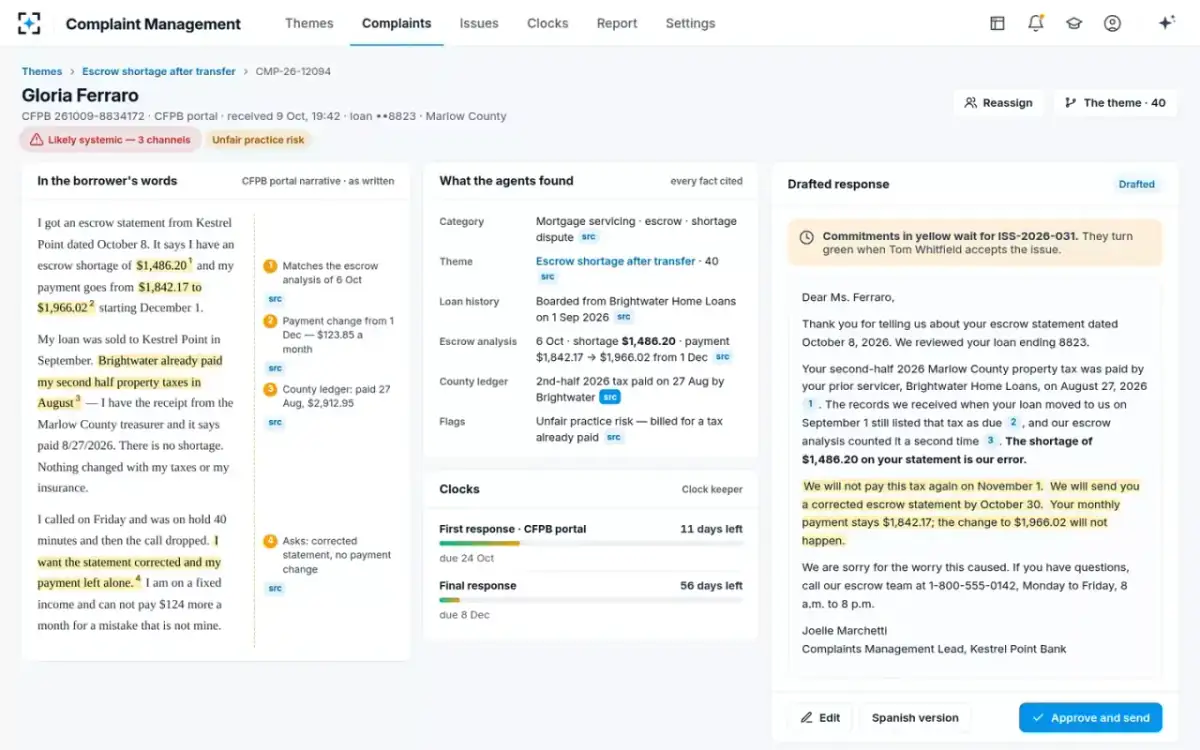
Look at the borrower’s note 4, “I want the statement corrected and my payment left alone”: the draft answers both asks.
How fast should a complaint response go out?
As soon as the facts support it, and sometimes in two steps. Regulation X rewards speed directly: a servicer that corrects the asserted error and tells the borrower in writing within five business days need not send the separate acknowledgment or the 30-day response (12 CFR 1024.35(f)(1)). When the answer depends on an investigation still running, the CFPB portal allows an in-progress response and a final one within 60 days of the CFPB sending the complaint, and Regulation X allows one 15-business-day extension on written notice.
What a two-step answer must not do is fill the gap with promises. The in-progress response says what is known, what is being checked and when the borrower will hear; the final one carries the findings and the commitments. In the sample case the first escrow response went out through the portal eleven days before it was due, on the morning the issue owner accepted the cause, because the draft and its citations were already waiting and only the commitments needed confirming.
Answering what the borrower asked, in the borrower’s terms
A response can be accurate and still not answer the complaint. The intake reader notes what each borrower wants as a separate fact, and the draft answers each request. Gloria Ferraro’s portal complaint asked for two things in one sentence: a corrected statement and no payment change. The draft answers each, in that order, and says when. It also uses her figures, $1,486.20 and $1,966.02, rather than codes, and names the prior servicer she named.
Plain language matters for the same reason. The approved templates set the voice; the drafter fills them with short sentences and the borrower’s own nouns. A Spanish version of a draft can be produced for review, which matters when the borrower wrote in Spanish or asked for service in it, a point complaints as fair lending signals takes further.
After the owner accepts: commitments confirmed, response sent early
Can AI write complaint response letters for a bank?
It can draft them; it should not send them. No federal rule forbids drafting with software, and existing law applies to the letter whoever drafted it. Treasury’s 2024 report advises firms to check AI use cases “for compliance with existing laws and regulations before deployment” (U.S. Treasury, December 2024). The controls that make drafting safe are the ones described here: facts drawn from records and cited, required content checked by rule, commitments tied to the owner’s acceptance, and a named person approving every send.
Measuring whether the drafts are right is a separate job. Testing the classification with known answers sets out how to seed and score the step upstream of the draft, which decides which rule’s content a letter needs.
What to look for in AI complaint response software
Look for where the facts come from, how required content is enforced, and who can send. Fluent writing is the cheapest part of the job and every tool now offers it. The differences that decide whether a tool reduces examination risk or adds to it are structural, and a buyer can test each one in a demonstration on a single complaint.
A general AI writer and a complaint response drafter, side by side
General-purpose AI writing tool: Whatever the user pastes in, or what the model infers; no link back to a record.
Drafter built for regulated complaint responses: Read from the account, escrow, payment and transfer records, with a citation on each fact.
General-purpose AI writing tool: Present if the prompt asked for it.
Drafter built for regulated complaint responses: Chosen by the clock the complaint started: reasons and right to documents for a Reg X no-error finding, and so on.
General-purpose AI writing tool: A style instruction.
Drafter built for regulated complaint responses: The bank’s approved, versioned templates by issue, with the approval date on each.
General-purpose AI writing tool: Written as freely as any other sentence.
Drafter built for regulated complaint responses: Marked until the issue owner accepts; a refund amount only when agreed.
General-purpose AI writing tool: Copy and paste into email or the portal.
Drafter built for regulated complaint responses: Nothing leaves without a named approver, and it goes back through the channel it came in.
General-purpose AI writing tool: A chat history, if kept.
Drafter built for regulated complaint responses: The complaint, the records cited, the draft, the edits and the approver, on one case.
Three questions sort vendors quickly. Can the tool draft without access to the account records, and if so what stops it inventing a figure? Can it send without approval, and can that be switched off for good? And when an examiner asks why a borrower was told something, can the bank show the record behind each sentence? A vendor that holds customer data is also a third party under the agencies’ 2023 guidance, which expects the bank to manage the relationship “in a safe and sound manner and consistent with applicable laws and regulations” (88 FR 37920).
The solution fits the right-hand column by design, and its scale shows in the sample bank’s overnight run: 21 drafted responses waiting for the complaints lead at 06:19, each with its citations and clocks. The solution’s own model estimates drafting a factual response at about five days when done by hand alongside the investigation, and about one day when the draft arrives with the findings; that is an estimate, not a measured result. Approval stays the same length either way, because a person still reads every letter.
What an approver should check before a complaint response goes out
- Every fact traces to a record
Open the citation for each figure and date. A fact with no source is not sent.
- Every ask is answered
Compare the borrower’s requests with the draft, one by one.
- The rule’s content is present
Reasons and the right to documents for a no-error finding; correction and effective date for an error found.
- Every promise is confirmed
No commitment that the issue owner has not accepted; no refund amount not agreed.
- Dates are ones the business will meet
A corrected statement “by 30 October” must be on someone’s plan.
- It goes back the way it came
Portal complaints through the portal; letters by letter, with the documents promised attached.
Questions people ask
Can one template serve every complaint of a type?
As a frame, yes; as the answer, no. Approved, versioned templates keep tone, disclosures and contact details consistent, and the sample bank’s escrow template is on its sixth version. The findings, figures and commitments must come from the account each time, which is what the Fed’s examiners found missing in “no error” letters.
Should the response admit the bank made an error?
When the records show it, saying so plainly is what the rules ask for: a Regulation X correction must describe the correction and its effective date, and any additional errors found must be corrected and described too.
Does a complaint response have to include the documents?
Not automatically, but the borrower has a right to them. Under Regulation X a servicer must send copies of the documents relied on, free, within 15 business days of a request, or say in writing that they are confidential. The CFPB’s 2025 report criticised responses that “refer to documents” without attaching them.
Who is responsible for a complaint response drafted by AI?
The bank. The rules attach to the letter, not to whoever drafted it, and a commitment the bank does not keep can be a deceptive practice whether a person or software wrote it. That is the reason a named approver, not the tool, sends each response.
Can the same drafter answer in Spanish?
The solution produces a Spanish version of a draft for review, which the approver checks like the English one. No federal rule requires responses in the borrower’s language, but a borrower who wrote in Spanish should be able to read the answer. The Complaint Management page shows the sample response in context.