Fair lending complaint examples rarely use the word discrimination: “they made my husband sign”, “I asked for someone who spoke Spanish and suddenly needed a co-signer”, “they don’t lend on our street”. Lenders can use complaints to detect fair lending issues by treating every complaint that alleges, or simply describes, different treatment on a prohibited basis as a fair lending signal: flagged at intake, escalated to the fair lending officer, and reviewed against loan files, whether or not the word “discrimination” appears. The interagency fair lending examination procedures ask for “copies of any consumer complaints alleging discrimination and related loan files”, and the CFPB’s complaint procedures expect complaints raising “unfair treatment or discrimination” to be categorised and escalated. Botminds’ Complaint Management is complaint management software in which the classifier flags these complaints, shows the sentence behind each flag, and leaves the decision to the fair lending officer alone.
The difficulty is volume and wording. Fair lending complaints are rare, they are rarely labelled as such, and they arrive through branches and calls more often than through formal letters. A program that waits for a count to spike will never see six complaints among thirteen hundred. The checklist below is what to flag instead.
What should send a complaint to the fair lending officer
- Any mention of a prohibited basis
Race, colour, religion, national origin, sex, marital status, age, receipt of public assistance, and, for housing credit, disability and familial status. A mention is enough to flag; the review decides what it means.
- Language and how service was offered
A request for service in another language, and what followed. It can describe treatment on the basis of national origin.
- Being asked for more
A co-signer, a larger down payment, extra documents or a higher rate than the borrower expected, especially when compared with someone else.
- Being turned away before applying
Statements that put someone off applying are covered by Regulation B’s discouragement rule, even when no application was taken.
- Where someone lives
Complaints that credit is restricted in, or products withheld from, particular neighbourhoods.
- What staff said
Remarks by loan officers, branch staff or brokers that reflect a prohibited basis.
- Marketing that excludes
Complaints that advertising or offers left a group out, including images.
What are examples of fair lending complaints?
They are complaints that describe a term, a request or a remark that may have turned on who the borrower is, and most are written as service complaints. The examples below are the kinds of sentence that should raise a flag, each with the provision it may engage. Several describe conduct Regulation B prohibits outright, whatever the motive, such as discounting part-time income or requiring a spouse’s signature from an applicant who qualifies alone, so the review has a rule to test before it reaches intent.
Eight fair lending complaint examples, in the borrower’s words, and the rule each may engage
| What the borrower says | Basis it may reflect | Rule to test it against |
|---|---|---|
| “I qualified on my own, but they made my husband sign the note.” | Sex, marital status | Reg B 1002.7(d)(1): no spouse’s signature if the applicant qualifies alone |
| “When I said I was on maternity leave, they put the application on hold.” | Sex, familial status | Reg B 1002.6(b)(3): no assumptions about childbearing and future income; Fair Housing Act for a home loan |
| “They said my disability benefits don’t really count as income.” | Public assistance income, disability | Reg B 1002.6(b)(2) and (b)(5); Fair Housing Act for a home loan |
| “My part-time job and my alimony were left out.” | Sex, marital status, or a Reg B income rule on its own | Reg B 1002.6(b)(5): part-time income may not be discounted; alimony counts if likely to be paid |
| “I asked for someone who spoke Spanish, and suddenly I needed a co-signer.” | National origin | ECOA; FFIEC underwriting factor U9 and overt factors O4–O5 |
| “The manager told me not to bother applying at my age.” | Age | Reg B 1002.4(b) discouragement; 1002.6(b)(2) on age |
| “My neighbour got a lower rate on the same loan from the same officer.” | Not stated: compare the files | FFIEC pricing factor P5; comparative file review |
| “They don’t offer home equity lines in our part of town.” | Race or national origin of the area | Fair Housing Act; FFIEC redlining factor R11 |
Two lessons follow from the table. The first four rows are complaints a team would normally code as a documentation or underwriting question, and the first and fourth can be Regulation B violations without any comparison at all. And the seventh row names no basis, which is common: a borrower who suspects unfair pricing rarely knows why. That complaint still belongs with the fair lending officer, because only a file comparison can tell a pricing exception from a pattern.
Why complaints matter more to fair lending since 2025
Federal fair lending supervision now runs on disparate treatment, and complaints are disparate-treatment evidence. In July 2025 the OCC told examiners they “will not request, review, or conclude on or follow-up on matters related to a bank’s disparate impact risk”, while continuing to look for “evidence of disparate treatment” (OCC Bulletin 2025-16). The FDIC updated its manual to evaluate discrimination “only through evidence of disparate treatment” (FDIC FIL-41-2025). The CFPB’s Regulation B final rule, effective 21 July 2026, states that ECOA does not authorise the effects test (91 FR 21620).
The statutes did not change. ECOA still makes it unlawful to discriminate “with respect to any aspect of a credit transaction” on the basis of “race, color, religion, national origin, sex or marital status, or age” (15 U.S.C. 1691), and the Fair Housing Act covers “the terms or conditions” of residential real-estate lending (42 U.S.C. 3605). What changed is the kind of evidence that carries a case. A statistical gap without a story is now a weaker lead; a borrower saying she was asked for something others were not is exactly the story. The agencies cited 189 institutions for ECOA or Regulation B violations in 2023 (CFPB Fair Lending Report).
What examiners ask for: the complaint-related fair lending risk factors
The interagency procedures, used by all the federal agencies, name complaints in five of their risk-factor families and treat unresolved fair lending complaints as a reason a product cannot be scoped as low risk (FFIEC, 2009). A complaints function that can produce these complaints, with the loan files, on request is ready for the first examiner question.
Where a complaint feeds the examiners’ fair lending risk factors
| Risk factor | The examiners’ wording | What the complaint tends to say |
|---|---|---|
| U9 · Underwriting | “Consumer complaints alleging discrimination in loan processing or in approving/denying residential loans.” | I was denied, or asked for more than others, after they learned who I was. |
| P5 · Pricing | “Consumer complaints alleging discrimination in residential loan pricing.” | My rate or fees were higher than my neighbour’s on the same loan. |
| S7 · Steering | “Consumer complaints alleging discrimination in residential loan pricing or product placement.” | I was put in a costlier product than I qualified for. |
| R11 · Redlining | “Complaints or other allegations ... that the institution excludes or restricts access to credit for areas with relatively high concentrations of minority residents.” | They don’t lend on my street, or the branch near me offers less. |
| M7 · Marketing | “Consumer complaints alleging discrimination in advertising or marketing loans.” | The offer went to other neighbourhoods, not ours. |
| O4, O5 · Overt | Statements by officers, employees or agents indicating discrimination or “attitudes based on prohibited basis prejudices or stereotypes”. | What the loan officer said to me. |
“Examiners should review complaints against the institution filed either with their agency or the institution.”
FFIEC Interagency Fair Lending Examination Procedures, risk factor R11
Regulation B adds a reason to look at complaints from people who never applied. Its discouragement rule bars “any oral or written statement, in advertising or otherwise, directed at applicants or prospective applicants” that would make a reasonable person believe the creditor would deny or worsen terms because of a prohibited basis (12 CFR 1002.4(b)). A branch conversation that ends with someone leaving without an application leaves no loan file, so the complaint may be the only record that exists.
What is discouragement under Regulation B?
It is a statement that would put a reasonable person off applying, or lead them to expect worse terms, because of a prohibited basis, and it is unlawful even when no application follows. Since 21 July 2026 the rule reads: a creditor shall not make any oral or written statement “directed at applicants or prospective applicants that the creditor knows or should know would cause a reasonable person to believe that the creditor would deny, or would grant on less favorable terms” an application because of a prohibited basis, and statements include “visual images such as symbols, photographs, or videos” (12 CFR 1002.4(b)).
Complaints are where discouragement shows up, because it leaves no other trace: no application, no adverse action notice, nothing in the HMDA data. The sentence to listen for is the borrower’s account of what was said before applying, at a branch, on a call or in an advertisement. “Not to bother at my age” and “you would need a co-signer anyway” are both candidates. The 2026 text’s “knows or should know” standard makes the review ask what the employee meant to convey as well as what was said, so the complaint should be logged with the borrower’s exact words and the name of the employee, while memories are fresh.
How to use complaints to detect fair lending issues: flag on mention, decide on review
The working rule is to flag generously and clear carefully. A flag costs the fair lending officer a few minutes; a missed pattern costs an exam finding or a referral. The solution’s classifier flags any complaint that mentions language, national origin, race, sex, age, marital status, disability or public assistance, and shows the sentence that triggered the flag so the officer can judge it quickly. Only the fair lending officer can clear a fair lending flag; no setting lets anyone else do it.
How a fair lending signal moves from a complaint to a decision
Agent
Intake readerReads the complaint from any channel and notes who, which product, what happened and what was said, each fact with its sentence.
Never: decide a message is not a complaint
Agent
ClassifierSets a fair lending flag on any mention of a protected characteristic and shows the sentence behind it.
Never: clear or downgrade the flag
Agent
Theme finderGroups related complaints across branches and channels, however small the theme.
Never: call a cause confirmed
A person decides
Fair lending officerOpens a review with dated steps — the file comparison, the interviews — then decides: a finding or not, and clears or keeps the flag.
A person decides
Chief compliance officerReports open reviews and findings to the board compliance committee.
A small theme with a fair lending flag: the sample review
Take a case from the solution’s fictional sample bank. Over about six weeks, six applicants at two branches, Eastfield and Palo Verde, complained through three channels that they were told to bring a co-signer after asking for service in Spanish. Six complaints among 1,286 would never register as a spike. Each one carried a fair lending flag from the moment it was read, and the theme finder joined them into one theme across the two branches.
The fair lending officer opened FLR-2026-007 with three dated steps: pull the 41 applications taken at both branches since 1 September and compare co-signer requests by language preference; interview the two branch managers; then decide, finding or not. The comparison is the core of the method examiners themselves use, setting the treatment of one group of applicants against similarly situated others on a discretionary term (FFIEC procedures, comparative file review). A co-signer request is exactly such a term.
A fair lending review that only the fair lending officer decides
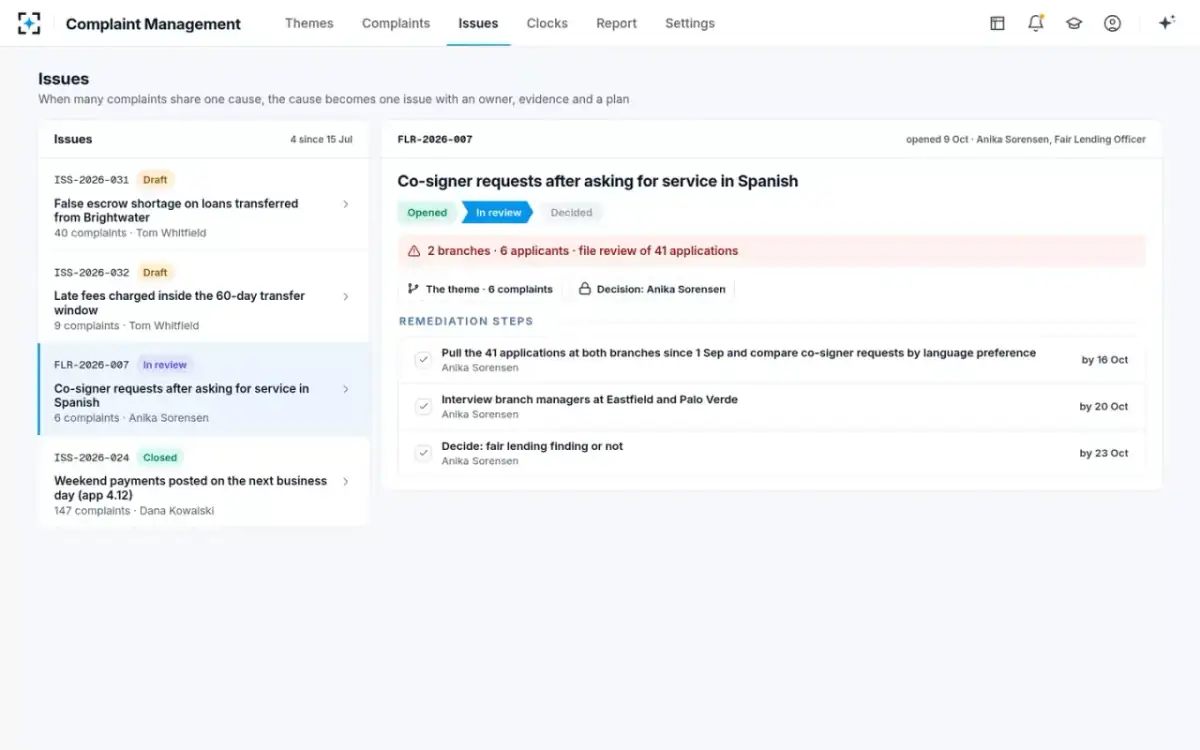
The review’s first step is a file comparison, not a reading of the complaints.
Whatever the decision, the file is what examiners ask for. The complaints, the flag sentences, the 41 applications compared, the interview notes and the reasoning for the outcome sit in one place. If there is no finding, that is recorded with its evidence, which is what lets a product be scoped without “unresolved fair lending complaints”.
Who should see fair lending complaints, and who should not decide them
Three seats need these complaints and only one decides. The complaints team logs and answers the borrower on the usual clock, and whoever approves the response should know the flag is open. The fair lending officer owns the review and the decision. The chief compliance officer reports open reviews to the board. Branch and business-line managers are interviewed and own the fix if there is a finding, but should not be the ones to decide whether their own branch’s conduct was a fair lending issue.
That separation is also why the flag cannot be cleared by agents. A model that reads complaints well can still be wrong about intent, context or the comparison that matters. The CFPB procedures put it plainly: complaints that “raise legal issues involving potential consumer harm from unfair treatment or discrimination” are to be “appropriately categorized and escalated” (CMR 13). Escalation means a person. Organising the complaint program covers the other decision rights, and testing the classification shows how to check that the flag fires when it should.
Questions people ask
Does a complaint have to allege discrimination to be a fair lending issue?
No. Many describe only what happened: a co-signer request, a higher rate, a comment from staff. Flag on the description, and let the review decide whether it reflects a prohibited basis. Some descriptions, such as a required spouse’s signature from an applicant who qualified alone, are Regulation B violations on their face.
Is disparate impact still relevant to complaint monitoring?
The OCC and the FDIC no longer review disparate impact, and the CFPB’s 2026 rule removes the effects test from Regulation B. Complaints mostly describe treatment, which is disparate-treatment evidence and is still examined. State fair lending laws and private suits under the Fair Housing Act are separate questions for counsel.
Should fair lending complaints be answered differently?
They are answered on the same clock, from the facts of the account, and the response should not pre-judge the review. It should not concede or deny discrimination before the fair lending officer has decided, and it should record any commitment, such as reconsidering an application, as subject to that review.
Do fair lending rules cover business loans?
ECOA and Regulation B cover business credit as well as consumer credit, so a complaint from a small-business owner about a co-signer or a personal guarantee demanded on a prohibited basis is in scope. The Fair Housing Act covers residential real-estate lending only.
How long should a fair lending complaint review take?
No rule sets a period, but the evidence decays fast: staff move, and branch conversations are remembered for weeks, not quarters. The sample review was scheduled over two weeks, file comparison first and decision last. The Complaint Management page shows that review alongside the rest of the program.