A bank complaint management system should capture every complaint from every channel into one case, set each regulatory clock, find patterns across channels, and draft responses for a person to approve, while the systems the bank already runs stay in place. Integration is the heart of it: connecting every place a complaint arrives, and every record that answers one, to a single complaint case, while each existing system stays the system of record for what it holds. The CFPB company portal keeps its complaints and receives the responses; the contact centre keeps its call recordings and transcripts; the servicing system keeps the loan, the escrow analysis and the payments, and is only read. Botminds’ Complaint Management is complaint management software built this way: it reads call transcripts, branch notes, mailboxes and scanned letters, public social posts that name the bank, state regulator referrals and the CFPB portal, and writes back only one thing, an approved response through the channel the complaint came from.
The reason to integrate rather than replace is the examiners’ first expectation: complaints “regardless of the channel through which they are submitted” are “appropriately recorded and categorized” (CFPB exam manual, CMR 13). A new front end that only one channel uses records one channel.
What should a bank complaint management system do?
Seven jobs, each traceable to something examiners test. Capture complaints from every channel, oral ones included. Code each in one taxonomy. Start every clock that applies and warn before it runs out. Escalate legal-risk complaints to a named person. Find patterns across channels and hand each to the owner of the process with its evidence. Draft responses from the account record for approval. Report what was found and fixed to the board, with an audit trail behind every number.
The weak point in most systems is the fifth job. Ticketing and CRM tools are built to close cases one at a time, and do it well; they rarely group complaints by what happened across channels, line them up with the bank’s own operational changes, or size the accounts affected beyond the people who wrote in. Those are the steps the OCC found missing when it ordered Bank of America to build a process to “identify, measure, manage, and report complaints” (OCC, 2022), and they are where agents add the most.
What features matter in complaint management software for an exam?
The features that let the bank show an examiner each step of the CFPB’s complaint procedures on one complaint and across many. A buyer can test each one in a demonstration, on the vendor’s data first and then on a week of the bank’s own.
What examiners test, the feature that answers it, and how to check it in a demonstration
| Examiners test | Feature that answers it | How to check it |
|---|---|---|
| Complaints recorded “regardless of the channel” (CMR 13) | Feeds from calls, branches, mail, email, social, referrals and the portal into one list | Ask to see a call transcript and a portal complaint about the same problem side by side |
| A common set of practices across units (CMR 13) | One taxonomy, the bank’s own, mapped to the CFPB’s issue names | Ask who maintains the categories and how a change reaches every channel |
| Legal-risk complaints escalated (CMR 13) | Flags with the sentence behind them, cleared only by a named person | Ask who can clear a fair lending flag, and try to clear one as someone else |
| Timely responses (Reg X, Z, E; 12 U.S.C. 5534) | Clocks per rule on the right calendar, with warnings | Enter a notice of error the day before a federal holiday and read the due dates |
| Root cause analysis (CMR 14) | Themes across channels, compared with a baseline and with operational events | Ask how forty complaints in three channels would be seen as one problem |
| Remediation to all harmed (CMR 15) | Search of the affected population beyond the complainants | Ask how many accounts share the error, not how many complained |
| Quality assurance (OCC, 2022) | Sampling, and the reason recorded for every code | Ask to run a seeded test before go-live |
| Board reporting (CMR 15) | A drafted report built from themes and issues, with citations | Ask what the board sees besides counts |
Botminds’ Complaint Management was built to answer each row: six agents read, classify, clock, group, investigate and draft, and three named people approve responses, accept causes and clear fair lending flags. Where it does not fit is worth saying too. It is not a contact-centre platform or a CRM, it does not post or reverse anything on an account, and it reads only the social posts that name the bank, not the wider internet.
The integration map: what each system gives, and what goes back
| System | Read into the complaint case | Written back | Stays the system of record for |
|---|---|---|---|
| CFPB company portal | Complaints and narratives, synced every 15 minutes | The approved response, through the portal | The complaint as the CFPB holds it, and the consumer’s feedback |
| State regulator referrals | Each department’s complaint and its response window | Nothing automatically; the approved response goes as the department asks | The department’s file |
| Contact centre | Call transcripts and agent notes | Nothing | Recordings and call history |
| Branches | Complaint notes logged by branch staff | Nothing | Branch records |
| Mailboxes and mail room | Servicing and complaints email; scanned letters | Approved replies, sent by the complaints lead | The original correspondence |
| Social media | Public posts that name the bank | Nothing | The platform |
| Core servicing records | Loan, payment history, escrow analysis, transfer files, county tax records | Nothing: read-only | Every account fact |
| Templates and categories | The bank’s approved response templates, products and issues | Nothing | The bank’s policy |
Which complaint channels does a bank have to capture?
All of them through which customers actually complain, and the exam procedures name more than most teams expect. Beyond the bank’s own channels, examiners obtain complaints “from the prudential regulator, state regulators, state attorneys general offices or licensing and registration agencies” and check that complaints about service providers receive “appropriate handling and follow-up” (CMR 14). A program that cannot show the state referral or the vendor complaint alongside its own will be asked why.
Social media is the channel most often left out. The FFIEC’s interagency guidance does not require banks to monitor the whole internet, but it notes that compliance risk arises “when a customer uses social media to communicate issues or concerns directly with a financial institution, such as an error dispute under Regulation E, a billing error under Regulation Z, or a direct dispute about information furnished to a consumer reporting agency” (FFIEC, 78 FR 76297). It allows a bank to set specific channels for disputes, but asks it to weigh the risk of not responding to complaints received elsewhere.
The channel mix at a sample bank, and the portal’s pace
555
calls among 1,286 complaints over 90 days: the largest channel, and a spoken one
Sample bank
66
public social posts naming the bank, read alongside letters and portal complaints
Sample bank
15min
how often portal complaints sync into the complaint list
Complaint Management
97%
of complaints the CFPB sent to companies in 2025 arrived within a day of receipt
CFPB, 2025
Read the account records, never write to them
The decision that makes integration safe is to read servicing records and never change them. A complaint program needs the loan, the payment history, the escrow analysis and the transfer file to answer a complaint and to find a root cause; it does not need to post a payment, reverse a fee or hold a disbursement, and it should not. Those actions belong to the people who own the servicing process, with their own controls.
In the solution, the agents read loan, escrow, payment and transfer records, and draft the request for the person who owns any change. In the sample case, the root-cause investigator searched all 6,214 loans boarded in a servicing transfer and found 1,140 with a tax instalment counted twice. Stopping the next tax run on those loans was the first step of the remediation plan, and it was the head of mortgage servicing’s step to take, not the software’s.
Data in and out of the complaint case
Agent
In: every channelPortal complaints every 15 minutes; transcripts, notes, email, scanned letters, referrals and public posts as they arrive.
Agent
In: account records, read-onlyLoan, payment history, escrow analysis, transfer files and county tax records for the account in question.
Never: change an account, hold a payment or contact a borrower
Agent
Inside: the complaint caseFacts with their sources, codes, flags, clocks, theme, issue and a drafted response.
A person decides
Out: approvalThe complaints lead approves each response; the issue owner accepts any commitment it makes.
A person decides
Out: the reply, the way it cameThrough the CFPB portal, or by letter or email, with the send on the record.
One complaint case, built from the portal narrative and the servicing records
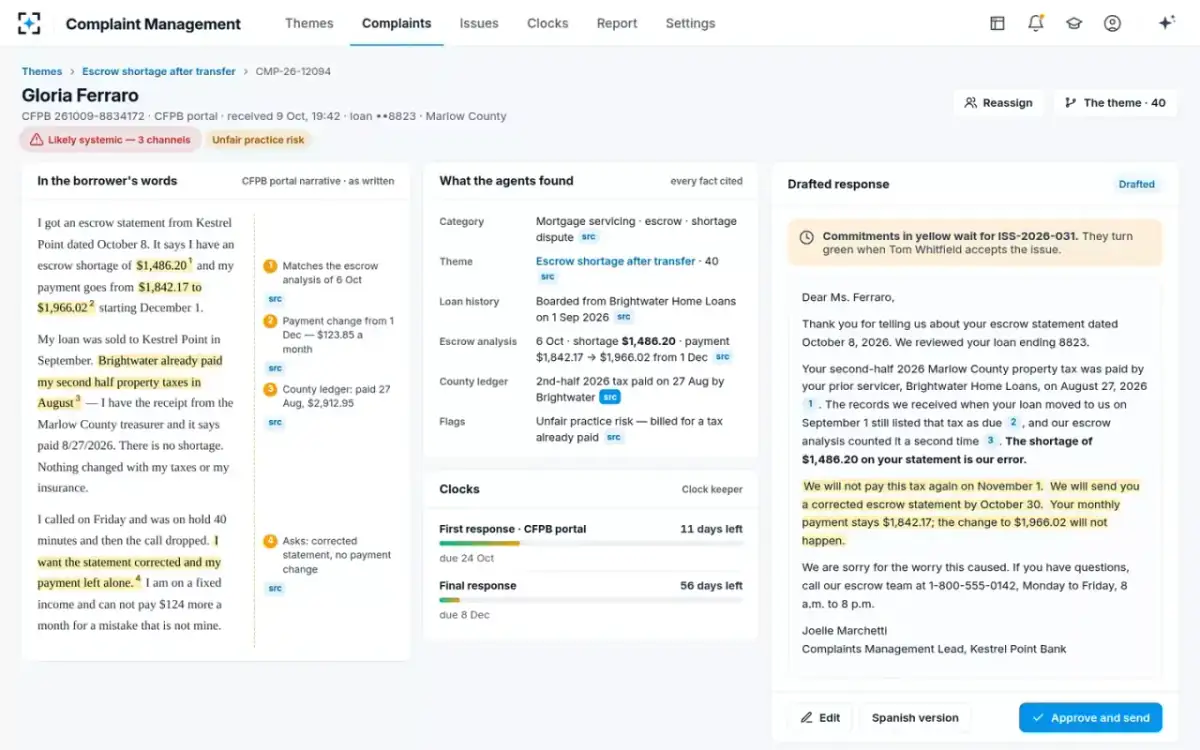
Each “src” marker opens the record the fact was read from.
Build, buy or join: three routes to a complaint management system
Most banks weigh three routes: build on the CRM they already own, buy a new complaint front end, or join the channels they have. Building on a CRM gives a case record but leaves the reading, coding and clock rules to be written and maintained in-house, and each regulatory change is a development ticket. Many projects instead start by choosing a new case-management front end and asking every channel to key into it. That moves the transcription problem rather than removing it: someone still copies the portal narrative, summarises the call and retypes the letter. Joining channels as they are leaves each team in its own tool and puts the reading, coding and clocking where the case is built.
Two ways to bring complaints together
Replace: a new front end for everyone: Re-key complaints from their own tools into the new system.
Join: read every channel into one case: Keep their tools; complaints are read from them.
Replace: a new front end for everyone: Copied by an analyst.
Join: read every channel into one case: Synced and read, with each fact cited to its sentence.
Replace: a new front end for everyone: Looked up by hand and pasted into notes.
Join: read every channel into one case: Read from the servicing records, cited, never changed.
Replace: a new front end for everyone: Whatever channels agree to adopt the front end.
Join: read every channel into one case: Every channel with a feed, including transcripts and social posts.
Replace: a new front end for everyone: After migration and training.
Join: read every channel into one case: From the first channel connected.
Vendors, data and the institution’s responsibility
A complaint system reads sensitive customer data, so it is a third-party relationship with all that implies. The institution stays responsible for vendor output: “the institution remains responsible for ensuring that the output from vendor-provided systems and services meets regulatory requirements” (Consumer Compliance Outlook, 2019). Interagency third-party risk guidance is being revised; the agencies proposed replacement guidance in September 2026 (Federal Reserve, FDIC, NCUA and OCC), and the 2023 guidance applies until it is final.
Vendors also generate complaints of their own. The FDIC’s complaint unit identified a third-party provider in 6,356 complaint cases in 2025, nearly 48% more than the year before (FDIC, 2026). A complaint case that notes the vendor involved lets a bank see those patterns too.
Questions to ask a complaint management software vendor
Ask about integration in concrete terms: what is read, how often, what is written back, and what is kept. The answers decide when clocks start, who can change an account, and what the bank can show an examiner later.
Eight integration questions for a complaint management software vendor
- Which channels do customers actually use?
Count by channel for a quarter, including calls and social posts, before deciding what to connect first.
- What is read, and how often?
Portal sync interval, transcript latency, mail-room scanning time. Each affects when a clock starts.
- What is written back, and by whom?
Only approved responses, through the channel of origin, with the approver on the record.
- Are account records read-only?
The complaint system should never post, reverse or hold anything.
- How is receipt time captured?
Clocks start at receipt; scanned letters and oral notices need their real receipt dates.
- Where do designated addresses route?
A Reg X designated address for notices of error must land in the same case list.
- Whose taxonomy and templates?
The bank’s own products, issues and approved templates, mapped to the CFPB’s issue names.
- What is on the record?
Every read, classification, draft, edit, approval and send, with who and when.
With the channels joined, the rest of the program can be organised around the complaint: the team structure, the clocks and the handling of templated complaints. The Complaint Management page shows every channel in one list on the sample bank.
Questions people ask
Does a complaint management system replace our CRM or case system?
It does not have to. The complaint case can sit beside the systems teams already use, reading what they capture and leaving them as the system of record for their own data. What it adds is what those systems rarely do: one taxonomy across channels, clocks per rule, and patterns found across cases.
How does a complaint management system connect to the CFPB portal?
In the solution, portal complaints sync every 15 minutes and approved responses go back through the portal, with the 15-day clock computed from the date the CFPB sent the complaint, not from when it was read. The CFPB said in June 2026 that it is building APIs “to more efficiently share complaint information” (CFPB, 2026), which may change how the feed is connected.
Should every social media mention be logged as a complaint?
The FFIEC guidance does not require monitoring all internet communications; it expects a risk-based approach. Public posts that name the bank and describe a problem with an account are the ones worth reading into the case list.
Does a complaint system need write access to account records?
No, and it is safer without it. Answering a complaint and finding a root cause need the loan, payments, escrow analysis and transfer records to be read; correcting an account belongs to the servicing team, under its own controls, after the issue owner accepts the fix.
What should a bank measure in the first month of a new complaint system?
Coverage by channel against the quarter before, recall on a seeded set of notices of error, the share of drafts approved with light edits, and time from receipt to a coded, clocked case. Those four show whether the system sees everything, starts the right clocks and saves the time it promised.