Bank complaint handling procedures work best when the program is organised around one case per complaint, not around the channel the complaint arrived through, because examiners judge the handling of every complaint as one program. Calls, emails, letters, branch notes, social posts, state regulator referrals and CFPB portal complaints should land in one list, coded in one taxonomy, each with its regulatory clock, so the same problem is seen once however it arrived. Botminds' Complaint Management is complaint management software built on that model: six agents read, classify, group and draft every complaint, and the decisions stay with three named people. This page sets out the team structure that goes with it, and why examiners reward it.
The work is hard for a structural reason. Each channel has its owner and its own coding. The contact centre owns calls, the servicing desk owns letters and notices of error, regulatory relations owns the CFPB portal, and marketing watches social media. A single escrow error can then turn up as twenty calls, a dozen emails and a handful of portal complaints, each coded differently by a different team, and no count ever looks alarming. The people below are the seats that carry a complaint program, shown before and after agents take the first read.
Five seats in a complaint program, and how each week changes
Today
Owns the program, the clocks and the monthly board report, and sees forty tickets where there is one problem.
With agents
Starts the day on themes across every channel, sends one issue to its owner, and approves every response before it goes.
Still theirs: Approving and sending every response.
Today
Reads 60–80 complaints a day across five queues, and spends much of it copying portal narratives into the bank’s system.
With agents
Works one list across every channel, each complaint already coded, flagged, clocked and drafted; edits drafts instead of retyping.
Still theirs: Deciding any message the agents mark as doubtful.
Today
Receives forty emails about escrow, transfers and payments, and works out the root cause himself.
With agents
Receives one issue with the proposed cause, the cited evidence, the affected loans and a remediation plan with dates.
Still theirs: Accepting the cause and the remediation, and any hold on a payment.
Today
Reviews whatever complaints are forwarded, and hopes to see a pattern before an examiner does.
With agents
Receives every complaint that mentions a protected characteristic as a flag, and each pattern as a review with its steps.
Still theirs: Clearing a fair lending flag: no one else can.
Today
Reports complaint risk to the board from counts that never show the cause.
With agents
Reads a monthly report of what was found and what was fixed, with each finding cited.
Still theirs: What goes to the board.
Why complaint teams end up organised by channel
Most complaint functions were assembled one channel at a time, and the org chart still shows it. The servicing mailbox grew a notice-of-error desk because Regulation X put dates on written claims of error. The CFPB company portal brought its own 15-day clock and a regulatory relations team to answer it. Social listening sits with marketing. Branch complaints are logged in whatever the branch system offers. Each door got an owner, a queue and a category list suited to that owner.
The result is a program that counts well and sees badly. Take the solution’s sample bank, a fictional lender called Kestrel Point Bank, over ninety days from 15 July to 12 October: 1,286 complaints through seven doors. Calls are the largest door by far, while the CFPB portal, the channel management watches most closely, brings in about one complaint in six.
Seven doors into one complaint program, ninety days at a sample bank
Organised by door, that program has seven coding schemes and seven definitions of resolved. The escrow error at the centre of the sample — a tax instalment counted twice after a servicing transfer — reached the bank as 23 calls, 11 emails and 6 portal complaints. “Escrow” and “payment increase” sat in different categories in different queues, and no single count spiked. That is the failure the rest of this page is designed to prevent.
What examiners expect of a complaint management program
Examiners assess one program, whatever the org chart says. The CFPB’s examination procedures for complaint response ask whether complaints, “regardless of the channel through which they are submitted, are appropriately recorded and categorized”, whether complaints that raise legal issues are “appropriately categorized and escalated”, and whether evaluations include “comprehensive root cause analysis” and retrospective remediation “to all consumers harmed by a particular violation” (CFPB Supervision and Examination Manual, CMR 13–15). Evaluations are to be “included in compliance reporting to the board and senior management.”
“If an institution maintains multiple consumer complaint response centers or units, determine whether it employs a common set of practices.”
CFPB examination procedures, Consumer Complaint Response, step 10
The interagency consumer compliance rating, which runs from 1 to 5, lists “the responsiveness and effectiveness of the consumer complaint resolution process” among the factors examiners weigh (FFIEC, 81 FR 79473). For large banks, the duty to answer regulators is statutory: section 1034(b) of the Dodd-Frank Act requires a “timely response, in writing where appropriate” to the CFPB and the prudential regulators, including the steps taken and any “follow-up actions or planned follow-up actions” (12 U.S.C. 5534).
The cost of getting the structure wrong is on the record. In July 2022 the OCC assessed a $125 million civil money penalty against Bank of America (OCC NR 2022-84). The order’s main subject was a prepaid card program for unemployment benefits, but it also found that the bank’s enterprise-wide complaints framework lacked an effective “process to identify, measure, manage, and report complaints”, an effective resolution process and an effective quality assurance process. It required a Board-approved framework with “an expanded complaints definition” and procedures for “identifying, tracking, documenting, analyzing, managing, monitoring, escalating, reporting, and resolving” complaints (OCC consent order AA-ENF-2022-21). Those verbs describe a single pipeline, not seven parallel ones.
What should a complaint handling procedure include?
A written procedure should cover the life of a complaint from the first contact to the board report, in the same way for every channel. The CFPB’s examination procedures, the OCC’s Bank of America order and the Federal Reserve’s examiner guidance all test the same stages: a definition, capture, categorisation, escalation, investigation, response, root cause, remediation, quality assurance and reporting. A procedure that stops at “respond within 15 days” covers one of them.
Ten parts of a bank complaint handling procedure, and the test behind each
- A written definition of a complaint
Broad enough to match the CFPB’s: “dissatisfaction with, or … suspicion of wrongful conduct by” the bank about a consumer’s own experience. The OCC required Bank of America to adopt “an expanded complaints definition”.
- Capture from every channel, including oral
Calls, branches, mail, email, social posts that name the bank, regulator referrals and the CFPB portal, “regardless of the channel through which they are submitted”.
- One taxonomy and its coding rules
Products and issues, with the CFPB’s issue names mapped in, so a portal complaint and a call about the same problem carry the same code.
- Escalation criteria
What goes straight to legal, fair lending or UDAAP review: discrimination, unauthorised enrolment, imminent foreclosure, servicemember status, other regulatory issues.
- The clocks and who watches them
CFPB portal, Regulation X, Z and E, state rules and the bank’s own service levels, each on its own calendar.
- An investigation standard
Responses “prompt and complete, and based on a thorough investigation of the facts”, with the records consulted kept on the case.
- Response content and approval
Approved templates, required regulatory content, and a named approver for anything that commits the bank.
- Root cause and remediation
Who looks for patterns, how often, who owns a confirmed cause, and remediation to all consumers harmed, not only those who complained.
- Quality assurance
Sampled re-review of coding and responses, with results tracked. The OCC order found the QA process itself ineffective.
- Reporting, third parties and training
Board and senior management reporting, the same tracking required of vendors that take complaints, and training updated from what complaints show.
Two of the ten are where procedures most often fall short. Third parties: collectors, payment apps and servicing vendors take complaints the bank never sees unless the contract makes them report, and a Federal Reserve examiner advises banks to require vendors to keep “similar tracking mechanisms, with routine reporting to the bank” (Federal Reserve Bank of Minneapolis, 2018). And quality assurance, which is usually described in a sentence and then never evidenced.
Does a small bank need a formal complaint management program?
It needs a program, but not necessarily a formal team; the standard is proportion to size and risk. A Federal Reserve examiner writes that “banks that receive few complaints and have relatively lower-risk products and operations” “should be able to manage their complaints less formally”, while examiners still consider “the bank’s policies and processes for overseeing complaints” and “the quality and timeliness of the bank’s investigations and responses” (Federal Reserve Bank of Minneapolis, 2018). The statutory duty to answer regulators in section 1034(b) falls on banks over $10 billion, but every bank’s complaint process is a factor in its consumer compliance rating.
Less formal does not mean fewer stages. A community bank with a few hundred complaints a year can run all ten parts above with one compliance officer and a shared log, provided every channel feeds the log and the officer reviews it for patterns. What it cannot do is skip the notice-of-error and Regulation E clocks, which apply at any size, or leave branch complaints out because they were resolved at the counter. The smaller the team, the more the procedure depends on capture and coding being automatic, because there is no second person to notice a missed letter.
Organise around the complaint, not seven queues
The structural fix is to make the complaint, not the channel, the unit of work. Every complaint becomes one case with the same fields wherever it arrived: who, which account, what happened, what the person wants, the product and issue codes, the risk flags, the clock, the theme and the draft. Channel becomes an attribute of the case, kept for reporting, not the thing that decides who handles it or how it is coded.
The same program, organised by channel and organised by complaint
Organised by channel: Each door has its own queue, staffed by the team that owns the door.
Organised by complaint: Every door feeds one list; the channel is a field on the case.
Organised by channel: Each team keeps its own categories; “escrow” in one queue is “payment increase” in another.
Organised by complaint: One taxonomy of products and issues, mapped to the CFPB’s issue names, applied to every complaint.
Organised by channel: The CFPB clock lives with regulatory relations; notice-of-error dates live with servicing.
Organised by complaint: Every clock that applies is set on the case at intake, whichever door it came through.
Organised by channel: Found at the monthly or quarterly trend review, from counts per queue.
Organised by complaint: Themes grouped by what happened, across channels, every night, against a 30-day baseline.
Organised by channel: Left to whichever business head receives the most emails.
Organised by complaint: Proposed with evidence and sent to one named owner as one issue.
Organised by channel: Counts by channel and by category.
Organised by complaint: What was found, who owns it, and what was fixed, each finding cited.
This is the model the solution runs. Its intake reader reads every complaint from every channel and pulls out the facts, citing the sentence each came from. Its classifier codes each one in the bank’s own taxonomy — nine products and 41 issues in the sample bank — sets risk flags and starts the right regulatory clock. Its theme finder groups complaints by what happened rather than the words used, and flags a theme as likely systemic when it doubles within 24 hours or spans three or more channels. The clocks a case can carry are covered in their own guide.
Seven doors in one view: every theme across every channel
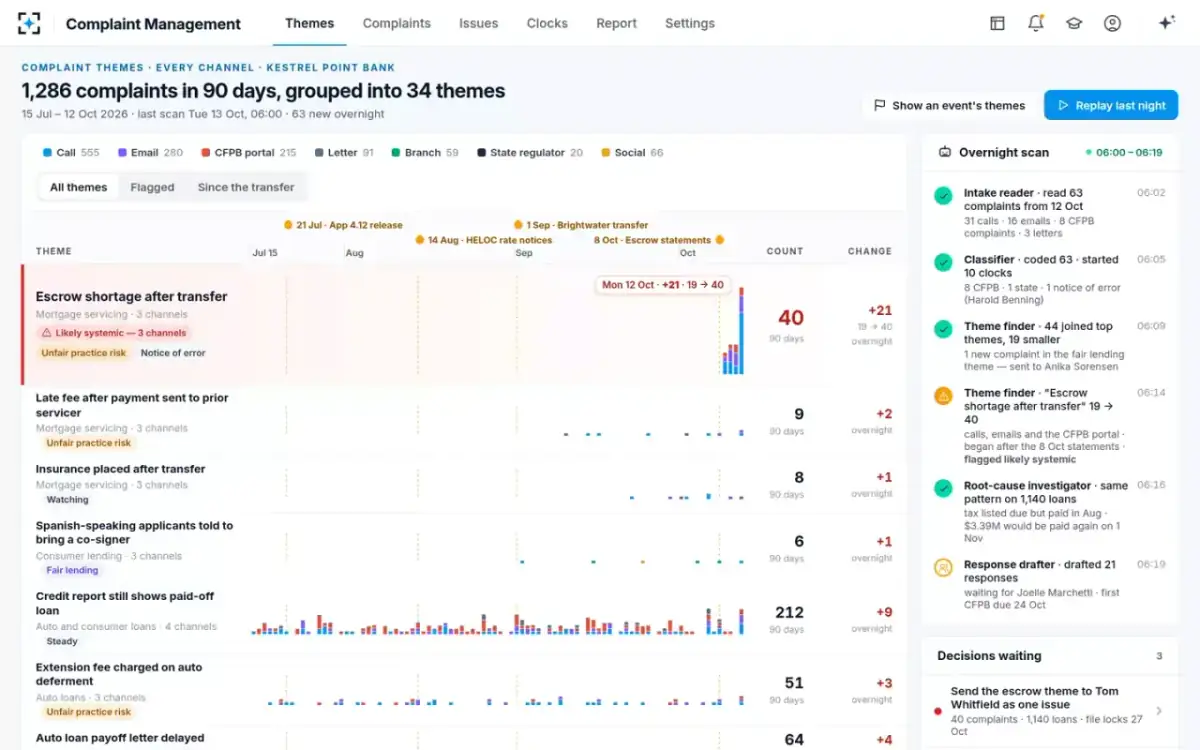
The channel is a colour in the bar, not a separate queue.
Three decisions that stay with named people
Agents can take the reading, coding, clocking, grouping and drafting. Three decisions should stay with named people, because each commits the bank to something. Writing them into the structure, and into the software, is what turns a set of tools into a program an examiner can follow.
Decision rights in a complaint program run with agents
| Decision | Who decides | What the agents prepare | What the agents may not do |
|---|---|---|---|
| Send a response to a borrower | Complaints management lead (or a named delegate) | A draft in the bank’s template, every fact cited, commitments marked if they depend on an open issue | Send anything, or promise a refund the issue owner has not accepted |
| Accept a root cause and its remediation | The business owner of the process, e.g. the head of mortgage servicing | The proposed cause with records side by side, the affected population and a dated plan | Change an account, hold a payment or call a cause confirmed |
| Clear a fair lending flag | The fair lending officer, and no one else | The flag with the sentence behind it, and a review plan when complaints form a pattern | Clear or downgrade the flag |
| Report complaint risk to the board | Chief compliance officer | A drafted monthly report from themes and issues | Export it without the officer’s edit |
The separation matters most at the boundary between the complaints team and the business. Complaints staff do not own escrow analyses or tax disbursements, so a complaint program that finds a systemic error must hand it to someone who does. In the sample, the root-cause investigator searched all 6,214 transferred loans, found 1,140 with the same false shortage, and drafted an issue for the head of mortgage servicing with a five-step plan whose first step was to stop the 1 November tax run. It could not stop the run itself. When a user asked it to, it answered that the hold was the issue owner’s call and added the step to his plan.
Who decides is a setting, written down
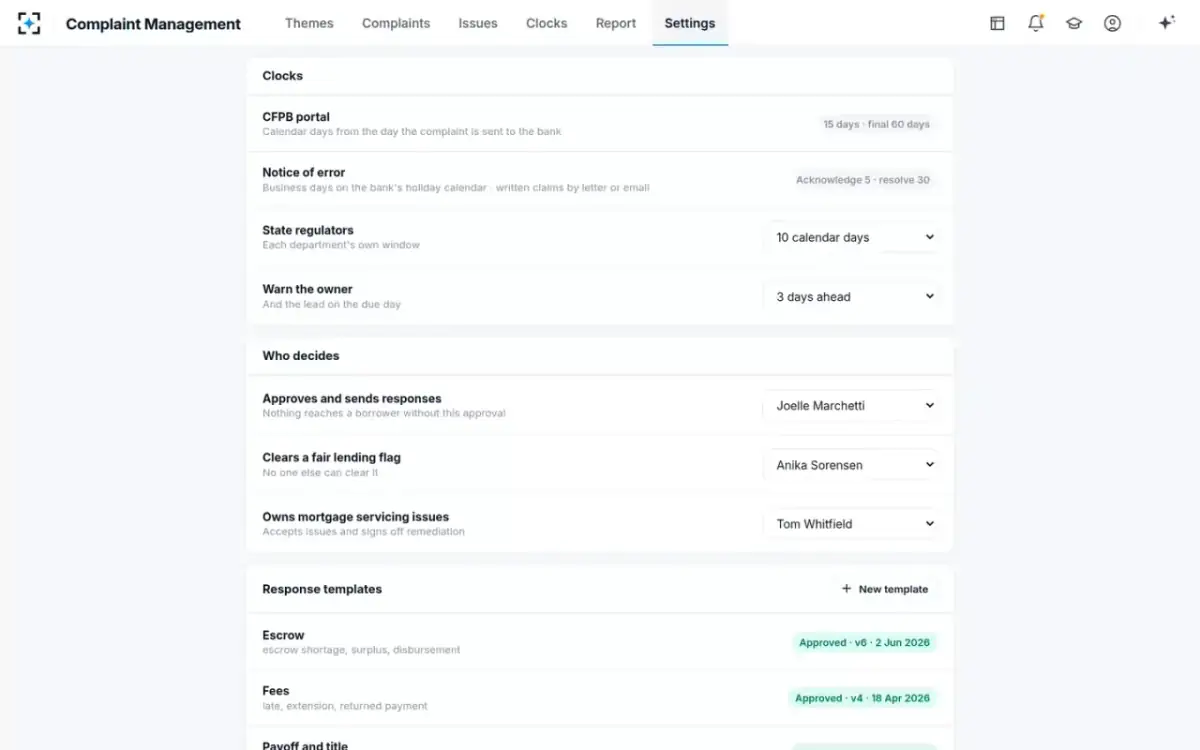
What changes in an analyst’s day
In a channel-based team, analysts spend most of the day on transcription and triage: reading the narrative, keying it into the bank’s system, picking a category, working out which deadline applies, and starting a letter. The sample bank’s analyst character reads 60 to 80 complaints a day across five queues and spends much of it copying portal narratives. None of that is judgment, and all of it is where coding drifts between people.
When agents take the first pass, the analyst’s work moves to three things. The first is the doubtful case: the intake reader never decides that a message is not a complaint, so anything it cannot place goes to a person. The second is the draft: an analyst edits a cited response rather than writing one. The third is quality assurance, the third leg of the OCC’s framework, which becomes sampling and checking the agents’ coding instead of re-reading every ticket. Testing the classification sets out how to do that sampling with known answers.
One case per complaint also changes what a new analyst has to know. In a channel-based team, knowledge of which deadline applies to which kind of letter sits in people’s heads, and Federal Reserve examiners have found staff who believed only a written notice starts the Regulation E clock (Consumer Compliance Outlook, 2026). When the clock is set on the case from the rule, a new hire inherits the rule rather than a colleague’s memory of it.
How to size a complaint team when agents take the first read
Size the team for decisions, not for volume. In a channel model, headcount scales with complaints read. In a case model, it scales with three loads: responses to approve, issues to work with their owners, and flags to clear. Those loads are measurable from the first week, and they are the numbers to plan staff against.
The sample bank shows the shape. Its overnight run between 06:00 and 06:19 read 63 new complaints, started ten regulatory clocks — eight CFPB, one state and one notice of error — joined 44 to existing themes, and left 21 drafted responses waiting for the complaints lead. Ninety days produced 34 themes and four issues, one of them a fair lending review. A lead approving a few dozen cited drafts a day and owning a handful of issues a quarter is a different job from supervising five queues, and it needs a deputy who can approve as well. The settings allow a second approver for that reason.
The people are scarce and expensive, which is the case for moving their time to judgment. The Bureau of Labor Statistics counted 19,850 compliance officers in credit intermediation in May 2025, at a mean wage of $94,090 (BLS Occupational Employment and Wage Statistics, May 2025). Capacity freed from retyping does not disappear; it goes to root cause and remediation, the work examiners now test for. The complaint KPIs a board should see turns those loads into measures.
Questions people ask
Should complaint handling be centralised or left with each business line?
Either can pass an exam if practices are common; the exam procedures ask whether multiple units employ “a common set of practices”. A central team that owns the taxonomy, the clocks and the reporting, with business lines owning root cause and remediation, gives one set of practices without moving the fixes away from the people who run the process.
Does the complaints function belong in compliance or in operations?
Banks do both. What the exam procedures test is that complaints raising legal risk are escalated and that evaluations reach the board, so whichever line owns intake, compliance needs a direct view of themes, flags and issues, and the fair lending officer needs the flags.
What counts as a complaint under CFPB rules?
There is no single regulatory definition. The CFPB describes complaints as “submissions that express dissatisfaction with, or communicate suspicion of wrongful conduct by, an identifiable entity related to a consumer’s personal experience with a financial product or service” (CFPB, 2025). A bank definition narrower than that, such as “written and unresolved”, is the gap examiners and the OCC’s 2022 order point to.
How many complaints can one complaint analyst handle?
No regulator publishes a ratio, and it depends on how much of the reading is manual. The sample bank’s analyst character works 60 to 80 a day across five queues by hand; when coding, clocks and drafts arrive done, the limit becomes the number of drafts a person can check properly, which is the figure to measure in the first weeks.
How does a social post or a branch conversation get into the same case?
Through the systems that already capture it: branch notes, contact centre transcripts and public posts that name the bank. Choosing a bank complaint management system covers what is read, what is written back and what stays the system of record. The Complaint Management page shows the whole program on the sample bank.