AI-generated complaints are now a recognised problem in the CFPB’s complaint system. The Bureau received more than 6.6 million complaints in 2025, up from 3.19 million in 2024 and 1.66 million in 2023, and said the increases “coincide with emerging technologies, such as large language models and autonomous software systems (‘AI Agents’) that empower bad actors to flood the system with duplicative and spurious submissions.” For a lender, the right response is to sort, not to dismiss: group templated complaints by the facts they assert, check each against the account, answer each on its clock, and decline only under the specific rules that allow it. Botminds’ Complaint Management is complaint management software whose agents read every complaint, group them by what happened rather than the words used, and never decide on their own that a message is not a complaint.
The difficulty is that a template and a grievance can look identical. A form letter from a credit repair service and a borrower’s own letter about the same error may share every sentence. One is a real dispute about a real account; the other may be too. Authorship does not settle it. The account does.
Where the 2025 surge sits, and how lenders closed mortgage complaints
All CFPB complaints received, 2025
- Credit or consumer reporting · 88%
- Every other product, mortgage included · 12%
Mortgage complaints sent to companies, 2025
- Closed with explanation · 91%
- Relief, administrative response or not timely · 9%
Why have CFPB complaints increased so much?
The growth is almost all in one product. Consumers submitted more than 5.8 million credit or consumer reporting complaints in 2025, 88% of the total, and the CFPB says the year-on-year increases “are driven almost entirely by a dramatic growth in credit or consumer reporting complaints” (CFPB, 2025). It names several causes: third parties such as “credit repair organizations and those who offer credit advice online and on social media”, more consumers returning to the process, and “an increase in the number of complaints submitted in a single session”. AI is the newest factor on that list.
CFPB complaints received, by year
“This has made it harder for the Bureau and companies to address authentic grievances made by actual consumers.”
CFPB, Consumer Response Annual Report 2025
The pressure reaches lenders even though most of the surge is about credit reports. Lenders furnish the data those complaints dispute, and many receive the same templates directly, as letters to the servicing address or emails to the complaints mailbox. A mortgage servicer whose share of portal complaints is small can still be the target of a template campaign through every other door.
What did the CFPB change in its complaint portal in 2026?
It tightened who can file and how, at the consumer’s end, and left the company’s duties where they were. On 24 June 2026 the CFPB said its process was being misused by “credit repair organizations and credit clinics”, by “social media influencers with questionable expertise encouraging followers to submit complaints” and by “new technologies (e.g., ‘AI tools’) that may act as an individual’s agent” (CFPB, 24 June 2026). The changes it announced are listed below.
The CFPB’s June 2026 complaint-system changes, and what each means for a lender
| Change | Status in the announcement | Effect on a lender’s complaint team |
|---|---|---|
| Two-factor authentication for consumers’ online accounts | Launched | Fewer bulk accounts at source; no change to the company’s clock |
| Address validation when a complaint is submitted | Planned | Better identity data on the complaint; still verify against the account |
| Notices that consumers must first use their dispute rights with the credit bureaus | Added to the portal | Mainly affects credit bureaus; a lender furnishing the data still gets direct disputes |
| A revised Portal Manual so credit bureaus follow a standard process | Issued | Aimed at credit bureaus, not lenders |
| More administrative response categories for apparent abuse | Being explored, not adopted | No new ground yet for a lender to close a complaint administratively |
| Backlog counted as complaints awaiting action over 30 calendar days from submission | Adopted | The CFPB’s own measure; the company’s 15 and 60 days are unchanged |
| APIs to share complaint information | Being built | May change how the portal feed reaches a lender’s system |
The pattern is that the gatekeeping happens before a complaint reaches the company. Once the CFPB sends it, the lender’s obligations are the same as before the announcement, and nothing in it lets a lender decline a portal complaint because it looks automated. The administrative categories the CFPB is “exploring” are the item to watch: if they are adopted, the response a lender may give to an abusive filing will widen, but they will be the CFPB’s categories, applied to its own rules.
Why a lender cannot simply set templated complaints aside
Every clock still runs. A portal complaint is due in 15 calendar days whoever drafted it. A written claim of a servicing error is a Regulation X notice of error whether a borrower typed it or software did, so long as it names the borrower, identifies the account and asserts an error (12 CFR 1024.35(a)). For banks over $10 billion, the duty to respond to regulators about complaints is in the statute (12 U.S.C. 5534), and it contains no exception for complaints the bank suspects were written by a machine.
There is also a substantive risk. A templated complaint can carry a real error. If a credit repair campaign tells a hundred borrowers to dispute late payments reported after a servicing transfer, some of those late payments may be wrong, and the template is how the bank finds out. The CFPB’s own report lists “new servicers incorrectly furnished negative information after servicing transfers” among 2025’s mortgage complaints.
What the rules let a lender decline, and how
The regulations already give lenders narrow ways to handle repeats and campaigns, each with conditions and, usually, a written notice to the consumer. None of them depends on who wrote the complaint, except the credit-reporting rule for direct disputes from credit repair organisations. None of them applies to the CFPB portal response itself.
Repeats, templates and campaigns: what each rule allows
| Rule | What may be declined | Condition | What the lender still owes |
|---|---|---|---|
| Reg X notice of error, 12 CFR 1024.35(g) | Duplicative, overbroad or untimely notices | Duplicative only if the servicer already complied and no new and material information is given; overbroad only where no specific error can be identified | A written notice of the determination and its basis within 5 business days; any valid error inside an overbroad notice is still answered |
| Reg Z billing error, 12 CFR 1026.13(h) | A reassertion of substantially the same billing error | The creditor fully complied with the rule the first time | Nothing further under the section |
| Reg E EFT error, 12 CFR 1005.11(e) | A later reassertion of the same error | The institution fully complied with the error-resolution rules | Nothing further, with one exception for certain information requests |
| FCRA direct dispute, 12 CFR 1022.43 | A direct dispute submitted or prepared by a credit repair organisation, or one that is frivolous or irrelevant | A reasonable belief about who prepared it; frivolous includes substantially the same dispute already handled | Notice to the consumer of a frivolous-or-irrelevant determination |
| CFPB company portal | Nothing | — | A timely response within 15 days, or 60 with an in-progress response |
Read the conditions closely, because they all turn on facts the bank must check. “Duplicative” under Regulation X means the same error the servicer has already answered, with nothing new. “Overbroad” means the servicer cannot tell what error is asserted, and even then it must answer any valid error it can identify. A complaint that is merely templated, but asserts a specific error on a specific account for the first time, is neither.
Sort by the facts asserted, not by the words used
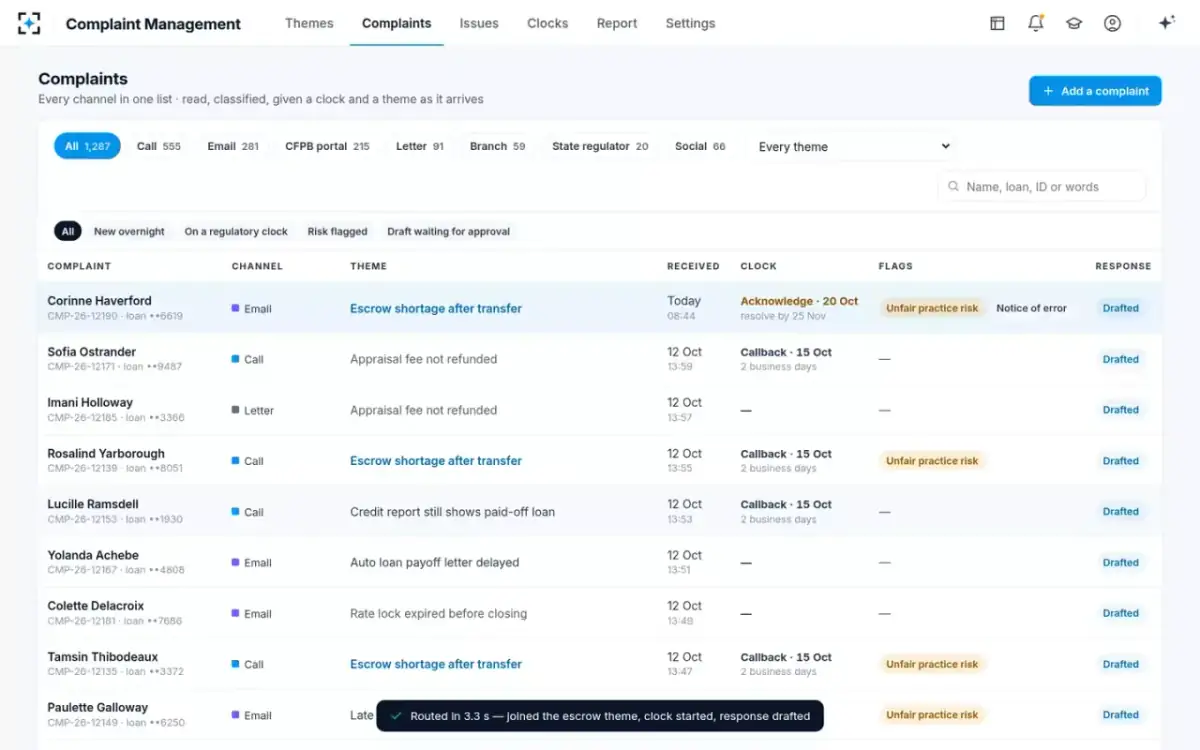
The useful grouping for templated complaints is by event, not by text. Two letters with identical wording may assert different facts about different accounts; two letters in different words may describe the same error. The solution’s theme finder places each complaint in a theme by what happened, not the words used or the channel. A campaign that sends the same text about unrelated accounts spreads across themes; real errors described in the campaign’s words join the themes of the borrowers who described them in their own.
How a templated complaint is sorted without being dismissed
Agent
Intake readerReads it like any other complaint: who, which account, what is asserted, what is asked, each fact with its sentence.
Never: decide a message is not a complaint
Agent
ClassifierCodes product and issue, sets flags and starts every clock that applies, including a notice-of-error clock for a written servicing claim.
Agent
Theme finderPlaces it by the event asserted, and shows when it repeats an earlier complaint on the same account.
Agent
Response drafterDrafts a factual answer from the account record, citing what the records show.
A person decides
Complaint analystDecides any determination the rules allow, such as duplicative or overbroad, and records the reason and the written notice.
A person decides
Complaints leadApproves and sends every response.
Checking the account is what separates a campaign from a grievance. If the escrow analysis matches the county record, the payment history shows the payment late, and the borrower raised the same point last month with no new information, the analyst has the facts for a duplicative determination and the drafted notice says so. If the records disagree, the complaint is a real dispute, whatever wrote it.
Every complaint in one list, whatever wrote it, each with its clock
How can you tell if a complaint was written by AI?
Not reliably, and a complaint program should not try to act on a guess. NIST’s review of synthetic content detection found that text detectors “tend to perform little better than chance when given short texts”, reaching about 90% on a measure of discrimination only with samples of around 750 words, and that they “classify English text as AI-generated more often when the writer is not a native English speaker” (NIST AI 100-4, 2024). Most complaints are short. A detector would wrongly mark some genuine complaints, and the people it would mark most often include borrowers writing in a second language.
The useful signals are about the facts and the pattern, and they can be recorded and defended. The same narrative filed for unrelated accounts, a batch arriving from one session, an account number that does not exist, an asserted payment date with no matching transaction, an error already answered with nothing new: each can be checked against the bank’s own records, and each maps to a rule. None of them requires knowing whether a person or a model typed the words, which is why the solution records them and never labels a complaint machine-written.
A working policy for templated and AI-written complaints
Eight rules for handling complaint campaigns
- Never close a complaint for its style
Wording, length or apparent authorship is not a ground in any rule. Facts are.
- Start every clock at receipt
Determinations come later; deadlines do not wait for them.
- Group by event and account
Same text, different accounts: separate complaints. Different text, same error: one theme.
- Verify against the record
Every asserted fact is checked against the account, escrow, payment and transfer records.
- Use the rule that fits, and only that rule
Duplicative and overbroad under Reg X; reassertion under Reg Z and Reg E; credit repair and frivolous under the FCRA direct-dispute rule.
- Send the written notice
Most declines require one, with the reason, within a set time.
- Answer the portal regardless
The CFPB response is due on time even when the underlying dispute is declined under another rule.
- Report campaigns separately
Give the board the volume of templated complaints next to the themes that matter, so one does not hide the other.
Reporting is the last point and the easiest to miss. If templated complaints are mixed into the counts, a campaign can look like a crisis or hide one. The complaint KPIs a board should see separates them. Testing the classification includes templated messages in its seed set, and the Complaint Management page shows the full program on the sample bank.
Questions people ask
Can a bank refuse a CFPB complaint filed by a credit repair company?
Not the portal response: the company still answers within the CFPB’s timeframe. The FCRA exception lets a furnisher decline to investigate a direct dispute it reasonably believes a credit repair organisation prepared, but that rule covers disputes sent to the furnisher, not the portal complaint.
Do companies have to respond to every CFPB complaint?
Every complaint the CFPB sends needs a timely response, but not every response is substantive. In 2025 companies gave an administrative response to 3% of the mortgage complaints sent to them, and the CFPB itself referred 12% of mortgage complaints to other regulators and found 4% not actionable before sending any (CFPB, 2025).
How many complaints does the CFPB receive a year?
More than 6.6 million in 2025, of which more than 5.9 million were sent to companies. Mortgages accounted for about 30,400, credit cards about 114,100 and vehicle loans and leases about 28,500; credit or consumer reporting accounted for 88% of the total.
What is a duplicative notice of error?
One that asserts substantially the same error the servicer has already investigated and answered, without new and material information, meaning information not reviewed before that is reasonably likely to change the result. The servicer may decline it, but must say so in writing, with the reason, within five business days (12 CFR 1024.35(g)). A second template letter about a different error is not a duplicate.
Is a complaint written with AI help less valid?
No rule says so. A borrower who uses a chatbot to put a real escrow error into words has still asserted the error, and under Regulation X a written assertion with the borrower’s name and account is a notice of error. The tool changes the wording, not the obligation.