The CFPB complaint response time is 15 calendar days: a company has 15 days to respond to a complaint the CFPB sends it through the company portal, or 60 days if it tells the consumer the response is in progress (CFPB). That is only one of the clocks a complaint can start. A written claim that a mortgage servicer made an error is also a Regulation X notice of error, due for acknowledgment in 5 business days and a response in 30. A card or home-equity line dispute can be a Regulation Z billing error, an account transfer dispute a Regulation E error, and a licensed servicer may owe a state its own dates. Botminds’ Complaint Management reads every complaint as it arrives and sets each clock that applies; this guide gives the decision tree behind it, so a complaint handler can apply it by hand.
The clocks matter because they run independently and on different calendars. Some count calendar days, some count business days without Saturdays, Sundays and legal public holidays, and some count billing cycles. Missing the one nobody noticed is the classic failure, and it has been expensive.
Five complaint clocks, drawn to the same scale
- Response due15 days
- If “in progress”, final responseto day 60
- Ack.5 bd
- Correct or explainto 30 bd
- Extension, with written notice+15 bd
- Acknowledge30 days
- Resolve within two billing cyclesmax 90 days
- Determine10 bd
- With provisional creditto 45 days
- Ack.5 bd
- Respondto 30 bd
- Extension+7 bd
How long does a company have to respond to a CFPB complaint?
Fifteen calendar days from the day the CFPB sends the complaint, or 60 days if the company gives an interim response saying the work is in progress. The CFPB’s 2025 report spells out the test: a complaint gets no timely response if the company does not answer “within 15 calendar days of the complaint being sent to the company—or within 60 days if it requested more time” (CFPB Consumer Response Annual Report 2025). Untimely complaints are marked as such in the public Consumer Complaint Database, and the consumer has 60 days to give feedback on the response.
The bar is high because almost everyone clears it. Companies answered 99.6% of the 5.9 million complaints the CFPB sent them in 2025 on time. Being in the last 0.4% is visible to the public and to the bank’s examiners, and for banks over $10 billion the timely response is a statutory duty under section 1034(b) of the Dodd-Frank Act.
What happens if a company does not respond to a CFPB complaint in 15 days?
The complaint is published as untimely, and the miss becomes evidence an examiner can read. The CFPB marks it “not having received a timely response” in the Consumer Complaint Database, and the company loses the chance to have its explanation shown beside the consumer’s account. There is no fine attached to a single late portal answer. The cost is a public record of it and a pattern that supervision can count.
For a bank or credit union with more than $10 billion in assets the duty is in the statute itself. Section 1034(b) of the Dodd-Frank Act requires a “timely response, in writing where appropriate” to the CFPB, the prudential regulators and any other agency with jurisdiction, and it says what the response must carry: the “steps that have been taken by the covered person to respond to the complaint”, the “responses received by the covered person from the consumer” and the “follow-up actions or planned follow-up actions” (12 U.S.C. 5534). A one-line “resolved” answer meets the clock and misses the content.
Two dates are easy to confuse. The 60 days run from the day the CFPB sent the complaint, not from the in-progress note, so an interim answer on day 14 buys 46 more days, not 60. And the CFPB’s own backlog figure is a different measure: since June 2026 it counts complaints “awaiting action for more than 30 calendar days from the date of submission” (CFPB, 24 June 2026). That is the agency measuring itself, and it does not move the company’s 15 days.
One letter, several clocks: the decision tree
Decide the clocks from what the message is, not from where it arrived. Work through the questions below in order and set every clock whose answer is yes; the earliest due date governs the work, but each obligation has to be met on its own terms. A borrower who emails the servicer about an escrow error and also files the same complaint with the CFPB has started both the portal’s 15 days and a notice of error’s 5 and 30 business days.
Which complaint deadline applies: six questions at intake
| Question | If yes, the clock | What the rule turns on |
|---|---|---|
| 1. Did the CFPB send it through the company portal? | 15 calendar days; 60 if the response is in progress | The date the CFPB sent it, not the date someone opened it. |
| 2. Is it a written claim of a servicing error on a mortgage loan? | Reg X notice of error: acknowledge in 5 business days, correct or explain in 30 (+15) | Writing, the borrower’s name, enough to identify the account, and the error asserted. A qualified written request asserting an error is a notice of error. |
| 3. Does it ask the servicer for information about the loan? | Reg X information request: acknowledge in 5; 10 days for the owner’s identity, 30 (+15) for the rest | Writing and a request, rather than a claim of error. |
| 4. Is it a written dispute of a charge on an open-end credit account? | Reg Z billing error: acknowledge within 30 days; resolve within two complete billing cycles, never more than 90 days | Received at the address the creditor disclosed, within 60 days of the first statement showing the error. |
| 5. Is it a dispute of an electronic transfer on a consumer’s deposit account? | Reg E error: determine within 10 business days, or 45 days with provisional credit | Oral or written, within 60 days of the statement. An oral notice starts the clock. |
| 6. Does a state rule or a state referral apply? | The state’s dates, e.g. 5 and 30 business days for a New York servicer | The lender’s licences and the department’s own referral. |
When is a complaint also a notice of error under RESPA?
When it is in writing and contains three things: the borrower’s name, information that identifies the mortgage account, and the error the borrower believes occurred. The definition is in 12 CFR 1024.35(a), and it does not require the words “notice of error” or “qualified written request”. A frustrated email that says the escrow analysis is wrong qualifies. So does a letter that says the servicer did not pay the tax bill on time, which is one of the eleven covered errors in paragraph (b).
“A servicer shall comply with the requirements of this section for any written notice from the borrower that asserts an error and that includes the name of the borrower, information that enables the servicer to identify the borrower’s mortgage loan account, and the error the borrower believes has occurred.”
12 CFR 1024.35(a), Regulation X
Two details change the arithmetic. A servicer may designate a specific address for notices of error by written notice to the borrower, and must post it on its website if the site lists any contact address. And a servicer that corrects the error and tells the borrower in writing within five business days is excused from the acknowledgment and the longer response, under paragraph (f). Both are reasons to classify written servicing complaints on the day they arrive, not when a queue reaches them.
Take a sample email as it runs through the solution. Harold Benning, a borrower at the fictional Kestrel Point Bank, writes to the servicing mailbox on 12 October that his escrow analysis is “in error” because his Ashby County taxes were paid on 28 August by the prior servicer. He names himself and his loan ending 4410. The classifier treats the written claim as a notice of error and the clock keeper sets two dates on business days, using the bank’s holiday calendar: acknowledge by 20 October, correct or explain by 25 November.
A servicing email, read as a notice of error with both Reg X dates
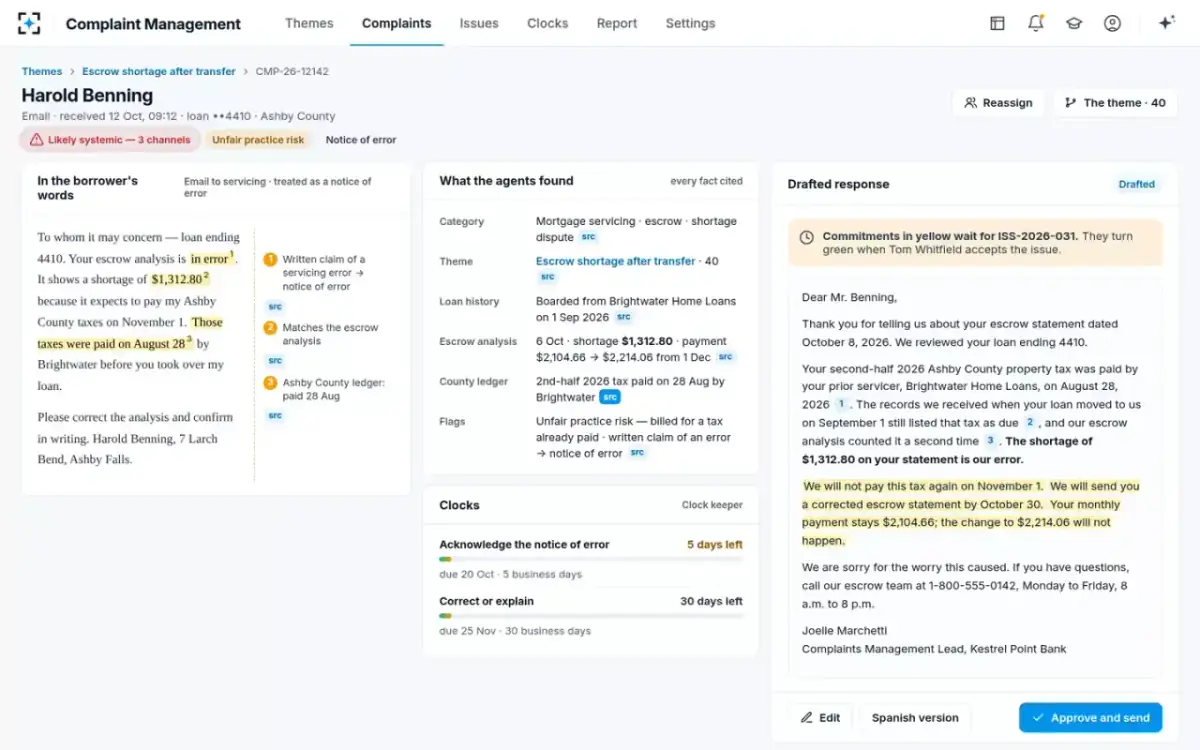
Look at the first margin note: the reason for the classification is shown, not just the label.
Billing errors and transfer disputes: the Reg Z and Reg E clocks
Regulation Z covers disputes on open-end credit, including credit cards and home-equity lines. A billing error notice must be written, received at the address the creditor disclosed, within 60 days of the first statement showing the error. The creditor then has 30 days to acknowledge it, unless it resolves the dispute sooner, and must resolve it “within 2 complete billing cycles (but in no event later than 90 days)” (12 CFR 1026.13).
Regulation E covers electronic transfers to and from a consumer’s deposit account, and here an oral notice counts. The institution must determine whether an error occurred within 10 business days, or take up to 45 days if it provisionally credits the account within the 10. It reports the result within three business days of finishing, and corrects an error within one business day of finding it (12 CFR 1005.11). Federal Reserve examiners found institutions that waited for written confirmation before starting, which the commentary forbids: an institution “may not delay until it has received a written confirmation” (Consumer Compliance Outlook, 2026).
What missed complaint clocks have cost
$45M
CFPB penalty, plus $19.8 million redress, for missed Reg Z billing-error acknowledgments and resolutions
Goldman Sachs Bank USA, Oct 2024
$11.5M
minimum consumer harm at a servicer with no system to tell notices of error from other mail
NOVAD Management Consulting, June 2024
99.6%
of 5.9 million CFPB complaints answered on time in 2025: the industry’s bar
CFPB, 2025
The NOVAD order is the clearest case of a clock never started. The servicer “did not distinguish notices of error from other correspondence received from borrowers, and did not track the receipt of or responses to notices of error.” The CFPB found at least $11.5 million of consumer harm and banned it from reverse-mortgage servicing. The failure was not slow investigation; it was classification.
Can a servicer extend the 30-day deadline to respond to a notice of error?
Yes, once, by 15 business days, if it tells the borrower in writing, with the reasons, before the 30 days end. The extension is not available for payoff-statement errors (seven business days, no extension) or for the two foreclosure errors, which must be answered before the sale or within 30 business days, whichever is earlier (12 CFR 1024.35(e)(3)). The CFPB portal’s 60 days work differently: they are available when the company marks its response as in progress, not by sending the consumer a notice of extension.
Some notices need no response at all. Paragraph (g) lets a servicer decline a notice of error that is duplicative, overbroad or untimely, but it must tell the borrower in writing within five business days and give the reason. That rule matters more each year, as templated and AI-written complaints increase the volume. It is a determination someone makes and records, not a reason to skip the clock.
Every complaint clock on one calendar, whatever door it came through
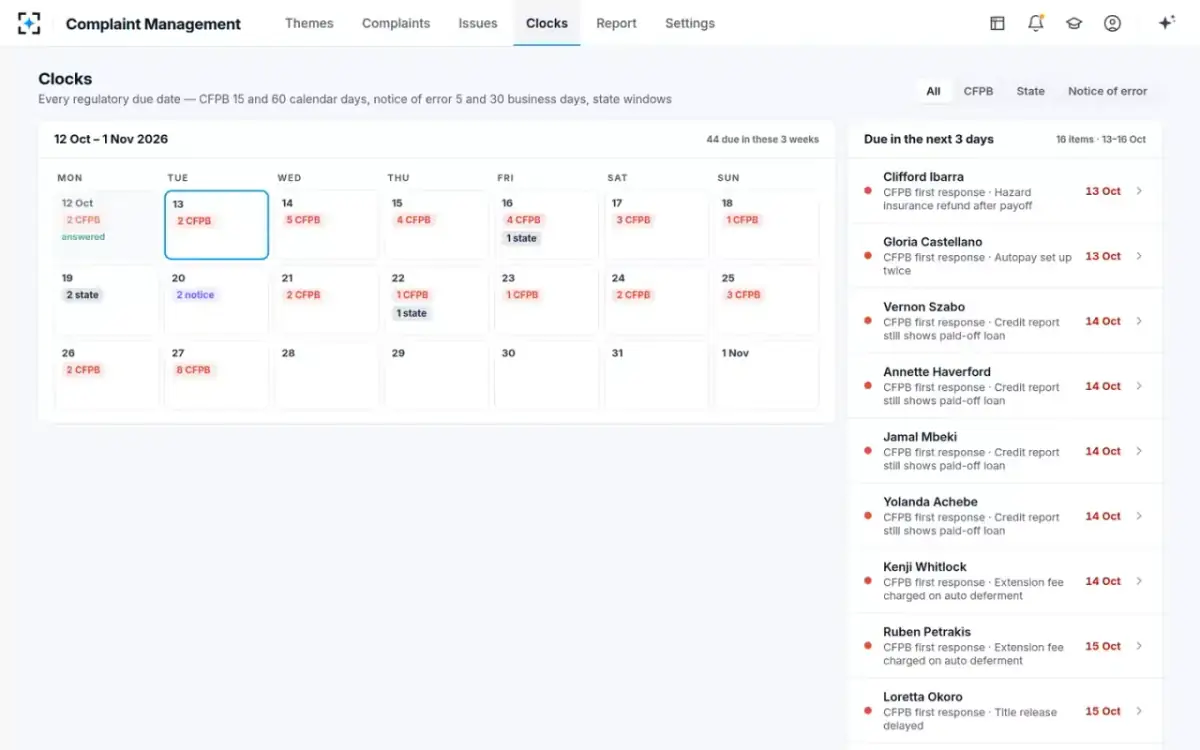
Are complaint deadlines business days or calendar days?
Both, depending on the rule, and the difference is weeks. The CFPB portal and Regulation Z count calendar days. Regulation X counts days “excluding legal public holidays, Saturdays, and Sundays”. Regulation E counts business days as days the institution is “open to the public for carrying on substantially all business functions” (12 CFR 1005.2(d)), so a bank that opens on Saturdays has a shorter Reg E calendar than one that does not. A tracker that applies one calendar to every clock is wrong on at least one of them.
Count one notice received on Monday 2 November 2026 three ways. Veterans Day (11 November), Thanksgiving (26 November) and Christmas Day fall inside the window, and each one pushes a Regulation X date by a day. Thirty business days end on 16 December, two weeks after thirty calendar days would.
One complaint received on 2 November 2026, counted on each calendar
| Clock | How it counts | Due |
|---|---|---|
| CFPB portal response | 15 calendar days from the day the CFPB sends it | Tue 17 Nov |
| Reg X notice of error, acknowledge | 5 business days, no weekends or legal public holidays | Mon 9 Nov |
| Reg X notice of error, correct or explain | 30 business days; Veterans Day and Thanksgiving fall inside | Wed 16 Dec |
| Reg X with the 15-day extension | 45 business days; Christmas Day and 1 January fall inside | Fri 8 Jan 2027 |
| Reg E determination, bank closed weekends and Veterans Day | 10 of the bank’s business days | Tue 17 Nov |
| Reg E determination, bank open Saturdays | 10 business days, Saturdays counted | Sat 14 Nov |
| Reg E with provisional credit | 45 calendar days | Thu 17 Dec |
The rows that catch teams out are the last three. A Regulation E investigation on a Saturday-opening bank is due three days sooner than the same investigation at a weekday-only bank, and the 45 days that follow provisional credit are calendar days, so they ignore every holiday in the table. Each clock needs its own calendar, set once by the compliance team and applied by the tracker, rather than counted by whoever picks up the complaint.
Setting the clocks at intake: a checklist
Seven intake checks that keep every complaint clock honest
- Record when and how it arrived
Date, time and channel on every complaint, including the date of an oral notice. Fed examiners cited banks that could not show when oral notices were given.
- Classify before you queue
Decide notice of error, information request, billing error or EFT error on the day of receipt. Early correction within five business days is only possible if you know it is a notice.
- Set every clock that applies
The same grievance can arrive as a portal complaint and a letter to servicing. Track each obligation separately; work to the earliest.
- Use the right calendar
Calendar days for the portal and Reg Z, business days without legal public holidays for Reg X, the institution’s business days for Reg E, the state’s own definition for a state rule.
- Know your designated addresses
A Reg X designated address and a Reg Z disclosed address both affect when a notice counts as received.
- Extend only on the rule’s conditions
A written extension notice before day 30 for Reg X; an in-progress response for the portal. Nothing else moves a date.
- Warn before the due day, not on it
The owner a few days ahead, the lead on the day. The solution warns three days ahead by default.
In the solution the clock keeper computes every date from the rule and the bank’s holiday calendar, and cannot extend one. A misconception about which notices count, the most common reason clocks are missed, is the subject of seven complaint-handling myths. What a response must say once the clock is running is covered in complaint response letters.
Questions people ask
Does a phone call start the Regulation X notice-of-error clock?
No. Regulation X applies to written notices, so a call alone does not start the 5 and 30 business days, although it is still a complaint to record. Regulation E is different: an oral notice of an EFT error starts its 10 business days, and the institution may ask for written confirmation but may not wait for it.
How long does a servicer have to answer a request for information?
Five business days to acknowledge it, then 10 business days if the borrower asks who owns the loan and 30 business days for anything else, with one 15-day extension on written notice (12 CFR 1024.36). The owner-identity request cannot be extended.
Can a lender report a disputed card charge as late while the billing error is open?
No. Until the Regulation Z procedure is complete, the creditor may not report the disputed amount as delinquent. The 2024 Goldman Sachs order cited adverse reports to credit bureaus “regarding amounts disputed in billing error notices prior to completing the requirements for billing error resolution” alongside the missed deadlines.
Are the Regulation E deadlines longer for new accounts?
Yes. For an account opened within the previous 30 days, the investigation window is 20 business days instead of 10, and the extended period is 90 days instead of 45. The 90 days also apply to point-of-sale and foreign-initiated transfers, whatever the account’s age (12 CFR 1005.11(c)(3)).
Do state regulator complaints have their own deadline?
Usually the referring department sets a response date, and some states also set servicing complaint clocks by rule. New York’s servicing rule covers “any written complaint”, not only claims of error: acknowledge within 5 business days, respond within 30, with one 7-day extension (3 NYCRR 419.6(e)). The solution’s default window for a state referral, 10 calendar days, is a setting the bank changes per department.
Which clock wins when one complaint starts several?
None replaces another. Each obligation is met on its own terms, and the earliest due date sets the order of work. A portal complaint that is also a notice of error needs the portal answer by day 15 and the Regulation X acknowledgment by business day 5, even though both describe the same escrow error. The Complaint Management page shows the clocks on the sample bank.