The complaint management KPIs a board should see measure whether the bank finds and fixes what complaints reveal: how quickly a pattern across channels is spotted, how long until its owner accepts the cause, how much of the affected population is remediated, and whether the fix holds, alongside on-time response for every regulatory clock. Counts by channel and category belong underneath, as context. Botminds’ Complaint Management is complaint management software that groups complaints into themes, hands systemic ones to their owners as issues, and drafts the monthly report for the board compliance committee from those themes and issues; the measures below are the ones it is built to produce.
The reason to change the report is in the examiners’ rating. Under the interagency consumer compliance rating, examiners weigh “root cause, severity, duration, and pervasiveness” for each violation, and assess “the responsiveness and effectiveness of the consumer complaint resolution process” (FFIEC, 81 FR 79473). A board that sees only counts cannot tell which of those four is getting better.
Twelve complaint KPIs, each with its formula
| KPI | How to compute it | What it tells the board |
|---|---|---|
| 1. Timely response, by clock | Responses sent by the due date ÷ responses due, separately for the CFPB portal, Reg X, Reg Z, Reg E and each state | Whether the floor is met. Report each clock: a blended rate hides the small ones. |
| 2. Acknowledgment on time | Acknowledgments sent within the rule’s window ÷ acknowledgments due | The first deadline, and the one most often missed when a notice is not recognised. |
| 3. Days to see a pattern | Date a theme is flagged likely systemic − date of its first complaint | Duration. How long the bank took to notice. |
| 4. Days to an accepted cause | Date the issue owner accepts the cause − date the theme was flagged | Root cause. How long from noticing to owning. |
| 5. Population found per complaint | Accounts affected by an accepted issue ÷ complaints in its theme | Pervasiveness. How far each complaint led. |
| 6. Remediation reached | Accounts remediated ÷ accounts affected, by issue | Whether the fix reached everyone, not only those who complained. |
| 7. Exposure stopped | Amounts not billed, not paid twice or refunded before the next operational run | Severity, in money. |
| 8. Fix holding | Complaints in a closed issue’s theme in the 30 or 60 days after the fix | Whether the root cause was the root. |
| 9. Themes rising | Themes up against their prior 30 days, with the operational event nearest their start | What to ask management about this month. |
| 10. Fair lending reviews | Open reviews and their age; decisions made, finding or not | The fair lending officer’s pipeline, with nothing quietly cleared. |
| 11. Classification accuracy | Seeded messages correctly classified ÷ seeded, by type, with the 95% bound | Whether the clocks and flags start when they should. |
| 12. Templated and duplicate share | Complaints handled as duplicative, overbroad or campaign ÷ all complaints | Keeps a campaign from inflating, or hiding, the real themes. |
What are the key complaint management KPIs?
Four families, in order of what they prove: timeliness by clock, speed to see and own a pattern, reach of the fix, and the integrity of the data underneath. The twelve measures above fall into them. Timeliness (KPIs 1 and 2) shows the legal floor is met. Pattern and ownership (3, 4 and 9) show the bank notices and acts. Reach (5, 6, 7 and 8) shows the fix touched everyone and held. Integrity (10, 11 and 12) shows the numbers can be trusted: flags are decided, classification is tested, and campaigns are not mistaken for themes.
A board needs at least one measure from each family, because each can look healthy while another fails. A bank can answer every complaint on time and still take three months to see that forty of them share a cause; it can find the cause quickly and remediate only the forty who wrote in. The CFPB procedures test all four: timely and complete responses, root cause, remediation “to all consumers harmed”, and reporting to the board (CMR 13–15).
Why complaint counts are not complaint KPIs
A count rises when the bank does something wrong and when it makes complaining easier, and falls when the problem is fixed and when customers give up. On its own it cannot tell those apart. The CFPB’s examination procedures ask something more specific: whether management “monitors consumer complaints to identify risks of potential consumer harm and CMS deficiencies, and takes appropriate prospective and retrospective corrective action”, and whether evaluations are “included in compliance reporting to the board and senior management” (CMR 13–15).
The OCC’s 2022 order against Bank of America used four verbs for what its complaints framework lacked: a process to “identify, measure, manage, and report complaints” (OCC consent order AA-ENF-2022-21). Measuring and reporting are in the list. A program’s KPIs are how a board sees whether the other two are happening.
What is a good timely response rate for complaints?
Close to 100%, and anything visibly below it needs an explanation. Timeliness is the one complaint KPI with public benchmarks, and they sit at 98.9% to 100%. Treat them as the floor that every program must meet, not as the goal, and report the rate per clock, because a 99% blended rate can hide a notice-of-error acknowledgment rate far lower.
Public timeliness benchmarks for complaint handling
99.6%
of 5.9 million CFPB complaints sent to companies in 2025 got a timely response
CFPB, 2025
100%
of written complaints the FDIC’s own complaint unit acknowledged within 14 days in 2025
FDIC, 2026
98.9%
of complaints the FDIC unit answered within its performance goals
FDIC, 2026
+21%
rise in complaints and call records the FDIC unit closed in 2025, to 32,128
FDIC, 2026
The FDIC’s figures describe the regulator handling complaints about banks, which makes them a useful yardstick of what a well-run unit can sustain. The FDIC also codes each complaint “with at least one product, issue, regulation, and finding”, and in 2025 its complaint unit identified 280 errors by banks and 108 violations. Coding to a finding, not just a category, is what makes KPIs 3 to 8 possible.
What complaint metrics should go in a board report?
The metrics that show what was found and fixed, with volume as context underneath. Take the solution’s sample bank, the fictional Kestrel Point Bank, and its October report for the board compliance committee. It opens with the volume, 1,286 complaints through seven channels from 15 July to 12 October, and moves at once to what was found: one systemic issue, a false escrow shortage on 1,140 loans after a servicing transfer, with the owner asked to stop a tax run before its file locked. Two more themes from the same transfer follow, then an open fair lending review, then a fix that is holding: late posting of mobile-app payments, 147 complaints in July and August, none since 2 September.
A monthly board report built from what was found and fixed
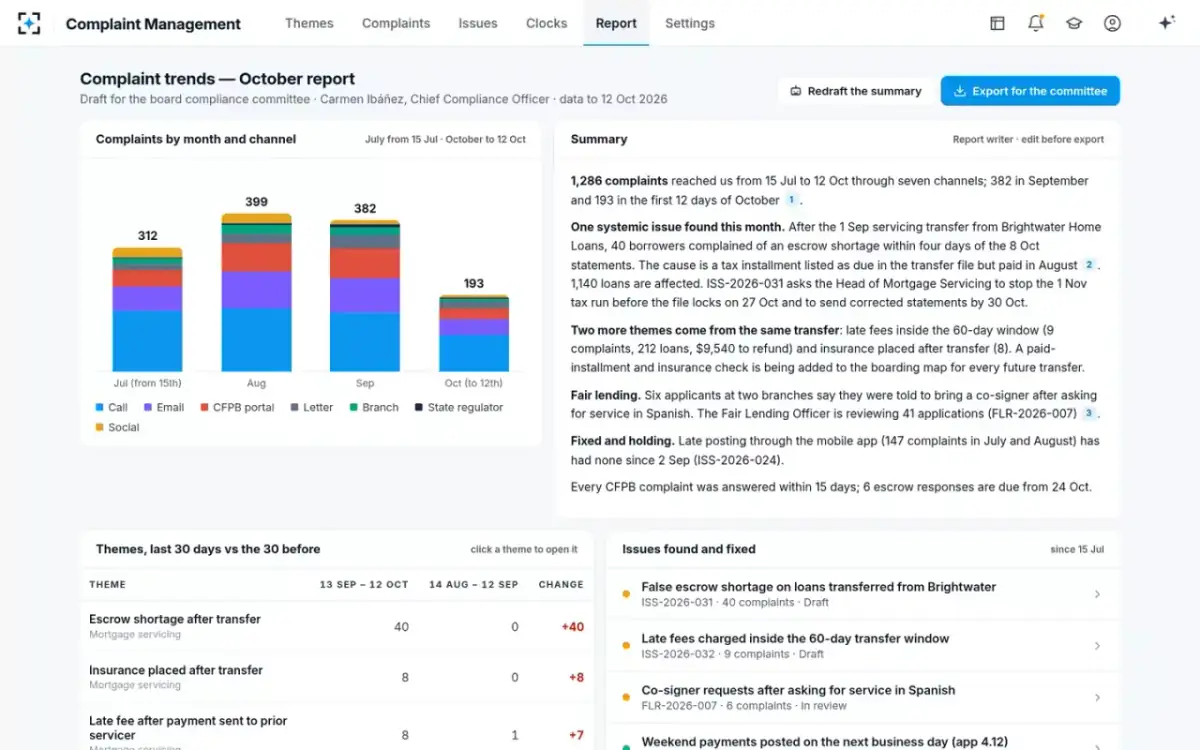
The last line is the timeliness KPI; everything above it is what counts reveal only after grouping.
Each item maps to a KPI in the table. “Every CFPB complaint was answered within 15 days” is KPI 1. The escrow issue is KPIs 3 to 7: the theme was flagged within days of the statements going out, the cause was proposed the same morning and later accepted by the owner, and the population, 1,140 loans from 40 complaints, set the remediation. The mobile-app fix is KPI 8. The fair lending review is KPI 10. A themes table, last 30 days against the 30 before, is KPI 9.
How do you measure time to identify a systemic issue?
Measure from the first complaint that belongs to the theme to the day the theme is flagged and sent to an owner, and report a second figure from the operational event that caused it. The first measures the complaint program; the second measures the bank. Both need the theme’s membership settled after the fact, because on day one nobody knew which complaints would turn out to share a cause.
Three choices make the number honest. Date the start by the first complaint later assigned to the theme, from any channel, including calls; starting from the first written complaint flatters the result. Date the stop by the flag plus the hand-off to a named owner, not by the trend review where someone first mentioned it. And count calendar days, since an escrow run or a fee cycle does not pause at weekends. Take an illustrative theme whose first call arrives on a Friday, whose first written complaint comes on the Monday and which is flagged on the Thursday: that is six days by the honest measure, three by the flattering one.
The operational-event figure is the one boards remember. In the sample case the servicing transfer happened on 1 September and no escrow complaint arrived for 37 days, until the first statements went out on 8 October. The program could not have seen the error sooner than the statements; the bank could have, at boarding. That is why the lasting fix there was a boarding check, and why both figures belong in the report.
How to read complaint KPIs together
Read them in pairs, because most single movements have two explanations. A rise in volume is bad news with a rising days-to-pattern and good news with a falling one. The combinations below are the ones a committee should ask management to explain.
Five KPI combinations, and what each usually means
| When you see | It usually means | Ask management |
|---|---|---|
| Volume up, days to see a pattern down | More channels logged, and joined up; the program is seeing more, sooner | Which channels were added, and what the new themes are |
| Volume down, days to see a pattern up | Customers giving up, or channels dropped from the log | Whether calls and branch complaints are still captured |
| Timely response high, notice-of-error acknowledgments lower | Notices not recognised at intake; the blended rate hides it | The seeded test result for notices of error |
| Causes accepted quickly, remediation reached low | Fixing forward without reaching the people already harmed | The remediation plan’s dates and who owns each step |
| Issues closed, the same themes back within 60 days | The fix addressed a symptom, not the cause | What changed in the process, not just the accounts |
How to measure the ROI of a complaint management program
Value it by what it stops, not by tickets handled. A complaint program earns its return when it finds an error before it is repeated across a portfolio, and the size of that return is set by the operational calendar: the next statement run, the next disbursement, the next fee cycle. The sum below is the structure; each term is priced from the bank’s own records.
The return on a complaint program, as a sum
Exposure stopped
Accounts affected × amount at risk in the next run, for issues accepted before that run
Sample: $3.39M of tax that would have been paid twice on 1,140 loans, before the 27 October file lock.
Issue owner and finance
Remediation found early
Overcharges reversed before borrowers pay them, plus refunds owed and made
Sample: $1.59M of shortage billed but not owed; 14 lump-sum payments, $19,870, to refund.
Issue owner
Penalty and order risk avoided
Probability of a finding × its cost, for clocks and patterns caught
Priced from the bank’s own exam history; the enforcement record below sets the scale.
Chief compliance officer
Analyst time redirected
Hours of transcription, coding and first drafts × loaded rate
Hours that move to root cause, QA and remediation, not out of the budget.
Complaints lead
Cost of running it
Software + approval time + issue and review time
Approval does not get faster: a person still signs every response.
Complaints lead and finance
The penalty term deserves care, because it is easy to overstate: federal enforcement has thinned since 2025. But the cases that do reach an order show the scale of a missed clock: $45 million in penalty and $19.8 million in redress for Goldman Sachs over Regulation Z billing-error timelines (CFPB, 2024), and at least $11.5 million of harm at NOVAD, a servicer with no system to track notices of error (CFPB, 2024). Under the CFPA, penalties for a knowing violation can reach $1,443,275 a day after the 2025 inflation adjustment (Federal Register, January 2025).
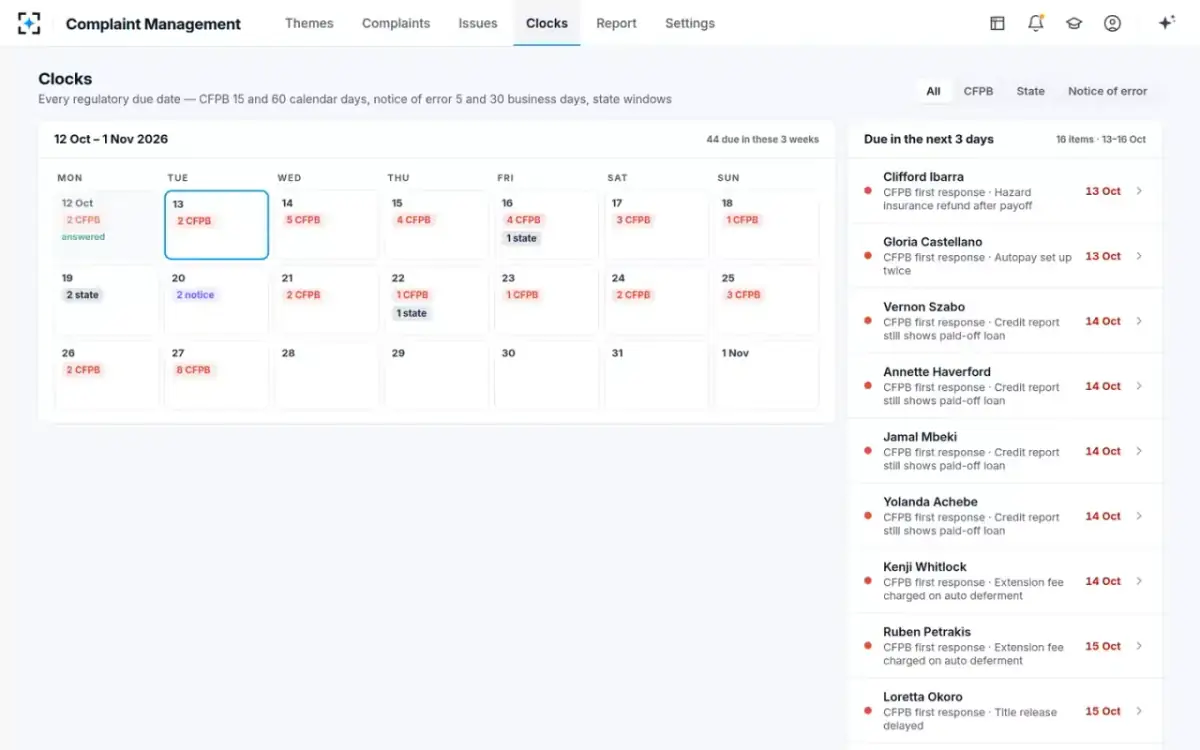
The timeliness KPI starts on the clocks calendar
Which complaint KPIs to start with
Six complaint KPIs to put in front of the board first
- Timely response, per clock
The floor. Include notice-of-error acknowledgments, the deadline most often missed.
- Days to see a pattern
The single best measure of whether channels are joined up.
- Days to an accepted cause
Shows whether the business owns what complaints find.
- Remediation reached
Accounts remediated against accounts affected, issue by issue.
- Fix holding
Complaints in a closed issue’s theme after the fix. A fix that does not hold is a finding waiting.
- Fair lending reviews, open and decided
With their age, so nothing waits quietly.
Most starter KPIs need complaints grouped into themes and linked to accounts; that is the work the agents do. The solution’s target for days to see a pattern is a systemic error flagged by day four, before a quarterly trend review would have seen it. The escrow root cause case shows the measures moving on one issue, the seeded test produces KPI 11, and the program structure names who owns each number. The Complaint Management page has the October report in context.
Questions people ask
How often should complaint KPIs go to the board?
Monthly or quarterly to the board compliance committee is common. The underlying measures should be live, because a pattern found at a quarterly review is often found after the next statement or disbursement has run.
Should complaint volume go down?
Not necessarily. Logging more channels raises it, and a bank that answers well may hear from more customers. Watch themes and their causes; a falling count with rising days-to-pattern is a worse report than the reverse.
How do you count a complaint that starts several clocks?
Once in volume, once per clock in timeliness. A portal complaint that is also a notice of error is one complaint, but it has three due dates, the portal response and the two Regulation X dates, and each is met or missed on its own. Counting it once in timeliness would let a missed acknowledgment disappear.
Should complaint KPIs be reported by channel?
As a breakdown, not as the headline. Channel shows where customers speak and whether a channel has gone quiet, which is useful; but a pattern counted per channel looks smaller than it is. In the sample case, the escrow theme was 23 calls, 11 emails and 6 portal complaints, and none of those numbers alone looked alarming.
How do you report complaint root causes to the board?
One line per accepted issue: the cause in a word or two and its category, the owner, the accounts affected, the share remediated and the date the fix is due. A cause still proposed is reported as proposed, with its owner, so the board sees what is decided and what is not.