A notice of error under RESPA is any written notice from a borrower that names the borrower, identifies the mortgage account and states the error the borrower believes the servicer made (12 CFR 1024.35(a), Regulation X). It does not have to use the words “notice of error” or “qualified written request”, and once it arrives the servicer has five business days to acknowledge it and thirty to correct the error or explain, with reasons, why there is none. A phone call is not a notice of error under RESPA. Under Regulation E, which covers electronic transfers on deposit accounts, a call does start an error clock, and under every rule the call is a complaint to record. Botminds’ Complaint Management is software that reads every complaint from every channel and sets those clocks from the rule text rather than from habit; the seven myths below are the habits it is designed to replace.
Each myth is one that frontline staff, complaint analysts or managers hold in good faith, and each is answered with the regulation or the examination manual, not with opinion. The first two sections set out what the RESPA rule actually covers, because most of the myths are a misreading of it.
Seven complaint-handling myths, and what the rules actually say
The myth: Only a written notice starts an error-resolution clock.
The rule: Reg E: an oral notice does, and the bank may not wait for written confirmation. Reg X and Reg Z need writing, but the call is still a complaint.
The myth: If we fixed it on the call, it is not a complaint.
The rule: Examiners expect complaints and inquiries recorded and categorised “regardless of the channel”, resolved or not.
The myth: A notice of error has to say “notice of error” or “qualified written request”.
The rule: It needs the borrower’s name, the account and the error asserted, in writing. Nothing more.
The myth: “We found no error” is a complete response.
The rule: Reg X and Reg E both require the reasons and the right to request the documents relied on.
The myth: Answering on time is what examiners check.
The rule: They test whether the investigation was reasonable, whether root cause was found and whether everyone harmed was remediated.
The myth: We owe a fix to the people who complained.
The rule: Remediation is expected for all consumers harmed by the same violation, and Reg X requires correcting errors found along the way.
The myth: The CFPB withdrew its complaint guidance, so the rules are looser.
The rule: What was withdrawn was policy on publishing complaint data and one advisory opinion. The statute and the error-resolution clocks are unchanged.
What is a notice of error under RESPA?
It is a written claim that the servicer got one of eleven things wrong, and it obliges the servicer to investigate and answer in writing. The duty comes from section 6 of RESPA, which bars a servicer from failing “to take timely action to respond to a borrower’s requests to correct errors” (12 U.S.C. 2605(k)), and Regulation X turns it into a procedure. Ten of the covered errors are specific; the eleventh, “any other error relating to the servicing of a borrower’s mortgage loan”, keeps the list from being a loophole.
The eleven errors a RESPA notice of error can assert
| Covered error, 12 CFR 1024.35(b) | How it reaches a complaints team |
|---|---|
| (1) Refusing a payment that meets the servicer’s written requirements | A returned payment after a payment-address change |
| (2) Misapplying a payment to principal, interest, escrow or fees | Extra principal held in suspense |
| (3) Not crediting a payment on the day it arrived | A late fee on a payment sent on time |
| (4) Not paying taxes or insurance on time from escrow, or not refunding an escrow balance | A county penalty notice, a lapsed homeowner’s policy |
| (5) A fee the servicer has no reasonable basis to charge | Inspection or late fees the borrower cannot trace |
| (6) An inaccurate payoff balance | A refinance or sale that closes short; 7 business days to answer |
| (7) Inaccurate information about loss mitigation and foreclosure | A borrower told the wrong deadline for a workout application |
| (8) Not transferring servicing information accurately to a new servicer | Escrow, payment or modification data lost in a transfer |
| (9) A first foreclosure notice or filing in breach of the loss mitigation rules | A foreclosure started while an application was pending |
| (10) Moving for judgment or holding a sale in breach of the same rules | A sale date on a loan under review |
| (11) Any other servicing error | Anything else about the servicing of the loan |
The rule also limits what a servicer may do while the notice is open. It may ask for documents but may not make them a condition of investigating, and may not conclude there was no error because the borrower did not send them (paragraph (e)(2)). It may not charge a fee or require a payment as a condition of answering (paragraph (h)). For 60 days after receipt it may not report adverse information to a credit bureau about any payment the notice disputes (paragraph (i)). And a servicer that names a designated address for notices, by written notice to the borrower, must post that address on its website if the site lists any contact address (paragraph (c)).
Getting it wrong is privately actionable. A borrower can sue under section 6(f) of RESPA for actual damages plus, for a pattern or practice of noncompliance, additional damages “not to exceed $2,000”, and in a class action up to the lesser of $1 million or 1% of the servicer’s net worth, with costs and attorney’s fees (12 U.S.C. 2605(f)). That is the exposure a misread letter carries, before any examination.
Is a qualified written request the same as a notice of error?
Only when it asserts an error; a qualified written request that asks for information is a request for information instead. RESPA defines a qualified written request as written correspondence, other than a note on a payment coupon, that identifies the borrower and the account and gives “a statement of the reasons for the belief of the borrower” that the account is in error, or enough detail about the information sought (12 U.S.C. 2605(e)(1)(B)). Regulation X sorts it by content: a QWR that “asserts an error relating to the servicing” is a notice of error, and one that asks for information falls under the request rule, with its own 5-day acknowledgment and 10- or 30-day answer (12 CFR 1024.36).
Many letters do both. A borrower who writes “my escrow analysis is wrong, and please send me the transfer records from the old servicer” has started two obligations in one envelope: correct or explain the escrow error, and produce the records. Each needs its own acknowledgment wording and its own due date. Labels on the letter, including the words “qualified written request” printed at the top of a template, change neither.
Myth 1: only a written notice starts the clock
It depends on the rule, and the exception is where violations come from. Regulation E applies to “any oral or written notice of error” received within 60 days of the statement (12 CFR 1005.11(b)). A bank may ask the consumer to confirm in writing within ten business days, which affects whether it must give provisional credit, but it cannot hold the investigation until the letter comes.
“A financial institution must begin its investigation promptly upon receipt of an oral notice. It may not delay until it has received a written confirmation.”
Official Staff Commentary to Regulation E, comment 11(c)-2, as quoted by Consumer Compliance Outlook
Fed examiners found institutions doing exactly that, and called it “one common misconception” that the duty to investigate “is triggered only when the consumer submits a written notice” (Consumer Compliance Outlook, 2026). The habit is understandable in a lender, because the two mortgage and card rules do require writing: a Regulation X notice of error is a “written notice” and a Regulation Z billing error notice is “a written notice” received at the disclosed address (12 CFR 1026.13(b)). Staff trained on servicing letters carry the rule over to deposit disputes, where it is wrong.
Error resolution is where examiners keep finding violations
74%
of the FDIC’s EFTA violations in 2025 were in the two Reg E error-resolution sections
FDIC, 2026
#3
Reg E §1005.11(c), the 10-business-day investigation, among Fed violations in 2025: 35 of 630
Federal Reserve, 2026
280
errors by banks that FDIC complaint staff identified from consumer complaints in 2025, and 108 violations
FDIC, 2026
Myth 2: a complaint resolved on the call does not need logging
It does. The CFPB’s examination objectives ask whether “consumer complaints and inquiries, regardless of the channel through which they are submitted, are appropriately recorded and categorized” (CMR 13). The CFPB’s own working definition is broad: complaints are “submissions that express dissatisfaction with, or communicate suspicion of wrongful conduct by, an identifiable entity related to a consumer’s personal experience” (CFPB, 2025). When the OCC found Bank of America’s complaints framework deficient, it required “an expanded complaints definition” (OCC, 2022).
The practical cost of not logging is not the missing ticket; it is the missing pattern. In the solution’s sample case, an escrow error first appeared as calls to the contact centre. Fifteen of the 21 escrow complaints that arrived on a single Monday were calls. A team that logs only unresolved or written complaints would have seen six.
Myth 3: a notice of error has to be labelled as one
Regulation X sets three content tests and no wording test: the borrower’s name, information that identifies the mortgage account, and “the error the borrower believes has occurred”, in writing (12 CFR 1024.35(a)). A qualified written request that asserts a servicing error is a notice of error; a letter that never uses either phrase can be one too. “The escrow analysis is wrong because my taxes were already paid”, signed and with the loan number on it, meets all three content tests. Whether it was received is a separate question, answered by the address the servicer has designated, if it has designated one.
The cost of the myth is in the NOVAD consent order: the servicer “did not distinguish notices of error from other correspondence received from borrowers”, did not acknowledge them in five business days, and harmed consumers by at least $11.5 million. In the solution, the classifier shows the sentence that made a message a notice of error, so the decision can be checked; a written claim of a servicing error by email is treated as a notice whatever it is called.
Calls, emails and letters in one list, each with the clock its content starts
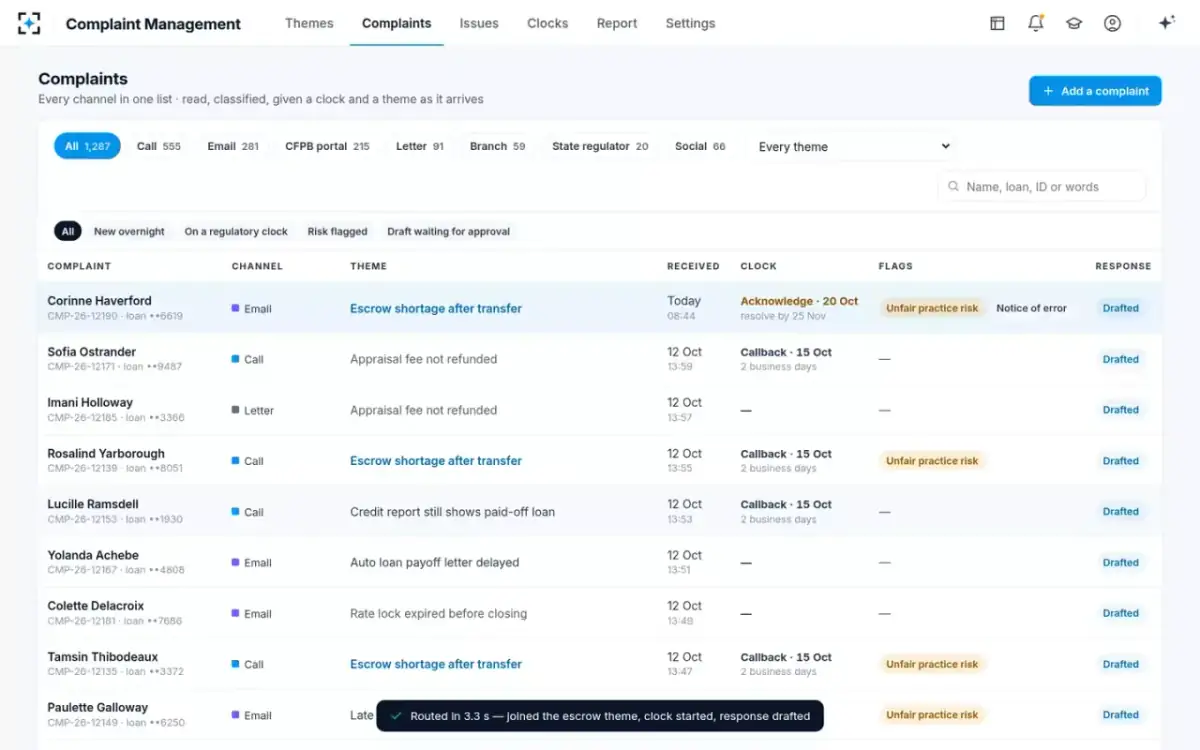
The flag and the clock come from what the message says, not from the channel it arrived through.
Myth 4: “no error found” is a complete answer
Neither rule allows it. When a servicer concludes no error occurred, Regulation X requires “a statement of the reason or reasons for this determination, a statement of the borrower’s right to request documents relied upon”, how to request them and a telephone number (12 CFR 1024.35(e)(1)(i)(B)). Regulation E requires a written explanation of the findings and notice of the right to the documents. Fed examiners cited banks whose letters used “generic language, such as ‘no error’”, and traced the violations to “insufficient templates generated by the institution’s dispute tracking system” (Consumer Compliance Outlook, 2026).
The fix is a response built from the account record rather than a template line. Complaint response letters that answer the complaint takes the required content rule by rule.
Myth 5: on-time answers are what examiners look at
Timeliness is the floor, not the test. Companies answered 99.6% of CFPB complaints on time in 2025, so being on time distinguishes almost nobody. The examination procedures ask whether responses are “prompt and complete, and based on a thorough investigation of the facts”, whether evaluations “include comprehensive root cause analysis”, whether root cause leads to changes in policies, procedures or training, and whether complaint evaluations reach the board (CMR 14–15). A program that answers every complaint on day 12 and never connects them can still be rated deficient.
Myth 6: the people who complained are the people owed a fix
The CFPB procedures ask whether the institution “provides retrospective remediation to all consumers harmed by a particular violation”. Regulation X adds a narrower duty inside each investigation: if the servicer finds errors other than, or in addition to, the one alleged, it “shall correct all such additional errors” (12 CFR 1024.35(e)(1)(ii)).
The sample case shows the scale. Forty complaints about a false escrow shortage led the solution’s root-cause investigator to search all 6,214 loans the fictional bank had taken over, and it found the same false shortage on 1,140. Of those borrowers, 1,088 had received the same statement and had neither complained nor paid. The forty were the signal; the remediation was owed to all 1,140. The escrow root cause case follows it step by step.
Myth 7: the 2025 withdrawals loosened complaint obligations
On 12 May 2025 the CFPB withdrew 67 guidance documents, including its policy statements on publishing complaint data and its advisory opinion on consumer information requests to large banks (90 FR 20084). None of that touched the statute or the regulations. Section 1034 of the Dodd-Frank Act still requires a timely response to regulators, and the Regulation X, Z and E clocks are unchanged. As the FDIC’s manual puts it, examiners cite “violations of law, regulation, or non-compliance with enforcement orders”, not of guidance (FDIC Consumer Compliance Examination Manual II-1.1). Every clock on this page is a regulation.
What to tell a borrower who calls with a complaint
Frontline staff need a short, correct script, because the myths start at the first conversation. The checklist below is the version the rules support. It also serves as the plain-language explanation a customer is owed.
A frontline card that matches the rules
- Log every call that expresses dissatisfaction
Resolved or not, with the date, the account and the borrower’s own words.
- For a disputed debit card payment or electronic transfer, start the investigation now
A Reg E notice can be oral. Ask for written confirmation if policy requires it, but do not wait for it.
- For a disputed credit card charge, tell the customer to write
That is a Reg Z billing error, and its protections start with a written notice at the address on the statement, within 60 days.
- For a mortgage servicing error, explain how to put it in writing
Give the designated address if the servicer has one. Regulation X protections start with the written notice.
- Never promise “we will look into it” without a date
The clock that applies is set when the complaint is logged; tell the borrower when to expect an answer.
- Flag what sounds like unfair treatment
Any mention of language, national origin, race, sex, age, marital status, disability or public assistance goes to the fair lending officer.
- Pass on, do not decide, a doubtful case
If it is unclear whether a message is a complaint, a person reviews it. Treat it as one until then.
The fair-lending line on that card is the subject of complaints as fair lending signals. Which clock each kind of message starts is set out as a decision tree in complaint response deadlines, and the Complaint Management page shows the whole program on the sample bank.
Questions people ask
Can a servicer refuse to answer the same notice of error twice?
Yes, if it has already complied for substantially the same error and the borrower brings no new and material information, meaning information not reviewed before that is reasonably likely to change the result. It must still tell the borrower in writing, within five business days of deciding, that it will not respond and why (12 CFR 1024.35(g)).
Is there a deadline for a borrower to send a notice of error?
Only after the servicing relationship ends. A notice delivered more than one year after servicing was transferred away from the servicer, or after the loan was paid off, is untimely, and the servicer may decline it with written notice. While the servicer still services the loan, there is no deadline.
Can a servicer require the borrower to send documents before it investigates?
No. It may ask for supporting documents, but it may not make them a condition of investigating, and it may not decide that no error occurred because the borrower did not provide them. The investigation has to be a reasonable one on what the servicer holds.
Does a notice of error stop negative credit reporting?
For 60 days, for the payment it disputes. After receiving a notice of error, the servicer may not furnish adverse information to any consumer reporting agency about that payment for 60 days. It may still pursue other remedies, including foreclosure, except where the notice asserts one of the two foreclosure errors.
What happened to the servicer that could not tell notices of error from other mail?
The CFPB’s 2024 order against NOVAD Management Consulting found no system for acknowledging or answering notices of error and at least $11.5 million of consumer harm, and banned the firm from reverse-mortgage servicing (CFPB, 2024). The penalty was $1 because of inability to pay, with $16.5 million suspended.