An insurance complaint handler is the person who investigates a complaint against an insurer, works out what happened from the policy, billing and claim files, writes the answer and records how it ended. Most of that work runs against a clock the handler did not set: a state department of insurance forwards the complaint and the law gives the insurer 14 days to answer in Florida, 10 business days for a claim inquiry in New York, 21 calendar days for a claim inquiry in California and 15 days in Texas. The hard part is rarely the writing. It is rebuilding, under that deadline, a story scattered across five systems. Insurance Complaint Management is Botminds' software that logs every complaint, sets its clock, pulls the file and drafts a cited answer, so the handler spends the day on judgment rather than retrieval.
The clocks a handler inherits with each department complaint
14days
Florida, from the division’s written request
10business days
New York, for an inquiry about a claim
21calendar days
California, for an inquiry about a claim
15days
Texas, plus 10 more on written notice
What does an insurance complaint handler do?
The handler takes each complaint from arrival to a signed answer and a recorded outcome: decide whether it is a complaint, find the customer and the policy, establish what happened, answer every point, work out any redress and close it in the complaint register. The role sits in a consumer services or customer relations department, and in New York that department is required by rule. Every insurer there must have an internal department "specifically designated to investigate and resolve complaints filed with the Department of Financial Services", with the power to overturn a decision, not merely explain it.
The same New York rule gives that department authority to question and change the position taken in individual cases or in company practices generally, and vests responsibility for it in a corporate officer. That is the job's real scope. A handler who finds that a claim was mishandled is expected to fix the claim, and a pattern of them is expected to reach someone who can fix the practice. Florida asks for a named person in the same spirit: each insurer must "designate a contact person for escalated complaint issues" and file an email address for the division's requests.
The work divides into two streams that run on different rules. Department complaints arrive through a regulator's portal or email with a file number and a statutory deadline. Direct complaints arrive by email, phone, letter, a producer writing for the insured or a public post, and run on the company's own standard. Both end up in the same register, and examiners read both.
Where the hours go on a single department complaint
On a department complaint, the larger share of the handler's time goes to finding and checking records, not to writing. Botminds' estimate for one department complaint handled by hand, drawn up for this solution, puts the total at about five and three-quarter hours. Two of them go to pulling the billing entries, notices and call notes, an hour and a half to writing, and an hour to noticing that other complaints share the same cause.
One department complaint: most handling hours go to finding the evidence
- Log, code, find the policy and work out the deadline0.75 h
- Pull the billing entries, notices and call notes2 h
- Write the response1.5 h
- Redress and sign-off0.5 h
- Spot the shared cause1 h
- Check the log, clock and pulled records0.4 h
- Edit the cited draft0.5 h
- Approve redress (0.25 h) and confirm the cause (0.1 h)
The split matters for staffing. A handler who works 25 to 30 open complaints, as the fictional handler in the solution's sample does, cannot give each one two hours of retrieval in a week, so the retrieval gets compressed and the answer rests on whatever was quickest to find. That is when a response cites a payment that was later reversed, or misses the notice of cancellation sitting in another system.
Three clocks that set the handler's morning
A handler's day is ordered by deadline, and the deadline depends on which regulator sent the complaint. Florida's statute requires the answer within 14 days of the division's written request for documents and information about a consumer complaint, and lets the division fine a company up to $5,000 per violation for missing it (§624.307(10)(b)). New York gives 10 business days to furnish the available information on an inquiry about a claim. California requires a complete written answer to a claim inquiry within 21 calendar days.
The counting rules differ as much as the numbers. Ten business days in New York always spans two calendar weeks, and longer across a holiday, while Florida's 14 days include weekends. Texas gives 15 days from receipt and, under §38.001(c), the department must grant 10 more if the insurer sends written notice that it needs them. A handler juggling all four is doing date arithmetic before reading a word of the complaint, which is why the clocks are worth seeing side by side in the department of insurance complaint response timeline.
The statutory date is not always the real one. If the complaint is about a notice of cancellation that takes effect before the department's deadline, the cancellation is the date that matters to the customer. In the solution's sample, a Florida referral received on 17 March was due to the division on 31 March, but the customer's cancellation took effect on 29 March, so the earlier date went on the complaint.
Is it a complaint? The first judgment of every day
Before anything is timed or answered, the handler decides whether a message is a complaint at all, and the definitions leave room for judgment. The NAIC's model law counts any written communication primarily expressing a grievance. The NAIC's market conduct handbook (2017 edition) widens that to any written communication expressing dissatisfaction and adds that an oral complaint later put into writing qualifies. The NAIC's model regulation on complaint records concedes the point plainly: "The essential question is: has the writer expressed a grievance?"
Texas draws the line from the other side. Its rule says a complaint is not a misunderstanding or a problem of misinformation that is resolved promptly by clearing it up to the writer's satisfaction, and it treats repeated letters about the same issue from the same person as one complaint (28 TAC §21.2502). A handler applying both tests to a call note that says "customer unhappy, explained fee" is making a call that examiners may later revisit.
Five questions a handler settles before a message becomes a complaint
- Does it express a grievance, not just ask a question?
The NAIC model regulation’s test. A request to correct a misspelled name may be information; the same request in anger may be a grievance.
- Is it in writing, or was a call written down?
The handbook (2017 edition) counts an oral complaint once it is converted to writing, such as a call note.
- Was it settled on the spot by correcting a misunderstanding?
Texas excludes those from the complaint record if resolved promptly to the writer’s satisfaction.
- Is it the same issue as an open complaint from the same person?
Texas treats it as part of the same complaint, so it updates the open one.
- Did a department send it?
Then it carries a statutory clock and the department will check that it reached the register.
Who writes in: the handler's caseload in public data
Most complaints come from policyholders, but a large minority come from people the handler never insured. In our analysis of the 22,564 complaints the Texas Department of Insurance closed in 2025, 51% were filed by the insured, 19% by a third party such as the other driver in a crash, and the rest by providers, attorneys, relatives, billing services and agents. Each writer needs a different kind of answer, and an attorney's letter is a different conversation from a relative's.
Who filed the complaints Texas closed in 2025
Complaints closed by TDI, 2025 (22,564)
- Insured · 51.4%
- Third party · 18.6%
- Provider or attorney · 11.3%
- Everyone else · 18.7%
The same data shows how long the department side takes. Texas closed its 2025 complaints a median of 84 days after receiving them, and 68% took more than 60 days. The insurer's answer is due in 15, so most of a department complaint's life is the department's review, not the handler's work. For the handler, the complaint is often closed on the insurer's side weeks before the regulator closes it.
How insurance company complaint handling procedures are judged
Examiners judge complaint handling against four standards in the NAIC handbook (2017 edition): every complaint recorded in the required format, adequate written procedures, adequate steps to finalize each complaint, and responses within the time the law allows. The third is the handler's own work. Examiners check that a response is timely, complete, supported by documentation, appropriate as a business practice, compliant with the law and the policy, and that it identifies the remedy owed. The full list is applied to a sample letter in the annotated DOI complaint response letter.
The handbook also tells examiners to "reconcile the regulated entity’s complaint register with a list of complaints from the insurance department". A department complaint the handler answered on time but never entered in the register is still a finding. The register is covered column by column in complaint register requirements for an insurance company.
The four people around one complaint, with Insurance Complaint Management
The handler is one of four people a complaint passes through, and each has a different stake in it. The team lead signs department responses and approves redress beyond the handler's limit. The conduct risk analyst turns the month's complaints into causes for a committee. The fix owner, often in billing or claims operations, needs to know a defect is real and how many customers it reached before spending money on it.
Insurance Complaint Management and the four people who carry a complaint
Today
Works 25–30 open complaints and spends half the day finding the billing entry or call note that proves what happened.
With agents
Opens a complaint with the file already pulled, the referral highlighted against it and a cited draft to check.
Still theirs: the judgment on what happened and what the draft may say
Today
Knows which complaint is due Friday but not why the team received nine about billing.
With agents
Runs the board by deadline each morning, regroups it by cause, and signs department responses from one screen.
Still theirs: department signatures and redress up to the team lead’s limit
Today
Codes trends by hand for the conduct committee; by the time they are ready they are a month old.
With agents
Confirms or rejects each proposed cause and gets the monthly report drafted from the register.
Still theirs: whether a pattern is real
Today
Hears about a defect from the fifth complaint and cannot size it.
With agents
Gets one defect, the customers it reached and a remediation for each of them.
Still theirs: the fix and its budget
What the handler's screen looks like when the file is already pulled
In the solution, a department complaint opens with the referral on the left, the draft in the middle and the records on the right. The referral is highlighted against the file: what matches the records, where the company erred, what the error cost the customer and what is urgent. Take the sample: Denise Albright, a fictional Florida homeowner, was drafted twice for her March premium, charged a returned-payment fee and sent a notice of cancellation.
One Florida complaint with the file pulled and the draft cited
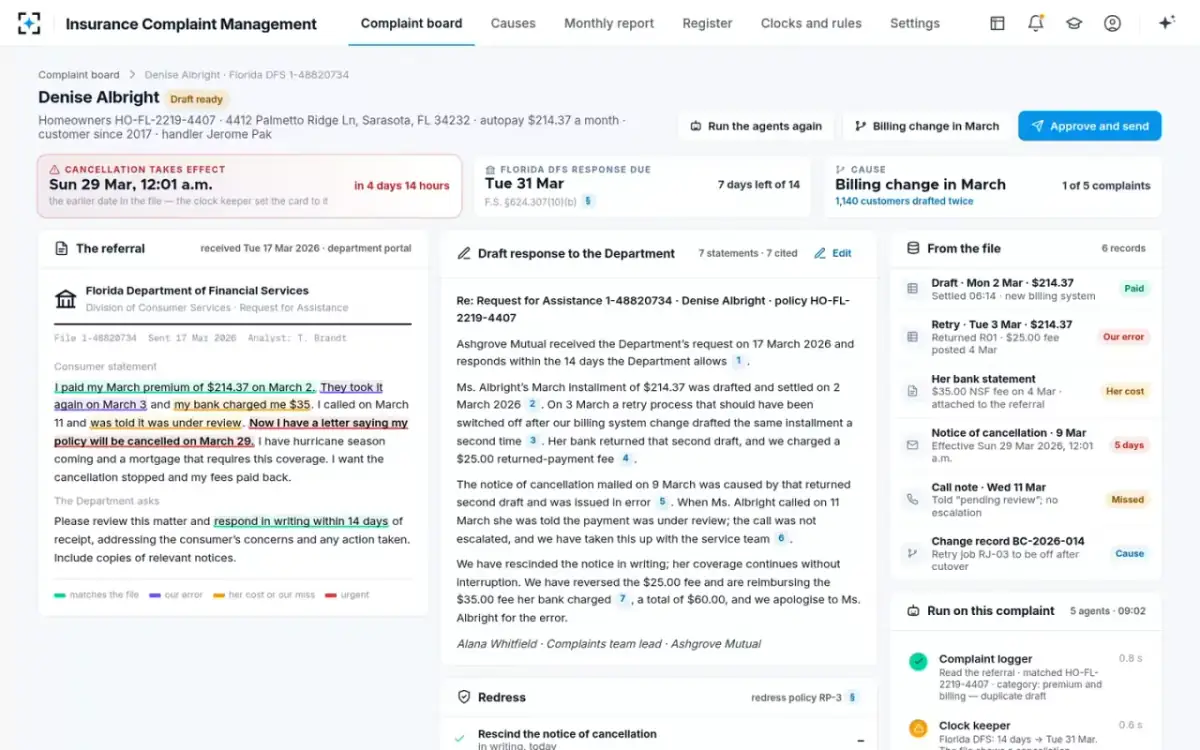
The agents did the retrieval in seconds: six records, from the two billing entries to the change record that explains the second draft. What remained for people was judgment. Was the call on 11 March a missed escalation? Is $60.00 the right redress under the company's policy? Should the letter apologise? Those are the parts of the job the handler and team lead keep, and the parts examiners hold them to.
What changes in the handler's day, and what does not
The deadline arithmetic, the logging, the record search and the first draft move to the agents; the reading, the decisions and the signature stay with people. In the solution, the complaint logger reads every channel and logs each complaint in the customer's own words, and an unclear case goes to a handler rather than being dropped. The clock keeper sets each deadline from its rule and never moves one; an extension is asked of a department by a person. The response drafter never sends.
The handler's skill shifts from finding to checking. A cited draft is only as good as the citations, so the new habit is to open the record behind each number and ask whether it says what the sentence says. That is faster than writing from scratch, and it leaves a trail: the draft, the records and the person who approved it sit on the complaint's history together.
Questions people ask
What is complaint handling in insurance?
It is the process of receiving, investigating, answering and recording complaints against an insurer, both those sent by a state department of insurance and those made directly. The NAIC's model law, which states adopt in their own words, calls for a complete record of complaints since the last examination, showing line of insurance, nature, disposition and time to process.
What does an insurance complaints department do?
It investigates and resolves complaints and acts on what it finds. New York requires every insurer to have one, with authority to change the company's position in individual cases or in its practices generally, and with a corporate officer responsible for it.
How long does an insurance company have to answer a complaint?
For a complaint forwarded by a regulator, it depends on the state: 14 days in Florida, 10 business days for a claim inquiry in New York, 21 calendar days for a claim inquiry in California and 15 days in Texas, with a 10-day extension on written notice. Direct complaints follow the company's own standard unless a state rule applies.
Do phone complaints count as complaints?
Under the NAIC handbook's definition (2017 edition), an oral complaint that is later converted to writing, such as a detailed call note, counts. The model law's own definition is a written communication primarily expressing a grievance, so how a company records calls decides how many complaints it reports.
What skills do insurance complaint handler jobs need?
Reading policies and claim files, date arithmetic across state rules, and writing answers that address every point a regulator raises. Examiners judge responses on completeness, documentation and whether the remedy owed is identified, so the core skill is evidence, not tone.
Who reviews a complaint handler's response?
Usually a team lead for department complaints, and in the solution's default settings a team lead signs every department response while reviewing a 10% sample of direct responses. Examiners later review a sample of complaint files against the handbook's standards.