A complaint management system for insurance companies is software that captures every complaint from every channel, keeps the register state law requires, tracks each regulator's response deadline, supports a complete answer and turns the year's complaints into causes management can fix. Unlike a general customer complaint tool, it has to satisfy a market conduct examiner: the NAIC's model law calls for a complete record of complaints since the last examination, and examiners reconcile that record against the department's own list. The safest way to go live is in the order those requirements run, testing each stage on past complaints before relying on it. Insurance Complaint Management is Botminds' system built that way, with six agents doing the logging, timing, research and drafting and a team lead signing.
"It permits management to quickly determine how well the company is doing in its dealings with its policyholders and the public."
NAIC Model Regulation for Complaint Records, preface
The NAIC's model regulation on complaint records, first adopted in 1973, says that of a complaint register, and it is still the best test of a complaint system: does it tell management, quickly, how the company is treating people? A system that only stores complaints passes an audit of its fields and fails that test. The plan below is built to pass both.
What should a complaint management system for insurance companies do?
It should do five jobs, each tied to a written requirement: hold one complete register, set every deadline from its source's rule, produce answers that address every point with evidence, control redress and sign-off, and find the causes behind complaints. Everything else, from dashboards to workflow, serves one of those five. A system that skips the first is a liability however good its analytics are.
What regulators already require of an insurer's complaint system, and how to test it
| Requirement | Where it is written | What the system must hold | How to test it before go-live |
|---|---|---|---|
| A complete record of complaints | NAIC Model 880 §4.L; Model 884; NY 11 NYCRR 216.4(e) central log | Every complaint since the last exam: line, nature, disposition, time to process | Load last year’s complaints and reconcile them with each department’s list |
| Answers on time | Fla. Stat. §624.307(10)(b); 11 NYCRR 216.4(d); Tex. Ins. Code §38.001(c) | Each source’s clock, counted the way its rule counts | Recompute deadlines for past department complaints and compare with the dates actually met |
| Answers that are complete | Florida: answer the issues and allegations in the complaint; NAIC handbook response criteria | The file’s records linked to each statement | Draft answers for closed complaints and compare them with what was sent |
| Procedures and authority | NAIC handbook Standard 2; NY 216.4(c) authority to change the company’s position | Who may approve redress and sign each kind of response | Replay past redress decisions against the configured limits |
| Analysis of what complaints show | Model 884 §5: compile counts by line, function, reason, disposition and state at least annually | Causes across channels, not only category counts | Replay a past quarter and see whether a known problem surfaces earlier |
Stage 1: one register for every channel
Start with the register, because every later stage writes into it and examiners read it first. The NAIC handbook (2017 edition) tells examiners to include complaints made directly to the company as well as those filed with the department, and to review the company's procedures for complaints received through social media where the company is active. A system that captures department portals but not the call centre's notes will look complete until the examiner samples a call.
The register also has to follow a definition the company has written down. Texas, for instance, treats repeated letters from the same person about the same issue as one complaint, and excludes a misunderstanding resolved promptly to the writer's satisfaction. In the solution, the complaint logger reads every channel the carrier connects, decides complaint or request against the carrier's definition, and sends unclear cases to a handler.
The test: load the last twelve months of complaints from every source, run them through the logger, and reconcile the result with each department's list of complaints against the company, the same reconciliation examiners perform. Every department complaint should appear once, matched to its policy and file number.
Stage 2: every source's clock
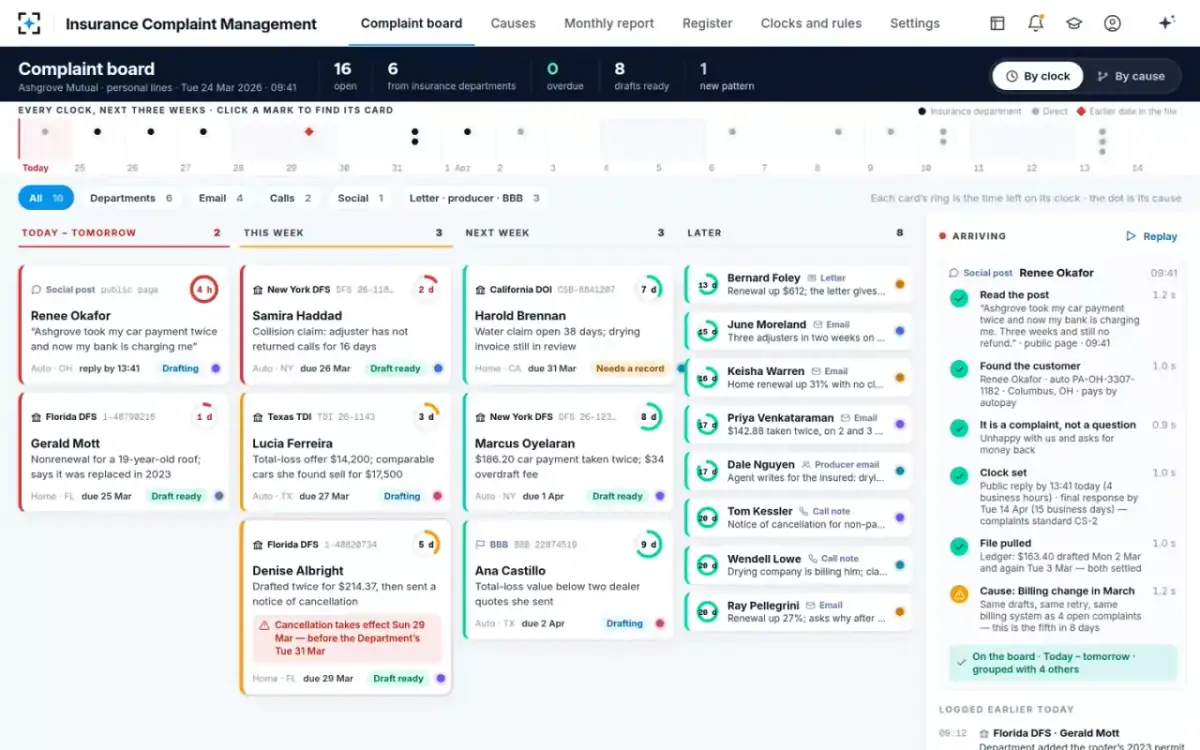
Next, put each complaint on the deadline its source sets, counted the way its rule counts. Florida allows 14 days from the division's written request for any consumer complaint. New York allows 10 business days on an inquiry about a claim. California allows 21 calendar days on an inquiry about a claim. Texas allows 15 days and must grant 10 more on written notice (§38.001(c)). The carrier's own standard covers direct complaints.
The clock rules are settings with citations, so the compliance team can read every one. In the solution the clock keeper also watches the file for an earlier date, such as a cancellation taking effect before the department's deadline, and puts that date on the complaint with the reason. It never moves a deadline; a person asks a department for more time. The full comparison of the clocks is in the department of insurance complaint response timeline.
The test: recompute the deadline for every department complaint in the past year and compare it with the date the response actually went out. Disagreements are either a configuration error to fix before go-live or a late answer the team did not know about.
Insurance Complaint Management’s board: every clock for the next three weeks
Stage 3: answers built from the file
Third, connect the systems the answers come from, because a complete answer is an evidence problem. Florida's statute requires the response to answer the issues and allegations in the complaint, and the NAIC handbook (2017 edition) asks examiners whether a response is complete, supported by documentation and identifies the remedy owed. In the solution, the file gatherer pulls the policy, billing entries, notices, claim notes and call notes, and the response drafter writes an answer in which every statement cites one of them.
This stage decides how much of the system's value the carrier gets. Read access to billing and claims is what turns a log into a cited draft; without it, the agents can log and time complaints but cannot prove what happened. A sample draft, annotated line by line, is in the DOI complaint response letter sample.
The test: draft answers for a sample of closed complaints and compare each with the response that was actually sent. Every statement in the draft should trace to a record, and every point the department raised should be answered.
Stage 4: redress limits and sign-off
Fourth, configure who may approve money and who signs each kind of answer, before any draft reaches a customer. New York requires the complaint department to have authority to change the company's position, and the person the company sends to a department conference must be authorized to make any determination the case warrants. A system should make that authority explicit: who signs, up to what amount, with a second approver for changes.
Redress authority, sign-off, patterns and channels are settings
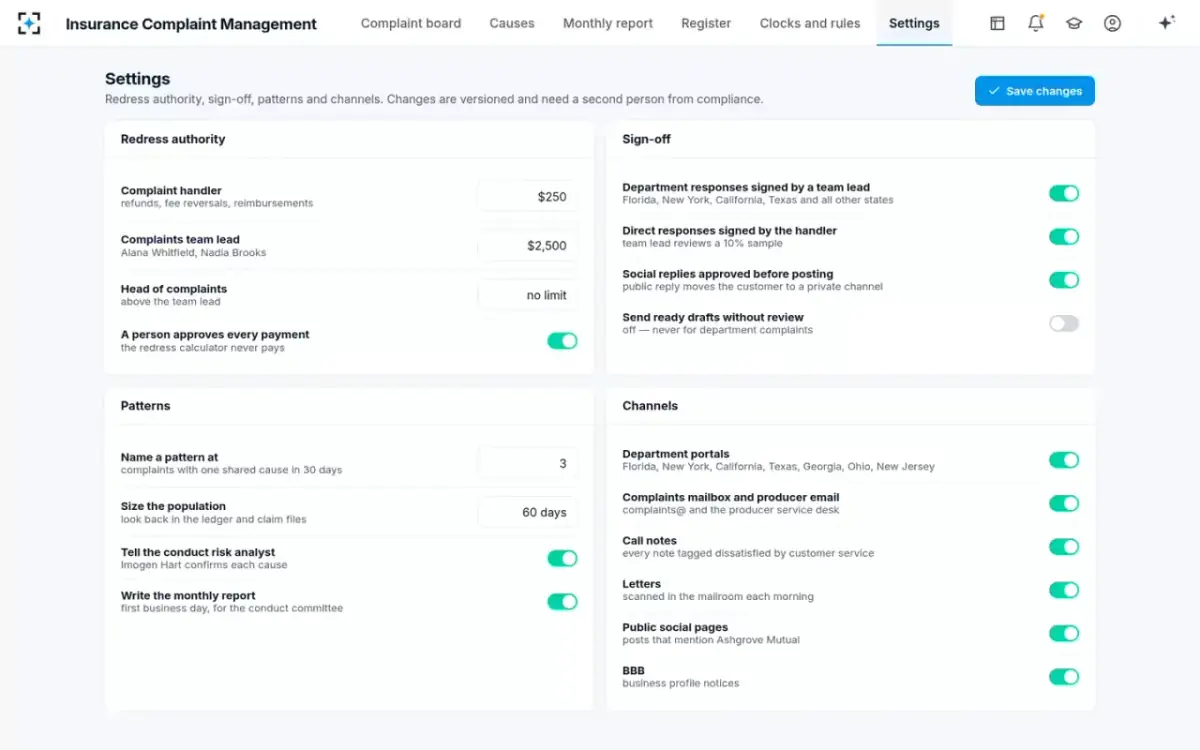
The test: replay last quarter's redress decisions. Each should land with the role that approved it, and any that would now route differently should be a deliberate policy change, not a surprise.
Stage 5: root cause and the monthly report
Last, switch on the analysis, because it depends on everything before it. The NAIC model regulation asks that complaint counts by line, function, reason, disposition and state be compiled at least annually; regulators look for spikes in a week. The solution's root cause finder compares each new complaint with open and recent ones, proposes a shared cause when enough match, sizes the customers affected and drafts the monthly report, and a conduct risk analyst confirms each cause.
The test: replay a past quarter in which a known problem produced complaints. The question is whether the system would have named it, and how many complaints earlier than the team did. In the solution's fictional sample, a billing defect was named at the fifth complaint, when 0.4% of the 1,140 customers it reached had complained.
The go-live tests, stage by stage, on your own past complaints
- Register
Twelve months of complaints from every source reconcile one for one with each department’s list.
- Clocks
Recomputed deadlines match the rules; every past late answer is found and explained.
- Answers
Drafts for closed complaints answer every point raised, and every statement traces to a record.
- Redress and sign-off
Past decisions replay to the right approver; limits changed only with a second person.
- Root cause
A known past problem surfaces from the replayed complaints, confirmed by the conduct risk analyst.
- Register export
The register exports with line, nature, disposition and time to process for the exam period.
Who owns each stage of the go-live
A complaint system crosses departments, so each stage needs a named owner on the carrier's side. The complaints team owns the definitions and the register; compliance owns the clock rules; billing and claims own the access the answers depend on; the conduct risk analyst owns what counts as a cause.
Insurance Complaint Management go-live: who decides what
Today
Owns a register assembled from mailboxes and spreadsheets at exam time.
With agents
Owns one register the agents keep current, and the definition of a complaint it applies.
Still theirs: the definition, redress limits and the escalation path
Today
Keeps deadline rules in a memo the handlers half remember.
With agents
Approves each clock rule, with its citation, as a versioned setting.
Still theirs: every rule change, as the second approver
Today
Answers handlers’ requests for records one email at a time.
With agents
Grants read access once; the file gatherer pulls records with their dates and sources.
Still theirs: their systems; the agents never change a record
Today
Builds the monthly trend report by hand from category counts.
With agents
Confirms or rejects proposed causes and reviews the drafted report.
Still theirs: what the conduct committee is told
Complaint management system for insurance agencies
An agency needs a smaller version of the same thing: a log, the clocks and a way to answer, because complaints about producers reach regulators too. Florida lets a licensee, including an agency or firm, designate an e-mail address for the division's requests; if it does not, the division uses the address of record in its licensing system (§624.307(10)(c)). Either way, the 14-day clock applies to the agency's answer.
Agencies also appear in their carriers' registers. Texas requires an insurer's complaint record to carry an identifier for the placing or servicing agent whenever an agent is involved (28 TAC §21.2504(b)), and the NAIC's category list has "agent handling" as a reason. A carrier's system should therefore let it see complaints by producer, and an agency should expect its carriers to be watching that view.
Insurance complaint management software, free, or a spreadsheet?
A spreadsheet can hold a compliant register; it cannot keep clocks, pull files or find causes. The NAIC handbook (2017 edition) observed that "Most companies maintain this information in some sort of PC-based spreadsheet format, such as Lotus or Excel." and told examiners to work with the company's file as kept. For a small book with a few department complaints a year, that is a reasonable choice.
A spreadsheet register against a complaint management system
Spreadsheet or free tool: Can hold every field the NAIC model asks for
Complaint management system: Holds them, filled as each complaint is logged
Spreadsheet or free tool: Only what someone keys in; call notes and posts are often missed
Complaint management system: Reads every connected channel and flags unclear cases
Spreadsheet or free tool: A formula someone maintains; business days and holidays by hand
Complaint management system: Each source’s rule with its citation, and earlier dates from the file
Spreadsheet or free tool: Written from scratch after searching each system
Complaint management system: A cited draft from the records, checked and signed by a person
Spreadsheet or free tool: Category counts at month end
Complaint management system: Shared causes across channels, sized, confirmed by an analyst
Spreadsheet or free tool: The file as kept, which examiners accept
Complaint management system: The register for any period, with every action on each complaint’s history
Complaint management software features to ask for
Ask each vendor to run a sample of your past complaints and show the five stage tests above. Then ask about the limits: what the software never does on its own, who can change a rule, and what an examiner sees. Insurance Complaint Management's answers are that agents never send, pay, move a deadline or confirm a cause; that rules and limits change only with a second person from compliance; and that every action, by an agent or a person, stays on the complaint's history.
Be clear about where it does not fit. A carrier with almost no direct complaint volume may not need agents at all. A carrier unable to grant read access to billing and claim systems will get logging and clocks, not cited answers. And for banks and other financial services firms, the rules are different, with the CFPB and federal regulators in place of state departments; the bank version is described in what a bank complaint management system should do.
Questions people ask
How long does it take to go live with a complaint management system?
It depends mostly on connecting channels and record systems, so a fixed week count is not a useful promise. A safer plan goes live stage by stage, register first, each stage only after it passes a test on the carrier's own past complaints.
Is there free insurance complaint management software?
A spreadsheet is the common free option, and the NAIC handbook (2017 edition) noted that most companies kept their registers that way. It can hold the required fields but will not set deadlines, gather files or find shared causes.
How is a customer complaint management system different from a regulatory one?
A customer service tool tracks tickets and satisfaction; an insurer's system must also keep the register the NAIC model law describes, meet each department's statutory deadline and produce answers a regulator will judge for completeness. The register is what examiners reconcile against the department's list.
Does a complaint management system replace the CRM?
It usually sits beside it, reading the CRM's call notes and emails as complaint channels. In the solution, the agents read from connected systems and never change a record in them.
Can a complaint system send responses to department portals?
In the solution's sample, a signed Florida response went to the department by portal upload, with a letter and email to the customer. A person approves and signs first; drafts are never sent without review for department complaints.