A DOI complaint response letter, the insurer's written answer to a state department of insurance about a consumer's complaint, should answer every issue and allegation the consumer raised, in order, each with the record that proves it, say plainly where the company was wrong, state the remedy in amounts and dates, and attach what the department asked for. Florida writes that standard into its statute, and the NAIC's market conduct handbook gives examiners six criteria for judging a response. The sample below is a fictional Florida complaint drafted by Insurance Complaint Management, Botminds' complaint software, in which every statement cites a record and a team lead signs. It is annotated line by line so the method can be copied with or without software.
"The response must address the issues and allegations raised in the complaint and include any requested documents concerning the consumer complaint not subject to attorney-client or work-product privilege."
Florida Statutes §624.307(10)(b), on responses to the Division of Consumer Services
What should a response to a department of insurance complaint include?
It should include an answer to every point the consumer and the department raised, the evidence for each answer, any remedy, and the documents requested. California's regulation says the same thing in other words for claim inquiries: "A complete written response addresses all issues raised by the Department of Insurance in its inquiry and includes copies of any documentation and claim files requested." New York's rule asks for the available information requested about a claim within 10 business days.
Examiners later judge the same letters against the NAIC handbook's criteria (2017 edition): the response is timely; complete and responsive to all issues raised; supported by adequate documentation; appropriate from a business practice standpoint; compliant with statutes, rules and the policy; and it identifies the appropriate remedies for the consumer. Every element of the sample below maps to one of those six.
A DOI complaint response letter sample, annotated
The complaint: Denise Albright, a fictional Florida homeowner, told the Division of Consumer Services that she paid her March premium of $214.37 on 2 March, that the insurer took it again on 3 March and her bank charged her $35, that she called on 11 March and was told it was under review, and that she now had a letter saying her policy would be cancelled on 29 March. She wanted the cancellation stopped and her fees paid back. The division asked the insurer to respond in writing within 14 days, addressing her concerns and any action taken, with copies of relevant notices.
The sample response, paragraph by paragraph, with what each one does
¶1
Re: Request for Assistance 1-48820734 · Denise Albright · policy HO-FL-2219-4407. Ashgrove Mutual received the Department’s request on 17 March 2026 and responds within the 14 days the Department allows [1].
Names the department’s file and the policy, and states receipt and timeliness first. [1] is the referral itself.
¶2
Ms. Albright’s March installment of $214.37 was drafted and settled on 2 March 2026 [2]. On 3 March a retry process that should have been switched off after our billing system change drafted the same installment a second time [3]. Her bank returned that second draft, and we charged a $25.00 returned-payment fee [4].
Answers her first two allegations (paid on 2 March, taken again on 3 March), one citation per statement, and states the company’s error in plain words.
¶3
The notice of cancellation mailed on 9 March was caused by that returned second draft and was issued in error [5]. When Ms. Albright called on 11 March she was told the payment was under review; the call was not escalated, and we have taken this up with the service team [6].
Answers the cancellation letter and the 11 March call: what she was told, what should have happened, what has been done.
¶4
We have rescinded the notice in writing; her coverage continues without interruption. We have reversed the $25.00 fee and are reimbursing the $35.00 fee her bank charged [7], a total of $60.00, and we apologise to Ms. Albright for the error.
Answers what she asked for: cancellation stopped, fees repaid, with the bank fee resting on a cited record. Remedy stated in amounts, not intentions.
Sig.
Alana Whitfield · Complaints team lead · Ashgrove Mutual
A named person with authority to sign for the company and to approve the redress.
The letter is short, around 200 words, and that is a feature. Each sentence carries one allegation or one action. Nothing is there to sound reassuring, and nothing the records cannot support is said. A reviewer at the department can check every claim it makes against the documents in the response package.
Start from the department's own request
The department's letter is the specification for the response, so read it as a checklist before reading the complaint. Here the division asked for three things: a written response within 14 days of receipt, an answer addressing the consumer's concerns and any action taken, and copies of relevant notices. The sample's first paragraph answers the first, the next three answer the second, and the third request, the notices, is something the response package must carry.
The timeliness line is not a formality. Florida's 14 days run from receipt of the division's written request, and the division can fine an insurer up to $5,000 per violation for missing it. Saying when the request arrived, and that the answer is within time, puts the company's position on the record before the examiner has to compute it. The deadlines in each state are compared in the department of insurance complaint response timeline.
One allegation, one answer, one record
Before drafting, list the allegations as separate items and find the record for each; the letter then writes itself in the consumer's order. A consumer's account is rarely structured, and the complaint above holds five distinct claims in five sentences. A response that answers the gist but skips one leaves the department to ask again, and an examiner reading the file to mark it incomplete.
The consumer's five points, the answer to each, and the record behind it
| What she said | Where the letter answers it | Record in the file | Finding |
|---|---|---|---|
| Paid the March premium of $214.37 on 2 March | ¶2, first sentence | Billing entry, 2 March: $214.37 settled | Confirmed |
| Taken again on 3 March | ¶2, second sentence | Retry entry, 3 March: returned, $25.00 fee posted 4 March | Confirmed: company error |
| Bank charged her $35 | ¶4 | Her bank statement: $35.00 NSF fee, 4 March | Confirmed: reimbursed |
| Called on 11 March, told it was under review | ¶3, second sentence | Call note, 11 March: told pending review, no escalation | Confirmed: service failure |
| Letter saying the policy would be cancelled on 29 March | ¶3, first sentence; ¶4 | Notice of cancellation, 9 March, effective 29 March | Issued in error: rescinded |
Mapping the allegations also exposes what the consumer did not say but the file shows. Her complaint named only the bank's $35 charge; the billing system also showed the insurer's own $25.00 returned-payment fee, so the letter reverses that too. An answer limited to her words could have left her out of pocket on a charge she did not itemise.
Admitting an error without admitting more than the records show
State what went wrong in the plainest words the records support, and stop there. The sample says the second draft came from "a retry process that should have been switched off after our billing system change", that the notice "was issued in error", and that the call "was not escalated". Each is a finding the records prove: the retry entry, the change record that should have retired the job, the call note.
What the letter does not do is speculate. It does not say how many other customers were affected, guess at why the job was left running, or blame an employee. Those questions belong to the root-cause review and the remediation, which in the sample reached 1,140 customers; the department letter answers one consumer's complaint. The drafter's limit in the solution, never to admit more than the records show, is the same discipline a careful handler applies by hand.
The same paragraph, weak and strong
A response examiners mark down: “A system issue may have caused a duplicate payment.”
The sample's approach: Names the date, the process and that it should have been switched off
A response examiners mark down: No dates; “our records indicate” with nothing attached
The sample's approach: Each statement cites the billing entry, notice or call note it rests on
A response examiners mark down: Not mentioned
The sample's approach: Says what she was told, that it was not escalated, and what was done
A response examiners mark down: “We will review her account and take appropriate action.”
The sample's approach: Notice rescinded in writing, coverage continuous, $25.00 reversed, $35.00 reimbursed: $60.00
A response examiners mark down: Regret without an admission
The sample's approach: One apology, for the error the records show
What to attach to the response
Attach every document the department asked for, and the ones the letter relies on. Florida's statute requires the response to include requested documents not covered by attorney-client or work-product privilege; California's requires copies of any documentation and claim files requested. In the sample, the division asked for relevant notices, so the package should carry the notice of cancellation and the written rescission.
That points to the one improvement the sample letter could take: a closing line listing the enclosures. The citations show which records the statements rest on, but a department analyst reading a printed letter should not have to infer what was attached. A list of enclosures turns the response package into something an examiner can check against the department's request in a minute.
How to respond to a department of insurance complaint in Florida
In Florida, respond in writing or electronically to the Division of Consumer Services within 14 days of its written request, addressing every issue and allegation and including the requested documents. Requests arrive at the e-mail address the insurer has filed with the department, and each insurer must also name a contact person for escalated complaint issues (§624.307(10)(c)). The division then reviews the company's response to make sure it followed Florida statutes and the administrative code, as it tells consumers (Florida DFS).
Two Florida details catch insurers out. The 14 days are not described as business days, so a request that arrives before a long weekend loses those days. And the penalty applies per violation: up to $5,000 for an entity and up to $1,000 for an individual licensee, so a pattern of late answers is a pattern of fines.
DOI complaint response letter template
The template below follows the order a department reads in. It works for a claim complaint as well as a billing one; for a claim, the evidence paragraphs cite the claim file and, where a claim was denied, the policy provision relied on, which NAIC Model 902 requires a denial to reference (§7).
A DOI complaint response letter template, in eight parts
- Reference line
The department’s file number, the consumer’s name, the policy and any claim number.
- Receipt and timeliness
The date the request was received and that the answer is within the time allowed.
- What happened, point by point
One paragraph or sentence per allegation, in the consumer’s order, each citing its record and date.
- Where the company was wrong
In plain words, limited to what the records show. Where it was right, the policy provision or rule relied on.
- What has been done
Actions already taken, with dates: notices rescinded, payments made, staff or process corrections.
- The remedy, in amounts
Each amount refunded or paid and the total; what the consumer will receive and how.
- Enclosures
Every document the department requested, plus the records the letter relies on.
- Signature with authority
A named person who can bind the company to the remedy, and contact details for follow-up.
How Insurance Complaint Management drafts and routes the response
In the solution, the file gatherer pulls the records each allegation needs, the response drafter writes the letter with a citation on every statement in the consumer's order, and the redress calculator works out what the redress policy owes and who may approve it. Nothing is sent until a person signs, and for department complaints the setting to send drafts without review cannot be switched on. In the sample, the drafter took 5.1 seconds; the team lead's reading and signature are the part that matters.
In Insurance Complaint Management, the team lead signs response, letter, rescission and refund
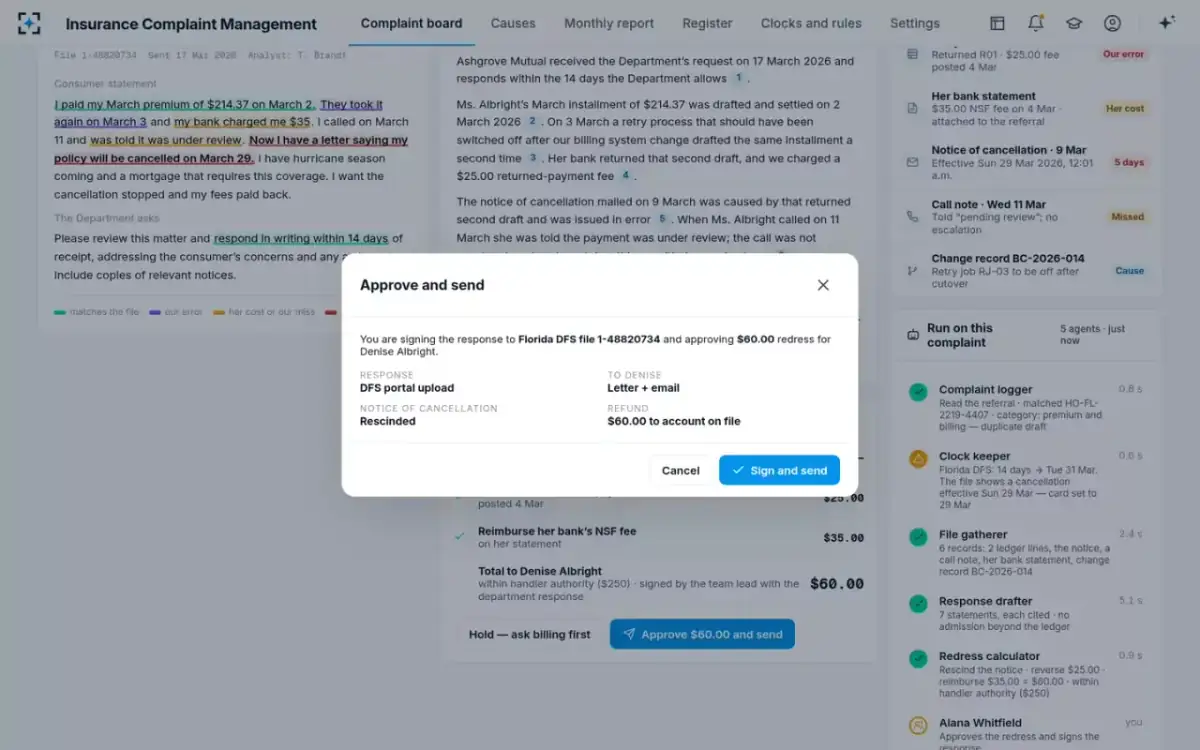
The same response went to the department by portal upload and to the customer by letter and e-mail, on day 7 of Florida's 14. A response that is complete and on time is also the strongest entry the complaint register can hold, which is why the register and the letter are worth designing together; the register is covered in complaint register requirements for an insurance company.
Questions people ask
Who should sign a response to a department of insurance complaint?
Someone with authority to commit the company to the remedy. New York requires the complaint department to be able to change the company's position and to sit under a corporate officer; in the solution's sample settings, a team lead signs every department response.
Should the consumer get a copy of the response?
Departments often share the insurer's response, and writing to the consumer directly is good practice. In the sample, the signed response went to the Florida division by portal upload and to the customer by letter and e-mail.
Can an insurer ask for more time to answer a DOI complaint?
In Texas, yes: the department must grant a 10-day extension if the insurer sends written notice that it needs more time, on top of the 15 days the statute allows. Elsewhere it is a request to the department, which in the solution is always made by a person.
Should a DOI response letter apologise?
Where the records show the company was wrong, a single plain apology for that error is appropriate and costs nothing the records have not already established. The sample apologises once, for the error, after stating the remedy.
How long should a DOI complaint response letter be?
As long as it takes to answer every point, and no longer. The sample answers five allegations in about 200 words because each sentence carries one point and its record; examiners judge completeness and documentation, not length.
What if the company was right?
Say so point by point, with the record and the policy provision or rule relied on. Florida still requires the response to address every issue and allegation, and a denial must reference the provision it rests on under NAIC Model 902.