A chief compliance officer insurance company job description usually lists the same duties: own the compliance program, report to the board, manage regulatory change, oversee complaints and examinations. What it rarely says is the part that takes most of the week at an insurer licensed in many states, which is deciding who may say what the law requires, in which state, as of which date, and who signs for it. Insurance is regulated state by state; the National Association of Insurance Commissioners has 56 member regulators, one for each state, the District of Columbia and five U.S. territories (NAIC; why the count is 56 and not 50 is in the NAIC AI bulletin adoption map), and each of them writes its own rules. The CCO's real product is a chain of accountable answers to those 56 regulators.
This page builds the job description from the rules that name seats, then follows one question through that chain. The question comes from 50-State Regulatory Research, Botminds' software in which agents read every state's codes, regulations and bulletins and cite each state's answer, while a compliance analyst accepts the answer and regulatory counsel signs it. The worked example uses a fictional carrier, Larkspur Mutual, and its fictional staff; every product figure on this page is sample data.
The seats a multi-state insurer's compliance chief answers for
56
chief insurance regulators in the NAIC: 50 states, DC and five territories
NAIC
1officer
New York requires to head the complaint department and carry out the regulator's directives
11 NYCRR 216.4(c)
2signatures
on New York's yearly cybersecurity certification, due 15 April
23 NYCRR 500.17(b)
29jurisdictions
had adopted the NAIC AI model bulletin by 8 Oct 2026, with 4 more states on their own rules
NAIC map
What does a chief compliance officer do at an insurance company?
The CCO owns the program that prevents and detects breaches of law, reports on it to senior management and the board, and is accountable for it when an examiner or a court asks. The most widely used federal definition of that role sits outside insurance law. The U.S. Sentencing Guidelines describe an effective compliance and ethics program, and require that "Specific individual(s) within high-level personnel shall be assigned overall responsibility for the compliance and ethics program" (§8B2.1(b)(2)(B), November 2025 manual).
The same guideline separates that owner from the people who run the program day to day. Those operators must "report periodically to high-level personnel and, as appropriate, to the governing authority", and must be given "adequate resources, appropriate authority, and direct access to the governing authority". Read as a job description, that is two roles: an owner who answers for the program and an operator with a line to the board. At many insurers the CCO is both. The guideline is written for sentencing, but it is the clearest public statement of what "owning compliance" means.
Insurance adds the state layer. A claims practice, a notice, a form or a rate is lawful or not under the rules of the state where the policy was written, and the examiner tests the file against that state's rule, not against the company's memo. A CCO at a carrier writing in 40 states is therefore accountable for 40 versions of most questions. That is why so much of the role is research, and why the research needs a sign-off chain of its own.
Who is the chief compliance officer, and which seats does insurance law name?
No state rule we read creates the title "chief compliance officer" for insurers, but several name the seats the CCO must fill or supervise. The job description should list them, because an examiner will ask who sits in each.
New York's Regulation 64 requires every insurer to run an internal department to investigate and resolve complaints filed with the Department of Financial Services, with a corporate officer responsible for it. The department is to act "with authority to question and change the position taken in individual instances or company practices generally" (11 NYCRR 216.4(c)). That is a remarkable grant: the complaint function may overrule the business. The same section requires a central log of all complaint activity.
Florida requires each insurer to give the state an e-mail address for complaint requests and to name a contact person for escalated complaint issues, with a name, e-mail and telephone number (Fla. Stat. §624.307(10)(c)). New York's cybersecurity rule goes further and names two signatures: the yearly certification or acknowledgment of compliance must carry the signatures of both the highest-ranking executive and the CISO (23 NYCRR 500.17(b)(2); the filing is covered in NY DFS cybersecurity notification requirements).
Artificial intelligence is adding seats. The NAIC's model bulletin on insurers' use of AI systems asks for a written program run by senior management accountable to the board; it had been adopted in 29 jurisdictions as of 8 October 2026 (NAIC map). Texas, one of four states with its own rules, issued a new bulletin on 12 June 2026 that expects a person to review and agree with any consequential decision made with AI before action is taken (TDI Bulletin B-0003-26). How governance of AI systems is organised, and who signs each one, is the subject of an AI governance committee charter.
Where a 50-state answer crosses four desks before the CCO stands behind it
A 50-state answer is the clearest example of the chain, because it is the CCO's statement of what the law is in every state, and the business builds systems on it. In the sample run, Larkspur's VP of claims operations asks whether a new claims platform can default to 15 calendar days to acknowledge a homeowners claim everywhere the company writes. The question passes two agents and two people before it reaches the business, and the CCO owns the rule that says so.
One 50-State Regulatory Research answer, desk by desk
Agent
State researcher readsReads each jurisdiction's code, regulations, bulletins and orders, plus the company's memos, and returns the passage that governs on the date asked.
Never: answer from memory, or without a passage
Agent
Citation checker re-readsRe-reads every state's answer against its passage and confirms the cited version was in force on the date asked.
Never: let an uncited answer reach the map
A person decides
Analyst acceptsReads the 51 answers, checks the day-count arithmetic on the states that matter, and accepts or sends back.
A person decides
Counsel signsOpens any state to the highlighted passage and its history, then signs the answer and the memo to the business.
A person decides
The CCO owns the ruleSets who must sign which answers, how old an answer may get, and what happens when a cited rule changes; answers for all of it to examiners.
The order matters more than the speed. The agent that reads is not the agent that checks, and neither of them decides. The analyst's acceptance says the answer is complete and the arithmetic holds. Counsel's signature says the law has been read correctly. The CCO's contribution is upstream: the written rule that no answer reaches the business without both, and that a signed answer is never edited, only replaced by a new version. Why the reading and the checking should be separate agents is the subject of AI and insurance compliance research.
Insurance compliance officer job description: the duties, the rules and the signatures
A useful job description ties each duty to the rule behind it and to the person who signs. Duties without a named rule become "monitor regulatory developments"; duties without a named signer become nobody's. The table below is built from rules read on 27 October 2026.
Compliance duties at a multi-state insurer, with the rule and the signer
| Duty | Where the rule is | Who does the work | Who signs or answers |
|---|---|---|---|
| Say what each state requires, as of a date | Each state's code, regulations and bulletins; NAIC models only where a state adopted them | Compliance analysts, with outside counsel for disputed points | Regulatory counsel signs; the CCO owns the method |
| Run the complaint function | New York 11 NYCRR 216.4(c), (e); Florida §624.307(10) | Complaint unit | A named corporate officer (NY); a named contact person (FL) |
| Certify cybersecurity compliance | New York 23 NYCRR 500.17(b), by 15 April each year | Information security, with compliance evidence | Highest-ranking executive and the CISO |
| Govern AI systems that touch consumers | NAIC model bulletin in 29 jurisdictions; CA, CO, NY, TX rules | An AI governance committee and model owners | Senior management, reporting to the board |
| Keep answers current when a rule changes | Every state register and bulletin index | Regulatory change desk | The analyst re-accepts; counsel re-signs |
| Report on the program | U.S. Sentencing Guidelines §8B2.1(b)(2) | The CCO's team | The CCO, to senior management and the board |
Two rows deserve emphasis in any insurer's posting. The first row is the one most often under-resourced, because a 50-state question looks like a research task rather than a control. It is a control: the answer becomes a system default, a form or a letter template, and every claim or policy processed under it inherits whatever error it contains. The fifth row is the one most often missing altogether. Washington's insurance commissioner filed a rewrite of the state's claims rules on 18 August 2026, effective 18 October, amending 15 sections at once (WSR 26-17-089). Every saved answer that cited those sections needed a second reading and, where the answer moved, a second signature.
Chief compliance officer description versus the people who do the reading
The CCO rarely reads the 51 codes. The analyst does, counsel checks the reading, and the business owner who asked decides what to build. The job description should say so plainly, because the most common failure is a CCO whose name is on answers nobody in the chain actually signed. In the sample run the four people around the answer look like this.
One question, four people: what their week held, and what it holds with the agents reading
Today
Thirty to forty state-law questions a month, each a week of reading 51 codes; the answer is stale by spring.
With agents
Reads 51 cited answers, checks the arithmetic on the states that matter and accepts the answer the same morning.
Still theirs: The decision to accept, and the duty to say which states need a second look.
Today
"Show me the section, and tell me if it changed since we last looked."
With agents
Opens any state to the highlighted passage, the version in force and its history, then signs the answer and the memo.
Still theirs: The signature. Nothing reaches the business before it.
Today
"Tell me the number to set, and where it has to be different."
With agents
Receives a signed memo with a recommended default, the states that differ and a citation beside each.
Still theirs: The business decision: which default to build.
Today
Files forms and notices in 50 states and needs the outliers, not 51 paragraphs.
With agents
Builds his notice schedule on a saved answer that is re-checked whenever a rule it cites changes.
Still theirs: The product, and the duty to ask again when the product changes.
Counsel's line is the one a CCO should hear in every hiring conversation. A signature on a 50-state answer is a statement about each state's text on a specific date, and counsel needs two things to give it: the passage, and proof that it has not changed since the answer was drafted.
"Show me the section, and tell me if it changed since we last looked."
Renata Ibarra, the sample run's regulatory counsel (fictional)
What the CCO signs, and what is only accepted
The CCO signs the program, not each answer: the rules for who accepts, who signs, how old an answer may become and what happens when a cited rule changes. Each answer is accepted by the analyst and signed by counsel, and the program makes sure that order cannot be skipped. In the solution these are settings the CCO's team controls, not habits.
In the sample configuration the jurisdictions are the 50 states and the District of Columbia, with territories switched off. Working and business days are counted on each state's own 2026 holiday calendar. A state's answer needs three things, the passage, the section and the version in force on the date asked, or the state shows "No rule found". Before an answer reaches the business the analyst accepts it and regulatory counsel signs. When a cited rule changes, the saved answer is re-checked the same night and marked. Answers older than 180 days are flagged. Each of those is a sentence the CCO can put into the compliance manual and show an examiner.
The distinction between acceptance and signature also limits liability for the people in the chain. The analyst who accepts answers for completeness and arithmetic. Counsel who signs answers for the reading of the law. The business owner who chooses option 1 or option 2 in the memo answers for the business decision. A CCO who blurs these into one email thread inherits all three.
Where the chain breaks: a memo that outlives its rule
Chains rarely break at the desk; they break over time, when an answer that was right on the day it was signed stays in use after the rule changes. Washington's October 2026 rewrite shows how far a change can reach. Before 18 October an insurer had to tell a first-party claimant whether the claim was accepted or denied within fifteen working days after receiving fully completed and executed proofs of loss. From 18 October the rule reads "Within 30 calendar days after receipt by the insurer of a notification of claim" (WAC 284-30-380(1) as amended). The number doubled, the unit changed from working to calendar days, and the event that starts the clock moved from proof of loss to the first notice. A memo written in September is wrong in three ways at once.
That is why the CCO's job description needs a freshness duty with an owner. Someone must read the registers and bulletins of every state the company writes in, match each change to the answers that cite the changed section, and put those answers back in front of the analyst and counsel. Matching changes to answers is the part that is easiest to automate and most often skipped by hand. Keeping the wider change inventory, beyond saved answers, is the work of regulatory change management software for insurers.
Chief compliance officer insurance company jobs: what to write into the role
When writing or reviewing the posting, put the accountability chain into it in plain terms. A candidate who has run a multi-state program will recognise every line; one who has not will ask useful questions about them.
Lines for an insurer's CCO job description
- Owns the written rule for who accepts and who signs each regulatory answer
Name the roles: analyst accepts, regulatory counsel signs, and the business owner decides what to build.
- Names a delegate for every seat a state rule creates
New York's complaint officer, Florida's escalated-complaint contact, New York's cybersecurity signatories, the AI governance owner.
- Requires an as-of date and a cited passage on every answer
An answer without its version date cannot be defended in an exam that tests files handled under an older text.
- Owns the freshness rule
How old an answer may get, and what happens the night a cited rule changes.
- Reports on the program to senior management and the board
With direct access to the board, as the Sentencing Guidelines expect of the people who run it.
- Keeps the evidence retrievable
Who asked, every passage read, every acceptance and signature, with times, for any examiner who asks.
- Oversees AI used in compliance work itself
The tools that read the law are AI systems too, and the bulletin's program covers them where they support regulated decisions.
Where 50-State Regulatory Research fits in the CCO's chain
The solution does the reading, the citing, the checking and the watching, and leaves acceptance, signature and the business decision with people. It does not give legal advice, file anything or send anything: the memo to the business waits for counsel's signature, and its writer adds no advice beyond the rules cited.
The signed memo for the business, with its sign-off trail
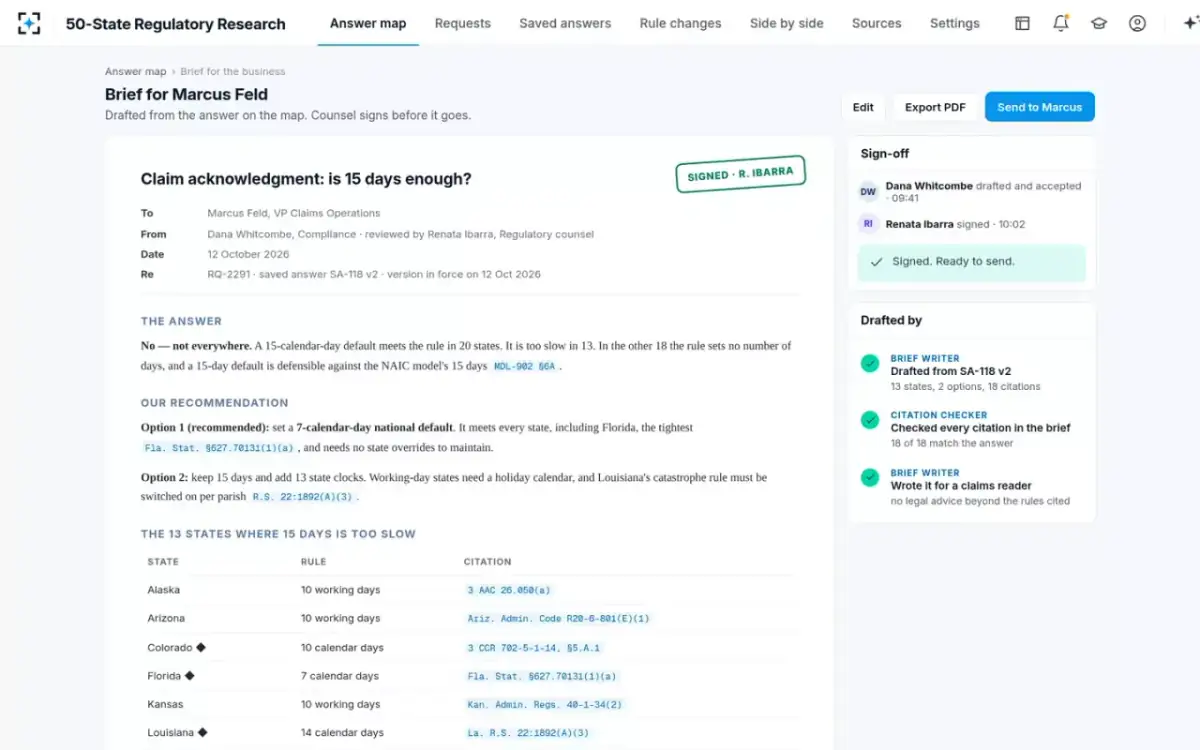
The queue behind the memo is where the CCO sees the program working. Requests from claims, underwriting, product, servicing and legal arrive with due dates, and questions that a current saved answer already covers are matched to it instead of starting over.
Requests from the business, with due dates and saved answers matched
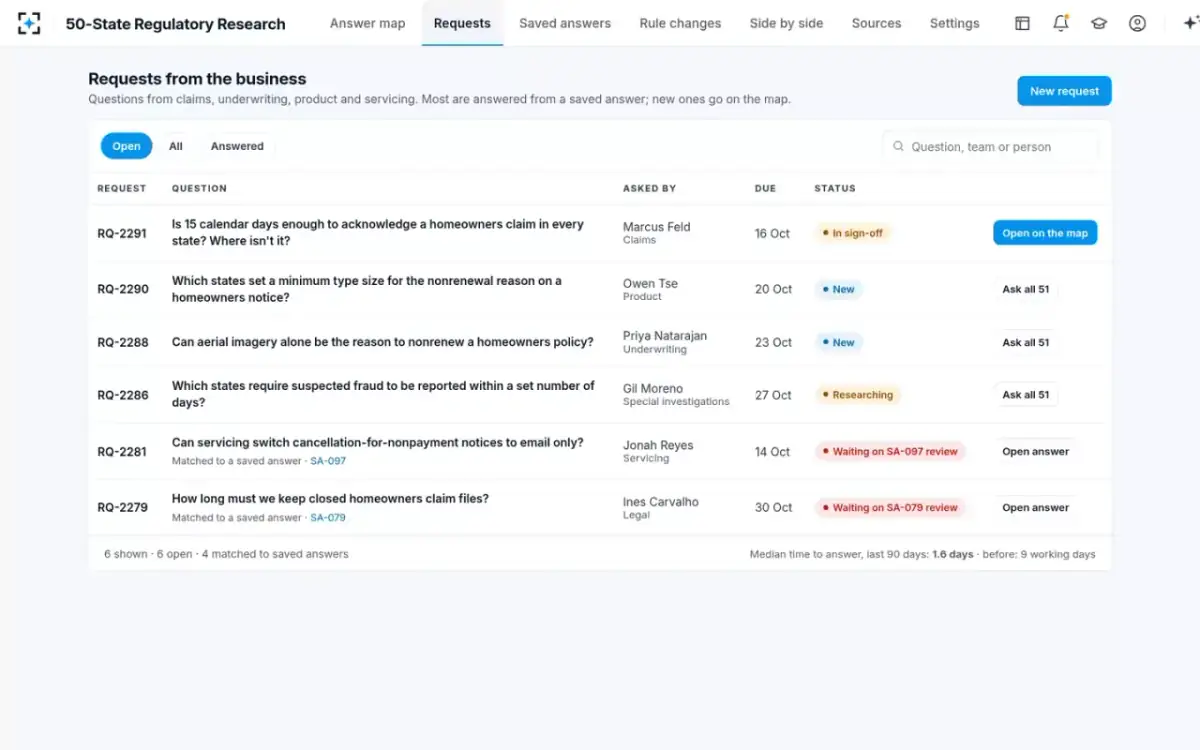
What the CCO gains is evidence rather than headcount. Every answer the business relies on carries its passages, its as-of date, the names of the person who accepted it and the counsel who signed it, and the history of the rules it cites. A day-by-day account of one such question is in the 50-state survey on insurance claims case study.
Questions people ask
Is a chief compliance officer required at an insurance company?
None of the state rules we read requires the title itself, but several require named people for specific functions. New York requires a corporate officer over the complaint department (11 NYCRR 216.4(c)), Florida a contact for escalated complaints (§624.307(10)(c)), and New York's cybersecurity certification is signed by the highest-ranking executive and the CISO (23 NYCRR 500.17(b)).
Who does the chief compliance officer report to?
To senior management and the board. The Sentencing Guidelines' definition of an effective program has the people who run it day to day report periodically to high-level personnel and, as appropriate, to the governing authority, with direct access to it (§8B2.1(b)(2)(C)).
What is the difference between a compliance analyst and a chief compliance officer?
The analyst reads the rules and accepts answers; the CCO owns the program that decides who reads, who signs and when an answer must be re-checked. In the sample run the analyst accepted a 51-jurisdiction answer at 09:41 and counsel signed at 10:02, under rules the CCO's team had set.
Who signs a 50-state regulatory answer?
Regulatory counsel should sign it after the analyst accepts it, and the business should receive it only after that signature. The CCO answers for the rule that enforces the order, and for showing an examiner who signed which answer and when.
How many regulators does a multi-state insurer answer to?
Up to 56 chief insurance regulators sit in the NAIC: the 50 states, the District of Columbia and five territories. An insurer answers to each state where it is licensed, and each can examine its files against its own rules.
What does the NAIC AI bulletin add to a CCO's job?
A written program for AI systems that make or support decisions about consumers, with senior accountability. As of 8 October 2026 the NAIC map showed 29 jurisdictions that had adopted it, and four states with their own insurance-specific AI rules or guidance.