Regulatory change management software for insurance companies reads the bulletins, statutes, regulations, orders and data calls from every state a carrier writes in, decides which ones touch its lines, maps each to the policy paragraph it changes, and tracks the change through a named owner to an accepted new version before the effective date. The business case is rarely about seats or features. It is about days: each day a changed rule sits unowned is a day closer to an effective date that passes with the old letter, form or procedure still in use, and the statutes price what follows per violation. Botminds' Regulatory Change Management for Insurers is designed around that number, with a target of two working days from publication to a named owner, against Botminds' estimate of about nine when the owner is found by email.
The product figures on this page are Botminds' estimates and design targets, or sample data on a fictional carrier, and are labelled where they appear. The penalty and cost figures come from statutes and NAIC model text, linked at each.
What Florida's statute caps a single nonwillful violation at, and what it adds
$12,500
per nonwillful violation in Florida since 1 July 2023, up from $5,000
$25,000
per nonwillful violation tied to a claim from a declared state of emergency
12%
a year: interest on restitution the insurer owes affected people
11months
one 2025 Florida exam of hurricane claims took; the company examined pays its reasonable cost
What regulatory change management software does for an insurance company
It does five jobs, and the buyer should test each separately: read every publication from the regulators the company answers to; screen out what does not touch its states, lines and products, with a reason; compare what remains with model text and earlier adoptions already implemented; map each new obligation to the paragraph of the company's policy, form or procedure it changes; and carry the change through an owner to an accepted version and a dated report. Alert services do the first job. The days are in the fourth and fifth.
The fourth job is why the category exists. A carrier licensed in a dozen states does not lack notice that a bulletin was issued; it lacks a fast answer to which paragraph of which policy is now wrong, who owns it, and whether the same text was already implemented for another state. Everything else follows from that answer.
What a late regulatory change costs an insurer: four drivers
A late change costs an insurer in four ways, each set by statute rather than by estimate: fines per violation, restitution with interest, the cost of the examination that finds it, and the rework of letters, forms and filings. The first two scale with the number of files handled under the old text, which is why the number that matters is days.
Fines scale with files, up to an aggregate. Florida's fine in lieu of suspension or revocation caps a nonwillful violation at $12,500, "up to an aggregate amount of $50,000 for all other nonwillful violations arising out of the same action", and a knowing and willful one at $100,000, up to $500,000. For violations tied to a claim from a declared state of emergency, the caps are $25,000 and $200,000 per violation, with aggregates of $100,000 and $1 million (Fla. Stat. § 624.4211). The NAIC's Unfair Claims Settlement Practices model sets $1,000 per violation up to $100,000, or $25,000 per violation up to $250,000 where the conduct was flagrant (NAIC Model 900).
Florida's fine caps per action: the aggregate a pattern of late files can reach
Restitution carries interest from the start. When an insurer discovers a nonwillful violation, the same section requires it to "correct the violation and, if restitution is due, make restitution to all affected persons", with "interest at 12 percent per year from either the date of the violation or the date of inception of the affected person’s policy, at the insurer’s option". Failing to pay restitution when due "constitutes a willful violation". Every week a wrong letter or rule stays in use adds files to that list.
The examination is billed to the company. In Florida the examined insurer pays the reasonable cost of the examination, and pays a contracted examiner directly (Fla. Stat. § 624.3161; the rules in other states are in who pays for market conduct exams). The 2025 targeted exam of Tower Hill Prime, on Hurricane Ian claims, was performed by a contracted firm and ran from 1 May 2024 to 1 April 2025 (Florida OIR).
Frequency turns a slip into a practice. Under the NAIC model, a claims act is an unfair practice if it is committed flagrantly, or often enough to amount to a general business practice (the Unfair Claims Settlement Practices Act, explained). A change implemented a month late is not one error but every file handled in that month, which is how a missed date becomes an exam finding with an error rate.
Florida's fines, before and after 2023: the penalty rule changed too
The fines themselves are a regulatory change. Florida's 2023 insurer accountability act, CS for SB 7052, approved on 31 May 2023 and effective 1 July 2023, rewrote section 624.4211: it raised each general cap two and a half times and added higher caps for claims arising from a declared state of emergency, which the 2008 text did not have (ch. 2023-172). A cost model built in 2022 understates the caps by a factor of two and a half.
Florida's administrative fine caps, before and after ch. 2023-172
| Violation | Before 1 July 2023 | From 1 July 2023 |
|---|---|---|
| Nonwillful, per violation | $5,000 | $12,500 |
| Nonwillful, aggregate per action | $20,000 | $50,000 |
| Knowing and willful, per violation | $40,000 | $100,000 |
| Knowing and willful, aggregate per action | $200,000 | $500,000 |
| Claims from a declared state of emergency | No separate cap: the general caps applied | $25,000 / $100,000 nonwillful; $200,000 / $1 million willful |
The compliance bulletin that arrives after the effective date
Waiting for a department to explain a new statute is a common way to lose the days. Texas's SB 1238 of 2025, which bars treating a widowed insured differently from a married one, took effect on 1 September 2025. TDI listed it in its legislative summary of 5 August 2025, and issued its compliance bulletin on 29 September 2025: "An insurance policy that is delivered, issued for delivery, or renewed on or after September 1, 2025, must comply with the requirements." The same bulletin warns that compliance "may require the insurer or carrier to submit updated form, rate, and underwriting guideline filings" (TDI B-0014-25).
One Texas statute: 27 days of notice before it took effect, 28 days in force before the bulletin
- Summary B-0012-25, 5 Aug → effective 1 Sep27 days
- In force, no compliance bulletin yet → B-0014-25, 29 Sep28 days
A carrier that treated the 29 September bulletin as the start of the work was four weeks into renewals under rates and underwriting guidelines that might need refiling. The text that mattered was in the 5 August summary, and before that in the statute itself. Software that reads the session laws and the department's summary the day they appear, and routes the obligation to the underwriting guideline and rate owners, turns those 27 days into working time. Filing the changed rates and forms is a separate job, covered in regulatory filing automation for insurance.
Building the business case for regulatory change management software, in days
The honest business case has two halves: time the compliance team gets back, which can be measured in a pilot, and exposure the company stops carrying, which can only be bounded. Keep them separate. A case that multiplies a fine by a guessed probability of examination and calls it savings will not survive the CFO.
The case for insurance regulatory change management software, written as a sum
Analyst time returned
publications needing a map × days saved per map × loaded day rate
Measure days saved in a pilot on last quarter’s publications; Botminds’ own estimate is 9 working days to an owner by email against a 2-day target.
Head of compliance
Repeat assessments avoided
state adoptions of model text already implemented × hours per assessment
The NAIC AI model bulletin alone had 29 adopting jurisdictions by 8 October 2026.
Regulatory change lead
Exposure no longer carried
files handled under old text per late day × days late × statutory cap per violation
A bound, not a forecast: use the statutory caps and restitution interest of each state written.
Chief Compliance Officer
Cost of the software
subscription + library and footprint set-up + owner time to review drafts
Reviewing drafts takes owner time; count it.
Procurement
The third term needs care. It is a bound on exposure, built from statutory caps and the number of files that pass through a changed process each day. For a claims acknowledgment rule in a property book, that is every new claim communication; for a renewal notice, every renewal. A carrier that knows its daily volumes can show the board what a ten-day delay would put at risk without pretending to know whether an examiner will look.
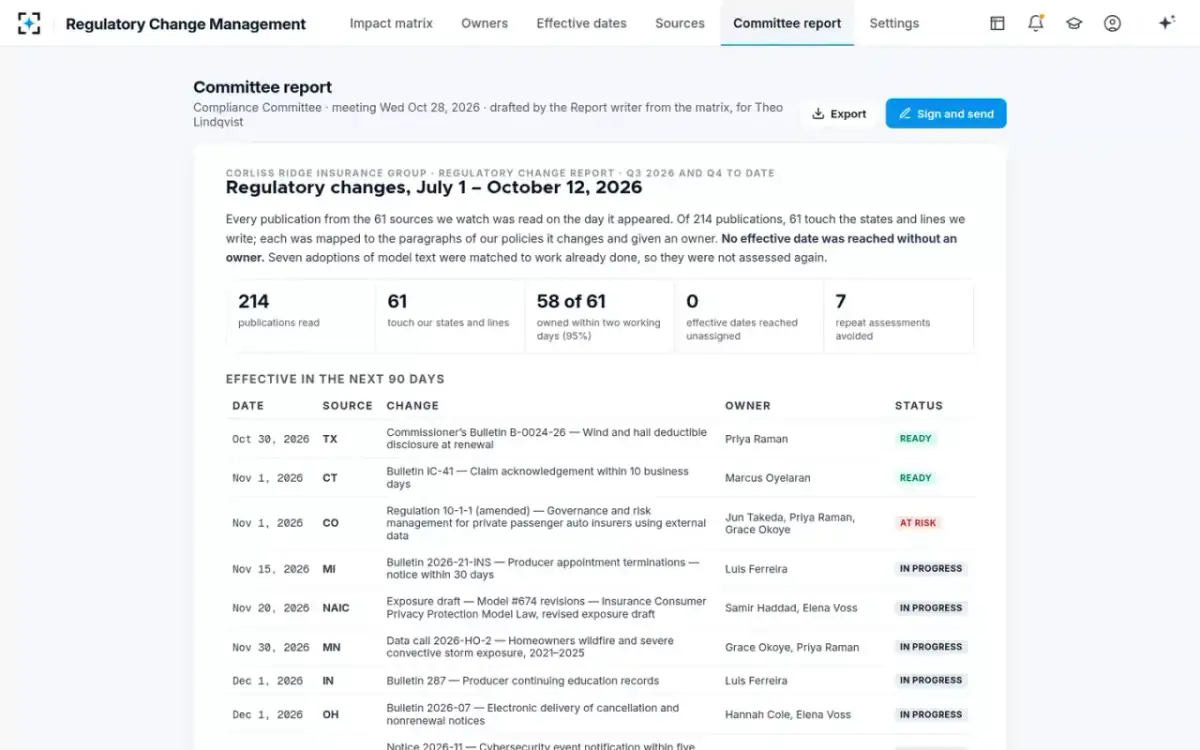
The committee report: every change, its owner and its status, drafted from the matrix
What to look for in regulatory change management software for insurance companies
Look for evidence on your own publications, not features on a slide. Five capabilities separate software that shortens the days from software that only lists them.
Coverage of the insurance footprint. All 56 NAIC member jurisdictions, the NAIC's own exposure drafts and models, and any federal or foreign regulator the company answers to, checked on a stated schedule, with a visible flag when a source fails to load. Ask which instrument types it reads: emergency orders and data calls are where short deadlines hide.
Dates read, not guessed. Enacted, effective, applies-to and rules-to-come dates kept apart and quoted from the text.
Matching against what you already did. A comparison with model text and with your earlier adoptions that names the earlier change and treats any wording difference as new. Without it, the 29th adoption of a model costs as much as the first.
Mapping to your paragraphs. Your policy and procedure library, by numbered paragraph, with a drafted change, a reason and a confidence. A department name is not a map.
People in the right places. A person confirms each map and owner; the owner accepts the change; the library changes only on acceptance; the report is signed. Testing a tool on one bulletin turns these into questions with the evidence that answers each.
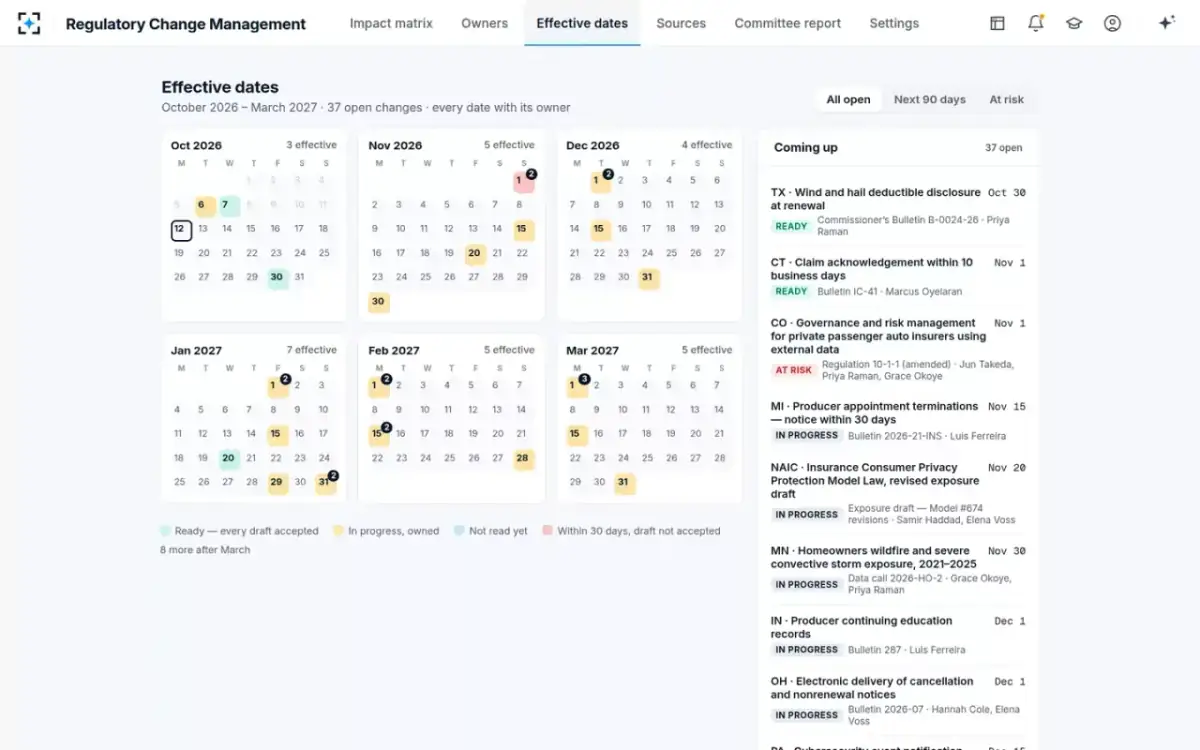
Every effective date with its owner, and the ones at risk
Where Regulatory Change Management for Insurers fits, and where it does not
It fits the gap between an alert and an accepted change: reading, matching, mapping, routing and reporting, with agents doing the reading and people deciding. It works alongside the sources and policy library a carrier already has; its agents read public publications only, and they never change a policy themselves.
It does not replace legal interpretation. Where a bulletin is ambiguous, the agents show the passage and the paragraph; counsel decides what it means. It does not file rates and forms with regulators, which is filing work. It does not run a market conduct exam response, although the dated versions it keeps are what that response draws on. And it does not make a late statute early: the 28 days after Texas's SB 1238 took effect were lost to everyone who waited for the bulletin, software or not.
For a bank's version of the cost question, see one missed effective date traced, written for federal consumer rules. To run the solution on last quarter's publications against your own library, start from Regulatory Change Management for Insurers.
Questions people ask
What is regulatory change management software for the insurance industry?
Software that tracks new bulletins, statutes, regulations, orders and data calls from the regulators an insurer answers to, decides which apply to its states and lines, maps each to the policy it changes and follows it to an owner and an accepted new version before the effective date. Insurance versions must handle 56 jurisdictions and repeated state adoptions of NAIC models.
What does compliance software for insurance companies cost compared with doing it by hand?
The comparison is days and files, not licences. Botminds estimates about nine working days from publication to a named owner by email against a two-day target with the solution; the exposure side is bounded by statutory caps such as Florida's $12,500 per nonwillful violation and 12% interest on restitution.
Which insurance regulatory compliance software companies should be on a shortlist?
Shortlist by the job, not the brand: alert and content services read sources; governance platforms hold registers and workflows; agent-based tools read, match and draft against your own policy paragraphs. Ask each to run one of your recent bulletins end to end and show the paragraph, the owner and the evidence.
Do insurers pay for their own market conduct exams?
In Florida, yes: the examined insurer bears the reasonable cost of the examination and pays a contracted examiner directly. Other states set their own rules; check the examination statute of each state written.
Is regulatory compliance software for insurance companies in the USA different from banking tools?
Yes, in what it must read and compare. Insurance is regulated by the states, so the same NAIC model arrives as many separate adoptions, and the work is finding the sentences that differ. Banking inflow is weighted toward federal agencies.