Insurance compliance automation software takes over the mechanical parts of keeping an insurer compliant with the rules of the states it writes in: reading what regulators publish, screening out what does not apply, comparing new texts with what the company already implemented, drafting the change to the affected policy and routing it to its owner. The best way to judge any such tool is not a feature list but a test: give it one real bulletin the team has already handled, and ask it to show, at each step, what it read, what it decided, why, and what a person still has to confirm. Botminds' Regulatory Change Management for Insurers is built to pass that test, and this guide sets it out so it can be applied to any tool, ours included.
Product figures on this page are sample data on a fictional carrier or design targets, labelled as such. The test cases use real state texts, linked where they appear.
What one bulletin should show when insurance compliance automation software runs it
18s
to read and map one nine-section AI bulletin in the solution, on sample data
7 of 9
sections matched to an earlier change and named; two marked new
≤ 2days
working days from publication to a named owner: the design target, not a measured result
0
policy paragraphs changed by an agent without the owner’s acceptance
What insurance compliance automation software should automate, and what it should not
It should automate the reading, the comparing and the drafting, and leave the deciding and the signing with people. In insurance the reading is large because the regulators are many: the NAIC's members are the chief insurance regulators of 56 jurisdictions, and one NAIC model, the AI model bulletin, had been adopted in 29 of them by 8 October 2026 (NAIC map). The comparing is where the time goes, because most of those adoptions repeat text the company already implemented. The drafting is where the value is, because it turns a bulletin into a change to a numbered paragraph.
What should stay with people is everything that commits the company: the judgement that a publication applies when it is borderline, the confirmation that a map is right, the choice of owner, the acceptance of the new wording, and the officer's signature on what goes to the committee or the regulator. A tool that automates those is not saving time; it is moving accountability somewhere an examiner cannot find it.
Insurance compliance software companies: three kinds of tool, three different tests
Tools sold as insurance compliance software do one of three jobs, and each needs a different test. Telling them apart before the first vendor meeting saves weeks.
Content and alert services find and summarise publications. Test them on coverage and speed: which of the 56 jurisdictions' bulletin pages, rule dockets, emergency orders and data calls they read, how soon after posting, and what happens when a source changes its page. They stop at the summary, so they cannot pass questions 4 to 8 below, and should not be asked to.
Governance and workflow platforms hold registers, tasks, attestations and reports. Test them on the record: can each obligation carry several dates, the earlier change that covers it, the paragraph it changes and the accepted version, and does "closed" mean the paragraph changed? They depend on someone else having done the reading and the mapping.
Agent-based tools, the category Regulatory Change Management for Insurers belongs to, read, compare and draft against the company's own policy library. Test them hardest on accuracy and on limits: the seeded texts in this guide, the paragraphs they choose and why, and the points at which they must stop for a person. A carrier may reasonably use one of each; what it must not do is assume that any one of them covers the whole chain.
The one-bulletin test: how to evaluate insurance compliance software
Pick a bulletin your team handled last quarter, with a known outcome: which sections were new, which paragraphs changed, who owned them and when the new versions took effect. Give the tool the same publication and your current policy library, and ask it to run from publication to a drafted change. Then compare, step by step, with what your team did.
The test works because the answer is known. A run on the vendor's own sample cannot show whether the tool finds your paragraphs; a run on your bulletin and your library can. It also exposes the steps a tool skips. If it produces a summary but no paragraph, it is an alert service. If it produces a paragraph but cannot say which earlier change already covers half of the bulletin, it will make you assess the same model text in every state.
Ten questions for insurance compliance automation software, and the evidence that answers each
- 1. Which sources did you read, and when?
Good evidence: a list of every regulator checked, the time of each check, and any source that failed to load shown as unchecked.
- 2. Why did you screen this publication out?
A one-line reason against the company’s states, lines and products, kept with the item, and a way to bring it back.
- 3. Which dates did you read?
Effective date, applies-to date and rules-to-come, each quoted from the text. Texas’s SB 815 of 2025 had all three.
- 4. Is this the same as what we already did?
The earlier change named for every section called covered; any wording difference treated as new.
- 5. Which of our paragraphs does it change?
Document and paragraph number, the reason for choosing it, and a confidence.
- 6. What exactly would you change?
The smallest redline, with the regulator’s passage beside it.
- 7. Who owns it, and who decided that?
An owner proposed from routing rules; the assignment confirmed by a named person; both on the record.
- 8. When is the change done?
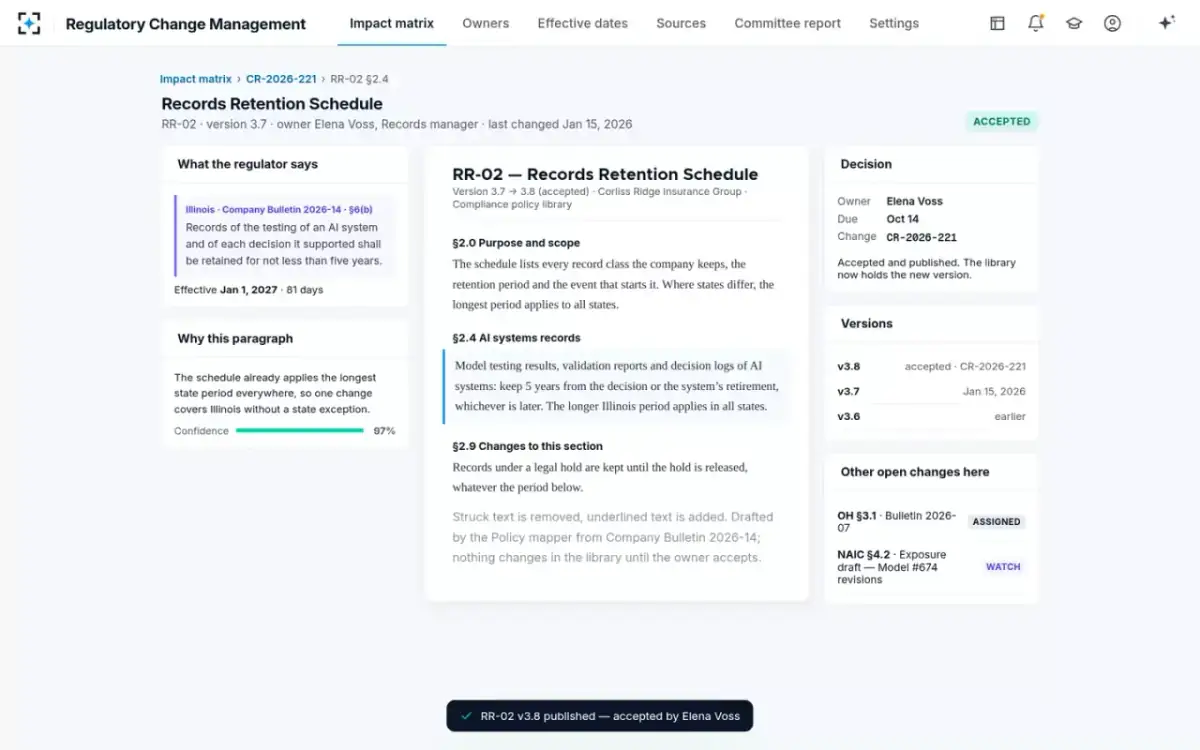
When the owner accepts and a new version is published, with the old version kept and dated.
- 9. What happens to instruments that are not rules?
Emergency orders, moratoriums and data calls kept whatever the score; data calls routed to data owners.
- 10. What would an examiner see?
A dated record of every read, decision, draft, assignment and acceptance, and a signed committee report.
Banks have a parallel list, written for a federal inflow, in regulatory change management software: twelve questions to ask. The insurance version differs in question 4: a bank rarely reads the same text from thirty regulators, and a carrier does so routinely.
Two seeded tests from real state texts
The fourth question is the one most tools fail quietly, so test it with known differences. Two real adoptions of the NAIC AI model bulletin make good seeds, because each is mostly the model's text with one material change a careless matcher will miss.
Connecticut, a changed definition and an added duty. Connecticut's Bulletin MC-25 of 26 February 2024 redefines "Degree of Potential Harm to Consumers" in terms of unfair or deceptive acts under Connecticut law rather than the model's economic impact, and requires domestic insurers to complete an annual AI certification, first due on 1 September 2024 (Connecticut Insurance Department). A tool that marks the definitions section as identical to the model, or misses the certification, fails.
Pennsylvania, three words that narrow the scope. Pennsylvania's Notice 2024-04, published on 6 April 2024, follows the model's program expectation but limits it to authorized insurers that use AI systems, where the model addresses all authorized insurers (Pennsylvania Bulletin). A tool should flag the scope sentence as different, even though the change narrows the duty rather than adding one; whether it matters is for the company to decide, but it must be shown.
Two seeded tests: what a weak matcher reports, and what a good one shows
Weak: similarity score: "Matches model, 96% similar." No action.
Good: word-level, earlier change named: "Degree of Potential Harm to Consumers: wording differs from the model; new." Routed to the AI governance owner.
Weak: similarity score: Summarised as "adopts the NAIC bulletin".
Good: word-level, earlier change named: Annual certification for domestic insurers, first due 1 September 2024: a new dated obligation, with an officer to sign.
Weak: similarity score: "Same as model."
Good: word-level, earlier change named: Scope sentence differs: the expectation is limited to insurers using AI systems. Shown as new; the lead decides whether any policy changes.
How to automate the insurance compliance process without losing the signature
Automate up to the point where a statement is made on the company's behalf, and no further. Every insurance compliance process ends in a statement by a person: the lead's confirmation that a map is right, the owner's acceptance of new wording, the officer's signature on a report or certification. The software should prepare each statement with its evidence attached, and record who made it and what it meant.
Automating the insurance compliance process, with each signature where it belongs
Agent
Read and screenEvery publication from the sources watched, tested against the footprint, with reasons kept.
Never: Screens out an emergency order, moratorium or data call in a state written.
Agent
Compare and mapSections matched to earlier changes; new obligations mapped to paragraphs with drafted redlines.
Never: Marks a section covered without naming the earlier change.
A person decides
Regulatory change lead confirmsThe map and the owners; corrects what is wrong. The Owner router cannot assign without this.
A person decides
Policy owner acceptsAccepts, edits or returns the draft; acceptance publishes a new version with the change number.
Agent
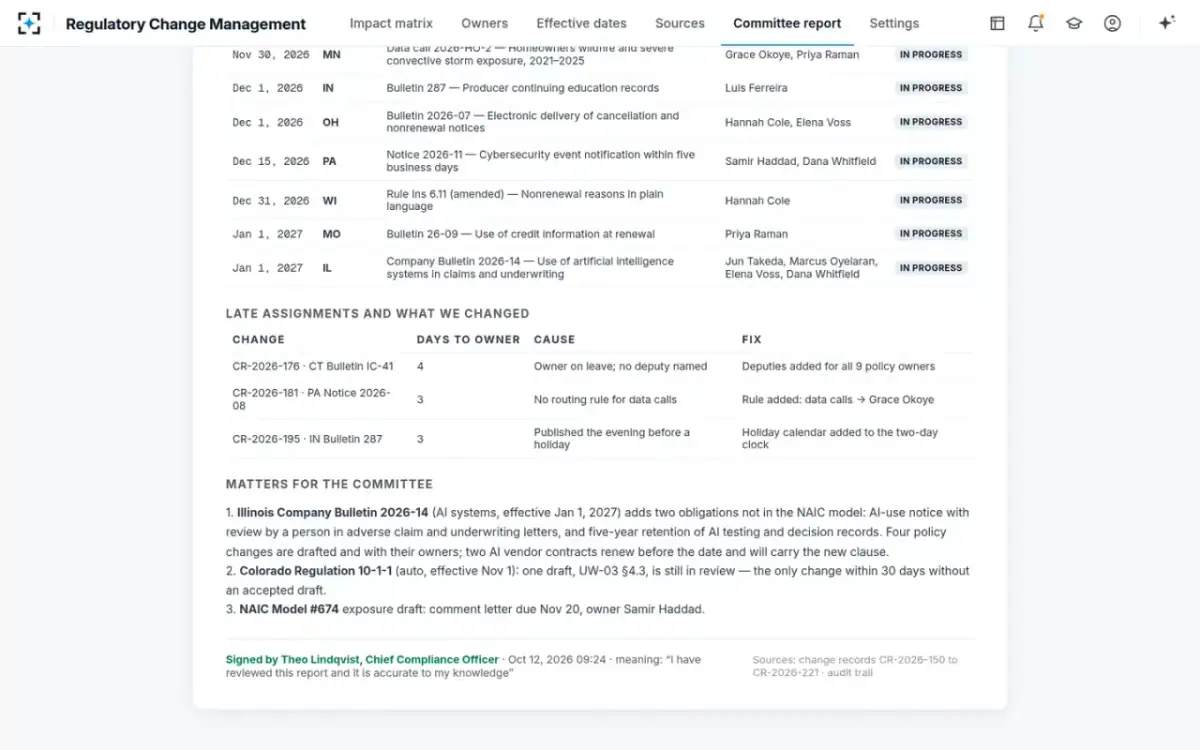
Track and reportReminds owners, escalates late items, drafts the committee report from the record.
Never: Signs or sends the report.
A person decides
Chief Compliance Officer signsSigns the report, with the meaning of the signature recorded.
The signed committee report: late assignments, their causes and the CCO's signature
What Regulatory Change Management for Insurers does, and what it leaves to others
A buyer should know what a tool is not for before the pilot, not after. The table is our own account of the solution.
Where the solution fits in an insurer's compliance work, and where another tool or a person is the answer
| Job | Regulatory Change Management for Insurers | Otherwise |
|---|---|---|
| Reading regulators’ publications | Yes: 56 jurisdictions, the NAIC, the Federal Insurance Office, the FCA, the PRA and EIOPA, every two hours in the sample settings | Public publications only; paid research services stay with their own subscriptions |
| Deciding relevance | Drafts a decision with a reason; the lead can bring anything back | Borderline cases are the analyst’s |
| Comparing with earlier adoptions | Yes, section by section, naming the earlier change | Whether a difference matters is the lead’s call |
| Changing policies and procedures | Drafts the redline; the owner accepts | The library stays the system of record |
| Interpreting ambiguous text | Shows the passage and the paragraph | Counsel decides what it means |
| Filing rates and forms | Routes the obligation to the filing owner | Filing is separate work |
| Responding to a market conduct exam | Keeps dated versions and decisions the response draws on | The exam response is managed elsewhere |
| Signing reports and certifications | Drafts and assembles the evidence | Always a person |
Filing changed rates and forms after a rule change is covered in product filing automation software. The rest of this page's questions are the ones to ask of every shortlisted tool, ours included.
What the test should end with: an accepted version, the old one kept
Designing the pilot: last quarter's publications, measured four ways
Run the pilot on publications already handled, so every answer can be checked. A quarter is enough for a multi-state carrier to see each instrument type at least once. Measure four things against what the team actually did, and agree the measures before the run.
Days to owner. From publication to a named, confirmed owner, per change. Botminds' own estimate is about nine working days by email and its design target two; the pilot replaces both with the company's own figure.
Maps corrected. How often the lead changed the drafted paragraph or owner, and why. A high rate early is normal while routing rules are set; it should fall.
Obligations found and missed. Sections the tool marked new that the team had missed, and the reverse. Include the two seeded texts above; a tool that calls either identical to the model has failed question 4.
Repeat assessments avoided. State adoptions of model text recognised as already covered, with the earlier change named. On the fictional carrier's sample quarter the solution's report counts seven.
Dates belong in the pilot too. Texas's 2025 session summary gives SB 815 an effective date, an applies-to date and rules to come, in three consecutive sentences (TDI B-0012-25); feed it to the tool and check that all three come back as separate dates. To run the pilot on your own quarter, start from Regulatory Change Management for Insurers; one AI bulletin traced through the agents shows what a passing run looks like.
Questions people ask
What is the difference between an insurance compliance automation tool and an end-to-end system?
A point tool usually automates one step, such as alerts or a register; an end-to-end system covers the chain from reading a publication to an accepted policy change and a signed report. For regulatory change, test any of them on the same chain with one real bulletin.
Which insurance compliance automation companies should I shortlist?
Shortlist by what each can show on your own bulletin and policy library: the paragraph it would change, the earlier change it recognises, the owner and the evidence. Ask every candidate to run the two seeded texts, Connecticut's MC-25 and Pennsylvania's Notice 2024-04, and report the differences from the NAIC model.
Can insurance compliance be fully automated?
The reading, comparing, drafting, reminding and report drafting can be; the confirmations, acceptances and signatures cannot, because regulators address them to the company and its officers. In the solution the agents cannot assign an owner without the lead or accept a draft for the owner.
What do insurance compliance solutions cost to run, beyond the licence?
Owner time to review drafts, the lead's time to confirm maps and set routing rules, and the work of preparing the policy library with numbered paragraphs. Count them in the business case; they are smaller than the reading they replace but they are not zero.
How long should an insurance compliance software pilot take?
Long enough to cover one quarter's publications for the states written, replayed against the current library, plus a month live alongside the existing process. That is enough to see every instrument type and to measure days to owner on the company's own changes.