The insurance regulatory updates of 2025 were, for most multi-state carriers, less about new subjects than about rules they had already implemented being changed again. Colorado's Division of Insurance amended its 2023 AI and external-data governance regulation so that it reached private passenger auto and health benefit plan insurers from 15 October 2025. Texas's legislature passed insurance bills whose effective dates fell on 20 June 2025, 1 September 2025 and 1 January 2026, many with rules still to come. New York issued a disaster-planning circular letter for property and casualty insurers on 5 June 2025 and repealed and replaced it on 20 May 2026. Four more jurisdictions adopted the NAIC AI model bulletin. An amendment to a done rule is the expensive kind of change, because the tracker row for the original says closed. Botminds' Regulatory Change Management for Insurers compares each new publication with the changes a carrier already made and names the earlier change it reopens.
Every rule below carries its own dates, taken from the regulator's text and linked. Product examples are sample data on a fictional carrier.
This circular letter repeals and replaces Circular Letter No. 3 (2025).
New York Department of Financial Services, Insurance Circular Letter No. 1 (2026), 20 May 2026
Insurance regulatory updates 2025, in one list
The list below is not every 2025 insurance publication; it is the ones that changed something a multi-state carrier had already implemented, or that set dates running into 2026. Each row names the instrument, its dates and what it reopened.
Insurance regulatory updates of 2025 that reopened finished work, with their dates
| Date | Jurisdiction and instrument | What changed | What it reopened |
|---|---|---|---|
| 5 Feb, 11 Feb, 18 Mar, 10 Dec 2025 | Delaware, New Jersey, Wisconsin, Hawaii: adoptions of the NAIC AI model bulletin | Four more jurisdictions adopted the model, by bulletin or, in Hawaii, a commissioner memorandum | The AI governance program, for any carrier licensed in them: each text compared with the version already implemented |
| 5 Jun 2025 | New York, Insurance Circular Letter No. 3 (2025) | Disaster planning, preparedness and response standards for property/casualty insurers | Catastrophe and business-continuity procedures; repealed and replaced on 20 May 2026 |
| 20 Jun, 1 Sep 2025; 1 Jan 2026 | Texas, 89th Legislature, summarised in TDI Bulletin B-0012-25 (5 Aug 2025) | 22 bills affecting TDI-regulated entities, with rules to follow on 12 | Underwriting, rating, forms and claims procedures; see the next section |
| 20 Aug 2025 (adopted); 15 Oct 2025 (effective) | Colorado, amended Regulation 10-1-1 | Governance and risk-management duties for external consumer data and models, extended beyond life insurers to private passenger auto and health benefit plan insurers | Any auto or health carrier’s view that the 2023 rule did not apply to it |
| 22 Oct 2025 | Colorado, Revised Bulletin B-10.004, reissued | Waiver of the quantitative-testing description for annual reports due 1 Dec 2024 and 1 Dec 2025 only | The 2026 annual report: later reports are expected to include the testing description |
Texas, 2025: one legislative session, three kinds of date
Texas shows why a single effective-date column fails. On 5 August 2025 the Texas Department of Insurance summarised 22 bills from the 89th Legislature's regular session that affect the people and entities it regulates, adding: "TDI-regulated individuals and entities must comply with any legislation that affects them" (TDI B-0012-25). The dates in that one bulletin fall into three patterns, and several bills carry more than one.
The 22 bills in Texas's 2025 legislative summary, by date: when they took effect, and what was still to come
Take SB 815, on the use of automated decision systems in utilization review. TDI's summary gives three dates in three sentences: "Effective September 1, 2025. Applies to policies issued or renewed after January 1, 2026. TDI will adopt rules." A carrier that implemented it in September for all policies did more than required; one that waited for the rules may have missed renewals from January. Neither had finished, because a rule was still to come and would reopen the work.
The pattern repeats across the session. SB 1644 on credit scores in underwriting and rating applies to policies issued or renewed after 1 January 2026. HB 2067, requiring written reasons for declinations, cancellations and nonrenewals, took effect on 1 January 2026, with rules to follow. Each of those dates is a separate row on a compliance calendar, and the rule-to-come is a future amendment to work the carrier will by then have marked done.
Colorado: a 2023 rule widened in 2025
Colorado's Regulation 10-1-1 is the clearest 2025 example of an amendment to a done rule. The Division of Insurance adopted it on 21 September 2023 for "life insurers that use external consumer data and information sources (ECDIS), as well as algorithms and predictive models that use ECDIS", and said it "will become effective on November 14, 2023" (Colorado DOI). Life insurers built governance programs to it. Auto and health insurers, reading the title, could reasonably file it as not applicable.
On 20 August 2025 the Division gave notice of the amended regulation, which its SB21-169 page titles as covering "Life Insurers’, Private Passenger Automobile Insurers, And Health Benefit Plan Insurers’ Use Of External Consumer Data And Information Sources, Algorithms, And Predictive Models", and set its effective date as 15 October 2025 (Colorado DOI, SB21-169 page; the rule itself is read in Colorado amended Regulation 10-1-1). For an auto or health carrier, the 2023 row marked "not applicable" was now wrong, and nothing in a tracker of closed rows would say so.
One Colorado rule, first adopted, then widened: the amendment arrives two years after the row closed
- In force for life insurers only, from 14 Nov 202323 months
- Widened to auto and health from 15 Oct 202512 months to date
A second Colorado change sits beside it. Revised Bulletin B-10.004 waives, for life insurers, the requirement to describe their quantitative testing for unfair discrimination in the annual report, because the Division has not yet adopted the regulation that would set that testing. The waiver covers only the annual reports due on 1 December 2024 and 1 December 2025, and later reports are expected to describe the testing (Colorado DOI; the bulletin's words are in Colorado's life insurance quantitative testing requirements). It was issued on 18 October 2024 and reissued on 22 October 2025. The testing rule itself remains a draft; whether the Division extends the waiver to the report due 1 December 2026 is open as of 27 October 2026.
New York: a 2025 circular letter repealed and replaced in 2026
New York's Department of Financial Services issued Insurance Circular Letter No. 3 (2025) on 5 June 2025, setting disaster planning, preparedness and response standards for property/casualty insurers, with a companion letter for life and health insurers. On 20 May 2026 it issued Circular Letter No. 1 (2026) on the same subject, which states that it "repeals and replaces" the 2025 letter, and its circular letter page now shows the 2025 letters as withdrawn (NY DFS).
Eleven and a half months separated the two. A carrier that implemented the 2025 letter in its catastrophe procedures in mid-2025 had a closed row and a current procedure. In May 2026 the procedure's authority was withdrawn and a new text took its place. Whether the 2026 letter changed the substance is a question only a comparison answers; what is certain is that the procedure now cites a repealed letter until someone updates it.
A new rule against an amendment to a done rule: why the second is the expensive kind
A new rule: A new row, open, visible to everyone.
An amendment to a rule already implemented: An old row, closed months or years ago, or a new row nobody links to it.
A new rule: Read closely because it is new.
An amendment to a rule already implemented: Skimmed because the subject is familiar.
A new rule: Found by asking who should own it.
An amendment to a rule already implemented: Assumed to be the original owner, who may have moved on.
A new rule: Everything the rule requires.
An amendment to a rule already implemented: Only the difference, which has to be found first.
A new rule: Late.
An amendment to a rule already implemented: Silently: the procedure looks current and cites the old text.
The NAIC AI model bulletin in 2025: four more adoptions
Four jurisdictions adopted the NAIC AI model bulletin in 2025, according to the NAIC's map: Delaware (Domestic and Foreign Bulletin No. 148, 5 February), New Jersey (Insurance Bulletin No. 25-03, 11 February), Wisconsin (an insurance bulletin, 18 March) and Hawaii (Insurance Commissioner Memorandum No. 2025-13A, 10 December) (NAIC map). After 21 adoptions in 2024, the 2025 ones arrived singly, months apart, to carriers whose AI governance programs were by then "done".
Each is an amendment in practice if not in name: a carrier licensed in Hawaii received, in December 2025, a text that is mostly the model it implemented in 2024 and may differ in places. The NAIC AI model bulletin adoption map lists all 29 adoptions to 8 October 2026 with their instruments.
New insurance rules in 2026 so far: the follow-ons
Several 2026 changes follow directly from 2025 or earlier rules, which is why the two years belong on one page. Each is dated as published.
New insurance rules and laws of 2026 that follow from earlier work, with their dates
| Date | Instrument | What it does |
|---|---|---|
| 1 Jan 2026 | Texas HB 2067 (2025 session) | Written reasons for declination, cancellation and nonrenewal take effect; TDI to adopt rules |
| 14 May 2026 (signed) | Colorado SB26-189, automated decision-making technology | Repeals and reenacts the 2024 AI act (SB 24-205); developer documentation duties start 1 January 2027; insurance is among the consequential decisions |
| 20 May 2026 | New York Insurance Circular Letters No. 1 and No. 2 (2026) | Disaster planning letters for property/casualty and life/health; No. 1 repeals and replaces No. 3 (2025) |
| 11 Jun to 5 Oct 2026 | Puerto Rico, Mississippi, South Carolina, North Dakota | Adopt the NAIC AI model bulletin: 29 jurisdictions as of 8 October 2026 |
| 12 Jun 2026 | Texas Commissioner’s Bulletin B-0003-26 | "Use of artificial intelligence", to all regulated entities; the NAIC map still lists Texas’s 2020 bulletin |
| 2026 | Alaska and Missouri statutes | Enact the NAIC Insurance Data Security Model Law (#668), listed with 2026 dates on the NAIC state page |
Colorado's SB26-189 deserves a note of caution. The Colorado General Assembly's summary says "The act repeals and reenacts those provisions" of SB 24-205, and that "Specified entities are exempted from the requirements of the act to the extent the entities comply with other legal obligations" (Colorado General Assembly). Whether a given insurer is exempted, and how the act interacts with Regulation 10-1-1, is a question for counsel; what a regulatory change team must record is that SB 24-205's provisions were repealed and reenacted with new requirements, some of them starting on 1 January 2027, so any work planned against the 2024 text has to be compared with the 2026 one.
Why amendments to done rules are the expensive kind, and how to catch them
Amendments are expensive because every system a carrier uses to manage change is built to notice new things. Alerts announce new publications; trackers open new rows; meetings ask what is new this week. An amendment to a closed rule is new only in relation to something old, and the relation is what gets lost.
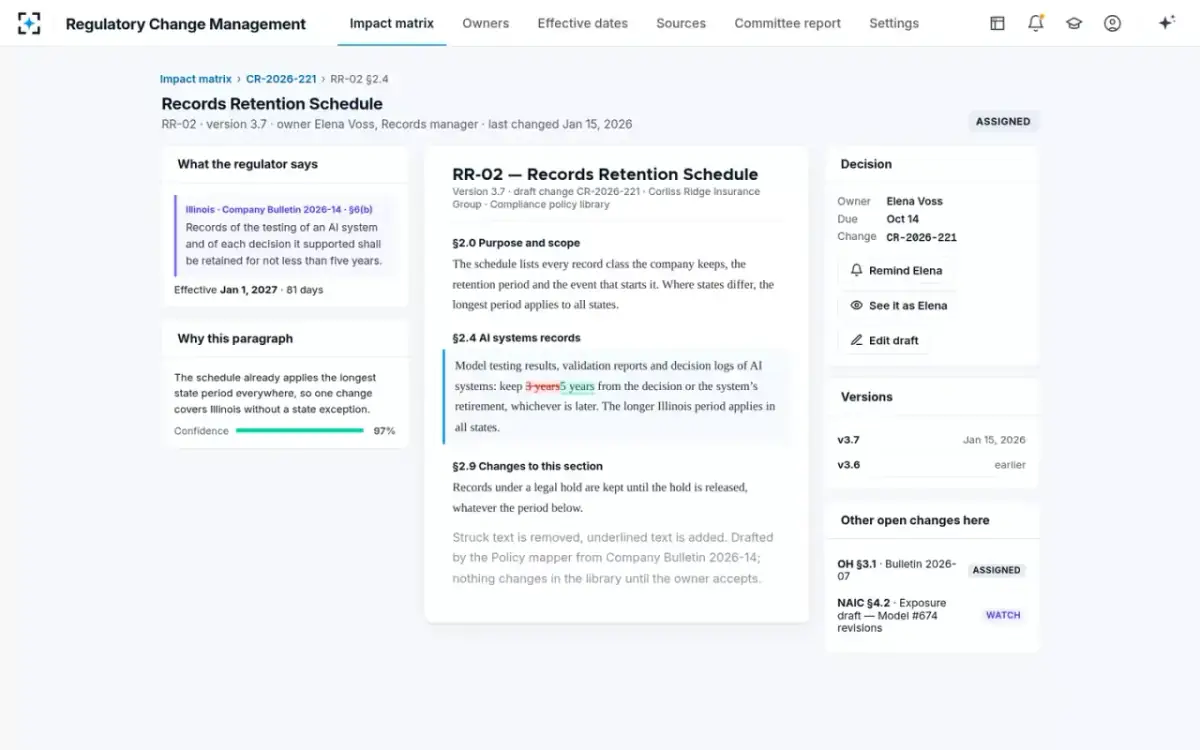
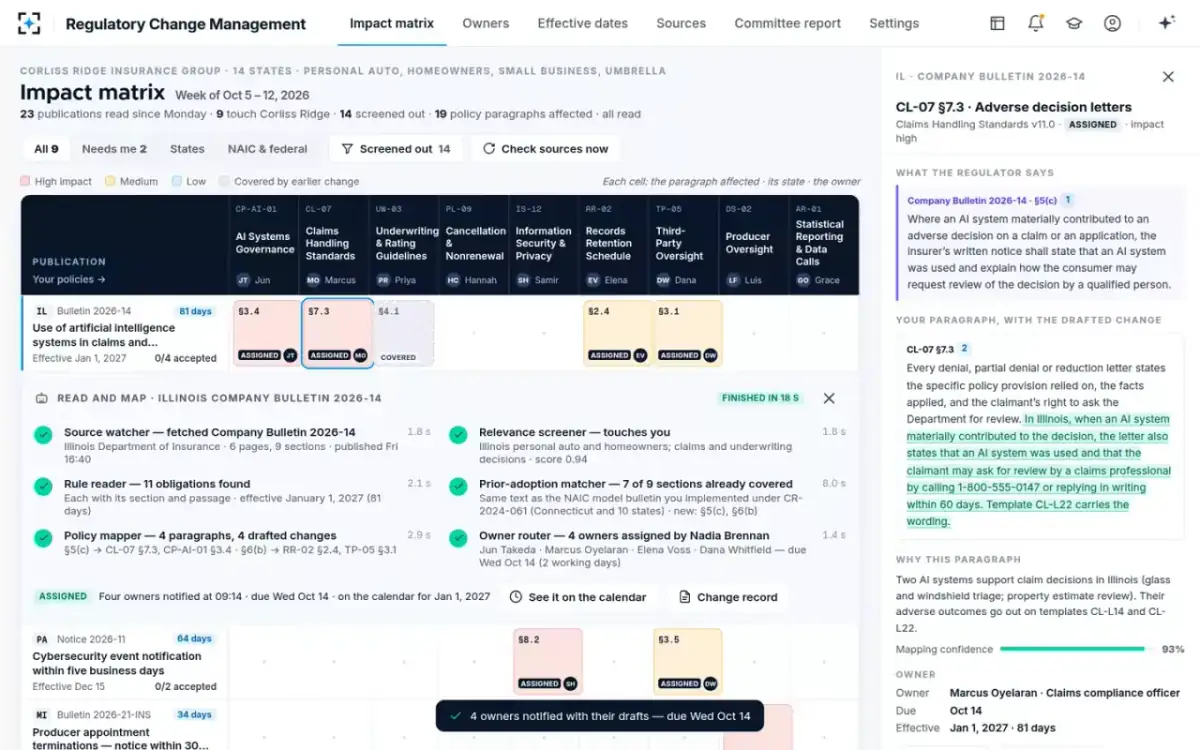
Catching them takes one design choice: compare every incoming publication with the changes already made, not only with other incoming publications. In Regulatory Change Management for Insurers the Prior-adoption matcher does that for every section of every publication, names the earlier change it touches, and treats any wording difference as new. When a publication reopens a closed change, the original owner gets the new passage beside the paragraph they changed last time, with the smallest further change drafted.
A drafted change against a policy already changed once
Four owners notified with their drafts, two working days after publication
Banks had their own 2025 version of this problem, with federal guidance withdrawn rather than state rules widened; 67 withdrawn CFPB guidance documents traces it. For an insurer, the 2025 lesson is the one Colorado taught: a rule marked not applicable or done is a standing hypothesis that the next amendment can disprove. An insurance compliance tracker that keeps the earlier change beside every row makes the hypothesis checkable; to see it run on your own 2025 publications, start from Regulatory Change Management for Insurers.
Questions people ask
What were the main insurance regulatory updates in 2024?
For AI governance, 2024 was the year of adoption: 21 jurisdictions adopted the NAIC AI model bulletin, starting with Alaska on 1 February 2024, and New York issued Insurance Circular Letter No. 7 on 11 July 2024. Colorado's Regulation 10-1-1 for life insurers, effective 14 November 2023, was in its first full year.
What new insurance laws take effect in 2026?
Among the examples on this page: Texas HB 2067 took effect on 1 January 2026, and several 2025 Texas bills apply to policies issued or renewed after that date. Colorado's SB26-189, signed on 14 May 2026, starts developer documentation duties on 1 January 2027.
How do I keep track of insurance regulation updates across states?
Read each state's bulletins, rules, orders and session summaries on a schedule, and compare each one with the changes already made, not only with this week's other publications. Record several dates per law: effective, applies-to and rules-to-come.
Did Colorado's AI regulation change in 2025?
Yes. Amended Regulation 10-1-1, noticed on 20 August 2025, took effect on 15 October 2025 and extends the 2023 governance requirements, written for life insurers, to private passenger auto and health benefit plan insurers. The quantitative-testing waiver was reissued on 22 October 2025 for reports due through 1 December 2025.
What insurance changes for 2026 should a carrier plan for now?
The dates already published: Colorado's SB26-189 duties from 1 January 2027, Texas rules still to come under 2025 bills, the NAIC's AI Systems Evaluation Tool, due for consideration in November 2026, and each new state adoption of the AI model bulletin.