An insurance compliance analyst job description usually lists the same five duties: monitor regulatory changes, interpret them for the business, update policies and procedures, support market conduct examinations, and prepare the certifications and filings an officer signs. Behind the list sits the defining feature of insurance regulation: a carrier answers to every state where it is licensed, and the NAIC's members are the chief insurance regulators of 50 states, the District of Columbia and five territories, 56 in all. The reading is not the hard part. The hard part is proving, for each bulletin, rule, order and data call, which paragraph of the company's own policies it changes, who owns that paragraph and the date it bites. Botminds' Regulatory Change Management for Insurers is built for that desk: agents read every publication the day it appears, match it with model text the carrier already implemented, and draft the change to the exact policy paragraph, while the analyst confirms the map and names the owner.
The product examples on this page are sample data on a fictional carrier, Corliss Ridge Insurance Group, which writes personal auto, homeowners, small business and umbrella in 14 states. The regulatory and wage figures come from regulators and the Bureau of Labor Statistics, linked where they appear.
The size of the desk an insurance compliance analyst sits at
56
insurance regulators whose chiefs make up the NAIC: 50 states, DC and five territories
29
jurisdictions that had adopted the NAIC AI model bulletin by 8 October 2026, each by its own instrument
16
commissioner bulletins from one state, Texas, in 2025, six of them data calls or calls for data
22
bills from Texas’s 2025 session that its department summarised for the companies it regulates
What does an insurance compliance analyst do?
An insurance compliance analyst turns what regulators publish into changes the company can prove it made. In a carrier, that means four kinds of work: reading and scoping each new publication, mapping it to the policies, procedures, forms and systems it touches, chasing the change through its owner to an effective date, and assembling the evidence an examiner or an officer will ask for. Titles vary: regulatory change analyst, compliance specialist, state compliance analyst. The work is the same.
The scoping question is narrower than it looks. Of everything a regulator publishes in a week, most of it is outside the carrier's states, lines or products, and the analyst's first judgement is to screen it out with a reason that can be shown later. What remains has to be read closely enough to answer three questions: what must change, by when, and in which of our documents. The third question is where the days go, because the answer is a paragraph number in a policy library the analyst did not write.
The rest of the job is follow-through. A change is not done when someone replies to an email; it is done when the paragraph has been rewritten, approved by its owner and published as a new version before the effective date. Examiners test the result on files, not on the tracker, which is why an insurance compliance tracker in Excel can show every row closed while a claim letter still lacks a required sentence.
Who the analyst answers to: 56 regulators, the NAIC and its models
The analyst answers to every insurance department in the carrier's footprint, and indirectly to the NAIC, whose model laws reach the desk once each state enacts its own version. The NAIC says it "provides expertise, data, and analysis for insurance commissioners to effectively regulate the industry and protect consumers," and its 56 members are the chief insurance regulators of every state, the District of Columbia and five U.S. territories (NAIC), which is why its adoption maps count jurisdictions, not states. A carrier licensed in 14 states has 14 departments publishing on their own calendars, plus the NAIC working groups whose drafts become the next round of state rules.
Models multiply the reading rather than reducing it. The NAIC adopted its model bulletin on the use of AI systems by insurers on 4 December 2023. By 8 October 2026 its adoption map listed 29 jurisdictions, including the District of Columbia and Puerto Rico, and four more states, California, Colorado, New York and Texas, with insurance-specific rules of their own (NAIC map). Each adoption arrived as a separate document with its own number and date, and each has to be read for what differs from the version already implemented. The NAIC AI model bulletin adoption map lists them one by one.
Four seats around one regulatory change, before and after the reading is done for them
Today
Reads each publication cold, decides if it touches the states and lines written, then searches the policy library and emails the business to find an owner.
With agents
Reviews a drafted map: the passage, the paragraph it changes, the earlier change that already covers part of it. Confirms or corrects, then assigns.
Still theirs: The judgement that a publication applies, and the map itself.
Today
Chairs a weekly meeting to find out what is unowned and how close each effective date is.
With agents
Sees every open change with its owner and date; spends the meeting on the few at risk.
Still theirs: Owner assignment and escalation.
Today
Receives a forwarded bulletin and a request to "assess impact".
With agents
Receives the regulator’s passage beside their own paragraph, with the smallest change drafted.
Still theirs: Accepting, editing or returning the change to their policy.
Today
Signs certifications and committee reports assembled by hand from trackers.
With agents
Signs a report drafted from the live list of changes, owners and dates.
Still theirs: The signature, and what it means.
What lands on the desk in one state's year
One state's output is enough to size the job. The Texas Department of Insurance listed 16 commissioner bulletins for 2025 on its own index, from a call for annual experience and workers' compensation deductible plans to FAIR Plan assessment guidance (TDI, bulletins 2025). Six of the 16 are data calls or calls for data. Each is a deadline for someone in the company, and none of them changes a statute.
The legislative session adds a second stream. TDI's bulletin B-0012-25 of 5 August 2025 summarises 22 bills from the 89th Legislature that affect the people and entities it regulates, and tells them plainly: "TDI-regulated individuals and entities must comply with any legislation that affects them." Sixteen of the 22 took effect on 1 September 2025, five on 20 June 2025 and one on 1 January 2026; twelve carry the note "TDI will adopt rules", which means a second publication on the same subject is still to come (TDI B-0012-25).
Multiply that by a footprint. A carrier in 14 states is reading 14 bulletin indexes, 14 sets of session laws, rule dockets, emergency orders after every storm, and the NAIC's exposure drafts. The analyst's real constraint is not reading speed but the number of publications that need a paragraph-level answer at the same time.
What one state published in a year, by kind: most of it is not a new rule
Texas commissioner bulletins, 2025 · 16
- Data calls · 6 · 37.5%
- New legislation · 5 · 31.25%
- Rates and filing · 3 · 18.75%
- Disaster, FAIR Plan · 2 · 12.5%
The duties, written from the regulators' own texts
Most job descriptions describe the analyst's duties in the employer's words. The regulators' texts describe them more precisely, because they say what the company must be able to produce and who must sign it. Four examples cover most of the desk.
Certifications an officer signs. Connecticut's AI certification form, which goes with its AI bulletin MC-25 of 26 February 2024, asks a domestic insurer to certify it has "reviewed the Department’s Bulletin No. MC-25" and states: "Upon the Department’s request, Insurer will make available all information and documentation requested consistent with Section 4 of the Bulletin." It is signed by an "Authorized Representative (Officer)" (Connecticut Insurance Department). The analyst assembles what the officer is certifying.
Attestations with a fixed date. Colorado requires an insurer that does not use external consumer data, or models built on it, "to file an attestation with the Division no later than December 1", signed by an officer (Colorado Division of Insurance). Missing the date is a finding even when the substance is right.
Procedures on request. Texas's AI bulletin B-0003-26 of 12 June 2026 says: "All regulated entities using AI should be able to furnish procedures and protections upon request by TDI" (TDI B-0003-26). Furnishing them means knowing which procedure governs which use, and which version was in force on a given date.
A named officer for regulator contact. New York requires each insurer's complaint function to be vested in "a corporate officer who is also to be entrusted with the duty of executing the Department of Financial Services' directives" (11 NYCRR 216.4). The analyst is the one who finds the directive and routes it to the officer and the procedure that must change.
Every open change by the person who owns the policy
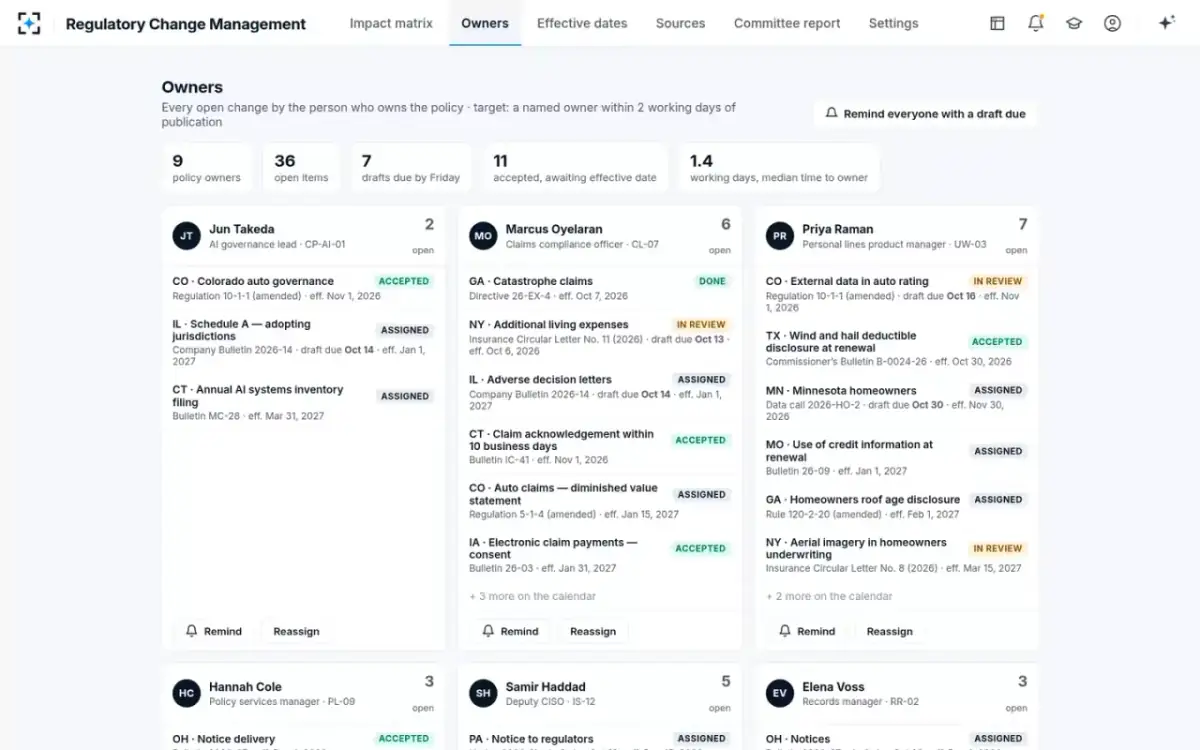
What is the difference between a compliance analyst and a compliance officer?
The analyst prepares and proves; the officer decides and signs. That line runs through every regulator text above: Connecticut's certification is signed by an officer, Colorado's attestation "must be signed by an officer of the insurer", New York's complaint function is "vested in a corporate officer". None of them names an analyst, because the analyst's work is the evidence behind the signature rather than the signature itself.
In a small carrier the two may be one person, which is exactly where the job description goes wrong. A one-person compliance shop that writes in a dozen states cannot read every publication closely, keep the policy library current and prepare the certifications, so something gets read late. A good description separates the duties even when one person holds both, so that the reading and mapping can be delegated, to a junior hire, an outside service or software, without delegating the decision.
An insurance compliance officer job description therefore leads with accountability: the compliance program, the committee report, the attestations and certifications, the examiner relationship. An analyst's leads with throughput and accuracy: publications read, maps drafted, owners assigned within a set number of days, nothing reaching its effective date unassigned.
Skills an insurance compliance analyst job description should ask for
The skills that matter follow from the work: reading legal text precisely, knowing which instruments bind, and working a policy library by paragraph. Three are underrated in most postings.
The first is telling instruments apart. A statute binds on its effective date; an adopted regulation binds; a bulletin states the department's reading; a model binds nowhere until a state enacts it. Colorado's Division of Insurance, for one, describes its bulletins as its interpretations of existing law, not binding norms. An analyst who triages by instrument first saves the business from treating every publication as an emergency, and statute, rule, bulletin or model sets out the order.
The second is reading dates. A Texas bill can be effective on 1 September 2025, apply to policies issued or renewed after 1 January 2026, and still await rules from the department. One law, three dates, and each can land on a different owner.
The third is version discipline. Examiners test files against the law in force when the file was handled. In Florida's 2025 exam of Tower Hill Prime, the examiners measured claim acknowledgments against the 14-day clock in the 2022 statute and noted in a footnote that the 2023 text had cut that clock to 7 days (Florida OIR; the footnote is read in the Florida OIR market conduct exam). An analyst who keeps only the current version of a procedure cannot answer which one applied.
An insurance compliance analyst job description, written from the work
- Read and scope every publication from the states and lines written
Bulletins, regulations, orders, circular letters, emergency directives, data calls and NAIC exposure drafts; screen out the rest with a reason that can be shown later.
- Match each new text with what the company already implemented
Most state adoptions of a model repeat text the company has seen; the work is finding the sentences that differ.
- Map each obligation to the policy paragraph, form or system it changes
A paragraph number, not a department name.
- Propose the owner and due date; confirm with the regulatory change lead
Assignment is a decision, not an email thread.
- Track every change to an accepted new version before its effective date
Closed means the paragraph changed, not that someone replied.
- Prepare certifications, attestations and data calls for an officer to sign
With the evidence behind each statement kept for the examiner.
- Support market conduct examinations with dated versions of procedures
Which text applied on which date, and when it changed.
- Report to the compliance committee: what changed, who owns it, what is at risk
Nothing reaching its effective date without an owner.
Insurance compliance analyst salary: what the federal data show
The Bureau of Labor Statistics does not publish a separate series for insurance compliance analysts; the nearest occupation in its survey is Compliance Officers (13-1041). For May 2025 it put employment at 417,070, with an annual mean wage of $88,400 and a median of $80,730 (BLS OEWS, 13-1041). Those are all-industry figures; BLS also publishes the occupation within insurance carriers (industry 524100), which is the series to check before setting a pay band.
Pay tracks the second skill set more than the first. An analyst who can read a state statute, a regulation and a bulletin and say which binds on which date is doing work closer to regulatory counsel's than to data entry. A posting that describes the job only as "monitor regulatory updates" describes the part that software now does, and prices the role accordingly.
People search for remote insurance compliance analyst jobs because the sources are all online. What a remote analyst needs is not proximity to the regulator but direct access to the policy library and its owners, since the job ends at an accepted change to a numbered paragraph.
A week on the desk, before and after the reading is done for you
The difference software makes is not in the analyst's judgement but in where the days go. In the sample week on the solution's screens, the fictional carrier received 23 publications from its sources; nine touched its states and lines, and 14 were screened out with a reason each. For each of the nine, the estimate below shows where the time between publication and a named owner goes.
From publication to a named owner: the reading and searching shrink, the decisions do not
- Read1.5 d
- Model1 d
- Paragraphs2 d
- Owner by email4 d
- OK0.5 d
- Map0.5 d
- Owner1 d
- OK0.5 d
In the second lane the analyst still reads, but reads a draft: the regulator's passage, the policy paragraph it changes, the earlier change that already covers part of it, and the reason the agent chose that paragraph. Where the draft is wrong the analyst corrects it, and the correction is the valuable part of the job. The six agents in the solution have written limits, such as "Never assigns without the regulatory change lead's confirmation" and "Cannot accept a draft — only the policy owner can".
Who the agents watch, and what they screened out
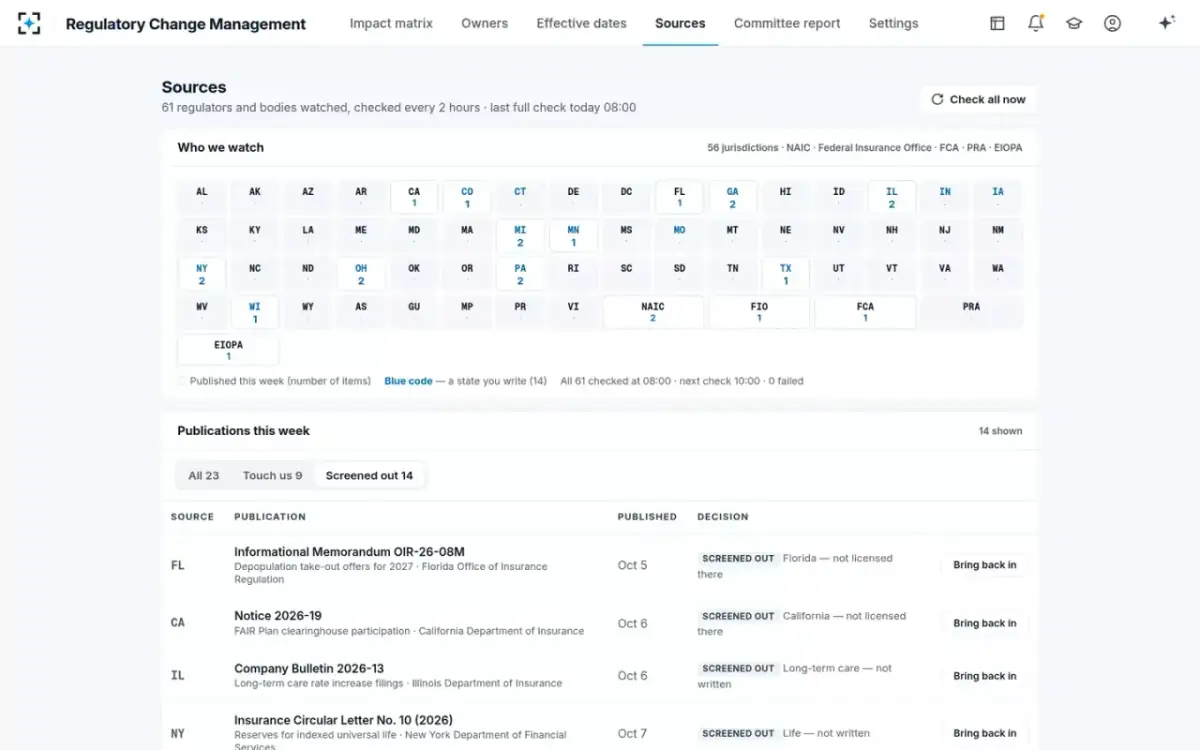
That is the honest scope of automation for this role. The reading, matching and searching go to software; the analyst keeps the decision that a publication applies, the map, and the evidence. To see the desk on the fictional carrier's week, start from Regulatory Change Management for Insurers; one bulletin traced through the agents shows the run second by second.
Questions people ask
What is a compliance analyst in an insurance company?
A compliance analyst turns regulators' publications into changes the company can prove it made: scoping each bulletin, rule and order, mapping it to policies and procedures, tracking it through an owner to its effective date, and preparing the evidence behind certifications. In a carrier the regulators are the state insurance departments, up to 56 of them, and the NAIC's models that states adopt.
What does an insurance compliance specialist do differently from an analyst?
Usually nothing material: the titles are used interchangeably. Where a company separates them, the specialist tends to own one area, such as producer licensing, claims or privacy, while the analyst works across the regulatory inflow. Both prepare evidence; neither is the officer who signs.
Are insurance compliance analyst jobs remote?
Many are, because every source the analyst reads is published online. What remote work needs is direct access to the policy library and its owners, since the job ends at an accepted change to a numbered paragraph, not at a summary sent by email.
What qualifications does an insurance compliance analyst need?
Requirements are set by each employer. The skills that matter follow from the work: reading legal text precisely, telling a binding rule from a bulletin's reading of one, and tracking dates. Texas's 2025 session alone produced insurance bills effective on 20 June 2025, 1 September 2025 and 1 January 2026.
What does an insurance compliance officer job description include?
Accountability: the compliance program, committee reporting, examiner relationships and the certifications and attestations the analyst prepares. Regulators address the officer directly; New York, for example, requires complaint handling to be vested in "a corporate officer".