AI regulatory change management for insurance companies means software agents that read every bulletin, regulation, order and data call from the states a carrier writes in, compare it with the NAIC model text and earlier state adoptions the carrier has already implemented, and draft the change to the exact paragraph of the carrier's own policy, while named people confirm the map, assign the owner and accept the new wording. Insurers are the hard case for this work because their rules arrive state by state: one NAIC model can reach a carrier as dozens of separate documents, each mostly familiar and slightly different. Botminds' Regulatory Change Management for Insurers was built for that pattern, and this guide follows one bulletin through it, from the moment it is published to the owner's acceptance.
The trace uses sample data on a fictional carrier, Corliss Ridge Insurance Group, which writes four lines in 14 states. The bulletin in the trace, "Illinois Company Bulletin 2026-14", is invented for the sample, and so are its section numbers; Illinois's actual adoption of the NAIC AI model bulletin is Company Bulletin 2024-08 of 13 March 2024, according to the NAIC's adoption map.
If a regulated entity uses AI to make a consequential decision, TDI expects a person to review and agree with all decisions before action is taken.
Texas Department of Insurance, Commissioner's Bulletin B-0003-26, 12 June 2026
Texas wrote that sentence about AI used on consumers, not about compliance tools. It is still the right design rule for one: the agents may read, compare and draft at machine speed, but a person agrees before anything leaves the compliance desk.
What AI regulatory change management means for an insurance company
For a carrier, AI regulatory change management is the same five tasks a compliance analyst has always done, with the first three handed to software: read and scope each publication, compare it with what is already implemented, find the policy paragraph it changes, name an owner, and track the change to an accepted new version before the effective date. The value sits in the third task. Alerts that a bulletin exists have been available for years; what costs days is working out which paragraph of which policy is now wrong.
In the solution the work is laid out as an impact matrix: publications as rows, the carrier's own policies as columns, and each lit cell a paragraph the publication changes, with its state, its owner and a drafted redline. Six agents fill the matrix: a Source watcher, a Relevance screener, a Rule reader, a Prior-adoption matcher, a Policy mapper and an Owner router. People fill in the decisions.
Why insurers are the hard case: one model, 29 adoptions
Insurance regulation is state law, and the NAIC writes models that each state may adopt in its own words. The NAIC model bulletin on the use of AI systems by insurers was adopted on 4 December 2023. By 8 October 2026 the NAIC's adoption map listed 29 jurisdictions that had adopted it, including the District of Columbia and Puerto Rico, and four states with insurance-specific rules of their own: California, Colorado, New York and Texas (NAIC map). Twenty-one adoptions came in 2024, four in 2025 and four so far in 2026, by our count of the dates on the map.
For a carrier that implemented the model once, each new adoption is a document that is mostly old text. The work is to find the sentences that are not, and the NAIC's map does not do that for you: it records that a state acted, not whether its text matches the model. That comparison is exactly the comparison an AI agent can do quickly and a person finds tedious: reading a 30th version of a familiar text word by word. The adoption map, jurisdiction by jurisdiction, shows the dates and instruments.
The trace: one bulletin, second by second
The sample bulletin was published at 16:40 on a Friday and picked up by the Source watcher at 16:52. On Monday at 09:00 the regulatory change lead opened the matrix, saw one unread row, and pressed Read and map. The run took 18 seconds.
One bulletin through Regulatory Change Management for Insurers: 18 seconds of agents, 14 minutes of people
- Fetch1.8 s
- Screen1.8 s
- Read2.1 s
- Match: 7 of 9 sections already done8.0 s
- Map: 4 drafts2.9 s
- Route1.4 s
Each step leaves something a person can check. The Source watcher recorded the publisher, the page count and the time it was published. The Relevance screener said why the bulletin touched the carrier: personal auto and homeowners in Illinois, claims and underwriting decisions, at a score of 0.94 against a screen-out threshold of 0.60. The Rule reader split the text into 11 obligations, each with its section, the passage and the date it bites, under a written limit: "Dates are copied, never inferred."
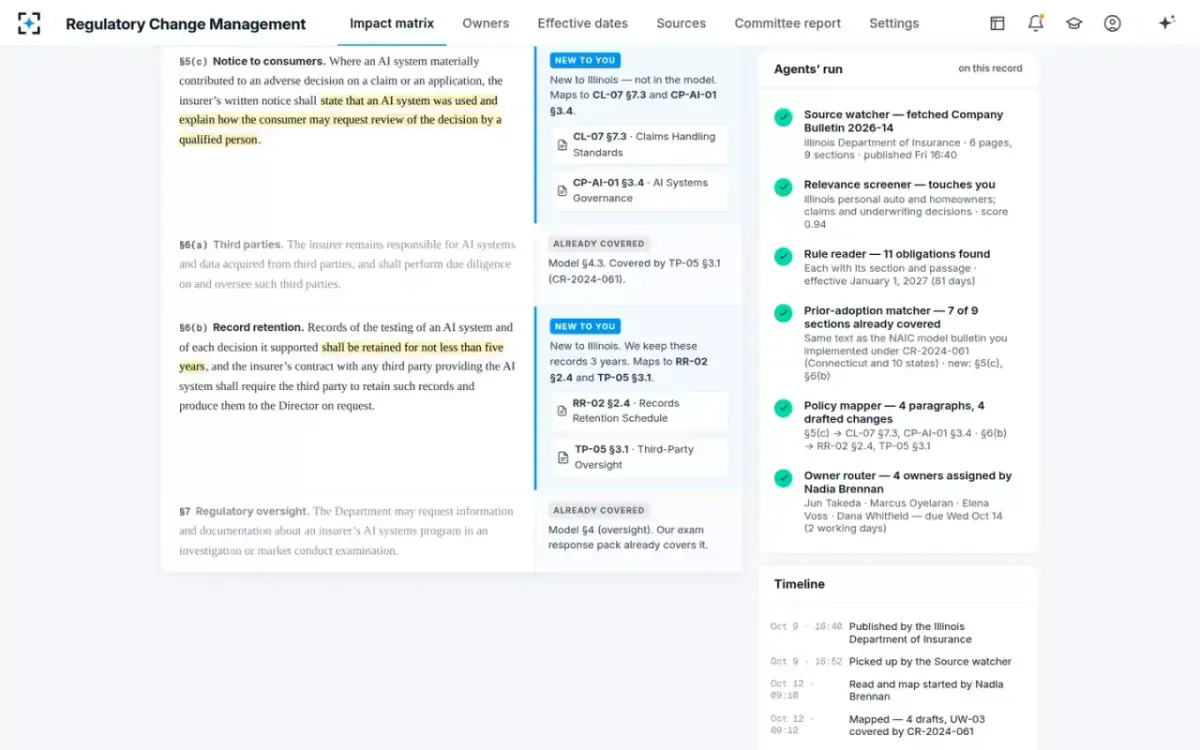
The matcher took the longest, eight seconds, because it compares every section with the NAIC model text and with the carrier's earlier adoptions. Seven of the nine sections matched text the carrier had implemented under an earlier change for Connecticut and ten other states. Two did not: a notice to consumers when AI contributed to an adverse decision, and a five-year retention period for AI testing and decision records where the carrier's schedule said three.
Read and map: the run under the bulletin's row
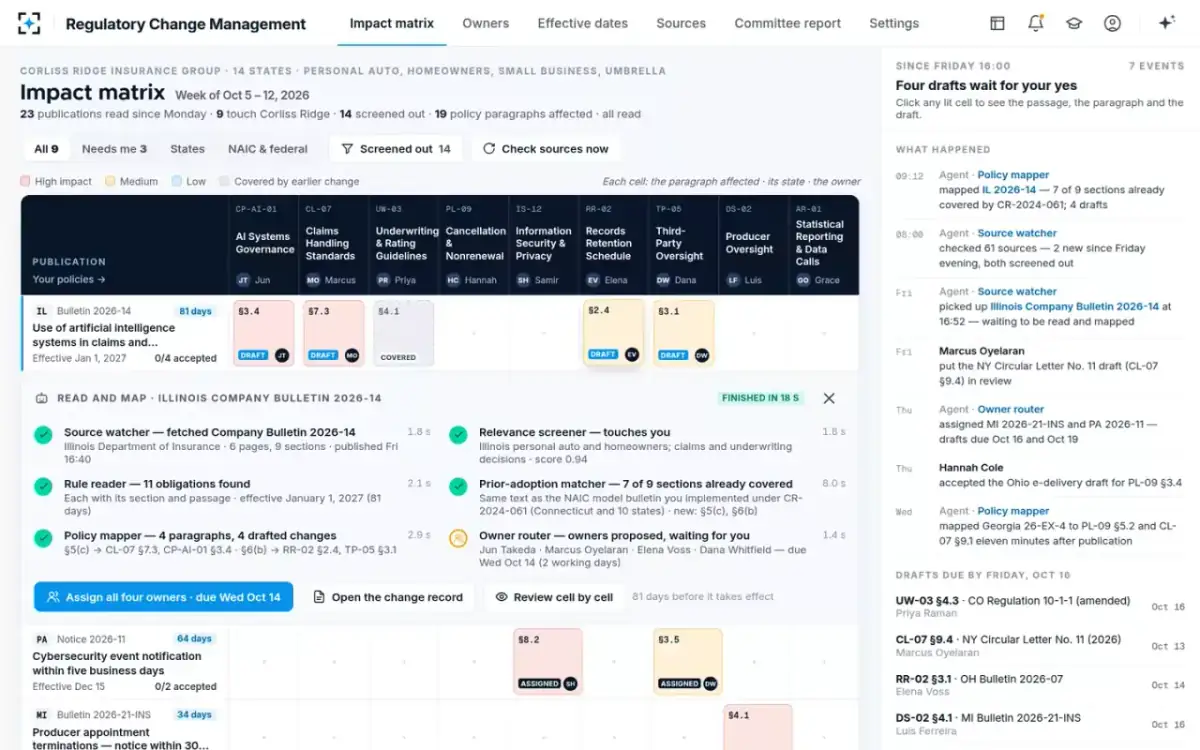
The Policy mapper then searched 3,180 numbered paragraphs and lit four: the AI governance policy, the adverse decision letter paragraph in the claims handling standards, the records retention schedule and the third-party oversight policy. For each it drafted the smallest change as a redline, said why that paragraph, and gave a confidence: 93% on the claims letter, 97% on the retention schedule. The underwriting rule showed as covered, hatched, because the earlier change had already rewritten it.
What the matcher must catch, and why "the same" is a word-level claim
The most valuable agent is also the riskiest: a matcher that marks a section "already covered" saves a day of work when it is right and hides an obligation when it is wrong. The solution's matcher works under two written limits: "Never marks a section covered without naming the earlier change" and "Any wording difference counts as new."
The second limit matters because real adoptions change words that change meaning. Connecticut's bulletin MC-25 of 26 February 2024 follows the NAIC model closely, yet it adds an annual AI certification for domestic insurers and rewrites one of the model's definitions in terms of Connecticut law. A matcher that scored paragraphs by overall similarity would call both sections the same as the model; a word-level comparison flags them. Reading the diff between a model and a state's text works through the Connecticut example sentence by sentence.
The bulletin section by section: new to you, or already covered by a named change
Where the agents stop: four decisions that stay with people
The agents stop at every point where the answer commits the company. Four decisions stay with named people, and the solution enforces each one in its permissions rather than in a policy memo.
Six agents, four human decisions: who does what on one AI bulletin
Agent
Source watcherChecks 61 regulators and bodies every two hours and pulls each new publication with its number and dates.
Never: Skips a source silently: one that fails to load shows as unchecked.
Agent
Relevance screener and Rule readerTests the publication against the states and lines written; splits it into obligations with their passages and dates.
Never: Discards: a screened-out item keeps its reason and can be brought back.
Agent
Prior-adoption matcher and Policy mapperMarks what is new against the model and earlier adoptions; drafts the smallest change to each affected paragraph, with a reason and a confidence.
Never: Changes the policy library: drafts only.
A person decides
Regulatory change leadConfirms the map, corrects it where it is wrong, and assigns the owners the Owner router proposed.
A person decides
Policy ownerAccepts, edits or returns the drafted change; acceptance publishes a new version of the policy with the change number.
A person decides
Chief Compliance OfficerSigns the committee report, with the meaning of the signature recorded.
In the trace, the lead confirmed the map at 09:14 and assigned four owners, each due two working days after the bulletin was published. One of them, the records manager, opened her redline: three years struck, five years inserted, with the reason that the schedule already applies the longest state period everywhere, so one change covers Illinois without a state exception. She accepted it, and the retention schedule moved to a new version recorded against the change number.
How is AI used in insurance regulatory compliance today?
AI touches insurance compliance in two ways, and they are easy to confuse. The first is AI as the subject of regulation: insurers' own use of models in underwriting, pricing, claims and fraud, which the NAIC model bulletin and the state rules govern. The second is AI as a compliance tool, reading and drafting for the compliance team. This guide is about the second, but the first sets the stakes, because most of the AI rules a regulatory change team now reads are about the company's own models.
Why AI bulletins fill an insurer's regulatory inflow
88%
of private passenger auto companies in the NAIC survey used, planned or explored AI/ML
70%
of homeowners companies did: 136 of 194 completing the NAIC survey
84%
of health insurers use AI/ML, from 93 companies surveyed by 16 states
29
jurisdictions had adopted the NAIC AI model bulletin by 8 October 2026
Those figures explain the shape of the inflow. When most carriers use models, every state adds an AI expectation, and every expectation lands on several owners at once: the AI governance lead, claims, underwriting, records, vendor management. A single AI bulletin in the trace touched four policies owned by four people. Coordinating that by email is where the days go, and it is the part an agent that drafts per paragraph and per owner shortens most.
Does AI regulation for insurers apply to the compliance tool itself?
Whether a compliance tool falls inside a carrier's AI program is the carrier's call, and the safer answer costs little. The NAIC model bulletin expects a written program for AI systems that make or support decisions in regulated insurance practices, and it reaches systems bought from vendors on the same terms as those built in-house (NAIC model bulletin; its requirements, section by section). A tool that drafts changes to claim letters supports decisions about how claims are handled, even if no consumer ever sees the tool.
Treating it as in scope means three ordinary things: an entry in the AI inventory, a vendor review, and evidence that its output is checked. The third is built into the design described above: the passage is shown beside every summary, the earlier change is named beside every "covered" mark, and no change is sent or published without a person. Texas's 2026 bulletin adds that its expectations "extend to any third party working with a regulated entity," which is a reason to keep that evidence where an examiner can see it.
What can go wrong, and the control for each
An AI regulatory change tool fails in a small number of predictable ways. A buyer should ask to see the control for each one working, not described.
Six ways AI regulatory change management can fail an insurer, and the control that catches each
| Failure | What it costs | Control in the solution |
|---|---|---|
| A source fails to load and nothing says so | A bulletin is never read; the first sign is the effective date or the exam | A source that fails to load is shown as unchecked, never skipped silently |
| A relevant publication is screened out | An obligation in a state written goes unowned | Every screened-out item keeps a one-line reason and can be brought back; emergency orders, moratoriums and data calls in a state written are always kept |
| A date is misread or guessed | The change is planned for the wrong day | Dates are copied from the text, never inferred, and shown with their passage |
| A changed section is marked "already covered" | A new obligation is hidden inside familiar text | No section is marked covered without naming the earlier change; any wording difference counts as new |
| The wrong paragraph is mapped | The right policy stays wrong and the wrong one is edited | Each draft gives the reason for the paragraph and a confidence, and the lead confirms the map |
| The change goes to the wrong owner or nobody | Days lost; the effective date passes unowned | The lead confirms every owner; reminders on day two; escalation at day four or 30 days before the effective date |
The bank version of the same question, which tasks agents can take and which stay with people, is set out for a bank's federal inflow in AI regulatory change management: which tasks agents can take. The insurance difference is the matcher: much of a bank's inflow is federal rules read once, while a carrier reads one NAIC model many times over. To run the trace on your own recent bulletins, start from Regulatory Change Management for Insurers, and test any tool on one bulletin before you buy.
Questions people ask
Can AI do regulatory change management for an insurance company on its own?
It can do the reading, comparing and drafting, but not the decisions. In the trace, six agents finished their part in 18 seconds; a person then took 14 minutes to confirm the map and assign four owners, and each owner accepted their own change. Regulators address their expectations to the company and its officers, not to a tool.
How is AI changing the insurance industry's compliance work?
Mostly by changing what the compliance team must read: by 8 October 2026, 29 jurisdictions had adopted the NAIC AI model bulletin, and NAIC surveys found most auto, homeowners and health insurers using or exploring AI/ML. The same technology now reads that inflow, so analysts review drafted maps instead of reading each version cold.
Is AI accurate enough to say a state bulletin matches the NAIC model?
Only if "matches" is tested word by word and the earlier change is named. Connecticut's adoption of the AI model bulletin added an annual certification and reworded a definition; a similarity score would have called both sections the same. A good matcher treats any wording difference as new and leaves the call on substance to a person.
What does AI in insurance regulation require of insurers?
Where a state has adopted the NAIC model bulletin, insurers are expected to maintain a written program for the responsible use of AI systems that make or support decisions on regulated insurance practices, including systems from vendors. Four states, California, Colorado, New York and Texas, appear on the NAIC map with insurance-specific rules or guidance of their own.
Does an AI compliance tool replace the compliance analyst?
It replaces the reading and searching, which by Botminds' estimate is four and a half of the nine working days a change takes to reach an owner by email. The analyst keeps the judgement that a publication applies, the correction of a wrong map and the evidence behind each certification.