Insurance regulatory tracking software watches the publications of the regulators an insurer answers to, state insurance departments, the NAIC and any federal or foreign body, and tells the compliance team what is new: bulletins, regulations, orders, circular letters, emergency directives and data calls. Most carriers already have some version of it, a subscription, a legal research service or a spreadsheet of department websites. What tracking alone does not do is the expensive part: decide which publications touch the company's states and lines, find the paragraph of the company's own policy each one changes, and route it to the person who owns that paragraph. Botminds' Regulatory Change Management for Insurers adds that part on top of the sources a carrier already reads, and leaves the feeds and the policy library where they are.
The product examples here are sample data on a fictional carrier writing four lines in 14 states. The regulatory examples are real and linked.
Prohibits the cancellation or nonrenewal of a policy in an impacted area, except at the written request of the policyholder, until December 10, 2024.
Florida Office of Insurance Regulation, Hurricane Milton emergency order EO 400473-24, posted 16 October 2024
That order applied to every insurer in Florida with policyholders in 35 named counties, and Florida's Office of Insurance Regulation posted it at 19:23. A tracking feed that delivers it the next morning has done its job. The question it cannot answer is which nonrenewal notices in the carrier's queue for those counties must now be stopped, and who stops them.
What insurance regulatory tracking software should track
It should track every instrument that can create a deadline, not only the ones that look like law. For a multi-state carrier that is a long list: statutes from each session, adopted and proposed regulations, commissioner bulletins, circular letters, emergency orders and moratoriums, data calls and statistical calls, NAIC model laws, model bulletins and working-group exposure drafts, and the publications of federal and foreign regulators where the carrier writes business.
The volume is less than people fear and more scattered than they hope. Texas's Department of Insurance listed 16 commissioner bulletins for 2025 and eight for 2026 by mid-September (TDI 2025, TDI 2026). New York's Department of Financial Services lists its insurance circular letters on a separate page, with withdrawn ones marked (NY DFS). The NAIC publishes all its model laws, regulations and guidelines with a state action page for each (NAIC). Each of the 56 jurisdictions has its own pages, numbering and calendar.
Insurance publications that create deadlines without looking like new law
| Instrument | A real example | Why tracking alone misses the deadline |
|---|---|---|
| Emergency order | Florida EO 400473-24, Hurricane Milton, posted 16 October 2024: grace periods and no cancellations or nonrenewals in 35 counties until 10 December 2024 | It binds on issue. The work is stopping specific notices in specific counties, the same day. |
| Amended emergency order | Florida amended its Hurricane Helene order the same day; the amended order runs its grace periods to 10 December 2024 | The original order is already "done" in the tracker; the amendment reuses its name. |
| Data call | Six of Texas’s 16 bulletins in 2025 were data calls or calls for data | A data call is a deadline for a data owner, not a policy change; it needs a different routing rule. |
| NAIC exposure draft | The NAIC Big Data and AI working group exposed its AI Risk Evaluation Supplement 6.0 for a 14-day comment period ending 30 October 2026 | Fourteen days is shorter than many committee cycles; the comment owner must be found at once. |
| Statistical filing | MCAS for the 2026 data year: submissions due 30 April 2027, health lines 31 May 2027 | Recurring and dated; it belongs on the calendar beside the changes. |
| Replacement guidance | New York lists circular letters withdrawn and replaced on its circular letter page | A replaced letter keeps its old row; the new one must reopen the old owner’s work. |
What an alert feed cannot tell you
An alert feed answers "what was published?" Four questions remain, and they are the ones that decide whether a change is made on time. Does it touch our states, lines and products? Have we already implemented this text for another state? Which paragraph of which of our policies does it change? Who owns that paragraph?
None of the four can be answered from the publication alone, because each depends on the company's own data: its footprint, its earlier change records, its policy library and its ownership map. That is why tracking services stop at the alert, and why the days from alert to owner are spent inside the company, mostly by email. Botminds' estimate for the fictional carrier is about nine working days from publication to a named owner by email, four of them spent finding the owner; the solution's design target is two.
The second question deserves emphasis in insurance. A carrier that implemented the NAIC AI model bulletin once will receive it again from each state that adopts it, 29 jurisdictions by the NAIC's map of 8 October 2026. A feed delivers each adoption as news. Only a comparison with the text already implemented says that seven of nine sections are old and two are new, and the adoption map, state by state shows how often that comparison is needed.
Integrate, don't replace: keep the feed, add the map
The cheapest go-live keeps what works. A carrier's existing alert subscriptions, its policy and procedure library and its ownership records all stay; the solution reads from them and writes back only one thing, an accepted new version of a policy, and only when its owner accepts it.
Where insurance regulatory tracking software stops, and the map the solution adds
Agent
Sources you already watchDepartment sites, the NAIC, federal and foreign regulators, read every two hours; your existing alert feeds can stay as a second check.
Never: Reads anything but public publications.
Agent
Footprint testEach publication tested against the states, lines and products in your settings, with a one-line reason for anything screened out.
Never: Drops an emergency order, moratorium or data call in a state you write.
Agent
Your earlier changesEach section compared with model text and with the change records you already have, and marked new or covered.
Never: Marks a section covered without naming the earlier change.
Agent
Your policy libraryEach new obligation mapped to the numbered paragraph it changes, with a drafted redline, a reason and a confidence.
Never: Edits the library: drafts only.
A person decides
Your regulatory change leadConfirms the map and the owners proposed from your routing rules.
A person decides
Your policy ownersAccept, edit or return the draft; acceptance writes the new version into the library with the change number.
How do state insurance bulletin trackers decide relevance?
Most decide by keyword or by a subject taxonomy chosen by the vendor. A better test is the company's own footprint: the states written, the lines in each, and the products. In the solution the Relevance screener scores each publication against that footprint, screens out anything below a threshold the regulatory change lead sets, and records why, such as "Life — not written" or "Florida — not licensed there".
Two design choices matter more than the score. First, some instruments are always kept, whatever the score: in the solution's settings, emergency orders, moratoriums and data calls in a state written. Second, nothing is screened out silently; each screened-out publication keeps its reason and can be brought back with one click. An examiner who asks why a bulletin was not acted on can be shown the reason recorded on the day it was read.
The rules the agents work to: footprint, clocks, relevance and who signs
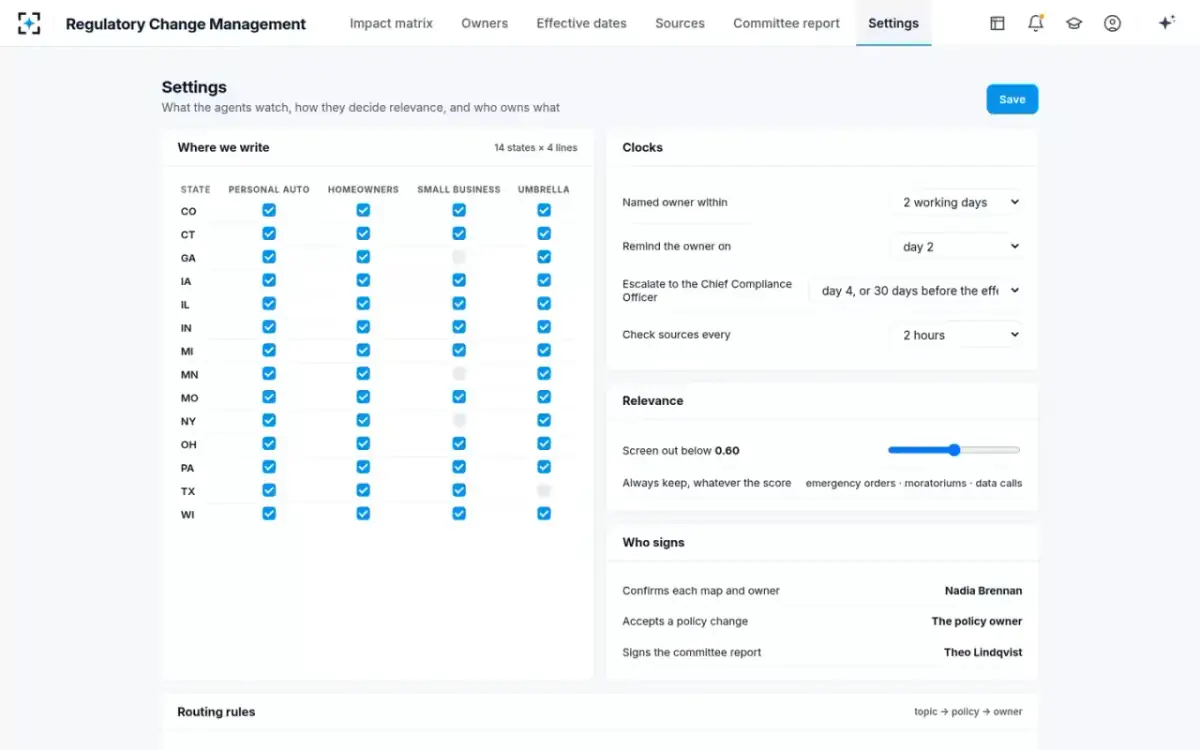
What should an insurance regulatory tracking record show an examiner?
It should show, for any publication, five things with dates: when it was read, what was decided about it, what it was mapped to, who owned it, and when the changed text took effect. Examiners test files against the rules in force when each file was handled; when a file fails, the next question is when the company learned of the rule and what it did. A tracking feed's delivery log answers the first half of that question at best.
The decision about relevance is the part most often missing. A publication judged not to apply leaves no trace in most trackers, so a year later nobody can show that it was read and why it was set aside. In the solution every screened-out publication keeps its one-line reason and the time it was screened, and every read, match, draft, assignment, acceptance and signature is recorded on an activity trail by person or by agent. A source that failed to load is shown as unchecked on that run, which is itself evidence: it says which day a gap existed and when it closed.
The record should also survive staff changes. When the analyst who read a 2024 adoption has moved on, the reason that its third section was treated as already covered must still be readable, with the earlier change it relied on named. That is the difference between a log of alerts and a record of decisions.
What to connect on day one
Four things decide how good the first month is, and none of them is a new data source. The sample committee report in the solution lists three late assignments and their causes: an owner on leave with no deputy, no routing rule for data calls, and a publication that arrived the evening before a holiday. Each one is a gap in what was connected, not in what was read.
What to connect when you add the map to your insurance regulatory tracking
- Your footprint, by state, line and product
The relevance test is only as good as this grid; include lines in run-off if their rules still apply.
- Your policy and procedure library, by numbered paragraph
Mapping needs paragraph numbers and versions; a folder of PDFs without them maps to documents, not paragraphs.
- Your earlier change records
So the 29th adoption of a model is compared with what you implemented for the first.
- Your owners, with deputies
Every policy needs a named owner and a named deputy; a change routed to someone on leave waits.
- Routing rules for non-rule instruments
Data calls, exposure drafts and statistical filings go to data and comment owners, not policy owners.
- Your working calendar
A two-working-day clock needs your holidays, or a Friday-evening bulletin is late on Tuesday.
- Your existing feeds, as a second check for the first quarter
Compare what each catches; keep the feed if it reaches a source the agents do not.
Who has to be in the room for the go-live, and what each brings
Today
Owns the alert inbox and the tracker.
With agents
Owns the footprint, the threshold and the routing rules; confirms maps and owners.
Still theirs: Every assignment.
Today
Keeps documents in a shared drive or a policy system.
With agents
Makes paragraph numbers and versions available to read; receives accepted versions back.
Still theirs: The library as the system of record.
Today
Receive forwarded bulletins.
With agents
Receive drafts against their own paragraphs, with the passage beside them.
Still theirs: Accepting changes to their own policies.
Today
Reads a report assembled by hand.
With agents
Signs a report drafted from the matrix, with late assignments and their fixes listed.
Still theirs: The signature.
Go-live in four steps, on publications you have already handled
The safest pilot replays the past. Take last quarter's publications for the states written, run them through the solution against the current policy library, and compare its maps with what the team actually did. Differences fall into three groups: the agents found a paragraph the team missed, the team found one the agents missed, or they disagree about whether a section was already covered. Each group tells you something specific.
Then run live for a month with the old feed still on, so every publication is caught twice. Then switch the owner routing on, with the lead confirming each one. Then retire whichever manual step the comparison shows is no longer needed, which is usually the weekly meeting to find out what is unowned, not the feed. The banking guide to building a regulatory change management framework covers the same inputs for a bank's footprint.
The week on one matrix: publications as rows, your policies as columns
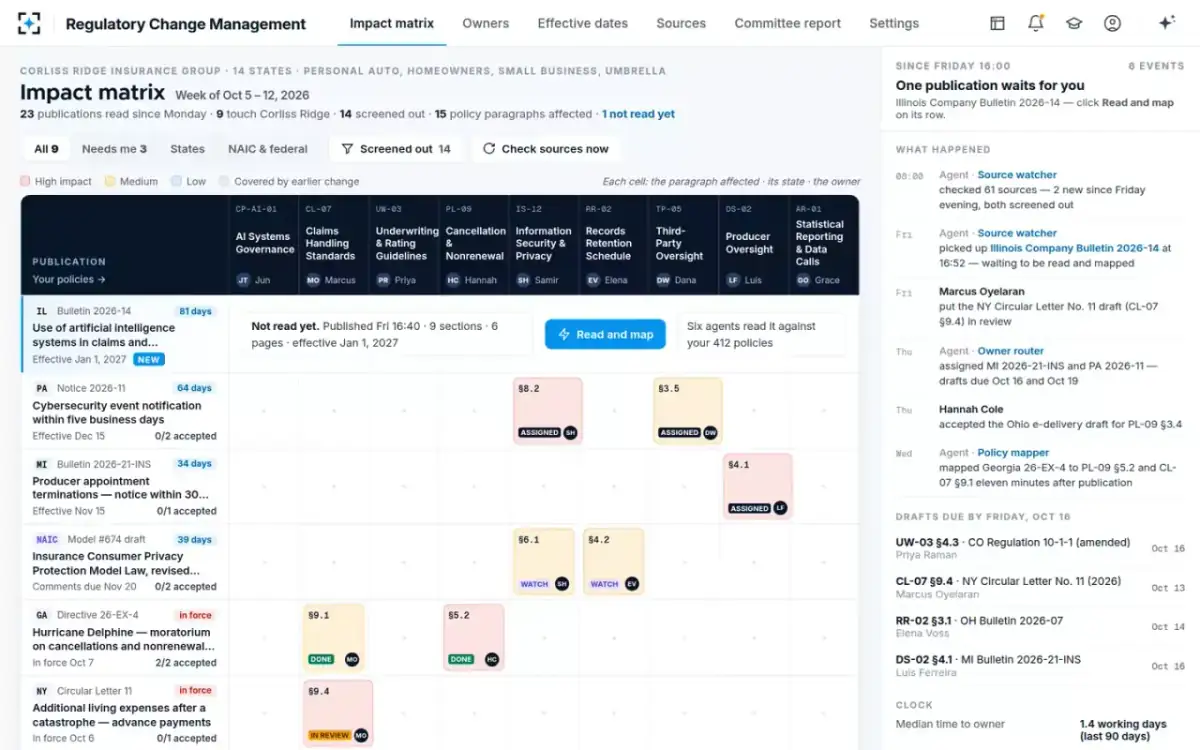
What a carrier ends up with is not a new feed but a different question answered each morning: not "what was published?" but "which of our paragraphs are wrong now, and who has them?" To see that matrix on your own last quarter, start from Regulatory Change Management for Insurers; an insurance compliance tracker in Excel explains what to keep from the spreadsheet you have.
Questions people ask
What is an insurance regulatory tracking system?
A system that collects new publications from insurance regulators, state departments, the NAIC and federal or foreign bodies, and records each with its source, dates and status. On its own it answers what was published; regulatory change management adds which of the company's policies each one changes and who owns the change.
Are insurance regulatory tracking services enough on their own?
They are enough to know a publication exists. They are not enough to know whether it touches your footprint, whether you already implemented the same text elsewhere, or which paragraph changes, because those answers depend on your own records. Botminds estimates four of the nine days to an owner are spent finding the owner by email.
How do I track state insurance bulletins across many states?
Read each department's bulletin index on a schedule, test each publication against the states, lines and products written, and keep a reason for everything screened out. Always keep emergency orders, moratoriums and data calls in states written; Florida posted its Hurricane Milton order at 19:23 on 16 October 2024, the day it was issued.
Should insurance compliance tracker software replace our policy management system?
No. The policy library should stay the system of record. Tracking software should read it by numbered paragraph, draft changes against it, and write back only an accepted new version, with the change number, when the owner accepts.
How often should insurance regulatory sources be checked?
Often enough that an emergency order is read the day it is issued. In the sample settings the solution checks its 61 sources every two hours (one or four hours are the other options), and shows any source that failed to load as unchecked rather than skipping it.