Insurance regulatory changes are any new or amended text that changes what an insurer must do, by when, in a state it writes in: a statute from the legislature, a regulation from the insurance department, a bulletin or circular letter from the commissioner, an emergency order after a disaster, a data call, or an NAIC model that states may later enact. They differ in force and in timing. A statute binds from its effective date; an adopted regulation binds; a bulletin states how the department reads the law it enforces; an emergency order binds the day it is issued; a model binds nowhere until a state enacts it. Sorting each change by instrument before reading it closely is the first triage step, and it is the one that most changes the workload. Botminds' Regulatory Change Management for Insurers records the instrument and its dates for every publication it reads, before mapping the change to the carrier's own policies.
Every example on this page is a real publication, linked. Product examples are sample data on a fictional carrier.
Bulletins are the Division’s interpretations of existing insurance law or general statements of Division policy. Bulletins themselves establish neither binding norms nor finally determine issues or rights.
Colorado Division of Insurance, Revised Bulletin No. B-10.004, issued 18 October 2024, reissued 22 October 2025
What is a regulatory change in insurance?
A regulatory change is a publication that alters an obligation: something a company must start doing, stop doing, do differently or do by a new date. In insurance the obligations come from state law, so a regulatory change is almost always a state publication, or an NAIC text that states will turn into one. The NAIC's members are the chief insurance regulators of the 50 states, the District of Columbia and five territories, and each publishes on its own schedule.
Not every publication is a change. A department's consumer guide, a press release about a rate hearing or a report on market statistics informs, but alters no obligation. The useful first question for each publication is therefore: what instrument is this, and what force does it carry? The answer decides how fast the company must move, who must read it, and whether a policy must change at all.
Insurance regulatory changes by instrument: who issues each, whether it binds, and when it starts
| Instrument | Issued by | Force | Starts | A real example |
|---|---|---|---|---|
| Statute | Legislature | Binds | Its effective date, sometimes with later dates for parts of it | Texas SB 1238 (2025), effective 1 September 2025 |
| Regulation | Insurance department, after rulemaking | Binds | The date in its adoption notice | Colorado Regulation 10-1-1, amended, effective 15 October 2025 |
| Bulletin, notice or circular letter | Commissioner or department | States the department’s reading of existing law and what it expects | Usually on issue | Pennsylvania Notice 2024-04; NY Circular Letter No. 1 (2026) |
| Emergency order | Commissioner or office, after a declared emergency | Binds, for a stated period | On issue | Florida EO 400473-24, Hurricane Milton, 16 October 2024 |
| Data call | Department or NAIC | A filing deadline | Due date in the call | Six of Texas’s 16 bulletins in 2025 |
| NAIC model | NAIC members, by vote | None until a state enacts it | When each state acts | The AI model bulletin of 4 December 2023 |
Does an insurance bulletin have the force of law?
Usually not by itself: a bulletin tells insurers how the department reads the statutes and regulations it enforces, and what it will expect to see. Colorado says so in each bulletin, in the words above. The obligations a bulletin describes rest on law that already binds, and a department that finds a violation cites the statute or regulation, not the bulletin.
That does not make bulletins optional reading. They tell a carrier what examiners will ask for. Texas's AI bulletin of 12 June 2026 says: "TDI will monitor the use of AI through examinations and product filings" (TDI B-0003-26). Some contain requirements stated in mandatory words: Connecticut's AI bulletin requires its domestic insurers to complete an annual certification. And they date the regulator's reading: a carrier that ignores a bulletin and is later found in violation of the underlying statute has a harder time arguing it did not know what the department expected.
Bulletins also follow statutes, sometimes late. Texas's SB 1238 took effect on 1 September 2025; TDI's compliance bulletin on it came on 29 September 2025 and applied it to policies delivered, issued or renewed from that first date (TDI B-0014-25). The statute bound from the first date; the bulletin explained it four weeks later.
A statute and the bulletin that follows it: the same rule, two instruments
Texas SB 1238 (statute): The 89th Legislature, regular session 2025.
TDI Bulletin B-0014-25: The Commissioner of Insurance, 29 September 2025.
Texas SB 1238 (statute): Amends Insurance Code section 544.002 to bar treating a widowed person differently from a married one.
TDI Bulletin B-0014-25: Explains the amendment and who it reaches, including HMOs.
Texas SB 1238 (statute): 1 September 2025.
TDI Bulletin B-0014-25: Adds no date; restates that policies from 1 September 2025 must comply.
Texas SB 1238 (statute): Comply.
TDI Bulletin B-0014-25: May need to submit updated form, rate and underwriting guideline filings.
Pennsylvania insurance department bulletins: notices in the Pennsylvania Bulletin
Pennsylvania's Insurance Department publishes many of its formal statements as notices in the Pennsylvania Bulletin, the Commonwealth's official gazette, which is why the NAIC map cites Pennsylvania's adoption of the AI model bulletin as "Insurance Notice 2024-04, 54 Pa.B. 1910". The notice, "Use of Artificial Intelligence Systems by Insurers; Notice 2024-04", was filed for public inspection on 5 April 2024 and published on Saturday 6 April 2024 (Pennsylvania Bulletin).
It is a good example of why the instrument's name is only the start. Pennsylvania's notice follows the NAIC model closely, but its scope sentence differs: where the model says insurers authorized in the state "are expected to develop, implement, and maintain a written program" (NAIC model), Pennsylvania's says all insurers authorized in the Commonwealth "that use AI systems are expected to develop, implement and maintain a written program". Three words narrow who the expectation reaches. A tracker that files it as "AI bulletin, PA, adopted" misses that.
What is a circular letter?
A circular letter is New York's name for a formal letter from the Department of Financial Services to a class of regulated entities, setting out the Department's expectations or interpretation on one subject. Each is numbered within its year, such as Insurance Circular Letter No. 7 (2024) on AI in underwriting and pricing, and each names its addressees: Circular Letter No. 1 (2026), on disaster planning, is addressed to all authorized property/casualty insurers and a long list of related bodies (NY DFS).
For triage, a circular letter behaves like a bulletin: it states what the Department expects under laws that already bind. Two features need tracking. Circular letters are replaced and withdrawn, as the 2025 disaster-planning letter was in 2026, so an implemented letter can lose its authority without its subject changing. And they are addressed precisely; a letter to life insurers does not reach a property/casualty carrier, which the relevance test can use. Insurance regulatory updates 2025 follows that replacement through.
Emergency orders: insurance regulatory changes that start the day they are issued
An emergency order binds at once, for a stated period, in a stated area. After Hurricane Milton, Florida's Office of Insurance Regulation issued Emergency Order 400473-24, posted on 16 October 2024, for all insurers and policyholders in 35 counties: it extended grace periods for anything an insured had to do until 10 December 2024, barred cancellations and nonrenewals in the area until then except at the policyholder's written request, and barred cancelling or nonrenewing a repaired residential property for 90 days after the repair (Florida OIR). The same day it amended its Hurricane Helene order.
Emergency orders also draw on limits written into statute. Florida's claims statute lets the Office, after a declared emergency, give residential property insurers more time to meet the statute's claims clocks, but caps any extension of the time to pay or deny a claim at 30 additional days (Fla. Stat. § 627.70131; how that plays out after a storm is in what is a catastrophe claim). An order that relaxes one clock therefore leaves others running, and a carrier needs to know which.
One emergency order, posted in the evening, binding at once
35
Florida counties under the Hurricane Milton order, for all insurers in the state
55days
from posting on 16 October to the 10 December 2024 end of the grace periods and the nonrenewal bar
90days
after repair during which a repaired residential property could not be cancelled or nonrenewed
30days
the most Florida’s statute lets the Office add to the period to pay or deny a claim
This is the instrument where a relevance threshold is dangerous. In the solution's settings, emergency orders, moratoriums and data calls in a state written are always kept, whatever their relevance score, because a missed emergency order is a set of wrongful nonrenewals before anyone reads the morning's alerts.
Data calls, exposure drafts and filings: changes that are not rules
Some of the most deadline-heavy publications change no rule at all. Six of the 16 bulletins on the Texas Department of Insurance's 2025 index are data calls or calls for data, from title insurance agents' experience to disallowed expenses (TDI). The NAIC's working groups expose drafts for comment on short windows: its Big Data and AI working group exposed an AI Risk Evaluation Supplement for a "14-day comment period ending Friday, October 30, 2026" (NAIC). Rate and form filings run on clocks set by each state's rating law, covered in file and use versus use and file.
These need different owners from policy changes. A data call goes to whoever holds the data; an exposure draft to whoever writes the company's comments; neither belongs in the policy owner's queue. A triage that sorts by instrument first can route them correctly the day they arrive, which is one of the fixes the solution's sample committee report records: "Rule added: data calls" routed to a named data owner after a late assignment.
NAIC models: changes that bind nowhere until a state acts
An NAIC model is a template, not a rule. The NAIC publishes each model with a state action page listing the states' enacted versions (NAIC), and a model binds a carrier only when, and as, a state enacts it. A new model or an amendment to one is therefore an early warning: it tells a carrier what its states are likely to publish over the following years, and lets it plan, but it creates no obligation on the day it is adopted.
The useful action on a new model is to record it, note which of the company's policies it would touch, and watch for state adoptions, each of which then arrives as a statute, rule or bulletin to be compared with the model. How states adopt NAIC model laws covers the routes and the comparison.
A triage order for insurance regulatory changes
Sorting by instrument first gives a triage order that puts the fastest-binding changes at the top and keeps the slower ones from crowding them out.
Triage each insurance regulatory change in this order
- Emergency orders and moratoriums in a state written
Read the same day; they bind on issue and usually stop actions already queued.
- Statutes with an effective date inside 90 days
Record every date: effective, applies-to, rules to come.
- Adopted regulations
Effective on the date in the adoption notice; compare with any earlier version you implemented.
- Bulletins, notices and circular letters
Read for what the department expects and will ask for in an exam; check whether it replaces an earlier one.
- Data calls and statistical filings
Route to the data owner with the due date; they change no policy.
- Proposed rules and NAIC exposure drafts
Route to the comment owner if the window is short; otherwise record and watch.
- New or amended NAIC models
Record the policies they would touch; act when your states adopt them.
Every publication read, and every screened-out one with its reason
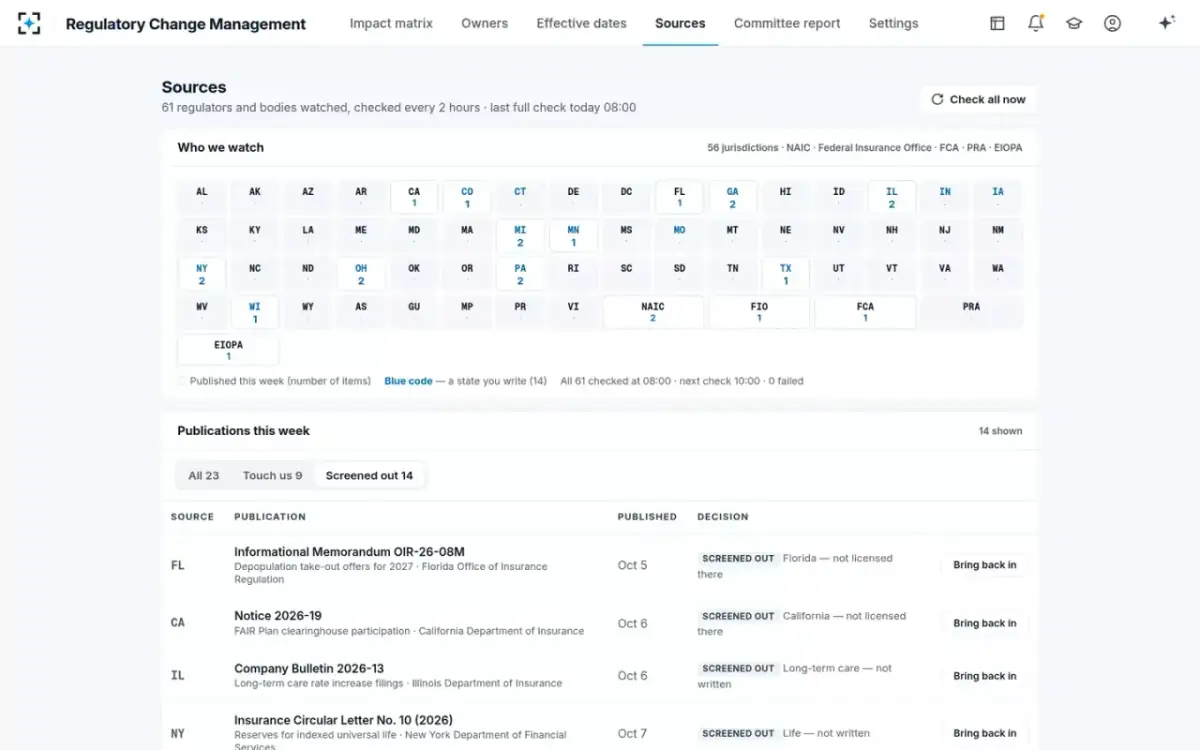
In the solution the instrument is read off each publication and drives what happens next: an emergency order is always kept, a data call is routed to its data owner, a bulletin is compared with the statute it interprets and with earlier versions, and a model is recorded against the policies it would touch. The analyst sees the instrument, its dates and the passage before deciding anything. To see it on your own last quarter, start from Regulatory Change Management for Insurers.
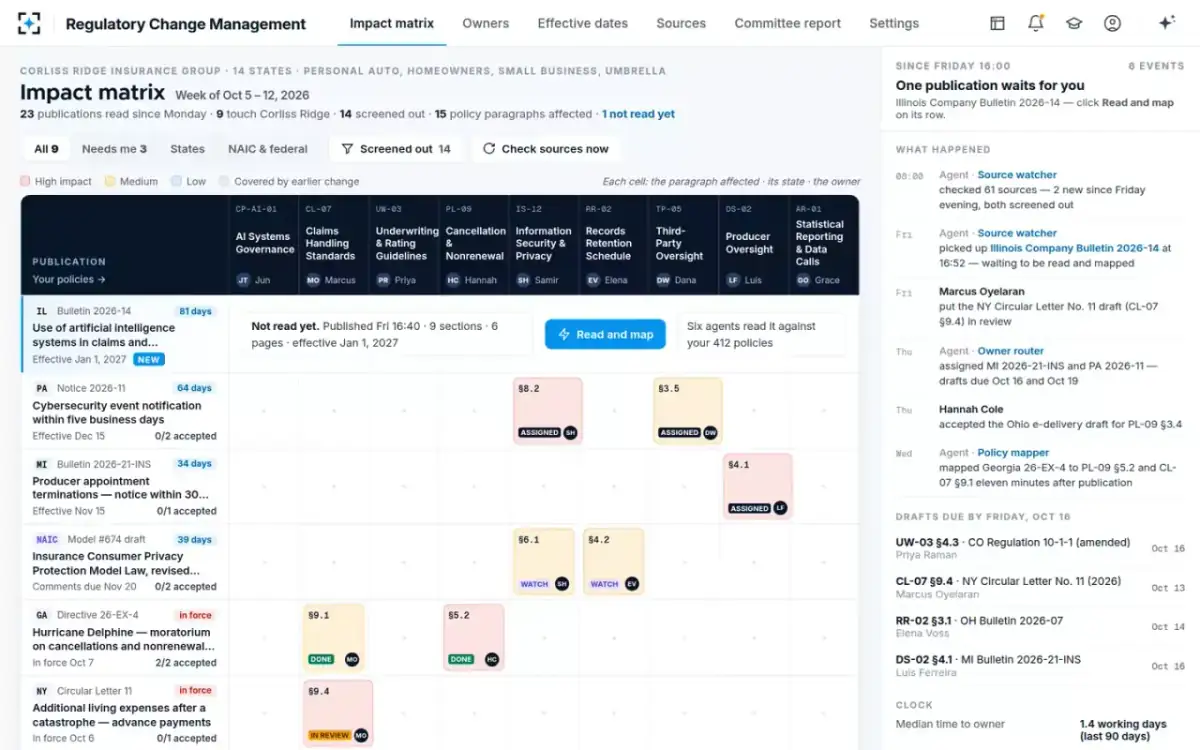
The week's changes on one matrix, whatever their instrument
Questions people ask
What are regulatory changes in insurance?
New or amended statutes, regulations, bulletins, circular letters, orders, data calls and NAIC models that change what an insurer must do or by when. They come mostly from the 56 state and territorial regulators, each on its own schedule, and from the NAIC's models that states adopt.
What are insurance bulletins?
Statements from a state insurance department explaining how it reads existing law or what it expects of insurers. Colorado describes its bulletins as its "interpretations of existing insurance law or general statements of Division policy"; they usually take effect on issue and can be replaced by the next bulletin.
What is an emergency order for an insurance company?
An order from the insurance regulator after a declared emergency that changes insurers' obligations in the affected area for a stated period, typically extending grace periods and barring cancellations and nonrenewals. Florida's Hurricane Milton order of 16 October 2024 covered 35 counties until 10 December 2024.
Are insurance regulatory updates the same as regulatory changes?
An update is any new publication; a change is one that alters an obligation. Many updates, such as consumer guides or market reports, change nothing, and a triage that sorts by instrument separates the two quickly.
Where are Pennsylvania insurance department notices published?
In the Pennsylvania Bulletin, the Commonwealth's official gazette, with a volume and page citation. Pennsylvania's adoption of the NAIC AI model bulletin, Notice 2024-04, appears at 54 Pa.B. 1910, published 6 April 2024.