An insurance compliance tracker in Excel is a spreadsheet with one row per regulatory change: the bulletin, statute or rule, the state and line, the effective date, the owner and a status. It is the most common way carriers keep regulatory change under control, and its weak point is the status column. "Closed" usually records that an owner replied or a task was ticked; it does not record that the claim letter, the form, the procedure or the system timer actually changed, or which version applied on which date. Examiners never read the tracker for that. They pull files and test them against the law in force when each file was handled. Botminds' Regulatory Change Management for Insurers keeps the row and the change together: each obligation is mapped to the policy paragraph it changes, and a row closes only when the owner accepts a new version of that paragraph.
The examples from the solution use sample data on a fictional carrier. The exam figures come from a Florida Office of Insurance Regulation report, linked where they appear.
One Florida exam, two versions of the same claims clock
14 → 7days
Florida’s clock to acknowledge a claim communication, from 1 March 2023
12.2%
of 295 sampled Hurricane Ian claims had a late acknowledgment, measured against the 2022 text
3 of 8
findings in the exam applied clocks the 2023 text had already shortened
$46,320
restitution the insurer paid after auditing the sampled claims under another finding
What is a compliance tracker?
A compliance tracker is a list of obligations with an owner and a status against each, kept so that nothing reaches its effective date unowned. In insurance it usually starts as a spreadsheet fed by alert emails and the department websites of the states the carrier writes in, and grows a tab per year. It does one job well: it shows what is open.
It does another job badly, and that job is the one the examiner cares about: showing what changed. A row can say "FL SB 2-A, claims acknowledgment, owner Claims, closed" and be entirely truthful, while the acknowledgment timer in the claims system still counts to fourteen. The tracker records a conversation about the change. The file records the change.
The distinction matters most for amendments. A new rule gets a new row and attention. An amendment to a rule the company already implemented reuses an old row, often marked closed two years earlier, and that is how amendments to rules already done slip through.
The columns most insurance compliance trackers in Excel carry, and the ones they need
A typical tracker carries source, state, line, summary, effective date, owner and status. Each is useful; together they cannot answer the examiner's question, which is which text applied to this file on this date, and when the company's procedure changed to match. The template below keeps the familiar columns and adds the ones that answer it.
An insurance compliance tracker template that proves the change, column by column
| Column | What goes in it | What it lets you prove |
|---|---|---|
| Source and number | Issuer, instrument and number: "Laws of Fla. ch. 2022-271 (SB 2-A), s. 15" | Which document created the obligation |
| Instrument type | Statute, adopted regulation, bulletin, circular letter, order, data call, model | Whether it binds, and from when |
| State, line, product | Where it applies; and the reason, if screened out | That out-of-scope items were judged, not missed |
| Dates | Enacted; effective; applies to policies or claims from; rules still to come | Which version applies to a given file |
| Obligation, with the passage | Who must do what by when, beside the regulator’s words | That the summary matches the text |
| Earlier change that covers it | The change number already implemented, or "new" | That a repeat was not assessed twice, or skipped wrongly |
| Policy paragraph, form or system | Document and paragraph number, form number, system setting | Where the change lives |
| Owner and due date | A named person, not a department | Who answers for it |
| Accepted version and date | New version number and the date it took effect | That the paragraph changed before the effective date |
| Evidence | Link to the redline, the approval and the old version | What the file was tested against on any date |
The "dates" column needs more than one cell. Texas's summary of its 2025 legislative session gives one bill an effective date of 1 September 2025, applies it to "policies issued or renewed after January 1, 2026", and adds "TDI will adopt rules" (TDI B-0012-25). One row with one date column forces someone to pick one of the three, and whichever they pick, one owner plans for the wrong day.
What the examiner reads instead of the tracker
The examiner reads files, and tests each one against the statute and the company's own procedures in force when it was handled. Florida's market conduct reports state the method plainly: an examination checks the insurer's practices against the Insurance Code, the insurance rules, the company's own procedures, its policy contracts and the Office's orders (Florida OIR; a full report is read in a market conduct examination report example).
In the 2025 targeted exam of Tower Hill Prime's Hurricane Ian claims, the examiners drew random samples from three populations: 107 of 3,397 claims closed with payment, 83 of 709 closed without payment, and 105 of 1,614 reopened or supplemental claims. Each of the 295 sampled files was tested against named subsections of the statute, and each finding is stated as an error rate: 36 late acknowledgments in 295 is 12.2%. None of that relies on the company's tracker. It relies on dated letters, dated notes in the claim file, and the text of the law that applied.
The sample the examiners drew: 295 files from three claim populations
Tower Hill Prime, Hurricane Ian claims sampled
- Closed with payment · 107 · 36.3%
- Closed without payment · 83 · 28.1%
- Reopened or supplemental · 105 · 35.6%
Florida's 14-day clock that became 7: one change, two versions in one exam
Florida's 2022 special-session property insurance law, SB 2-A, was approved by the Governor on 16 December 2022 and took effect that day except where a section says otherwise. Its section 15 opens: "Effective March 1, 2023", and rewrites the claims clocks in section 627.70131 (ch. 2022-271). The duty to "review and acknowledge receipt" of a claim communication went from 14 calendar days to 7; the investigation start after proof of loss went from 14 days to 7; the period to pay or deny a claim went from 90 days to 60. The statute today reads "within 7 calendar days" (Fla. Stat. § 627.70131).
The Tower Hill exam covered claims from 28 September 2022 to 31 December 2023, so its scope straddled the change. The examiners tested acknowledgments against the 14-day clock in the 2022 text, and recorded the change in a footnote: the 2023 statute had cut its 14-day clocks to 7 days, its 45-day clocks to 30 and its 90-day clocks to 60 (the footnote and its findings are read in the Florida OIR market conduct exam). Findings 3, 7 and 8, on acknowledgment, payment within 90 days and interest after 90 days, all applied clocks that the 2023 text had already shortened.
Now imagine the tracker row for SB 2-A. It probably closed in early 2023 with "claims procedures updated". What an examiner needs is different: the procedure version that took effect on 1 March 2023, the date the claims system's acknowledgment timer changed from 14 to 7, and for each sampled file, which clock applied to it. A one-line status cannot hold that, and a carrier that cannot produce it cannot show that a file handled on 2 March was measured against the right day.
What an insurance compliance tracker in Excel says, and what the file has to show
The tracker row: Closed, 14 Feb 2023: "claims procedures updated".
The evidence an examiner tests: Procedure version effective 1 March 2023, with the old and new text and who approved it.
The tracker row: Claims.
The evidence an examiner tests: The named owner of the acknowledgment paragraph and of the system setting.
The tracker row: 16 December 2022 (the day the act was approved).
The evidence an examiner tests: 1 March 2023 for section 15; the act’s other sections took effect on approval.
The tracker row: Florida, property.
The evidence an examiner tests: Which open claims switched clocks on 1 March 2023, and how the system treated them.
The tracker row: Link to the bulletin summary.
The evidence an examiner tests: Dated acknowledgment in each sampled file, measured against the clock that applied that day.
Closed versus changed: five checks before a row is closed
A row should close on evidence, not on a reply. Five checks, each answerable from documents rather than from memory, separate the two. They work in a spreadsheet as well as in software; software only makes them cheaper.
Before an insurance compliance tracker row says closed
- Is the new text in an accepted, numbered version?
Name the document, paragraph and version, and the date it took effect. A draft or an email is not a change.
- Did it take effect before the obligation did?
Compare the version date with the right effective date, which may be the application date for policies or claims, not the enactment date.
- Are the forms, letters and system settings changed too?
A procedure that says 7 days does not shorten a system timer set to 14.
- Is the old version kept, with its dates?
Files handled before the change are tested against it; the examiner may ask for both.
- Is the passage linked beside the change?
So a reviewer can see the regulator’s words and the company’s words side by side.
A drafted change against the exact paragraph, with the regulator's words beside it
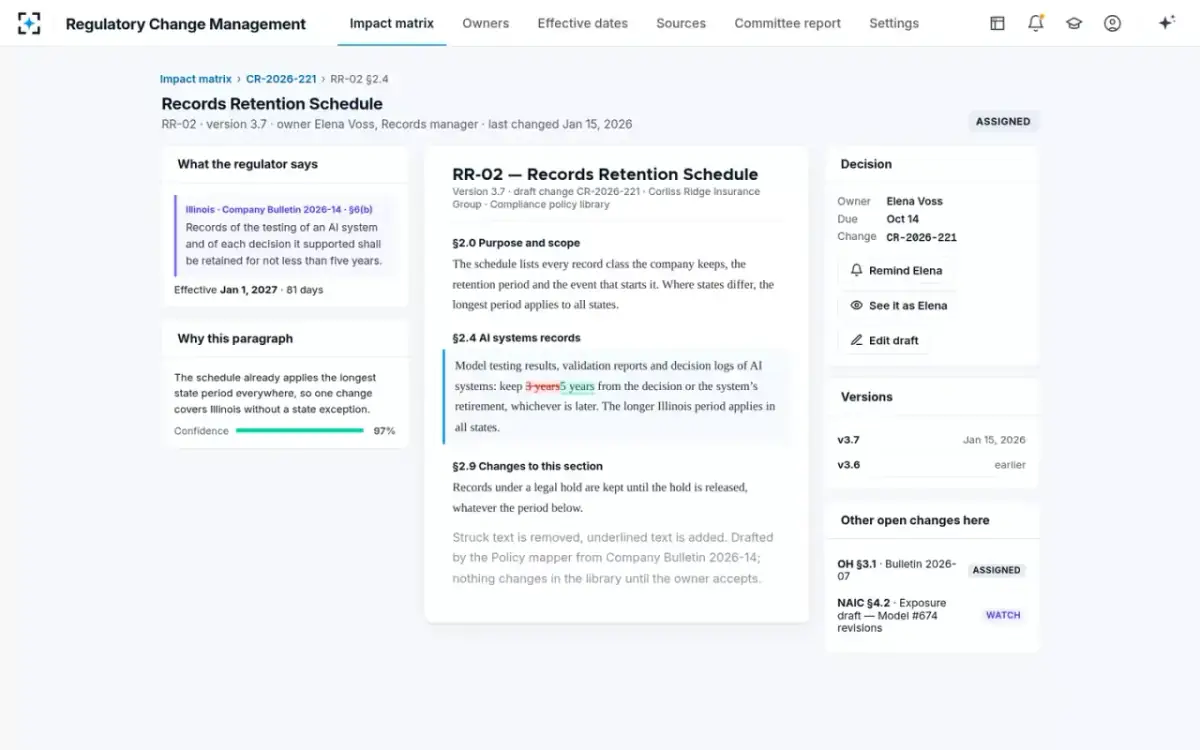
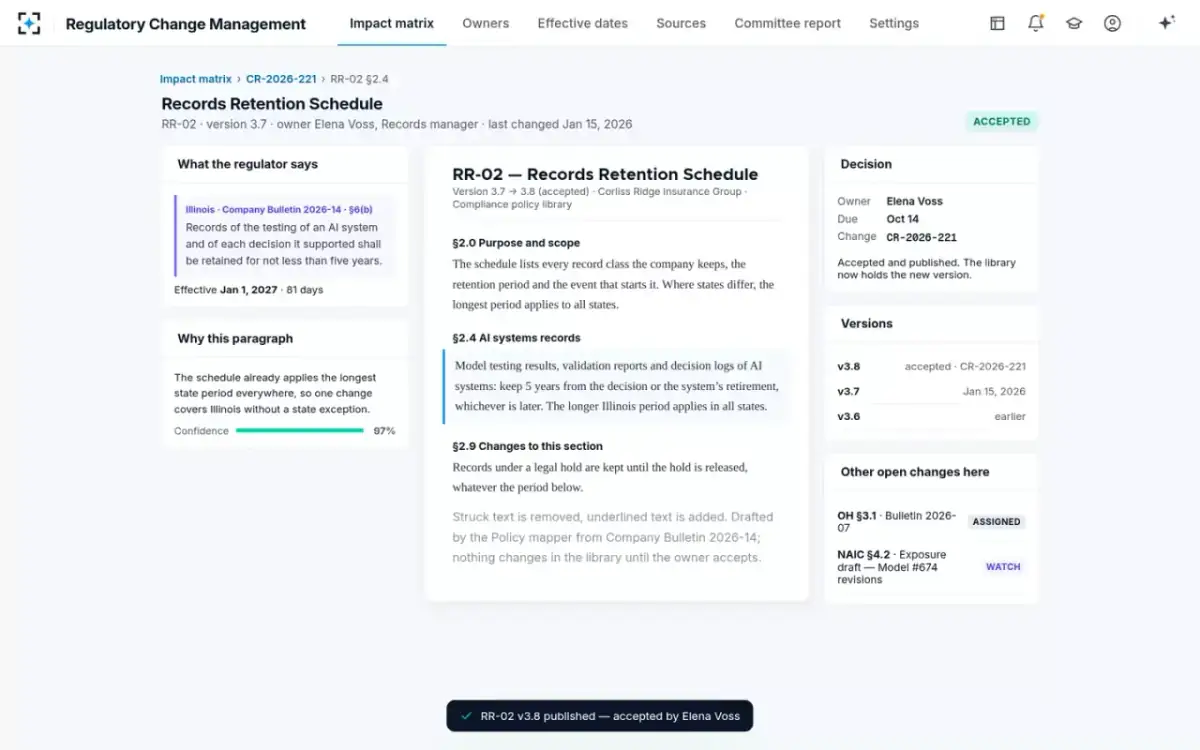
In the solution the row and the paragraph are the same object. The impact matrix shows each publication as a row and each policy as a column; a lit cell is a paragraph that must change, and it carries the regulator's passage, the drafted redline and the owner. The cell turns to done only when the owner accepts, at which point the library publishes a new version recorded against the change number. Version history is kept, so the question "which text applied on 2 March" has an answer. A guide written for banks, policy version control, covers the library half of this in more depth.
Accepted: the new version is published and the old one kept
Insurance compliance checklist: the dated items a tracker must also hold
Not every line in a compliance tracker is a change. Many are recurring, dated obligations that an officer certifies or files every year, and a tracker that holds only changes misses them. A carrier's compliance calendar should carry them beside the changes, because an amendment often moves one.
Recurring, dated items an insurance compliance checklist should hold: four examples
| Item | Who | Date | Source |
|---|---|---|---|
| Claims-handling manual attestation (residential property) | Each authorized residential property insurer in Florida | On or before 1 August 2023, then annually on or before 1 May | Fla. Stat. § 627.4108(3), as cited in Florida OIR’s 2025 exam report |
| Attestation of no use of external consumer data and models | Life, private passenger auto and health insurers in Colorado that do not use them | No later than 1 December each year | Colorado Division of Insurance, SB21-169 page |
| Artificial Intelligence Certification | Connecticut domestic insurers | On or before 1 September 2024, and annually thereafter | Connecticut Bulletin MC-25, 26 February 2024 |
| MCAS filing, 2026 data year | Insurers writing the MCAS lines | 30 April 2027; 31 May 2027 for health, other health and short-term limited duration | NAIC MCAS 2026 page |
Each of these sits on a calendar and each has an officer's name behind it. They are also where amendments bite quietly: Colorado's regulation was amended in 2025 to reach auto and health insurers, so the set of companies owing the 1 December attestation changed. A tracker that holds the attestation as "annual, closed" for last year will not say that this year's population is different.
When an Excel tracker is enough, and when it breaks
A spreadsheet is enough while three things stay small: the footprint, the number of owners, and the number of states adopting the same model text. A carrier in two or three states with one compliance officer who also owns most procedures can keep version and evidence columns by hand and close rows honestly.
It breaks on repetition and on hand-offs. The NAIC AI model bulletin had been adopted in 29 jurisdictions by 8 October 2026, which means 29 documents a multi-state carrier must compare with the version it already implemented; a spreadsheet records that someone compared them, not what they found. And a change touching four policies owned by four people becomes four rows, four email threads and four chances for "closed" to mean four different things.
That is where software earns its place: not in listing changes, which a spreadsheet does, but in holding the passage, the paragraph, the earlier change, the owner and the accepted version together, so that "closed" means one thing. To see the impact matrix on the fictional carrier's quarter, start from Regulatory Change Management for Insurers; insurance regulatory tracking software sets out what to connect if you keep your current alert feeds.
Questions people ask
Is there an insurance compliance tracker Excel template I can start from?
Yes: the ten columns in the table above work in any spreadsheet. The three most trackers lack are the earlier change that covers the obligation, the accepted version and its date, and a link to the evidence; without them a closed row cannot show what changed or when.
What is the difference between compliance tracking and regulatory change management?
Tracking lists obligations and their status. Regulatory change management carries each one through reading, scoping, mapping to the policy it changes, an owner and an accepted new version before the effective date. A tracker can support it, but the status column only records the last step someone reported.
How should a tracker handle a law with several effective dates?
Give each date its own field: enacted, effective, applies to policies or claims from, and rules still to come. Florida's SB 2-A took effect on approval on 16 December 2022 except where a section said otherwise; section 15, the claims clocks, took effect on 1 March 2023.
What should an insurance regulatory compliance checklist include?
The changes in flight and the recurring dated items: annual certifications and attestations, statistical and market conduct filings such as MCAS, and claims-manual attestations where a state requires them. Each needs an owner and the officer who signs.
How long should a compliance tracker keep closed rows?
At least as long as the files they govern can be examined, and with the old procedure versions attached. Florida's 2025 Tower Hill report examined claims from 2022 and 2023 in an exam that ended in April 2025.