Policy version control is the record of every version of a policy, procedure or job aid: what it said, who approved it, who checked it, why it changed, and the dates it was in force. In a bank or credit union it has to answer two questions an examiner asks: what did this procedure say on a given day, and did every document that quoted a changed rule change with it on the day the rule took effect? A file history answers the first only roughly, because the date a file was saved is not the date its text applied, and it cannot answer the second. Botminds' Policy & Procedure Management is an agentic solution that links each version to the rule behind it, finds every document a rule change touches, and publishes the checked versions on the effective date. This guide follows one change through it.
The change is real: the Regulation CC funds availability amounts that rose on July 1, 2025. The institution is not: the case runs on a fictional sample credit union with 1,240 procedures and job aids, 96 owners and 38 branches.
One small rule change, and the version work it set off
407days
between publication in the Federal Register and the effective date
5
dollar amounts changed in the rule; nothing else in it moved
17
documents in the sample library still quoting the old amounts
1
owner's typo caught before Compliance signed
What is policy version control in a bank?
It is document version control with three things a file system does not keep: the dates each version was in force, the signatures that let it take effect, and the rule or decision that caused it. A version of a hold procedure is not "the file saved on May 20"; it is "version 8, approved by the owner on May 20, checked by Compliance the same day, in force from 12:00 AM on July 1, 2025, because 89 FR 43737 raised the amounts". The approval date, the publish date and the effective date are three different dates, and only the last one tells you what staff were supposed to do.
The regulation models the discipline itself. Section 229.11 of Regulation CC keeps its own history in the text, period by period: the large deposit amount was $5,000 before July 1, 2020; "From July 1, 2020, through June 30, 2025, the amount is $5,525"; and "Effective July 1, 2025, the amount is $6,725" (12 CFR 229.11(c)). A procedure library that can say the same thing about each of its own sentences has version control in the sense an examiner means.
What changed in Regulation CC on July 1, 2025?
Five dollar amounts in the funds availability rules rose with inflation, and nothing else changed. The adjustment is automatic: the rule says the amounts "shall be adjusted effective on July 1, 2020, on July 1, 2025, and on July 1 of every fifth year after 2025" using the CPI-W, rounded to the nearest $25 (12 CFR 229.11(a)). The 2025 figures followed "the 21.8 percent increase in the CPI-W between July 2018 and July 2023" (89 FR 43737).
The Regulation CC amounts that every hold procedure, quick card and script had to change on July 1, 2025
| Amount | Section | Through June 30, 2025 | From July 1, 2025 |
|---|---|---|---|
| Minimum amount available on the next business day | 229.10(c)(1)(vii) | $225 | $275 |
| Cash withdrawal amount, by 5:00 p.m. on the availability day | 229.12(d) | $450 | $550 |
| New account amount | 229.13(a) | $5,525 | $6,725 |
| Large deposit threshold | 229.13(b) | $5,525 | $6,725 |
| Repeatedly overdrawn threshold | 229.13(d) | $5,525 | $6,725 |
The rule gave institutions more than a year: it was published on May 20, 2024 and took effect on July 1, 2025. That is the trap. A year of notice means the change is easy to log and easy to forget, and the documents keep being copied in the meantime. In the sample library, one of the job aids that had to be reviewed was added in March 2025, ten months after the rule was published, and it depended on a procedure that still quoted the old amount.
The trace: from the Federal Register to an approved redline in one day
Version control starts before anyone edits a word: with a list of every document whose text the rule makes wrong. In the sample, the rule was logged the day it was published, and six weeks before the effective date, the lead time set in the credit union's settings, the Impact agent re-ran the search against the documents as they stood that morning. Everything after that happened on one working day, Tuesday, May 20, 2025.
One rule change, one working day: from the re-run to scheduled versions
- Find and draft7:02–9:42
- Owners review9:42–12:13
- Wait for checkto 2:50
- Check, fix, schedule2:50–3:40
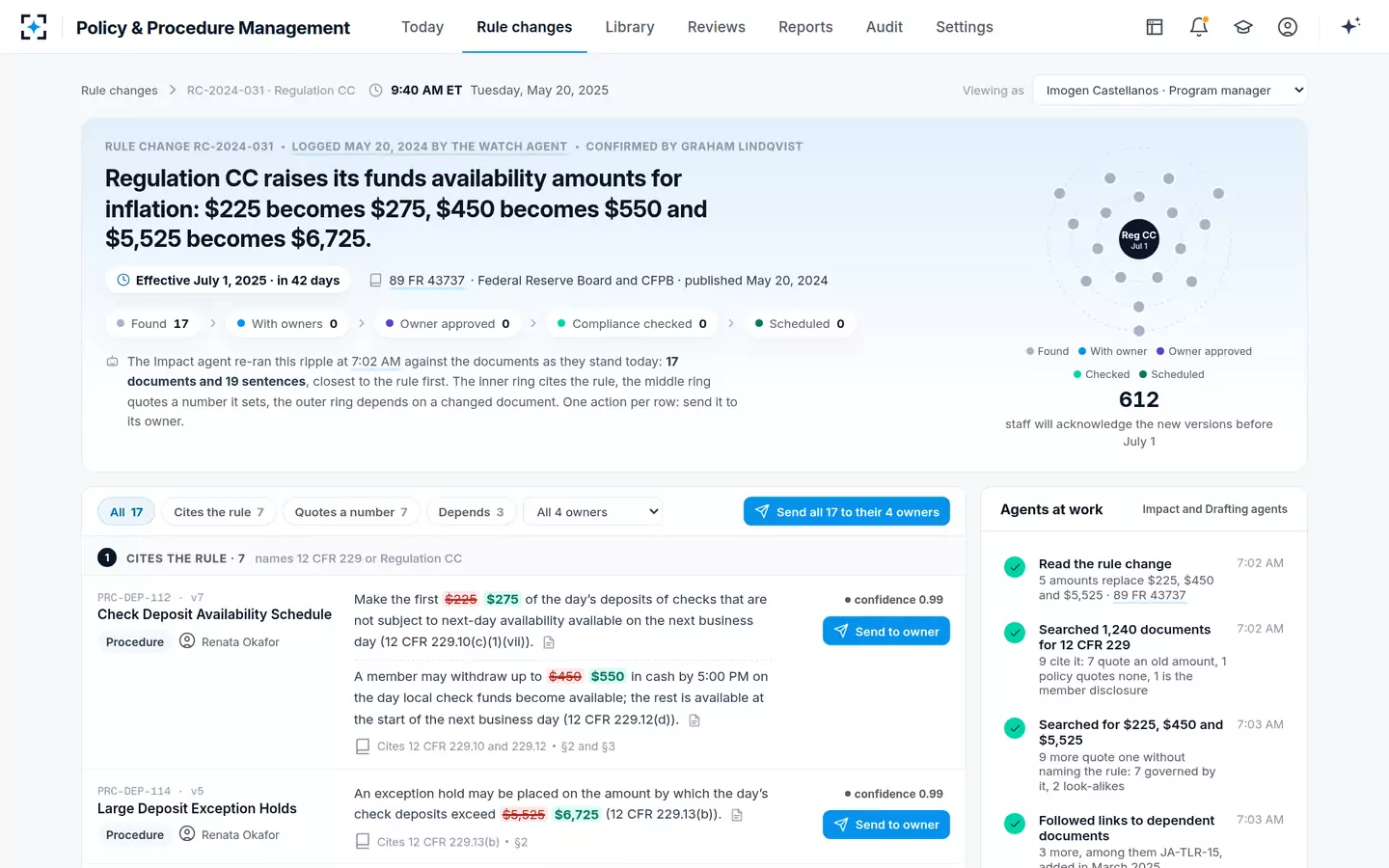
At 7:02 AM the Impact agent searched the 1,240 documents for the citation, then for the old amounts, then followed links to documents that depend on a changed one. At 9:42 the program manager sent all 17 to their 4 owners in one step. The deposit operations manager approved her first redline at 10:05, and approvals came in through the morning; the contact center manager's, at 12:13 PM, carried an error. At 2:50 the Rule check agent compared every number in every owner-approved version with the rule: 16 matched and one did not. By 3:31 the corrected version was approved, and at 3:40 the 17 new versions were scheduled.
How do you find every document that quotes a dollar threshold?
Search three ways and keep the reason for every exclusion. First by the rule's citation and name, which finds the documents written from the rule. Then by each old amount in every form a writer might use: $5,525, $5525, 5,525.00 and the spelled-out amount on a form. Then by the links between documents, because a quick card that says "see the large deposit procedure" changes when that procedure does, even though it quotes nothing.
The second search is the noisy one. An amount like $450 appears in places the rule never reaches: a daily ATM cash limit the institution sets for itself, a fee schedule, a worked example in a loan payoff procedure. Each match has to be read in its sentence and either taken into the change or set aside with a reason someone can check later. In the sample, three candidates were set aside that way, and the program manager could add any of them back with a reason code.
How the 17 documents were found: a citation search alone finds fewer than half
The middle bar is the reason version control in a library cannot start from the rule's name. Seven documents quoted $225, $450 or $5,525 without naming Regulation CC, among them the teller hold quick card and a teller script; a search for "229" would have missed every one. Why the numbers end up in job aids that never name the rule is a question of how a library is layered.
The ripple: every document the rule touches, closest first
Who signs off a procedure change?
Three people, each once: the procedure's owner approves the content, Compliance checks it against the rule, and the program manager publishes it. Nobody does two of these for the same version. A version record should carry all three, with the time of each, because "approved" without "checked" is the gap examiners look for.
In the trace, the check was where the one error surfaced. The contact center manager's hold-question procedure, edited by hand, said $6,275 for the large deposit threshold; the rule says $6,725. The Rule check agent set it aside with the rule passage, Compliance approved the 16 matching documents in one action and returned the 17th with the reason code "Number does not match the rule". The returned draft, the reason and the corrected version are all part of that document's history. How to test whether software catches an error like that is a test any bank can run on its own documents.
When should a procedure change be published?
On the effective date, at the start of it, and not before. Until June 30, 2025 the old amounts were the law: a teller who held the $475 over $5,525 in a $6,000 check deposit in June was within the rule, and a procedure published early would have told her not to. Early is a mistake too: until July 1 the rule and the credit union's own disclosed policy both used the old amounts, and staff working from a new version would apply a policy nobody had yet adopted.
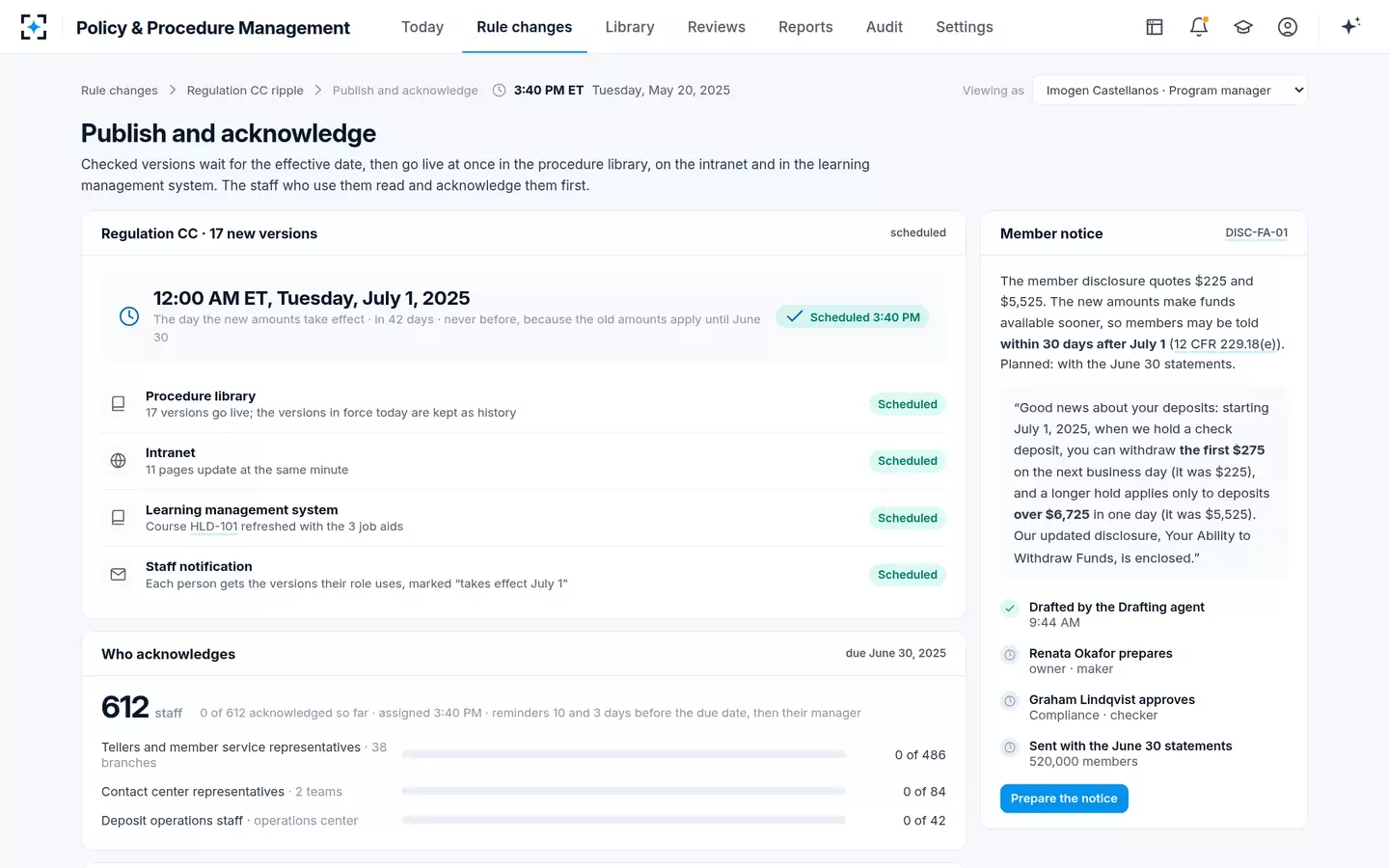
In the sample the 17 versions were scheduled for 12:00 AM Eastern on Tuesday, July 1, 2025, in the procedure library, on 11 intranet pages and in the learning management system course that carries the three job aids, all at the same minute. Staff could read them before then, marked "takes effect July 1". The versions in force kept their place until midnight, so a question asked at the teller line in June got the June answer.
Customer notices run on their own clock. Regulation CC requires notice to consumer account holders "at least 30 days before implementing a change to the bank's availability policy", but "a change that expedites the availability of funds may be disclosed not later than 30 days after implementation" (12 CFR 229.18(e)). Higher amounts make funds available sooner, so the sample credit union could tell members with the June 30 statements.
Scheduled for midnight on the effective date, everywhere at once
How do you prove which procedure was in force on a date?
Pick the date and read the version whose in-force window contains it, with its approval and its check beside it. If the library cannot do that, the answer is rebuilt from email, which is slow and, when the edits were made on one day and posted on another, often wrong.
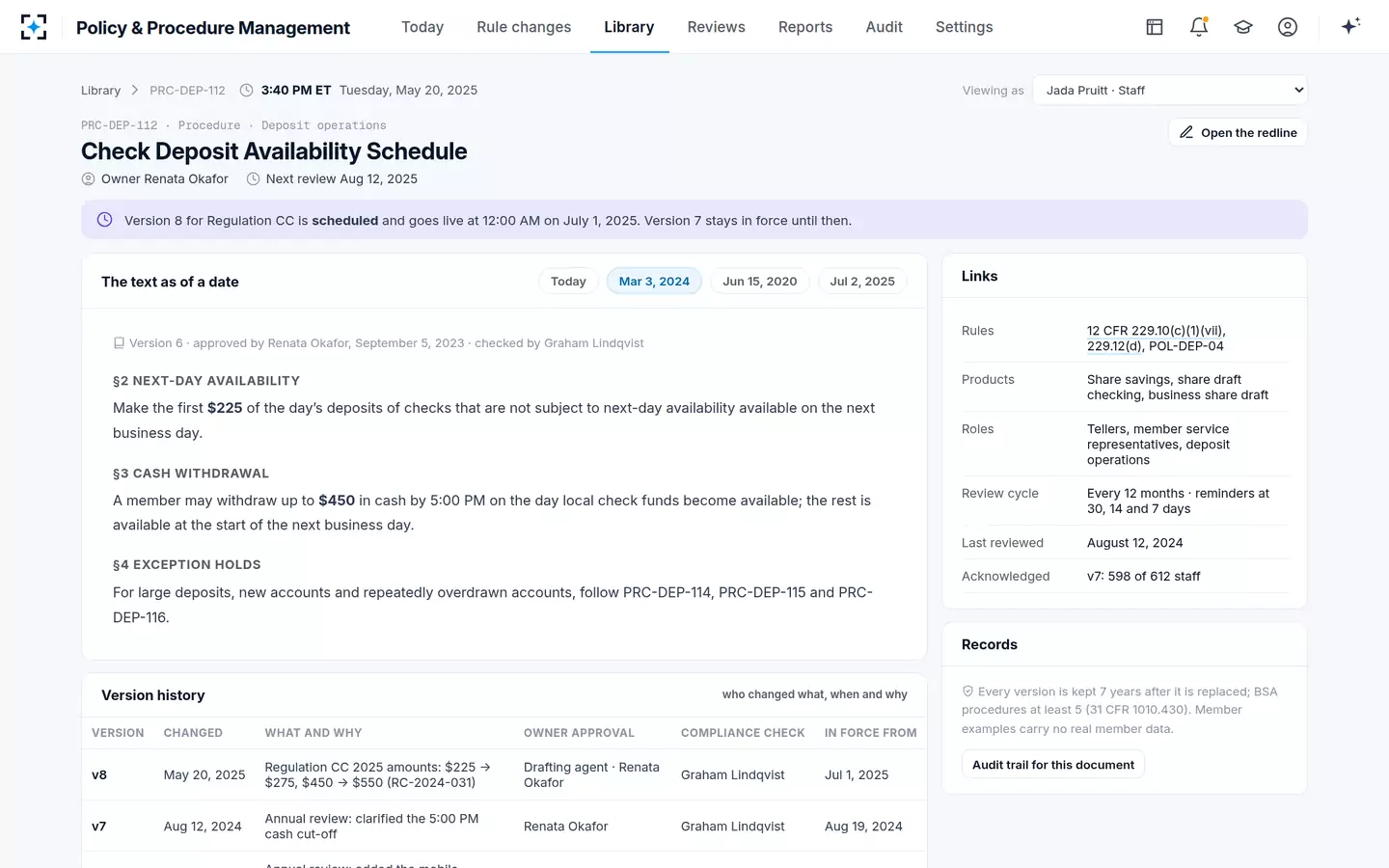
Three versions of one procedure, each with its window, approval and check
| Version | What changed and why | Owner approval | Compliance check | In force |
|---|---|---|---|---|
| v6 | Annual review; quotes $225 next-day and $450 cash amounts | September 5, 2023 | Checked | until August 18, 2024 |
| v7 | Annual review: clarified the 5:00 PM cash cut-off | August 12, 2024 | Checked | August 19, 2024 to June 30, 2025 |
| v8 | Regulation CC 2025 amounts: $225 to $275 and $450 to $550 (89 FR 43737) | May 20, 2025, as drafted | May 20, 2025 | from July 1, 2025 |
An auditor in the sample who picks March 3, 2024 sees version 6, approved by the deposit operations manager on September 5, 2023 and checked by Compliance, quoting $225 and $450. Version 7 was approved on August 12, 2024 and took effect a week later, on August 19, which is exactly the gap a file history hides. Version 8 is approved and scheduled; until July 1 the screen says so, and version 7 stays in force until July 1, 2025.
Any procedure as it read on any date
How long should old versions of procedures be kept?
No federal rule sets one retention period for procedures, so the answer comes from the records the procedures support and the look-back an examiner may take. Regulation CC requires a bank to "retain evidence of compliance with the requirements imposed by this subpart for not less than two years" (12 CFR 229.21(g)); the procedure in force when a hold was placed is part of that evidence. Records the Bank Secrecy Act rules require must be kept for five years (31 CFR 1010.430(d)).
Some rules point the other way. The NCUA's vital records rule, which is about recovering from a disaster, says that "unless required by other law or regulation, older versions of vital records may be destroyed once their current versions are stored" (12 CFR 749.2(c)). That is permission for a backup site, not a retention policy for the procedure library. The sample credit union keeps every version for seven years after it is replaced, and its BSA procedures at least five; those are its settings, chosen to outlast any likely exam look-back, not periods the law prescribes for procedures.
Two practical rules follow. Keep superseded versions readable with their dates and signatures, not as an archive of files, because a version without its in-force window cannot answer the examiner's question. And keep the reason with the version: "Regulation CC 2025 amounts" is the difference between an edit and a compliance action. What the staff acknowledgment of each version has to prove is the other half of the record. To trace a change of your own through the ripple, the redline and the schedule, start from Policy & Procedure Management.
Questions people ask
How do you track changes to policies and procedures?
Record each change as a new version with its reason, the owner's approval, the Compliance check and the date it takes effect, and keep the old version with its in-force window. In the sample, every version of a hold procedure shows who changed what, when and why, and the reason names the rule, such as 89 FR 43737 for the 2025 Regulation CC amounts.
What is the difference between version control and document control?
Document control governs how a document is created, approved, distributed and retired; version control is the part that keeps each version and its history. In a bank both need one thing generic tools lack: the effective date, which is often weeks after approval and is the date that decides what staff should have done.
Should version numbers change for small edits?
Any change to what staff are told to do should be a new version with its own approval, check and date, however small. Changing $225 to $275 is two characters and a new version. A typo fix that changes no instruction can be recorded without a new review cycle, as long as the history shows it.
How often does Regulation CC change its dollar amounts?
Every five years. Section 229.11 sets adjustments effective July 1, 2020, July 1, 2025 and July 1 of every fifth year after, based on the change in the CPI-W, so the next is due July 1, 2030. The amounts have been $275, $550 and $6,725 since July 1, 2025.
Can a procedure take effect before the rule does?
Only if it tells staff to do something the old rule also allowed. A procedure that raises the next-day amount from $225 to $275 early makes more funds available than the rule required, which a bank may choose to do, but a procedure that raises the large deposit hold threshold early stops holds the old rule permitted. The safe default is to publish on the effective date and let staff read the new version beforehand.