Policy and procedure management software keeps an institution's policies, procedures and job aids in one place, each with an owner, a review date, an approval trail and a record of every version and of who acknowledged it. For a bank or credit union, that description fits most products on the market and decides little, because the expensive failures happen elsewhere: a rule changes and a teller quick card that quotes the old amount is never found; an owner types the wrong number and it is approved; the new version goes live the day the edit is finished instead of the day the rule takes effect. The twelve questions below test for those failures, each with the rule or supervisory text that makes it matter. Botminds' Policy & Procedure Management, an agentic solution for this work, is described against the same questions, including where it does not fit.
Where the answers draw on the solution at work, it is running on a fictional sample credit union with 1,240 procedures and job aids and 96 owners.
Why the questions are about change, not storage
56
final rules from the six federal banking and BSA agencies in 2025, by our count
7of 17
documents one rule change touched that never named the rule
1of 17
owner edits with a wrong number, caught before sign-off
0
versions published without the owner's approval and a Compliance check: the design target
What is policy and procedure management software?
It is software that governs the life of an institution's written rules for itself: drafting, approval, publication, acknowledgment, review and retirement, with a record of each. Products sit in roughly four groups, by what they add to a document store. Some add an approval workflow; some add read-and-acknowledge tracking; some add a regulatory feed that lists new rules; and a few connect the feed to the documents, so a rule change produces a list of the sentences it makes wrong.
The fourth group is the one that matches how a bank's procedures fail. The FDIC expects procedures to give staff what they need to complete a transaction, regulation cites included, and to be updated as the regulatory environment changes (FDIC, II-3.1); the volume of change, about one final rule a week from the six federal agencies by our count, is what makes the link between rule and document the costly part. A tool that stores procedures perfectly but cannot say which ones a rule touches leaves the costly part where it was.
What features should policy management software have?
The ones that answer the twelve questions below. The first four test the rule-change path, the next four the record, and the last four the fit with how a bank is run and examined. Ask each one of every vendor, and ask to see it on your own documents.
Twelve questions for any policy and procedure management software
- 1. Does it find every document a rule change touches, including the ones that never cite the rule?
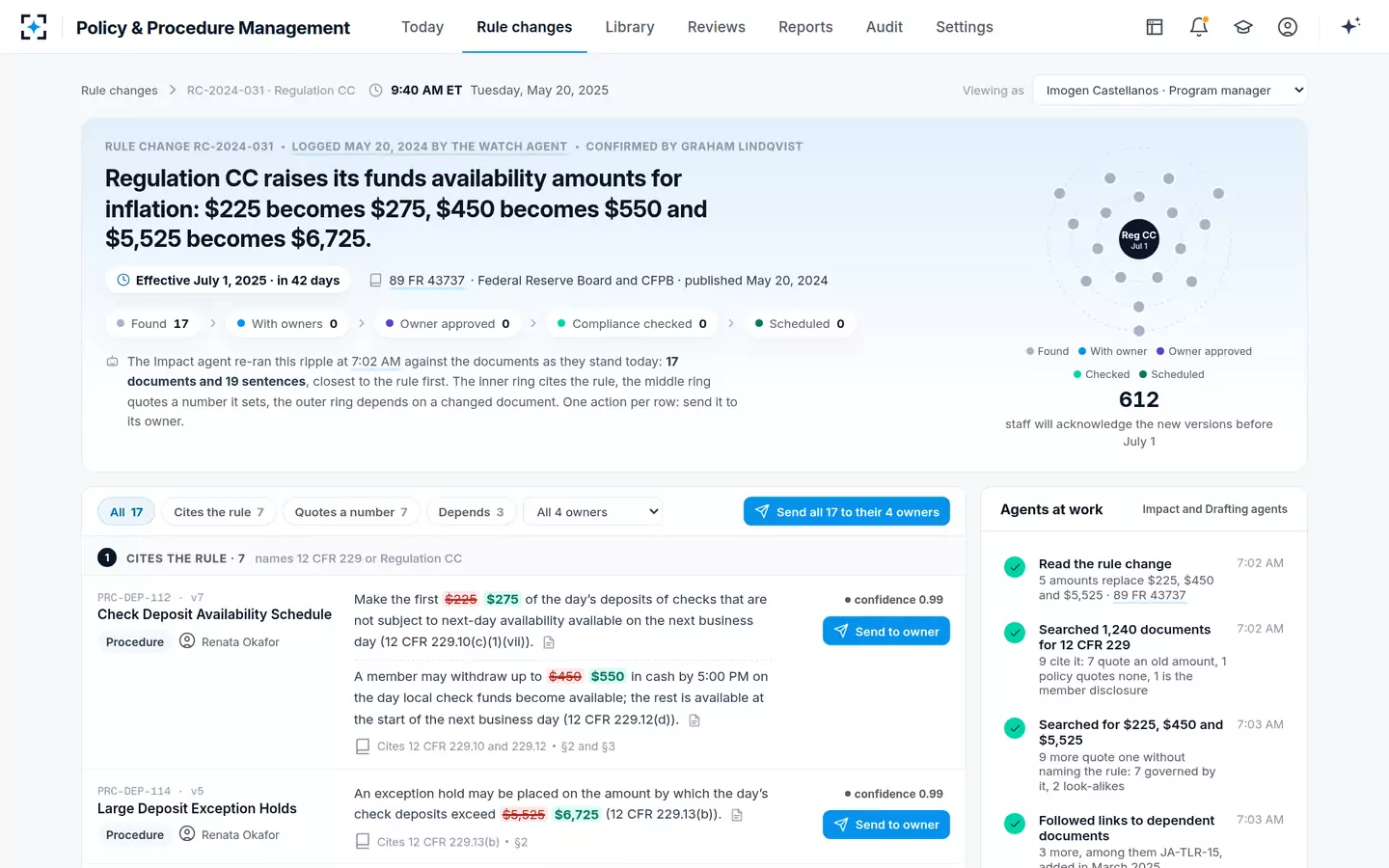
Teller cards and scripts quote amounts without naming the regulation. In the sample, 7 of 17 affected documents did.
- 2. Does it explain what it left out?
A $450 ATM limit the institution sets is not the Regulation CC cash withdrawal amount. Every exclusion needs a reason someone can check.
- 3. Does it draft the change in the document's own words, and change nothing else?
An edit that also rewrites a cut-off time is a second, unapproved change.
- 4. Does it check the owner's final version against the rule, number by number?
Errors are typed after drafting. A $6,275 for $6,725 (12 CFR 229.13(b)) reads as plausible.
- 5. Can the same person approve and check one version?
The answer should be no. Owner, checker and publisher are three people, each once.
- 6. Does it publish on the effective date, everywhere staff read?
Library, intranet and learning system at the same minute; never before the rule applies.
- 7. Does it record acknowledgment of each version, before it takes effect?
A name, a version and a time, with reminders; a reminder sent is never recorded as a read.
- 8. Can an examiner read any procedure as of any date?
Regulation CC alone requires evidence of compliance to be kept for two years (12 CFR 229.21(g)).
- 9. Does it keep every document owned when people leave?
The OCC expects policies to make accountability clear. An owner who has left cannot answer for anything.
- 10. Does it read the regulators you answer to?
NCUA letters for a credit union, OCC bulletins for a national bank, the CFPB and FinCEN for both, and your own board minutes.
- 11. Does it keep restricted procedures restricted?
SAR procedures must not leak into a staff answer: a SAR and anything revealing one are confidential (31 CFR 1020.320(e)).
- 12. Can you test it on your own documents before you buy?
A seeded test on copies of your procedures shows what a demonstration cannot.
Questions 1 and 4 are the ones most worth a demonstration on your own files. In the sample, a search for the citation found 7 of the 17 documents a Regulation CC change touched; the amounts found 7 more; links to dependent documents found the last 3. And after every owner had approved, a comparison of each number with the rule set aside one document where the owner had typed $6,275 for the $6,725 the rule sets (12 CFR 229.13(b)).
The answer to question 1: every document, closest to the rule first
Does policy management software track regulatory changes?
Some products include a feed of new rules; fewer connect that feed to the documents. A feed tells the compliance officer that the Federal Reserve Board and the CFPB adjusted the Regulation CC amounts. A connection tells each owner which of their sentences quote $225, $450 or $5,525 and what they should say from July 1, 2025. The second is the work the institution owes, and it is the part a feed leaves to a search of the shared drive.
Ask what the feed reads and who decides applicability. In the solution, the Watch agent reads the Federal Register, NCUA letters to credit unions, CFPB rules and the board's own minutes every morning, logs each change with its effective date and the numbers it sets, and proposes whether it applies. It never closes a change as not applicable; only Compliance can, with a reason. The volume is real but uneven: our count of final rules from the six agencies fell from 67 in 2024 to 56 in 2025, while the NCUA alone published 17 in 2026 by late October, more than in the two previous years together.
How is policy management software different from document control?
Document control manages documents: versions, check-in and check-out, approval routing, distribution and retirement. Policy management adds the people around a policy, owners, approvers and the staff who must acknowledge it. Rule-aware policy management adds the link to the law: which sentence implements which rule section, what a change makes wrong, and whether the owner's edit matches the rule.
Document control, policy management and rule-aware policy management
Document control, or a basic policy tool: The file
Rule-aware policy and procedure management: The sentence and the number, linked to a rule section
Document control, or a basic policy tool: A person searches and emails owners
Rule-aware policy and procedure management: Every document that cites, quotes or depends on the rule is listed with its owner and draft
Document control, or a basic policy tool: An approval route for the file
Rule-aware policy and procedure management: Owner approves the content; Compliance checks it against the rule; a different person publishes
Document control, or a basic policy tool: Publication on approval, or a manual date
Rule-aware policy and procedure management: Approved versions held and published at the start of the rule's effective date
Document control, or a basic policy tool: A distribution list or a read receipt
Rule-aware policy and procedure management: Acknowledgment of each version by the roles that use it, before it takes effect
Document control, or a basic policy tool: File history
Rule-aware policy and procedure management: The text in force on any date, with its approval, check, reason and the rule behind it
What do examiners want to see from policy management software?
Examiners do not test software; they test whether the institution's procedures are current, followed and evidenced, and the software either answers their questions quickly or makes someone rebuild the answer from email. The OCC's examination procedures for the board and management include a step to "determine how management verifies that adopted policies are followed and that exceptions are documented" (OCC, Corporate and Risk Governance). The software's part in that is the record: every version, approval, check, publication and acknowledgment, with who, when and why.
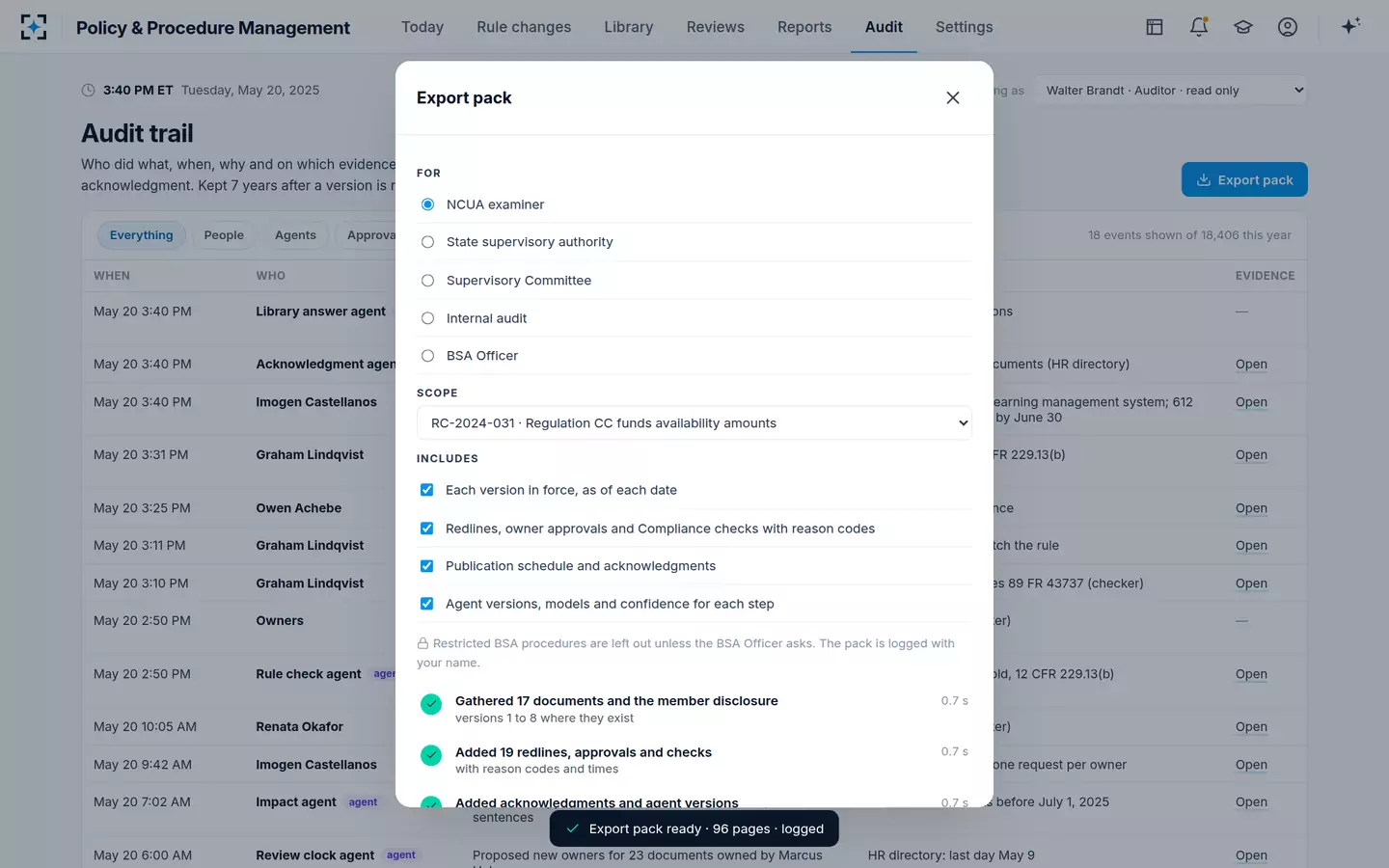
In the sample, an internal auditor builds an export pack for the credit union's examiner scoped to one rule change: each version in force as of each date, the redlines with owner approvals and Compliance checks and their reason codes, the publication schedule and acknowledgments, and the agent version behind each step. Restricted BSA procedures stay out unless the BSA officer asks, and the pack itself is logged with the name of the person who built it.
An export pack for the examiner, built from the trail and logged
How much does policy management software cost?
We know of no regulator or research body that publishes prices for this software, so the useful comparison is with the hours it replaces. Ask how a price scales: with the number of documents, with the staff who read and acknowledge them, or with the systems connected. The hours depend on how many rule changes touch documents each year and how long each takes by hand.
Pricing the decision: hours returned against what the tool costs
Program hours returned
Rule changes that touch documents × about 21 hours
Botminds estimate: about 24 hours by hand to log, decide, search, chase, check and rebuild history, about 3 with the solution. Not measured.
Policy program manager
Errors that never publish
Wrong numbers caught × the cost of one in force
Hard to price, easy to count in a seeded test: one in 17 owner edits in the sample.
Compliance
The subscription
Vendor quote for your documents, staff and connections
Ask for the price on your own library size, not a tier.
Procurement
Set-up
Owner, rule link and role for each document
Work the library needs whichever tool is chosen; the tool can propose some of it.
Program manager and owners
The fictional sample credit union logged 47 rule changes between January 1 and May 20, 2025, of which 19 touched at least one document. That is the number to establish for your own institution before any price is compared, because a tool that saves 21 hours on a change that happens twice a year is a different purchase from one that saves it forty times.
How long does it take to implement policy management software?
It depends less on the software than on the library. The steps are the same for any tool: give it read access to where the procedures live; connect the HR directory so every document has a current owner; link documents to the rules they implement; set review cycles, approvers and restricted documents; and run it on a rule change you have already handled, so the result can be compared with what you did by hand. That last run is the benchmark: if the tool's list misses a document you changed by hand, you have your answer before any contract is signed.
What to have ready before any tool goes live
| Item | Why | Who supplies it |
|---|---|---|
| Access to the library, intranet and learning system | The tool reads the documents in place and publishes new versions back | IT, as the owner of those systems |
| The HR directory | Owners, roles and departures; who must acknowledge what | HR |
| A past rule change and what you did | The benchmark: compare the tool's list and redlines with your own | Compliance |
| Review cycles and approvers | Which documents are reviewed how often, and who signs | Compliance, approved by the Compliance Officer |
| Restricted documents | BSA and other procedures only some staff may read | BSA officer |
| The vendor's third-party file | Due diligence, contract, information security, exit | Vendor management |
The last row is not a formality. The interagency guidance on third-party relationships suggests that reviewing a provider's "websites, marketing materials, and other information related to banking products or services may help determine if statements and assertions accurately represent the activities and capabilities of the third party" (88 FR 37920). For a tool whose claim is that it finds every affected document, the most direct check of that assertion is a test on your own documents: plant ten known errors and count what it catches.
Policy & Procedure Management against the twelve questions
It is built to answer questions 1 to 9 and 11, and question 12 by invitation. For question 10 the sources it reads are a setting, in the sample the Federal Register, NCUA letters, CFPB rules and board minutes, so check that your own regulators' publications are on the list. It finds every document a rule change touches by citation, by number and by dependency, explains each look-alike it leaves out, drafts redlines in the owner's words, compares every number in the owner's approved version with the rule, publishes on the effective date to the library, intranet and learning system at once, tracks acknowledgment of each version, keeps every document owned through departures, and lets an examiner read any document as of any date. Agents never approve, check, publish, reassign or close a change; people do, each once.
It is not a replacement for the library, and it does not move it; keeping the library where it is and adding the checks is the usual shape. It does not write new policy for a new product from nothing, and it does not decide whether a rule applies. For a very small library with one owner, a careful manual process may be enough, and it is worth testing that honestly. To see the twelve answers on your own procedures, start from Policy & Procedure Management.
Questions people ask
What is the best policy and procedure management software for banks?
The one that passes the twelve questions on your own documents, not on a demonstration set. For a bank or credit union, weight questions 1 and 4 most: finding the documents a rule change touches when they never cite the rule, and checking the owner's final numbers against the rule before sign-off. Those are where procedure errors reach customers.
Does policy management software need to connect to the core banking system?
Not for procedures. The useful connections are the procedure library, the intranet, the learning management system, the HR directory and the regulatory feeds. In the sample the library answer agent never reads member accounts; it answers staff only from published procedures, citing the passage.
Should policy management software include a regulatory change feed?
A feed is useful only if it reaches the documents. Ask whether a new rule produces a list of the sentences it makes wrong, with their owners, or only an alert to the compliance officer. In the solution, the feed proposes applicability, Compliance confirms it, and the confirmed change is what starts the search of the library.
Can policy management software handle job aids and scripts?
It should treat them as first-class documents with owners, because they are where regulated numbers hide. In the sample, the teller hold quick card and a teller script quoted Regulation CC amounts without naming the rule, and both were in the list of 17 that had to change on July 1, 2025.
Who should own the software inside the bank?
The policy program manager runs it day to day, Compliance owns its settings, and internal audit reads everything without changing anything. In the sample, an administrator proposes setting changes and the Compliance Officer approves them, so no one person can change how the rules are applied.