Policy owner responsibilities come down to four: keep one policy, procedure or job aid true to the rules and decisions it carries, approve every change to its content, answer for it when an examiner or auditor asks, and hand it to a named successor before leaving the role. In a bank or credit union the owner is usually a line manager, the head of deposit operations or of the contact center, not a compliance specialist, and the job sits on top of a full-time one. It is hard because the rules under those documents keep moving: by our count the six federal agencies that write banking rules published 56 final rules in 2025, about one a week. Botminds' Policy & Procedure Management is an agentic solution that keeps every procedure, job aid and script owned and reviewed, finds the ones a rule change touches, and drafts each redline for the owner to approve.
The examples come from the solution running on a fictional sample institution, Norrell Federal Credit Union, with 1,240 procedures and job aids, 96 owners and 2,300 staff. The rules and supervisory texts are linked where they are quoted.
One sample library: who owns what, and what one departure leaves behind
96
named owners for 1,240 procedures, job aids and scripts
61
deposit procedures held by one owner, the deposit operations manager
23
documents left without an owner when one manager left
17
documents one Regulation CC change reached, spread over 4 owners
What are a policy owner's responsibilities?
A policy owner is the named person who answers for what one document says. That breaks into four duties: keep the text consistent with the rules, the board's policy and the way the work is actually done; write or approve every change to it; explain it, with its history, to an examiner, an auditor or a colleague at the counter; and keep it owned, which means handing it on rather than letting it lapse. Everything else, from formatting to publishing, can sit with someone else.
Supervisors expect the name to exist. The OCC's handbook on corporate and risk governance says that to be effective, "policies should clearly delineate accountability and be communicated throughout the bank", and its examination procedure for the board and management tells the examiner to "verify that policies assign accountability and are communicated to appropriate personnel" (OCC, Corporate and Risk Governance). An unowned procedure fails that test on its face, whatever it says.
The federal government's own internal control standard puts the duty in one sentence. The 2025 Green Book, written for federal agencies, says management "documents in policies and procedures for each unit within the entity's organizational structure its responsibility for a business process's objectives and related risks and control activity design, implementation, and operating effectiveness" (GAO-25-107721, paragraph 12.03). Read for a bank, that is the owner: the unit that runs the process owns the text that governs it.
Who owns, approves, checks and publishes each kind of document
| Document | Owner (writes and answers for it) | Approves the content | Checks it against the rule | Publishes it |
|---|---|---|---|---|
| Board policy (for example the BSA program, the funds availability policy) | A senior officer, such as the BSA officer or the head of deposits | The board, where a rule names it; otherwise a board committee or senior management | Compliance | Policy program manager |
| Procedure (for example a check deposit availability schedule) | The manager who runs the process, such as deposit operations | The owner | Compliance | Policy program manager |
| Job aid or teller quick card | The manager whose staff use it, often branch operations | The owner | Compliance | Policy program manager |
| Call script | The contact center manager | The owner | Compliance | Policy program manager |
| Member or customer disclosure | Prepared by the owner of the matching procedure | Compliance | Compliance, against the rule's notice timing | Policy program manager |
Who should own a bank procedure?
The person who runs the process the procedure describes, and who could tell from the counter or the queue whether it is still true. For a check hold procedure that is the deposit operations manager; for a hold-question call script it is the contact center manager; for a teller quick card it is whoever manages the staff who use the card. Ownership follows the work, not the subject: a Regulation CC procedure owned by Compliance is a procedure written by someone who never places a hold.
The supervisory texts split the work the same way. The OCC says that while the board or a designated committee "is responsible for approving designated policies, management is responsible for developing and implementing the policies" (OCC). The FDIC's compliance examination manual lists among a compliance officer's responsibilities "developing compliance policies and procedures" and "reviewing policies and procedures for compliance with applicable laws and regulations and the institution's stated policies and procedures" (FDIC Consumer Compliance Examination Manual, II-3.1). In a library of a thousand documents, one compliance officer cannot write them all; what Compliance can do is check each one, which is why the owner and the checker should be different people.
Job aids need an owner of their own. A teller quick card is usually derived from a procedure but kept by the branch side, and in the sample library the quick card was one of seven documents that quoted a Regulation CC amount without naming the rule. The safe default is to give each job aid the owner of the process at the counter and to link it to its parent procedure, so a change to the parent reaches it; where a bank's numbers should live across policy, procedure and job aid takes that argument further.
Owner, approver, checker, publisher: four signatures, not one
A policy owner and a policy approver are different roles. The owner writes and answers for the content; an approver, where one is needed beyond the owner, decides that the institution adopts it, such as the board for its BSA program. Two more roles sit beside them: the checker, usually Compliance, who confirms the text matches the rule, and the publisher, who makes the approved version the one staff see. Keeping the four apart is the maker-checker principle applied to words.
Four roles around one procedure, before and with Policy & Procedure Management
Today
Gets an email that says "please update", finds the right Word file and works out which sentences the rule changes
With agents
Reads only the changed sentences, each beside the rule section behind it, and approves, edits in their own words or returns with a reason
Still theirs: The wording, and the decision that the text is right
Today
Reviews some of the edits by eye, with no record of what was checked against what
With agents
Sees every number in the owner's version compared with the rule and spends the time on the ones set aside
Still theirs: The check; never edits content
Today
Searches the shared drive for the rule's citation, emails owners and chases them for weeks
With agents
Sends every affected document to its owner in one step and schedules approved versions for the effective date
Still theirs: Publishing; approves no content
Today
Asks what a procedure said on a date and waits while the history is rebuilt from email
With agents
Picks a date and reads the text in force, with its approval and check
Still theirs: Reads everything, changes nothing
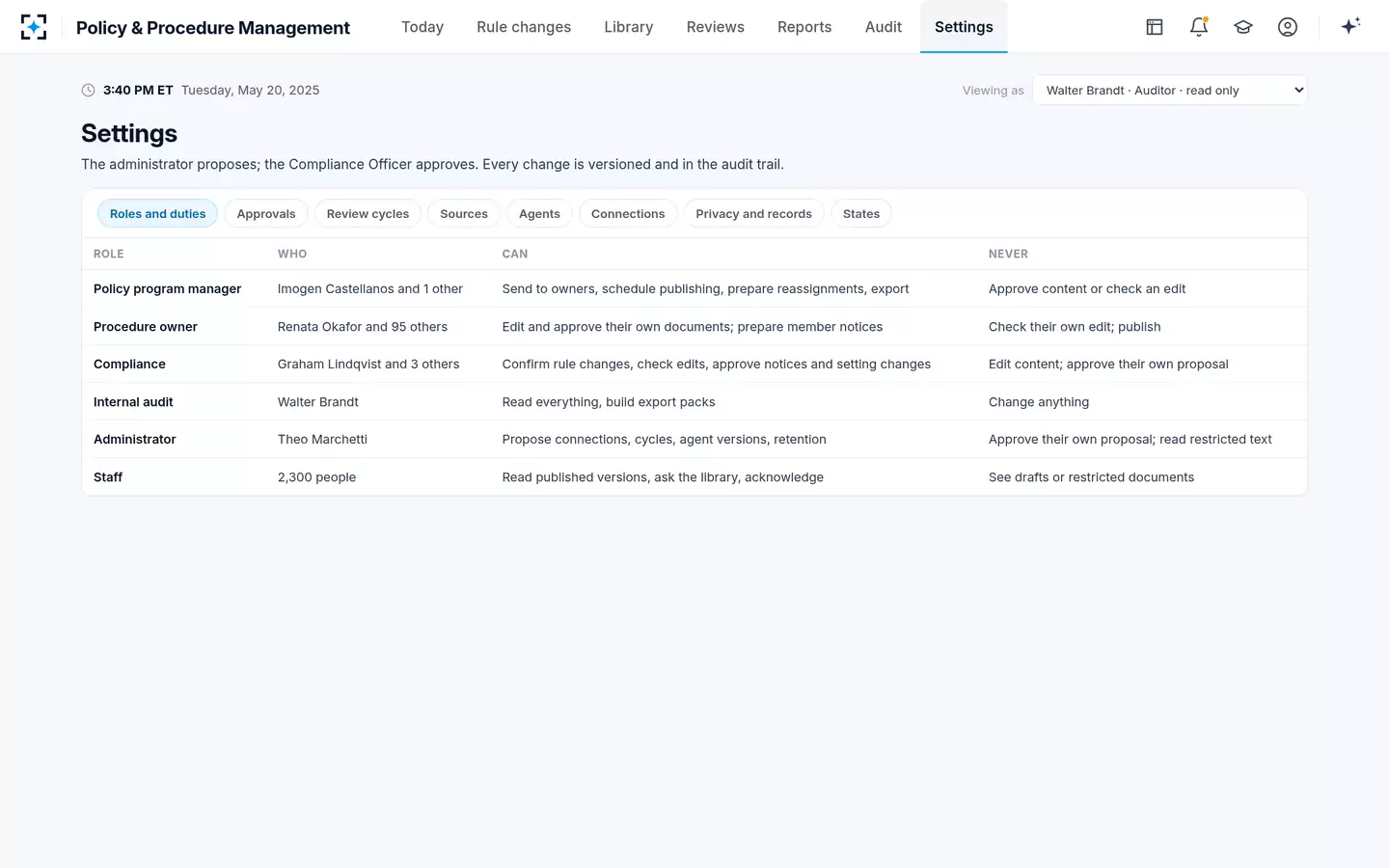
In the sample credit union these duties are settings, not habits. The procedure owner can edit and approve their own documents but cannot check their own edit or publish it; Compliance can confirm rule changes and check edits but cannot edit content or approve its own proposal; the program manager can send, schedule and export but cannot approve content; the internal auditor reads everything and changes nothing.
Separation of duties, written down as roles
What does an owner do when a rule changes?
The owner decides which sentences in their documents the rule changes, rewrites them in the document's own words, and approves the new version in time for it to take effect on the rule's date and not before. The decision that the rule applies at all belongs to Compliance; the owner's question is narrower and harder: where in my text does this rule live?
The Regulation CC inflation adjustment shows how narrow. The Federal Reserve Board and the CFPB raised five funds availability amounts effective July 1, 2025: the minimum next-day amount from $225 to $275, the cash withdrawal amount from $450 to $550, and the new account, large deposit and repeatedly overdrawn thresholds from $5,525 to $6,725 (89 FR 43737). Nothing else in the rule changed. A hold procedure needed two or three numbers changed in the right sentences, on the right day.
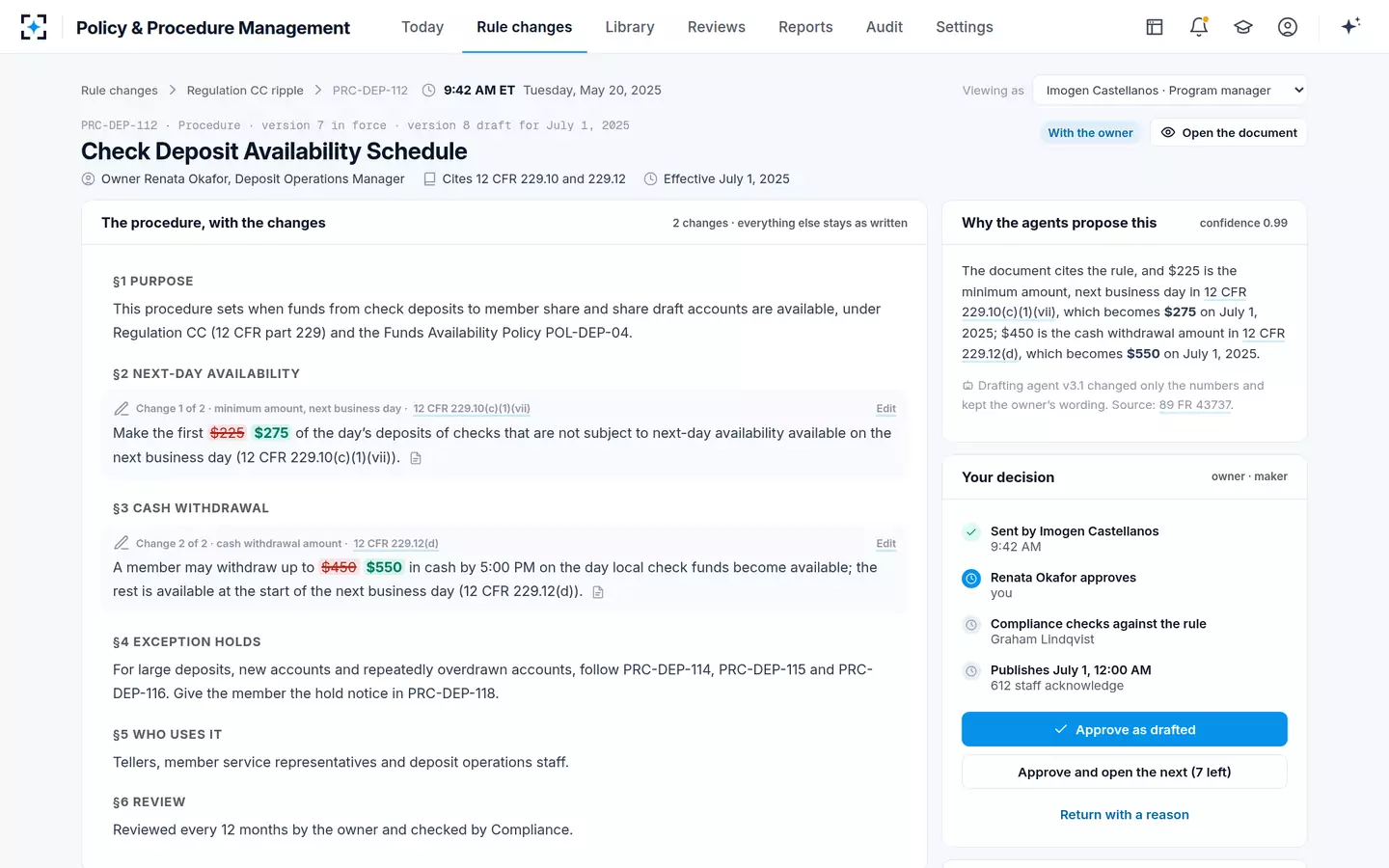
In the sample, those numbers sat in 17 documents belonging to 4 owners, and the deposit operations manager held 8 of them. Her check deposit availability schedule needed two changes, each shown beside the rule section behind it; she approved both as drafted. The contact center manager, editing a hold-question procedure by hand, typed $6,275 where the rule says $6,725. A comparison of every number with the rule set it aside before Compliance signed, and the corrected version came back within the hour. The whole change, traced step by step from the Federal Register to the teller line, shows where each version was made and kept.
The owner's six checks on a redline
- Each new number matches the rule section it implements
A transposed digit reads as plausible; the section citation beside the sentence is what to compare against.
- Only the sentences the rule touches have changed
An edit that also rewrites the cut-off time or the hold notice wording is a second change that needs its own reason.
- The version takes effect on the rule's date
The old amounts applied until June 30, 2025. Published early, a procedure tells staff to apply amounts the rule does not yet set.
- Documents that depend on this one are listed
Quick cards, scripts and forms that point to this procedure move with it, even if they quote nothing.
- Any customer notice is timed by its own rule
A change that speeds up availability may be disclosed within 30 days after it takes effect; any other change needs notice at least 30 days before (12 CFR 229.18(e)).
- A returned draft carries a reason
The reason is what an examiner reads when asking why the text differs from the agents' proposal.
The owner reads only what changed, beside the rule
How many procedures should one owner have?
No rule sets a number, and documents per owner is the wrong measure. What matters is how many rule changes land on one person's documents each year, and whether that person can turn each one around before its effective date. A manager with 60 operational procedures that rarely change carries less than one with 15 procedures under Regulations CC, DD and E.
Ownership is lopsided: one desk holds five times the average
The sample shows how uneven ownership becomes. The deposit operations manager owns 61 procedures, nearly five times the average, and the deposit desk sits under several of the rules a branch network runs on: funds availability, account disclosures, electronic transfers and cash reporting. When the Regulation CC amounts moved, 8 of the 17 affected documents landed on her desk at once.
The volume behind that is steady: the six federal agencies that write most bank and credit union rules published more than fifty final rules in each of the last three years by our count of the Federal Register, and why a once-a-year review cannot keep pace with that flow has its own guide. That count includes technical items such as civil penalty inflation adjustments, and most rules touch no given institution. But each one has to be read to know that, and the ones that do apply arrive on the desks of the same few owners.
What happens when a policy owner leaves the bank?
The documents keep their text and lose the one person who could say whether it is still true. Reviews lapse quietly, because the reminder goes to a closed mailbox, and the next rule change is sent to an owner who is no longer there. The FDIC's compliance manual makes the same point about turnover in general: a written program matters more when the people who know the work are no longer available (FDIC, II-3.1).
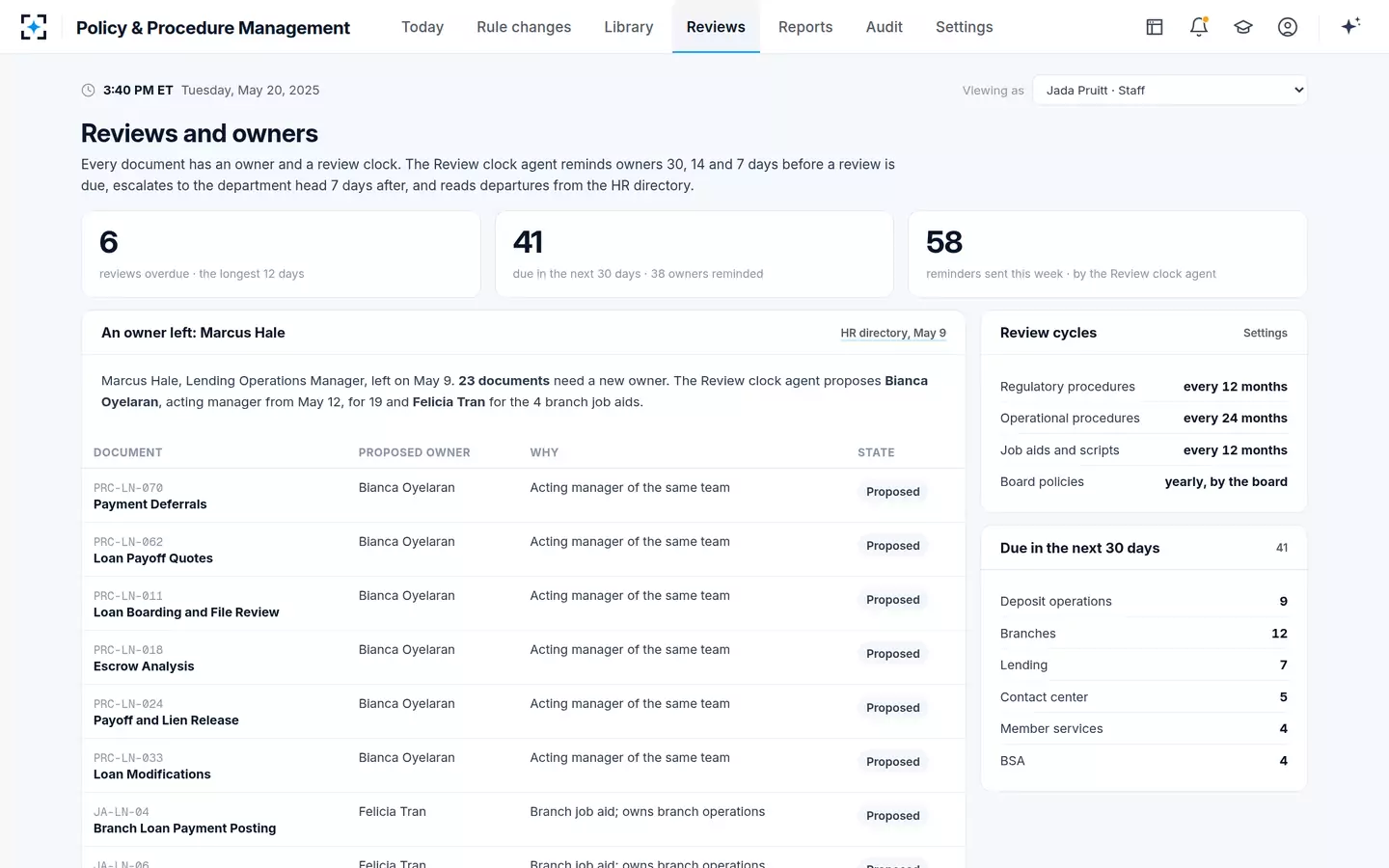
In the sample, the lending operations manager left on May 9 and 23 documents lost their owner: lending procedures and four branch job aids. The HR directory recorded the departure that night. The solution proposed an acting manager of the same team for 19 of them and the branch operations owner for the four job aids, each with its reason. The program manager prepared the change, and each new owner accepted before the documents moved.
An owner leaves: from the HR directory to an accepted new owner
Agent
Review clock agent reads the departureThe HR directory shows the last day; every document the person owns is listed with its next review and any open rule change.
Never: reassigns anything on its own
Agent
Proposes a new owner for each documentThe acting manager of the same team for procedures; the branch operations owner for job aids; each with the reason.
A person decides
Program manager prepares the changeAccepts or changes each proposal, and can split the documents between several people.
A person decides
Each new owner acceptsOwnership moves only on acceptance; the review clock restarts with the new name on every reminder.
Twenty-three documents, two proposed owners, one reason each
How Policy & Procedure Management keeps every document owned
It treats ownership as data that must stay current, not as a name typed on a cover page. Every procedure, job aid, form and board policy carries an owner, a review date and links to the rules it implements. The Review clock agent reminds owners 30, 14 and 7 days before a review is due and escalates to the department head 7 days after; in the sample that left 6 reviews overdue on the morning of the story, the longest by 12 days, with 41 more due within the month.
When a rule changes, ownership is what routes the work. The Impact agent finds every document the change touches, the Drafting agent writes each redline in the document's own words, and the program manager sends all of them to their owners in one step, one request per owner. The owner never receives a list that says "please update"; they receive the sentences, the rule passage and a decision to make. Ownership also sets the review calendar, and why the annual review should follow the rule changes is argued separately.
Where the owner's judgment stays
The agents find, draft, check and remind. They never approve content, never publish, never reassign a document and never close a rule change as not applicable; those are decisions for the owner, Compliance and the program manager. The owner keeps the parts that need someone who knows the work: whether a sentence the agents left alone should change too, whether a number the agents set aside as a look-alike really is one, and whether a job aid still describes what tellers do.
Some documents also need an approver above the owner. The board must approve certain policies and programs by rule, starting with the BSA compliance program, which must be in writing, approved by the board and recorded in its minutes (12 CFR 21.21 for national banks; 12 CFR 748.2 for credit unions). The owner of that program still writes and answers for it; which policies a rule sends to the board is a shorter list than most libraries assume. To see the owner's view, the redline and the departure screen together, start from Policy & Procedure Management.
Questions people ask
Is the policy owner the same as the compliance officer?
Usually not, and it is safer if they differ. The FDIC lists developing and reviewing policies and procedures among a compliance officer's responsibilities, but in a library of hundreds of documents the officer's practical role is the check: confirming each owner's text matches the rule. If the same person writes and checks a version, nobody has checked it.
Who approves changes to bank procedures?
Three hands, in order: the owner signs off what the procedure says, Compliance tests it against the rule, and a program manager or equivalent publishes it. Procedures are management's documents: the OCC places developing and implementing policies with management, and the board approves designated policies and the programs a rule names, such as the BSA program.
Does the board have to approve procedures?
Not as a rule. Regulations require board approval of specific written policies and programs, such as the BSA compliance program under 12 CFR 21.21 or 748.2, and a few name policies and procedures together, such as the interbank liability limits in Regulation F. Ordinary operating procedures, like a check hold procedure, are management's to approve.
How do you assign owners to job aids?
Give each job aid the manager whose staff use it, and link it to the procedure it summarises. In the sample, four branch job aids went to the branch operations owner when their previous owner left. The link matters more than the name: when the parent procedure changes, the job aid has to be reviewed with it.
Can a committee own a policy?
A committee can review and approve; it should not be the owner. The OCC lets the board or its designated committees periodically review policies, but accountability for what a document says, and for changing it when a rule moves, needs a named person who receives the request and can be asked about it at the exam.
What should a policy owner hand over when they leave?
The list of documents they own, each with its next review date, any rule change waiting on them, drafts in progress and the reasons behind recent edits. In the sample the departure was read from the HR directory the same night, and 23 documents were proposed to two new owners with a reason each before any review fell due.