Policy vs procedure vs job aid, in a bank or credit union: a policy is the institution's statement of what it will do and within what limits; a procedure is the set of steps staff follow to carry it out; and a job aid is a short extract of those steps for use at the counter or on the phone, such as a teller quick card, a checklist or a call script. The difference matters most for numbers. A regulated amount such as the Regulation CC large deposit threshold belongs in one procedure that cites the rule, yet it is copied into job aids and scripts that never name the rule, and those are the documents a rule change misses. Botminds' Policy & Procedure Management is an agentic solution that finds every document a rule change touches, by the rule's name, by the numbers it sets and by the links between documents, and sends each one to its owner with the redline drafted.
The example throughout is the Regulation CC change of July 1, 2025, run through the solution on a fictional sample credit union with 1,240 procedures and job aids.
Where the old Regulation CC amounts sat in one sample library
By document type · 17 documents
- Procedures: 14 · 82%
- Teller job aids: 3 · 18%
By how they were found · 17 documents
- Cite the rule: 7 · 41%
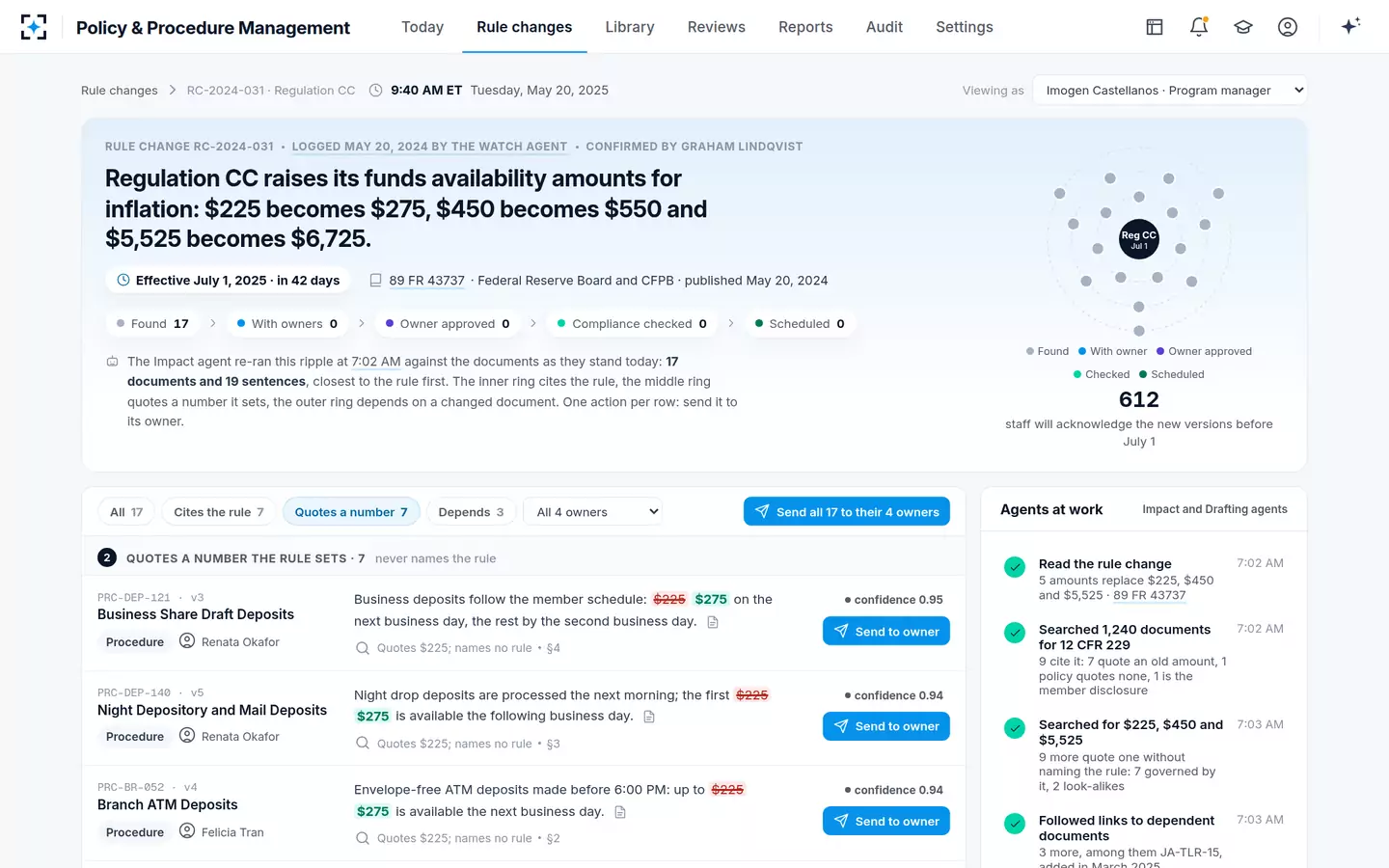
- Quote an amount, never name the rule: 7 · 41%
- Depend on a changed document: 3 · 18%
What is the difference between a policy and a procedure?
A policy says what is expected; a procedure says what to do. The federal internal control standard puts it in two sentences: "Policies reflect management or oversight body statements of what is expected to be done. Procedures consist of actions that implement policies" (GAO, Standards for Internal Control in the Federal Government, 2025, paragraph OV1.04). The OCC's version for banks adds what policies are for: "Policies are statements of actions that the bank adopts to pursue certain objectives. Policies guide decisions and often set standards (on risk limits, for example)", while processes are "the procedures, programs, and practices that impose order on the bank's pursuit of its objectives" (OCC, Corporate and Risk Governance).
The FDIC's compliance manual describes the same relationship from the compliance side: "Policy statements on compliance topics provide a framework for the institution's procedures and provide clear communication to management and employees of the Board's intentions toward compliance" (FDIC Consumer Compliance Examination Manual, II-3.1). In practice the line is about who decides. A policy is approved by the board or by senior management under authority the board gives; a procedure is owned and approved by the manager who runs the process. The policies a rule sends to the board are a short, named list.
What is a job aid?
A job aid is a short reference that puts the steps of a procedure where the work happens: a teller quick card at the window, a checklist for opening an account, a script for the hold questions a contact center hears every day. No banking regulation defines the term, and none needs to; what defines a job aid is that staff use it instead of the procedure, in the moment, often with a customer waiting.
That is also what makes it risky. The GAO standard notes that "those in key roles for the unit may further define policies through day-to-day procedures, depending on the rate of change in the operating environment and complexity of the business process" (GAO-25-107721, paragraph 12.04). A job aid is the most day-to-day of those definitions, written for speed, and speed means quoting the number rather than the rule. In the sample, the teller hold quick card and a teller script both quoted Regulation CC amounts without naming the rule.
What is the difference between a job aid and a procedure?
A procedure is the complete, owned, approved statement of how a process works, with the rules and policy behind it; a job aid is a derived shortcut that should never say anything the procedure does not. The table compares the three layers on the questions that matter when a rule changes.
Policy, procedure and job aid, compared on what a rule change needs
| Policy | Procedure | Job aid or script | |
|---|---|---|---|
| What it says | What the institution will do, and its limits | The steps, the exceptions, the forms and notices | The steps and numbers staff need in the moment |
| Who approves it | The board or a committee it designates, where a rule or the board requires | Its owner, checked by Compliance | Its owner, checked by Compliance, against the procedure it serves |
| Who reads it | Managers, the board, examiners | Staff who run the process, auditors | Front-line staff, often with a customer waiting |
| Regulated amounts | Best left out, so a rule adjustment does not need the board | Stated once, with the rule section and the period it applies | Quoted for speed, often without the rule's name |
| How a rule change finds it | By the citation | By the citation and the amount | Only by the amount or by its link to the procedure |
Where should a regulatory threshold be written?
In one procedure, with the rule section beside it and the period it applies, the way Regulation CC itself states its amounts. Section 229.11 does not just say $6,725; it gives $5,525 for the five years to June 30, 2025 and $6,725 from the next day (12 CFR 229.11(c)). A procedure that carries the amount with its section and its dates can be found by the citation, checked against the rule and changed on the right day.
The FDIC asks for the same thing in general terms. Policies and procedures "should provide personnel with all the information needed to perform a business transaction", which "may include applicable regulation cites and definitions, sample forms with instructions, institution policy, and, where appropriate, directions for routing, reviewing, retaining, and destroying transaction documents" (FDIC, II-3.1). A regulation cite next to the number is what turns a job aid from a copy of an amount into a pointer to a rule.
The other half of the discipline is labelling the institution's own numbers as its own. The sample credit union limits ATM cash withdrawals to $450 a day, a limit it sets for itself that happens to equal the old Regulation CC cash withdrawal amount. A search for $450 finds both; only a label, or a reader who knows, tells them apart. In the sample run, the card procedure with the $450 limit was left out of the change, with that reason written down.
Should a job aid quote a dollar amount?
Yes, if staff need the number at the counter, which for holds they do: a teller cannot look up the large deposit threshold while a member waits. But a job aid that quotes a regulated amount should name its source, the rule section and the procedure it summarises, and it should be linked to that procedure so a change to one reaches the other. Without the link, the job aid is found only if someone searches for the number.
Documents that quote the amount and never name the rule
Is a teller script a procedure?
It is a job aid with a special property: its words reach the customer. A script for explaining a hold, or a phone procedure for hold questions, is in effect a spoken disclosure, and the rules on what a bank tells customers about availability are specific. A bank must post "in a conspicuous place in each location where its employees receive deposits to consumer accounts a notice that sets forth the time periods applicable to the availability of funds deposited in a consumer account" (12 CFR 229.18(b)), and must give a written disclosure of its specific availability policy (12 CFR 229.16). A script that says something different from the posted notice and the disclosure is a problem whoever wrote it.
So scripts deserve a procedure's discipline: an owner, a link to the procedure and the rule, and a Compliance check of every number. In the sample, the one error in the Regulation CC change was in the contact center's hold-question procedure, where the owner typed $6,275 for $6,725; the number-by-number check caught it before sign-off.
"Compliance policies and procedures are the means to ensure consistent operating guidelines"
FDIC Consumer Compliance Examination Manual, II-3.1
Who approves a job aid?
The owner of the process whose staff use it, with the same Compliance check as the procedure it serves. The owner should be the person who would notice if the job aid and the counter disagreed: for branch job aids that is usually the branch operations owner. In the sample, when a lending operations manager left, the four branch job aids among that manager's documents were proposed to the branch operations owner, "Branch job aid; owns branch operations", while the procedures went to the acting manager of his team.
Approval also has a place to live. The sample's three teller job aids sit in a learning management system course as well as in the procedure library, and the new versions were scheduled to change in both at the same minute on July 1, 2025. What an owner answers for applies to a quick card as much as to a forty-page procedure.
What should a bank procedure include?
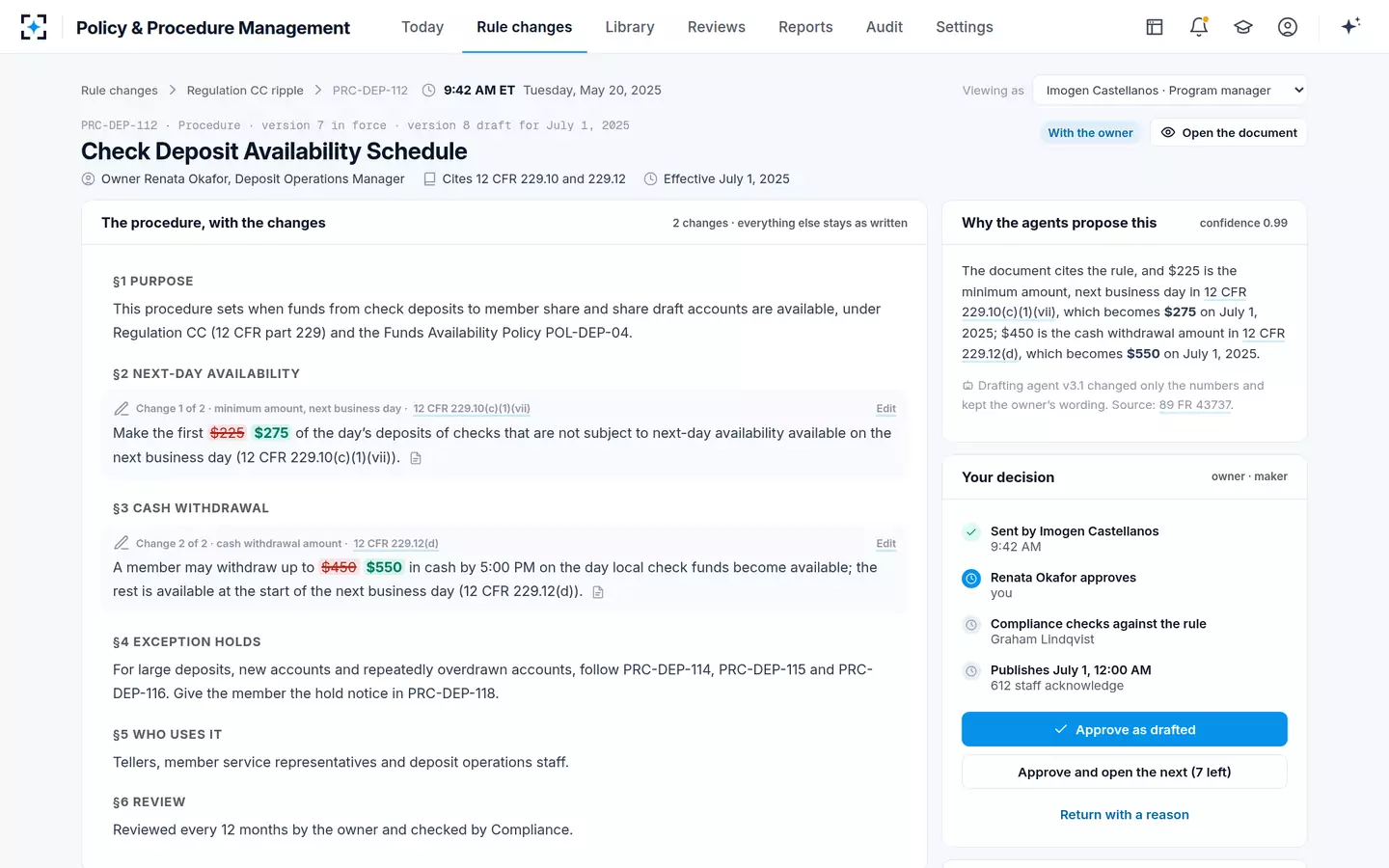
Enough for a person to complete the transaction and for an examiner to see why each step exists. The sample credit union's check deposit availability schedule shows a compact structure: purpose, citing Regulation CC and the funds availability policy it implements; next-day availability; cash withdrawal; exception holds, pointing to the large deposit, new account and repeated overdraft procedures and the hold notice; who uses it; and its review cycle.
What a procedure that carries regulated amounts should contain
- The policy it implements
So a change at board level reaches it, and so the board policy can stay free of amounts.
- The rules it implements, to the section
Such as 12 CFR 229.10(c)(1)(vii) for the next-day amount, not "Regulation CC".
- Each regulated amount, once, with its section and dates
The way 12 CFR 229.11(c) itself states them.
- The institution's own limits, labelled as its own
An ATM limit or a fee the institution sets, so a search for a rule amount can tell them apart.
- The documents derived from it
Quick cards, scripts, forms and notices, linked so a change reaches them.
- Who uses it
The roles that must acknowledge each new version.
- Owner, review cycle, version and effective date
So the text in force on any date can be shown with who approved and checked it.
A procedure built to be changed: amounts with their sections, exceptions by link
How Policy & Procedure Management finds the numbers wherever they live
By searching the way the numbers spread, not the way the library is filed. When Compliance confirms a rule change, the Impact agent searches every document for the rule's citation, then for each amount the rule replaces, then follows links to documents that depend on a changed one, and ranks the results closest to the rule first. Each look-alike it leaves out carries its reason, and below 0.80 confidence it asks a person instead of deciding.
Three searches, one list, every exclusion explained
Agent
Search the citationEvery document that names 12 CFR 229 or Regulation CC: in the sample, 9, of which 7 quoted an old amount.
Agent
Search the amountsEvery $225, $450 and $5,525: 9 more documents, 7 governed by the rule and 2 look-alikes left out with a reason.
Agent
Follow the linksDocuments that point to a changed one: 3 more, among them a teller job aid added in March 2025.
Never: edits a document
A person decides
Owners decideEach owner approves, edits or returns the redline; the program manager can add a look-alike back with a reason code.
The same layering governs answers at the counter. The library answer agent answers staff only from published versions, cites the passage and says when an approved version will change the answer on a set date; it never quotes a restricted document, such as a BSA procedure, to someone without access. The whole Regulation CC change traced step by step shows the three layers moving together, and Policy & Procedure Management can be run on a sample of your own procedures and job aids.
Questions people ask
What is the difference between a policy, a procedure, a standard and a guideline?
A policy states what the institution will do; a standard sets a measurable requirement under it, such as a limit; a procedure gives the steps; a guideline offers recommended practice that leaves room for judgment. Banks use the terms loosely. What matters is that each document says which kind it is, who approves it and which rules it carries.
Is a standard operating procedure the same as a job aid?
No. A standard operating procedure is a full procedure for a routine task; a job aid is a shortcut derived from it for use in the moment. Both need an owner, but the job aid should never contain anything its procedure does not, including any regulated amount.
Do examiners look at job aids?
They look at what staff do, and job aids are often what staff use. An examiner testing holds may compare a teller's practice with the posted notice and the disclosure Regulation CC requires; if a quick card quotes an amount the rule no longer sets, the card is where the difference starts.
How many job aids should a procedure have?
As few as the work allows, each linked to its parent. In the sample, three teller job aids carried the hold amounts alongside 14 procedures, and every one of the three had to change for July 1, 2025; each extra copy of a number is one more document a rule change has to find.
Should the board policy quote regulatory amounts?
Better not. A board policy that commits the institution to follow Regulation CC needs no change when the rule's amounts are adjusted every five years; one that quotes $5,525 needs a board approval before each adjustment takes effect. Keep amounts in procedures, where the owner can change them on the rule's date.