File and use vs use and file is a question of order. Under a file and use rating law, the insurer files the rate with the state insurance department and can begin using it when it is filed, or after a short waiting period, while the department keeps the right to disapprove it. Under a use and file law, the insurer uses the rate first and files it within a set number of days afterwards. Both are "competitive" rating laws, as opposed to prior approval, where the rate cannot be used until it is approved or deemed approved. The hard part is that each state defines the terms its own way, and the same homeowners rate change can be four different projects in four states. Botminds' Rate & Form Filing Automation exists for filing teams running those projects at once: its agents build and check each state's package, and its deadline watcher holds every state's clock on one timeline.
The rating-law families, in the regulators' own handbook
5
families: prior approval, file and use, use and file, no file, and flex rating
NAIC handbook
1
state with no rating law at all, according to the NAIC: Illinois
NAIC handbook
7%
the flex band South Carolina uses for homeowners: changes within it are file and use
S.C. Code §38-73-260
90days
ahead of the effective date for a Florida "file and use" filing
Fla. Stat. §627.062
File and use vs use and file: the short answer
The NAIC's Product Filing Review Handbook, written by state regulators, gives the standard definitions. File and use: "the rates can be introduced into the market at the same time as they are being filed with the insurance regulator. Specific approval is not required, but the department retains the right of subsequent disapproval." Use and file: "the rates can be introduced into the marketplace and must be filed with the regulator at a specified later date" (NAIC, 2024).
Both sit under what the handbook calls competitive rating laws, which "typically allow use of rates as long as they are filed." The difference is which comes first, the filing or the use, and therefore what the insurer risks. Under file and use, the regulator sees the rate at the moment it is used. Under use and file, the regulator may see it weeks later, after policies have been written at it.
The handbook adds the caution that governs everything else on this page: "The terms of the classification can vary by state." A state's statute, not the label, decides the clock.
What is prior approval, and what is a deemer clause?
Prior approval means the rate cannot be used until the department approves it. In the handbook's words, rates "must be filed with and approved by the state insurance department before they can be used," and approval "can be by means of a deemer provision, which indicates approval if rates are not denied within a specified number of days" (NAIC, 2024). A deemer clause is that provision: silence becomes approval on a fixed day.
California is the best-known prior approval state for personal lines. Under Proposition 103, an application is deemed approved 60 days after public notice unless a hearing is requested and granted, ordered by the Commissioner, or required because a personal lines change exceeds 7% and a hearing is timely requested, and in any event 180 days after the application is received (Cal. Ins. Code §1861.05(c)). California also has file and use statutes for a few lines; its Department reports that it reviews those filings "for a limited number of P&C lines of business," such as workers' compensation and title (CDI 2025 Annual Report).
Two other families complete the set. No file, or open competition, laws "do not require the rates to be filed with or approved by the state insurance department," though the insurer must keep its rating records for the commissioner. And flex rating requires prior approval "only if the rate change would be greater than (and sometimes less than) a certain percentage" (NAIC, 2024).
Which rating law applies? A decision path
Work it in order: the line, then the state's law for that line, then the size of the change, then the state's own meaning of its labels. Each step is a decision for the filing team, made from the statute and the department's instructions.
From line and state to the filing clock, in five decisions
A person decides
Which line, which state?Rating laws are set state by state and often line by line. New York requires prior approval for private passenger auto but not homeowners.
A person decides
Prior approval for this line?If yes, the clock is the review period and any deemer: in California, 60 days after public notice at the earliest.
A person decides
Is there a flex band?If the change exceeds it, the filing becomes prior approval: South Carolina homeowners above 7%; New York auto above its band.
A person decides
File first, or use first?File and use may still mean a wait (Florida, 90 days ahead). Use and file sets a deadline after use (Florida, 30 days).
A person decides
Use before approval, or wait?Weigh the refund and rollback risk. Many insurers wait for approval even where the law does not require it.
File and use insurance meaning, state by state
File and use insurance means a different calendar in each state that uses the phrase. In Texas, for residential property and personal auto, "An insurer may use a rate filed under this subchapter on and after the date the rate is filed," and the Commissioner must act on a rate not yet in effect within 30 days, with one extension for good cause (Tex. Ins. Code §§2251.101, 2251.103). In South Carolina, a homeowners change within the 7% band "may become effective not less than thirty days after the date of the filing" (S.C. Code §38-73-260(C)).
Florida's use of the term is the one that surprises newcomers. A Florida filing counts as "file and use" only "If the filing is made at least 90 days before the proposed effective date and is not implemented during the office's review of the filing and any proceeding and judicial review"; the Office then has 90 days to issue a notice of intent to approve or disapprove, failing which "The rate shall be deemed approved" (Fla. Stat. §627.062(2)(a)1.). In substance, Florida's file and use is a prior approval with a 90-day deemer.
The same words, different clocks: rating laws for a personal lines rate change in five states
| State and line | What the law calls it | When the new rate can be used |
|---|---|---|
| Texas · residential property, personal auto | File and use (Ch. 2251, Subch. C) | On and after the filing date; disapproval before effect within 30 days, or after a hearing once in effect |
| Florida · property and auto | "File and use" or "use and file" (§627.062(2)(a)) | File and use: filed 90+ days ahead, not used until the Office acts or day 90. Use and file: used first, filed within 30 days |
| California · homeowners, auto | Prior approval (Proposition 103) | After approval, or when deemed approved: 60 days after public notice at the earliest, 180 days from receipt at the latest |
| South Carolina · homeowners | Flex: file and use within 7% (§38-73-260) | Within the band: 30 days after filing. Above it: prior approval with a 60-day waiting period, extendable by 60 |
| New York · homeowners | No prior approval (§2305(a)) | Filed and reviewed through SERFF with the Rate Filing Sequence Checklist; not on §2305(b)'s prior approval list |
| New York · private passenger auto | Prior approval, with flex rating (§§2305(b), 2350) | Within the flex band, under the conditions in Regulation 153; otherwise when approved or after 30 days without disapproval |
Use and file insurance: the refund risk
Use and file insurance lets the rate go first, and puts the insurer's money at risk if the regulator later disagrees. Florida's statute says so in terms: an insurer's use and file filing must be made "as soon as practicable, but within 30 days after the effective date," and "An insurer making a 'use and file' filing is potentially subject to an order by the office to return to policyholders those portions of rates found to be excessive" (Fla. Stat. §627.062(2)(a)2.). The refund is ordered "in the form of a credit or refund" under paragraph (h).
The NAIC handbook describes the general pattern for file and use too: the department "retains the right of subsequent disapproval," and "In most instances, the subsequent disapproval is on a prospective basis only. In some states, refunds can be required." South Carolina's flex rule shows the prospective version: an order issued more than 30 days after the filing was received "is on a prospective basis only and does not affect a contract issued or made before the effective date of the order."
Earliest day a filed homeowners rate increase can be used, at the statutory minimum
Flex rating: when the size of the change decides
Under flex rating, the same filing is file and use or prior approval depending on how big it is. South Carolina's homeowners rule allows "overall average rate-level increases or decreases, for all coverages combined, of seven percent above or below the insurer's rates then in effect" on a file and use basis, adds that "The seven percent cap does not apply on an individual insured basis," and limits insurers to two such increases in twelve months, the second subject to prior approval (S.C. Code §38-73-260(A)–(B)).
New York's private passenger auto flex rule adds a policyholder test. The Department's instructions say that if the renewal impact on any one policyholder exceeds plus or minus 30%, or the company has already implemented a prior approval increase or two flex increases in the past twelve months and now files another increase, "the company must indicate its understanding that the filing is PRIOR APPROVAL" (NY DFS, Exhibit RT-5 instructions).
Texas has its own version for insurers placed under prior approval. Once a rate is approved under that subchapter, the insurer may use a later rate without approval if it does not exceed "107.5 percent of the rate approved by the commissioner" or "110 percent of any rate used by the insurer in the previous 12-month period," whichever is lower (Tex. Ins. Code §2251.152(b)). In every flex state, the overall change in the memorandum is the number that decides which law applies, which is why it has to be the same everywhere it appears.
Is Texas a file and use state for insurance?
Yes, for most property and casualty lines, including residential property and personal auto: an insurer may use a filed rate on and after the filing date. Two exceptions matter. The Commissioner may order an individual insurer onto prior approval where its "rates require supervision because of the insurer's financial condition or rating practices," or where "a statewide insurance emergency exists" (Tex. Ins. Code §2251.151(a)). And a rate in effect can still be disapproved after a hearing.
Texas filings are also public: the statute makes each filing and its supporting information public information under Chapter 552 of the Government Code (Tex. Ins. Code §2251.107). A file and use rate is used immediately and read by competitors almost as quickly; reading rivals' filings is the work of a separate Botminds solution, Competitor Rate Filing Analysis, which explains what in a rate filing is public record.
Prior approval vs file and use states insurance: one change, five states
One rate revision becomes five filings, and under different rating laws it becomes five different projects. Take a single homeowners program change of 8.5% overall. In Texas it could be used on the filing date. In South Carolina, a state change of 7% or less would wait 30 days, while one above 7% would face a 60-day waiting period. In Florida, filed as file and use, it would wait 90 days. In California it would wait for public notice and at least 60 days more, and a hearing could be required for an increase above 7%.
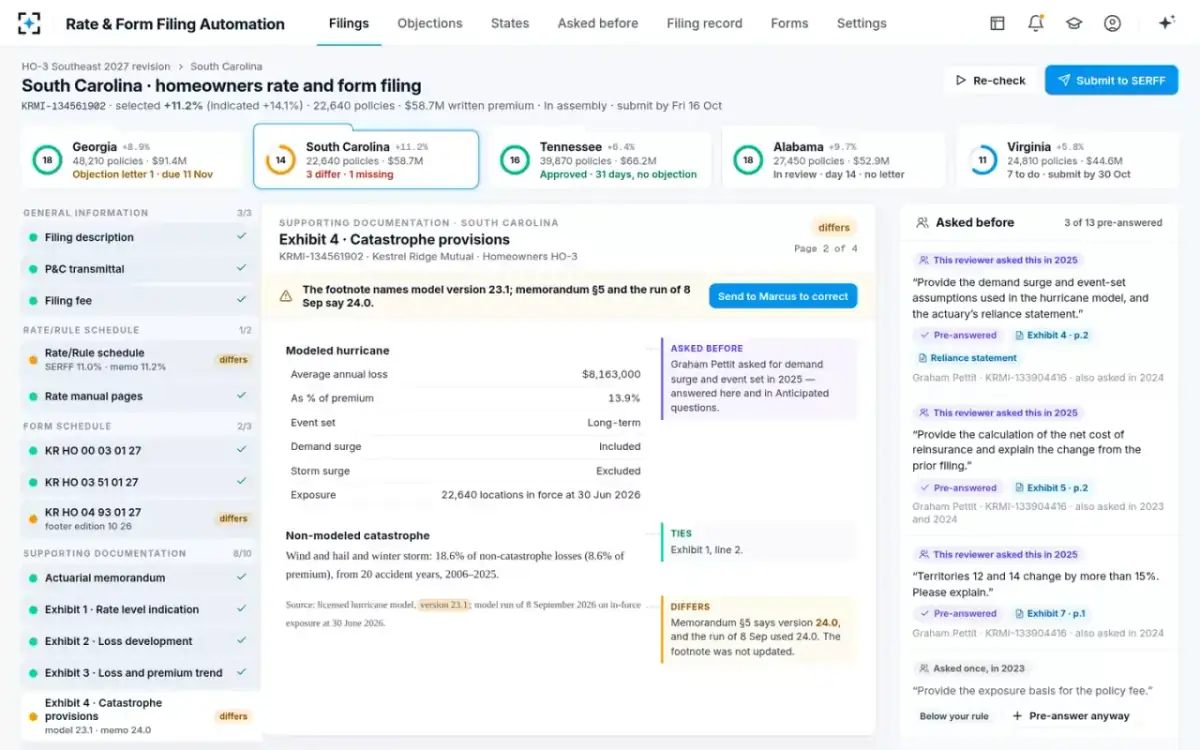
The program number is not the state number. In the fictional sample in Rate & Form Filing Automation, a +8.5% program across Georgia, South Carolina, Tennessee, Alabama and Virginia lands as +8.9%, +11.2%, +6.4%, +9.7% and +5.8% by state. Under a 7% flex band, some of those would be file and use and others prior approval, and the boundary is decided by each state's own overall figure, not the program's.
One program, five state clocks
Why insurers often wait for approval anyway
A file and use right is only worth using if the rate is unlikely to be rolled back. A Federal Reserve staff study of homeowners rate filings reported what practitioners told the authors: "the cost of rolling back and refunding consumers is prohibitively high. As a result, in practice, insurers typically seek pre-approval even in states which do not explicitly require one" (FEDS 2022-064, footnote 9). The study's views are its authors', but the arithmetic behind the habit is easy to see.
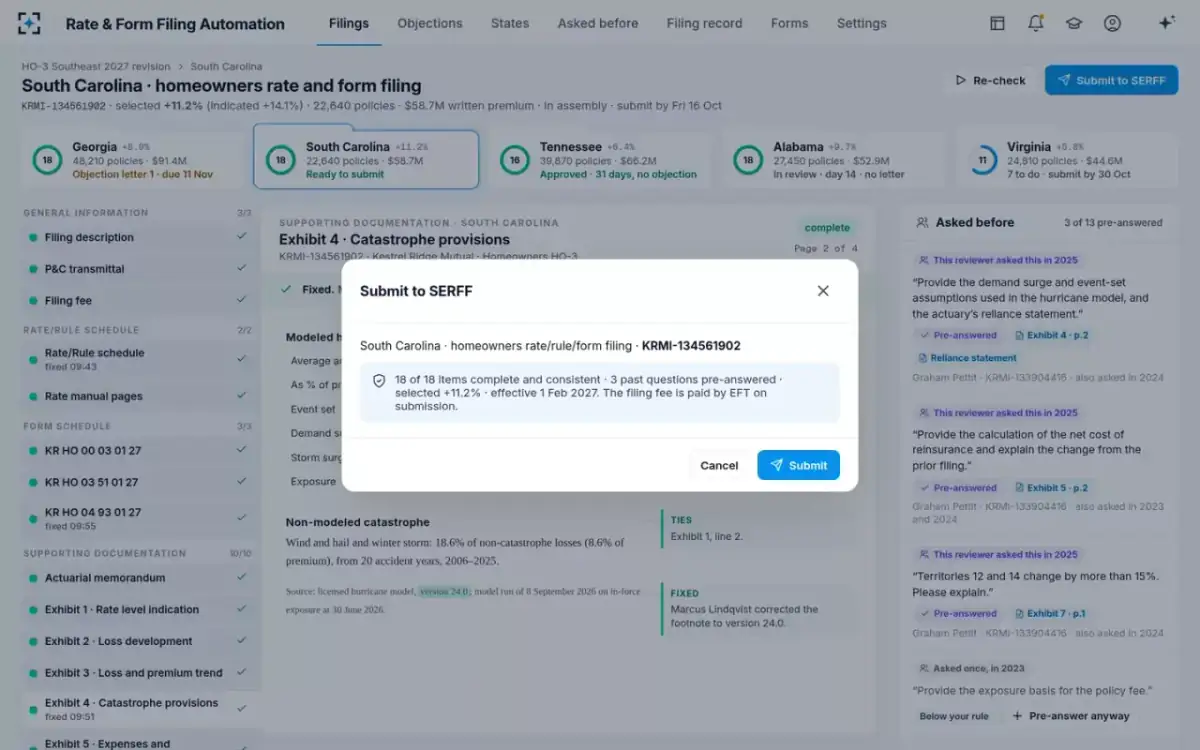
Waiting turns a file and use state into a de facto prior approval state, and moves the risk from refunds to delay. The better answer is to file something that will not need to be rolled back: a package complete against the state's checklist and consistent with itself, with the questions the department asked last time already answered. That is the work Rate & Form Filing Automation does before submission, and the rate filing approval timeline puts a price on each day the alternative costs.
Clean before it goes: the submission summary
For the rating laws in their own words, the NAIC handbook's chapter 4 is the regulators' reference; for one state's prior approval requirements in detail, see the California prior approval rate filing instructions. To see five state clocks on one sample program, start from Rate & Form Filing Automation.
Questions people ask
What does file and use mean in insurance?
It means the insurer files its rates with the state insurance department and may use them when filed, or after a short statutory wait, without waiting for specific approval; the department can still disapprove them later. The NAIC notes that later disapproval is usually prospective, though some states can require refunds.
Which states are file and use for insurance?
It depends on the line, and the labels vary. Texas uses file and use for residential property and personal auto; South Carolina uses it for homeowners changes within a 7% band; Florida's "file and use" requires filing 90 days ahead and waiting for the review. Check the state's statute for the line, because the NAIC itself warns that the terms can vary by state.
What is the difference between prior approval and file and use?
Under prior approval, a rate cannot be used until it is approved or deemed approved after a set number of days. Under file and use, it can be used on filing or after a short wait, subject to later disapproval.
What is a deemer clause?
A deemer clause treats a filing as approved if the regulator has not acted within a set period. California's Proposition 103 deems an application approved 60 days after public notice in the ordinary case and 180 days after receipt at the latest; Florida deems a file and use filing approved at day 90 without a notice of intent.
Is use and file riskier than file and use?
Usually, because policies are written at the new rate before the regulator has seen it. Florida's statute makes a use and file insurer potentially liable to return the excessive portion of the rate to policyholders.