The California prior approval rate filing instructions are the Department of Insurance's Prior Approval Rate Application Filing Instructions, a 74-page document (October 16, 2026 edition) that tells every insurer filing a rate, rule, form or new program under Proposition 103 how to complete the Department's Application, Rate Template, Standard Exhibits Template and, for certain property lines, Standard SIS Exhibits Template, and to file them through SERFF with an affidavit. Three things changed in 2026: the template formulas are locked, a reconciliation report generated by the Department's portal earns the faster review clock, and the affidavit now declares that the templates were not altered. A package that disagrees with itself was always a problem; in California it is now a compliance question. Botminds' Rate & Form Filing Automation checks every state package against itself before submission, and in California that habit matches what the Department now requires.
Insurers may not modify the Department's proprietary formulas in the Application, Template, Exhibits, and SIS Exhibits.
California Department of Insurance, Bulletin 2026-2 (March 26, 2026)
What are the California prior approval rate filing instructions?
They are the rulebook for a complete rate application in California's prior approval lines. The instructions open with the scope: "Every insurer wishing to introduce new, or change existing, rules, rates or forms, or to introduce a new program, must complete a Prior Approval Rate Application ('Application'), an Affidavit and, if applicable, depending on filing type, a Prior Approval Rate Template" and the standard exhibit templates, "in compliance with Title 10, Chapter 5, Subchapter 4.8 of the California Code of Regulations" (CDI instructions, October 16, 2026 edition).
The package is spreadsheets as much as prose. The Application, Rate Template and Standard Exhibits Template are macro-enabled Excel workbooks; many exhibits must be filed twice, as working Excel with the formulas intact and as searchable PDF; all applications go through SERFF; and before approval issues, the insurer must file "a complete rate manual which contains all current rates, rating factors and rating rules." No fee goes with the application; the Department bills an administrative fee.
The instructions change often. The Department's change log records updates to the package on seven dates in 2026 to the end of October, five of them to the instructions themselves (CDI application change log). The instructions themselves tell filers to "Refer to the California Department of Insurance ('Department') website for the most current" Application, Affidavit and templates, all posted on the Department's prior approval rate filing page.
Prop 103 rate filing requirements in one page
Proposition 103 sets the standard, the clock and the public's role. The standard: "No rate shall be approved or remain in effect which is excessive, inadequate, unfairly discriminatory or otherwise in violation of this chapter." The clock: an application is deemed approved 60 days after public notice unless a hearing is requested and granted or ordered, or a personal lines change above 7% draws a timely hearing request, and in any event 180 days after receipt (Cal. Ins. Code §1861.05). The public's role: consumers and their representatives may request a hearing within 45 days of public notice.
The regulations add the arithmetic. "For most lines of insurance, the regulations prescribe a particular formula and factors to determine the maximum and minimum permitted earned premium," the instructions explain; an insurer that wants to go outside that range files a variance request under 10 CCR §2644.27, with one Rate Template excluding the variance and one including it (CDI instructions, section III). The templates are where that formula lives, which is why the Department guards them.
The rule reaches beyond rates. A rule or form change that affects the rate or cost of coverage "will be construed as an application requesting a rate change," and an insurer that says a manual or eligibility change has no rate impact must file it as a rule or form filing that "does not take effect until at least 90 days after public notice." In California, the forms specialist works under rate law.
What changed in 2026: the formulas are locked
Bulletin 2026-2 made explicit what the instructions had implied: the formulas belong to the Department. "Unauthorized and undisclosed modification of formulas violates the Instructions," the Commissioner wrote, and modification "belies the veracity of the Affidavit," with possible "severe penalties, civil liability, and potential prosecution for perjury or other crimes if the circumstances demonstrate misrepresentation to the Department" (CDI Bulletin 2026-2).
The October 2026 instructions carry the rule into the filing text: "Insurers are strictly prohibited from modifying the templates in any way not expressly authorized by these instructions. This includes, but is not limited to, modifying, altering, or disabling any formulas, macros, or protected cells. Any unauthorized modification, whether intentional or inadvertent, may affect the integrity of the submitted data." The consequences listed include "rejection of the filing, administrative penalties, and/or referral for investigation and enforcement action" (CDI instructions, section I).
California prior approval filing: before 2026 and in the October 2026 edition
Before the 2026 changes: Undisclosed changes already breached the instructions, which required any data adjustment to be explained in the filing memorandum (edition of 7/14/25, as Bulletin 2026-2 cites it)
October 2026 edition and 2026 bulletins: Formulas "may not" be modified (Bulletin 2026-2); no formula, macro or protected cell may be altered, "whether intentional or inadvertent"
Before the 2026 changes: A Data Quality and Reconciliation Checklist (2018) listing the Department's common reconciliation errors, as guidance
October 2026 edition and 2026 bulletins: The PARA Portal's Combined Reconciliation Report, with every error and warning "addressed or explained" before the portal generates the final Application and Templates
Before the 2026 changes: Proposition 103's deemer dates, which the Department frequently asks applicants to waive
October 2026 edition and 2026 bulletins: Bulletin 2024-7's 60-day review from public notice plus up to two 30-day extensions, where the portal is used and the final report is filed
Before the 2026 changes: Information filed is "true, complete and correct," as the instructions required
October 2026 edition and 2026 bulletins: September 2026 form: "true, complete, and accurate," no price optimization, Excel templates "not been altered," and now used for file and use filings too
Before the 2026 changes: No separate template before the October 2025 update
October 2026 edition and 2026 bulletins: A Stacked Rate Changes template with every rate application, so public notice shows the cumulative change
Before the 2026 changes: No dedicated section
October 2026 edition and 2026 bulletins: New section II.L (September 2026): request by SERFF filing note, copied to intervenors where there are any
The reconciliation report and the 60-day review
In 2026 the faster review clock is earned by reconciling. Bulletin 2024-7 promised a 60-day review from public notice once "full implementation of a data reconciliation tool and process for insurance companies is achieved," calling the tool "absolutely integral and critical" to the new timelines (CDI Bulletin 2024-7). The October 2026 instructions name the tool and the condition: "In the event the insurer generates its rate filing submission using the PARA Portal, the review timelines outlined in Bulletin 2024-7 will apply, provided the insurer has submitted the final Combined Reconciliation Report with all errors and warnings addressed" (CDI instructions, section II.K).
The portal does not yet take every filing. It is "not yet available for transferred program filings, filings with variances, programs with less than six years of experience since program inception, or Commercial Multi-Peril SIS/CATNCOR filings," and it accommodates up to 20 new or revised forms. Filings compiled outside it must complete the Application and templates "without the benefit of the above-mentioned reconciliation functionality." For those, the 2018 reconciliation checklist remains the Department's own list of what to compare: premiums across the annual statement's Page 14, the Rate Template, the Application's reconciliation page and two exhibits; exposures across three sources; and every Rate Template input against its exhibit (CDI reconciliation checklist).
The timeline then runs as the Bulletin set it: review within 60 days of public notice; up to two 30-day extensions, each with a written status of the issues resolved and unresolved to the insurer and any intervenor; then the Department's calculated rate, which the insurer has 10 calendar days to accept or reject. The rate filing approval timeline compares that clock with other states'.
California's rate review rules, 2024 to 2026, to scale in months
- Bulletin 2024-7: 60-day review once a reconciliation tool existsAug 2024
- Intervenor reform proposed; stacked-rate template addedSep–Oct 2025
- Bulletin 2026-2: formulas lockedMar 2026
- Intervenor rules in effect; affidavit and withdrawal updated; October editionAug 2026
The filing memorandum California asks for
Every California filing carries a filing memorandum with a fixed minimum content: a clear statement of purpose, a summary of all proposed changes, the assumptions relied on, support for each trend, development and catastrophe selection as "the most actuarially sound," any adjustments to the data, any credibility standard and its justification, and comment on every model used in any way. The closing line governs what a filing can achieve: a proposed change the memorandum does not address is not approved unless the approval letter says otherwise (CDI instructions, section V; the full list is worked through in the actuarial memorandum example).
Models carry extra paperwork. The instructions require a Catastrophe Model Form or Non-Catastrophe Model Form and, for some models, a pre-application required information determination, or PRID; an application relying on a model "will be considered incomplete until the PRID for the model(s) is available." The September 2026 update added wildfire as a catastrophe model type in the Application's model disclosure. A model version updated in the memorandum but not the exhibit footnote is exactly the kind of discrepancy these forms now make visible.
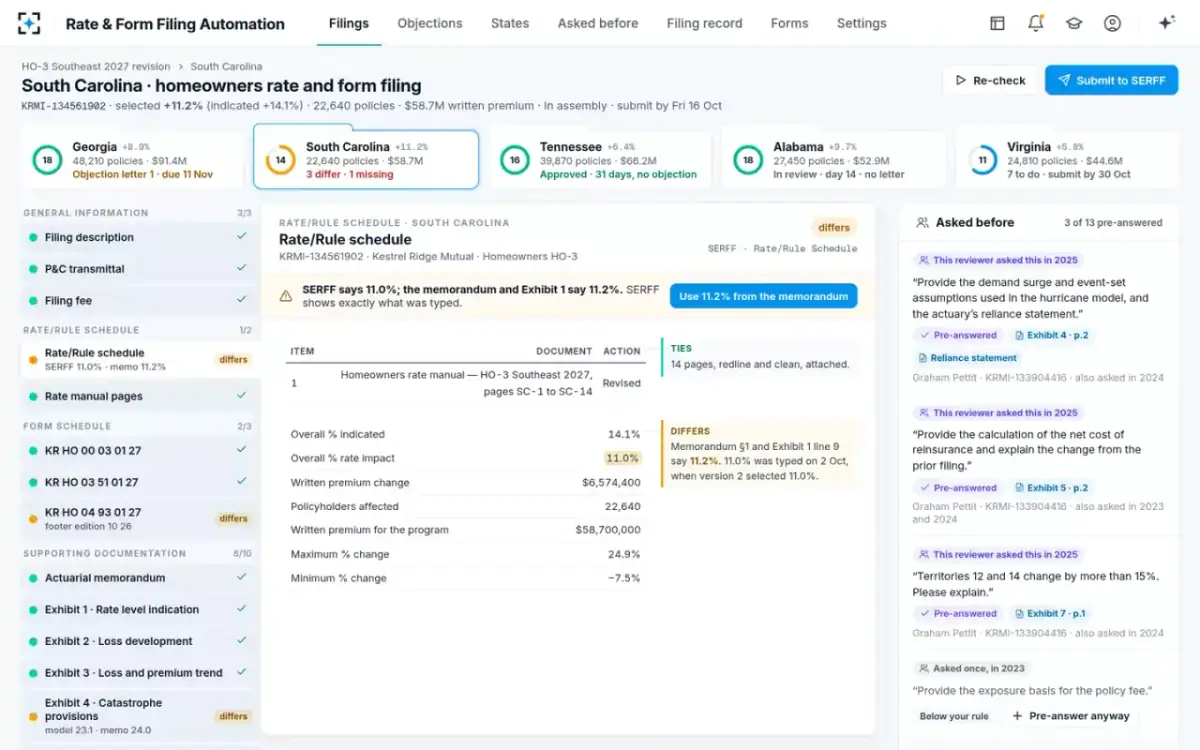
The example is from the fictional sample in Rate & Form Filing Automation, which runs in five southeastern states rather than California: an exhibit footnote named hurricane model version 23.1 while the memorandum and the model run used 24.0, and the actuary's reliance statement on file was for the old version. The consistency check caught it before submission. An actuarial memorandum example walks the same memo section by section.
One number, three places, checked before upload
Stacked rate changes and the 7% line
California counts a rate change against the rates in effect when the application is filed, including any approved change not yet effective. The instructions give the example: if a 6.9% change was approved effective December 1, 2025, and a second 6.9% application is filed on November 1, 2025, "the cumulative impact of the two rate changes is 14.3%," and public notice reflects 14.3% (CDI instructions, section II.J). Every rate application now carries a Stacked Rate Changes template, whether or not changes stack.
The 7% line matters because Proposition 103 requires a hearing on timely request when a personal lines change exceeds it. Two changes that each sit under 7% can, stacked, cross it, which changes the public notice, the intervenor's leverage and the clock. The arithmetic is simple, 1.069 × 1.069 = 1.143, but it has to be done in one place and carried to every document that states the change.
Intervenor Prop 103: the 45 days and the 2026 rules
Proposition 103 gives consumers and their representatives a role in rate proceedings, and intervenors have 45 days after public notice of a complete application to petition to participate. Bulletin 2024-7 restated that intervenors must provide a "substantial contribution" and "not duplicate the work of the Department's rate review experts to be eligible for compensation," and that for a personal lines increase above 7% where an intervenor has petitioned for a hearing, a calculated rate the insurer accepts needs "the written consent of the intervenor" before it is implemented (CDI Bulletin 2024-7).
The Department rewrote the intervenor rules in 2025–26. The Commissioner announced the proposal in September 2025, saying the process "has not been updated since 2006" (CDI release, 19 September 2025); the package went to the Office of Administrative Law in 2026 with provisions including "regular status updates from AHB Administrative Law Judges every 30 days to all parties" (CDI release 018-2026); and on 11 August 2026 the Department announced the regulation "now in effect" (CDI release 026-2026). The releases are the Department's own account of its rules.
For a filing team, the practical effect is that an intervened filing has more people reading the same numbers, on a record that is published. A withdrawal request must now be forwarded "to the Department and the intervenor(s) via email." Consistency across documents matters most when the reader is an adversary.
California insurance rate filings by the numbers
California received 3,282 property and casualty rate, rule and form filings in 2025, down from 3,433 in 2024, from nearly 700 companies, and all of them arrived through SERFF. Homeowners filings rose from 147 to 210; private passenger auto filings fell from 346 to 200 (CDI 2025 Annual Report). The Department reports that its review "reduced requested rate increases by more than $736 million" in 2025, and that the first two Sustainable Insurance Strategy filings it approved took "on average less than 95 days."
California rate filings received, by line, 2024 and 2025
A pre-upload checklist for a California prior approval filing
Before upload, a California prior approval filing should pass two tests: complete against the Application's Filing Type and Checklist page, and consistent with itself across the templates, exhibits, memorandum, rate manual and SERFF. The checklist below is ours, built from the October 2026 instructions.
Before a California prior approval filing goes to SERFF
- Current editions of the Application, Rate Template, Standard Exhibits and SIS templates, macros enabled
Check the Department page and the change log on the day you start.
- No formula, macro or protected cell altered
Fill only the input cells; explain any data adjustment in the filing memorandum; request a variance where the formula does not fit.
- The Combined Reconciliation Report run, every error and warning addressed or explained
Required for the Bulletin 2024-7 timeline when the portal is used.
- Outside the portal: the 2018 reconciliation comparisons done by hand
Premiums, exposures, paid losses, claim counts and every template input against its exhibit.
- Filing memorandum covers every proposed change and every model
A change not in the memorandum is not approved.
- Model forms and any PRID in place
An application relying on a model without its PRID is incomplete.
- Stacked Rate Changes template completed
Even when nothing stacks.
- Affidavit signed through Adobe Sign, with the SERFF company tracking number
The instructions accept only Adobe Sign signatures and ask for the same tracking number as SERFF.
- Complete rate manual ready
Required before approval issues.
Nothing leaves with a gap: the submission summary
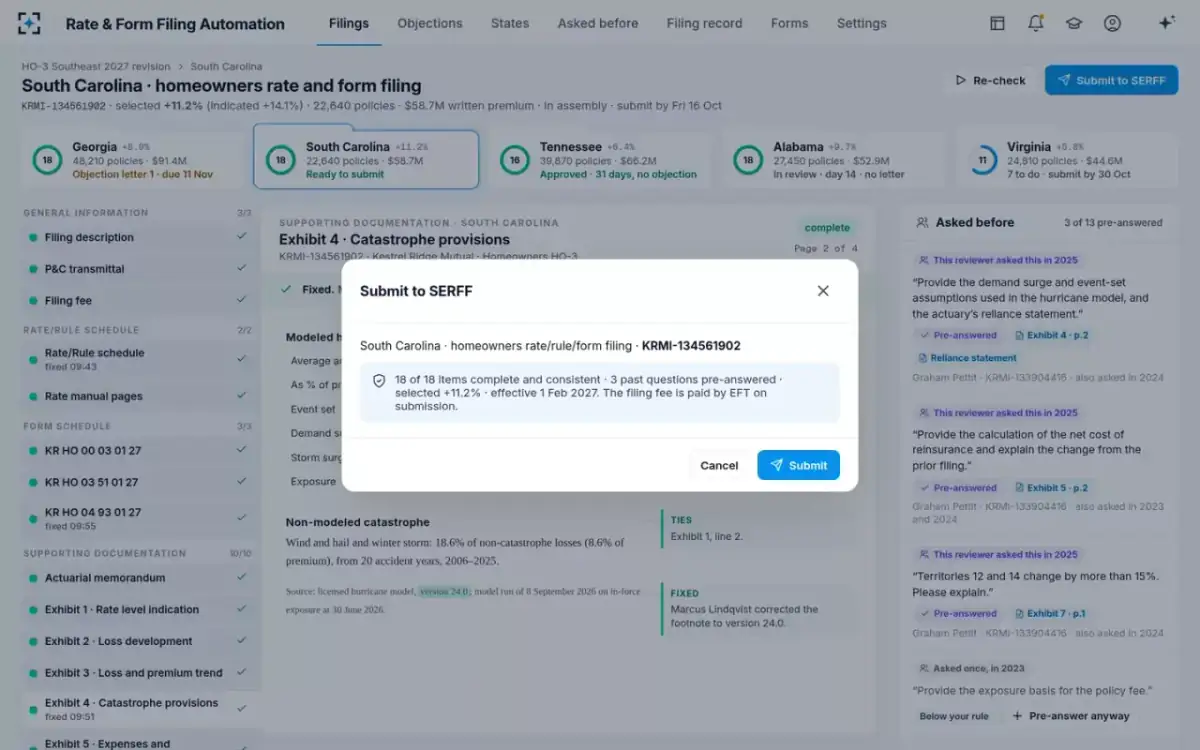
Where the solution fits in California, honestly: Rate & Form Filing Automation reads each department's instructions and checklists, ties every number, model version and edition across the memorandum, exhibits, manual pages, SERFF fields and forms, and never invents or edits an actuarial number. It does not replace the Department's portal or its reconciliation report, and it has no business inside the Department's formulas, which are the Department's. What it adds is the same discipline across the documents the templates do not cover, in California and in every other state the program is filed. To see that check on the sample program, start from Rate & Form Filing Automation; for the same two tests on New York's form, see the NY DFS rate filing checklist.
Questions people ask
Where are the California rate filing instructions?
On the California Department of Insurance's prior approval rate filing page, with the Application, Affidavit, templates, model forms and a change log to read first. The current instructions are the October 16, 2026 edition; check the page before each filing, because the package was updated seven times in 2026.
Can I change the formulas in California's rate templates?
No. Bulletin 2026-2 says insurers "may not modify" the Department's formulas, and the instructions prohibit altering any formula, macro or protected cell, intentionally or not. Where the prescribed formula does not fit, the route is a variance request under 10 CCR §2644.27.
How long does California take to approve a rate filing?
By statute, 60 days after public notice in the ordinary case and 180 days after receipt at the latest. Under Bulletin 2024-7, when the filing is built in the PARA Portal with a clean reconciliation report, review runs 60 days from public notice with up to two 30-day extensions.
What is the California rate filing affidavit?
A declaration under penalty of perjury, signed by an authorized representative through Adobe Sign, that the filing is true, complete and accurate, that no price optimization was used, and that the Excel templates were not altered beyond what the instructions allow. The September 2026 edition is also used for file and use filings.
What is an intervenor under Prop 103?
A person or group that joins a rate proceeding to represent consumers, petitioning within 45 days of public notice; intervenors who make a substantial contribution can be compensated. California's new intervenor regulation took effect in 2026, with clearer compensation standards and regular status updates in rate hearings.