The insurance product development roles behind a state rate and form filing are five: the product manager who decides what the program should be and which rate to select, the pricing actuary who builds the indication and signs the support, the rate filing analyst who assembles each state's package and submits it in SERFF, the forms specialist who drafts and edits the policy language, and the compliance or state filings lead who knows each department's rules and clocks. The work is hard because one decision becomes many documents in many states, and a regulator reads all of them together. Botminds' Rate & Form Filing Automation exists for the space between those seats: its agents assemble and check each state's package and draft answers to objection letters, while every number, signature and concession stays with the person who owns it.
The example used throughout is fictional sample data as it runs through the solution: Kestrel Ridge Mutual's HO-3 Southeast 2027 revision, a +8.5% overall homeowners rate change filed in Georgia, South Carolina, Tennessee, Alabama and Virginia, worth $26.66 million of annual written premium. The research figures come from regulators and federal statistics, linked where they appear.
The seats are specialist, and the system they file into is national
31,200
actuaries employed in the United States in 2025, at a median pay of $130,000
BLS
9%
projected growth in actuary jobs, 2025–35, "much faster than average"
BLS
7,000+
insurers, third-party filers and advisory organizations filing through SERFF
NAIC
500,000+
SERFF transactions a year
NAIC
What are the insurance product development roles in a rate and form filing?
Five roles carry a personal lines filing, though a small insurer may put two of them in one person and a large one may split each across a team. The titles vary; the work does not. Someone decides the product and the selected rate, someone prices it, someone writes the contract, someone builds and submits the state package, and someone knows what each department requires and when it will act.
The regulators' own description of the cycle names most of them. The NAIC's Product Filing Review Handbook, written by state regulators for filers and reviewers, puts it in four sentences: the filer "identifies a need for the insurance product"; the contract language is drafted, "including the policy form, the cover page or declarations, and any endorsements"; "Actuaries would price the product and develop rating rules or actuarial memoranda"; and the filer develops "underwriting rules to guide marketing and underwriting staff" (NAIC, 2024). What the handbook leaves implicit is the fifth seat: the person who turns all of that into a filing a given state will accept.
Five insurance product development roles, before and after the agents take the copying and checking
Today
Decides the selected rate and the form changes, then learns of a form-edition mismatch when a reviewer writes about it.
With agents
Is asked for the right form copy before submission; no response offers a rate or form change without their approval.
Still theirs: the selected rate, every form change, any concession
Today
Signs answers rebuilt from email and finds the page behind each figure by hand.
With agents
Sees each drafted answer with the exhibit and page it rests on, and corrects their own exhibits.
Still theirs: every exhibit, every signature, every actuarial answer
Today
Assembles each state package by hand and checks every exhibit against the memorandum by eye.
With agents
Opens each state binder already checked: what differs, what is missing, and who owns the fix.
Still theirs: submitting in SERFF and sending each response
Today
Keeps edition dates in footers, schedules and cross-references aligned across states.
With agents
Gets a footer-against-schedule comparison for every form in every state, with the redline against the prior edition.
Still theirs: the policy language itself
Today
Works out each state's checklist and each response deadline by hand.
With agents
Sees each department's checklist marked present or missing, and every clock on one timeline.
Still theirs: extensions, withdrawals and any waiver
The People figure is the argument of this page in miniature. In every seat, the part that moves to the agents is reading, copying and comparing. The part that stays is a decision someone signs. That split is not a product choice alone: the regulators' documents put names on those decisions, as the sections below show.
The insurance product development process, from need to filing
The insurance product development process runs in a fixed order: need, contract, price, rules, then filing. The NAIC handbook adds the step most teams skip: "Ideally, the filer would review applicable state-specific product standards and filing requirements during the product development phase to assure that the submitted filing is complete and compliant" (NAIC, 2024). In other words, the filing requirements belong at the start of the lifecycle, not at the end.
The handbook is blunt about what happens otherwise: "The filing process is a two-way street. Delays occur when a filer has not taken the time during the product development process to correctly identify state-specific product regulatory requirements." That sentence assigns the delay to the seat that did not look ahead, and it explains why so many filing teams now ask compliance into the room before pricing is final.
For a rate revision rather than a new product, the cycle is shorter but the same in shape. Experience comes in, the actuary builds an indication, the product manager selects a rate, the forms specialist decides whether any language changes, and the analyst builds one package per state. A single program revision in five states is five packages, each with its own SERFF schedules, its own checklist and its own reviewer.
The pricing actuary: indication, selection, signature
The pricing actuary owns the numbers and the memorandum that explains them. The Bureau of Labor Statistics lists the duties in plain terms, among them to "Produce charts, tables, and reports that explain calculations and proposals" and to "Explain their findings and proposals to company executives, government officials, shareholders, and clients" (BLS). In a filing, the government officials are the department's rate reviewers, and the reports are the memorandum and its exhibits.
The standard that governs that report is the Actuarial Standards Board's ASOP No. 41. It asks the actuary to set out methods, assumptions and data clearly enough for another qualified actuary to judge whether the work is reasonable (ASOP No. 41, §3.2). A department's actuary is exactly that other actuary. How a memorandum meets the test, section by section, is the subject of an actuarial memorandum example for a rate filing.
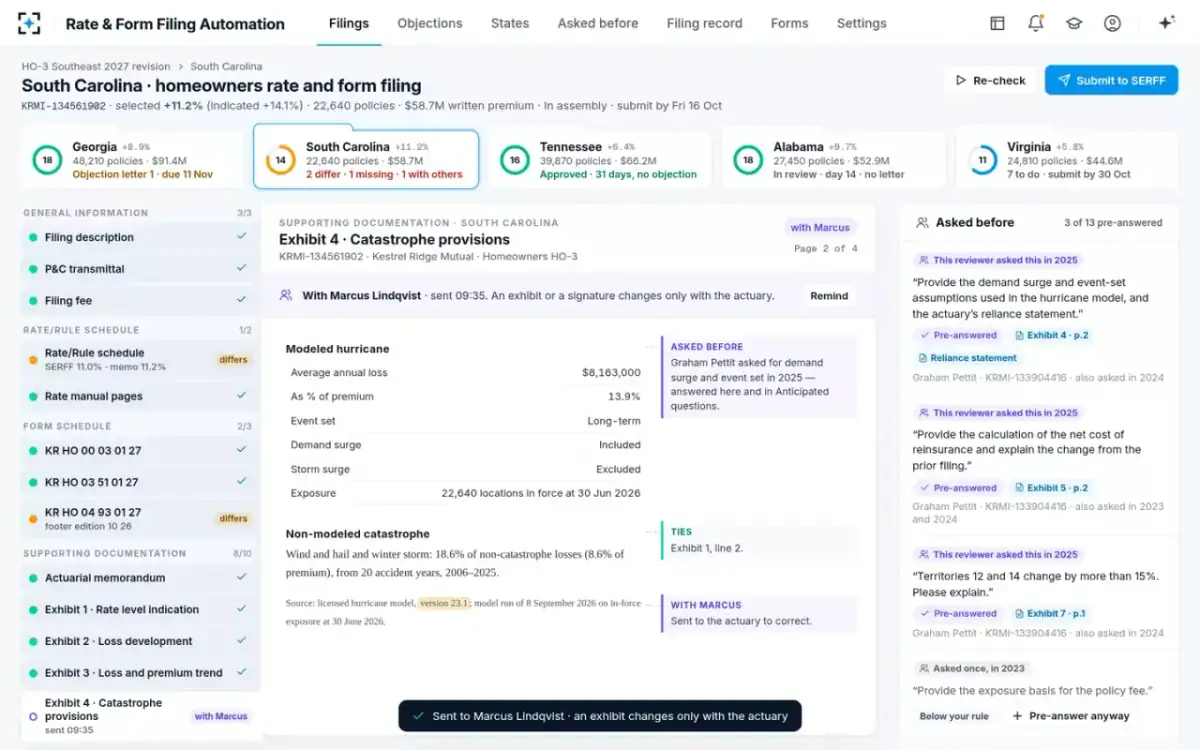
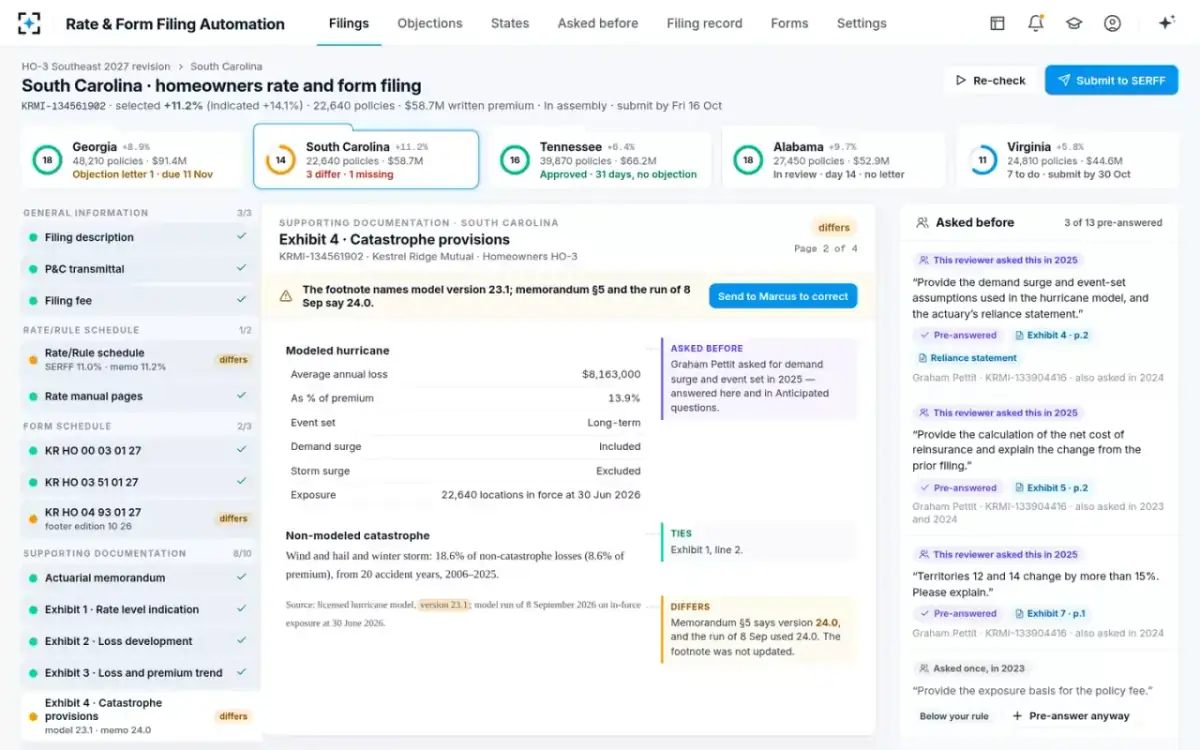
The actuary is also the seat that cannot be bypassed when an exhibit is wrong. In the sample, an exhibit footnote names hurricane model version 23.1 while the memorandum and the model run of 8 September say 24.0. The analyst can see the mismatch, but the fix goes to the actuary, because the exhibit and its signature are the actuary's.
A wrong footnote goes to the actuary, not to the analyst
The rate filing analyst: the package and SERFF
The rate filing analyst turns one program decision into one package per state and is the person who presses submit. The package follows SERFF's own structure: general information and the transmittal, the rate/rule schedule, the form schedule and the supporting documentation. The NAIC handbook notes that "All Uniform Transmittal Document fields have been built directly into SERFF and are part of every SERFF filing," so the analyst types many of the same facts into fields that a reviewer will compare with the memorandum (NAIC, 2024).
That is where the analyst's risk lives. The sample's South Carolina package carries the overall rate change in three places: memorandum section 1, Exhibit 1 line 9, and the SERFF rate/rule schedule. The first two say 11.2%. The SERFF field says 11.0%, typed on 2 October when an earlier version of the exhibits selected 11.0%. Nothing in a checklist catches that; a reviewer reading the numbers does.
The analyst also answers the letters. An objection arrives in SERFF with a response window, and the analyst gathers each answer from the actuary, the product manager and old correspondence. Responding to an objection in SERFF follows one letter through that work.
The product manager and the forms
The product manager owns the selected rate and, with the forms specialist, the contract. The regulators treat both as rate decisions. California's prior approval instructions say an insurer must file "full rate support for any changes in rates, rating factors, rating and eligibility guidelines or contract language that affect the rate or cost of coverage to any insured due to the broadening or restricting of coverage" (CDI instructions, October 2026 edition). A wording change that narrows coverage is, in California, a rate filing.
The forms seat lives in edition dates. A form's footer, its line on the form schedule and every endorsement that refers to it must carry the same edition. The NAIC handbook notes that a form reviewer "might need to coordinate activities with the rate filing reviewer for implementation effective date consistency for rate, rule, and form filings" (NAIC, 2024): the department reads rates and forms together, so the insurer has to build them together.
In the sample, the roof surfacing payment schedule, form KR HO 04 93, carries a 10 26 footer in South Carolina's copy against a 01 27 entry on the schedule. The fix belongs to the product manager, who holds the right copy; the agents only find it and route it.
Compliance and the state filings coordinator
The compliance seat knows what each department requires and when it will act. The Bureau of Labor Statistics defines the occupation broadly: "Compliance officers make sure that people and organizations meet legal and regulatory requirements," and lists among the duties to "Stay current on relevant laws and regulations and advise individuals and organizations on how to comply with them" (BLS). In filing, that means each state's review standards checklist, its filing instructions and its rating law.
The coordinator's half of the seat is time. Each state runs its own clock: a Texas rate can be used on the day it is filed, with at most 30 days for the Commissioner to disapprove it before it takes effect, a Florida "file and use" rate waits for a 90-day review, a California prior approval application is deemed approved 60 days after public notice unless a hearing is requested. One revision in five states can mean five calendars. The rate filing approval timeline prices each of those days.
Who signs what in a personal lines filing, by the regulators' own documents
| Document or decision | Who signs or owns it | Where the rule comes from |
|---|---|---|
| Actuarial memorandum and exhibits | Pricing actuary | ASOP No. 41 (actuarial report); state filing instructions |
| California affidavit that the filing is true and complete | An authorized representative of the insurer | CDI prior approval instructions, section II.B |
| New York speed-to-market rate certification | An authorized officer | NY DFS form CERT-R |
| Selected rate and any concession in a response | Product manager or head of pricing | The insurer's own authority; regulators review the result |
| Policy form language and editions | Product manager with the forms specialist | State form filing rules; NAIC handbook chapter 3 |
| Submission and correspondence in SERFF | Rate filing analyst | Each department's SERFF filing requirements |
Where the handoffs break, and why regulators notice
Most filing delays start between seats, and regulators have said so in writing. New York's Department made its rate filing checklist mandatory in 2002 after finding that review delays often traced back to submissions that were incomplete or not drafted to the applicable rules (NY Circular Letter 11 (1998), Supplement 4). California's Commissioner listed the same cause in 2024, among reasons reviews had run past Proposition 103's timelines: "insurance companies filing incomplete applications" (CDI Bulletin 2024-7).
An incomplete or inconsistent filing is rarely one person's error. It is a number that changed in the actuary's exhibits after the analyst typed it into SERFF, a form edition the product manager updated in one state and not another, a checklist item compliance flagged last year that nobody carried forward. Each seat did its own job. The package still disagrees with itself.
Where one homeowners revision changes hands, and what the agents do at each handoff
A person decides
Product manager selectsSets the selected rate and the form changes for the program, state by state.
A person decides
Actuary prices and signsBuilds the indication, writes the memorandum and signs the exhibits.
Agent
Package assemblerBuilds each state's package from the memorandum, exhibits, forms and checklist, and fills the SERFF fields.
Never: invents or edits an actuarial number
Agent
Requirements and consistency checksMarks each checklist item present or missing; ties every number, model version and edition across the package.
Never: changes a figure
A person decides
Analyst routes and submitsSends each difference to its owner, then submits in SERFF when the package is clean.
The fix the regulators ask for is completeness at submission. The fix the seats need is a shared view of the same package, checked against itself before anyone outside sees it. The NAIC handbook makes the cost of the alternative plain from the reviewer's side: "noncompliant filings require a great deal of time to document the shortcomings in the filing" (NAIC, 2024). That time comes back to the insurer as a letter.
What changes in each seat with Rate & Form Filing Automation
The change is in where the days go, not in who decides. Botminds' estimate for one state's homeowners rate and form filing with one objection letter is about 13 working days of effort by hand, spread across the seats, and about 3.5 days with the solution. The estimate is ours, built from the steps in the sample, not a measured result at a customer.
By Botminds' estimate, the copying and checking shrink and the actuary's review does not
By hand · 13 working days
- Assembling the package · 31%
- Checking numbers, editions, checklist · 23%
- Finding past questions · 8%
- Drafting objection answers · 30%
- Actuary review · 8%
With the solution · 3.5 working days
- Assembling · 29%
- Checking · 14%
- Past questions · 14%
- Drafting · 14%
- Actuary review · 29%
The actuary's day is the one that does not move, and it should not. The solution's rule is that "an exhibit or a signature changes only with the actuary," and any answer that cites an exhibit or the memorandum waits for the pricing actuary's approval. What changes for the actuary is the material: each drafted answer arrives with the exhibit and page it rests on, so review is reading, not searching.
For the analyst, the morning starts with the package already checked. For the product manager, a form mismatch arrives as a request before submission instead of as a reviewer's question afterwards. For compliance, each department's checklist is marked present or missing. For the coordinator, every clock is on one timeline with the margin before the effective date.
One revision, five states, one binder per state
Insurance product filing jobs: what the work asks of people now
Filing work rewards people who can read a rate exhibit and a statute in the same hour. Job titles for the seat include rate filing analyst, product filing specialist, state filings analyst and regulatory filings manager, and the work can be done from anywhere because SERFF is a web-based system. The Bureau of Labor Statistics does not publish a separate series for filing analysts; the nearest published occupations are actuaries, with 31,200 jobs in 2025, and compliance officers, with 436,400 jobs and a median pay of $80,730 (BLS).
What the agents change is the mix of the job. Less of it is copying a figure from an exhibit into a SERFF field and checking it by eye; more is deciding what to do about a difference, explaining a selection to a reviewer and knowing which department reads which exhibit closely. California alone took in 3,282 property and casualty rate, rule and form filings in 2025 from nearly 700 companies, all of them through SERFF (CDI 2025 Annual Report). Volume at that scale is why the checking moves to software and the judgement does not.
The seats also need a common language for what "done" means. A package is done when it is complete against the state's checklist and consistent with itself, which are two different tests, as the NY DFS rate filing checklist shows on New York's form. To see the five seats working on the same sample filing, start from Rate & Form Filing Automation.
Questions people ask
What does an insurance product development specialist do?
An insurance product development specialist coordinates a product or rate change from the business need to the filed program: gathering the form language, the actuarial support and the underwriting rules, and making sure each state's requirements are known early. The NAIC handbook describes the cycle as need, contract language, pricing and rating rules, underwriting rules, then filing, and says delays occur when state requirements are not identified during development.
What is the insurance product development lifecycle?
It runs from identifying a need, through drafting the policy form and endorsements, pricing and writing rating rules or actuarial memoranda, and writing underwriting rules, to filing with each state and answering the department's questions. For an existing program, the lifecycle repeats as a rate revision whenever new experience arrives; a Federal Reserve staff study of homeowners filings found that, across 2009 to 2019, the average insurer filed for a rate change in about 70% of the states and years in which it wrote business.
Are insurance regulatory filings jobs remote?
They can be, because filing is done through SERFF, a web-based system that nearly every jurisdiction accepts. The work still depends on close contact with the pricing actuary and the product manager, since every number and form change in the package belongs to one of them.
Who signs a rate filing?
The pricing actuary signs the actuarial memorandum and exhibits, and some states add an officer's or authorized representative's signature on the filing itself. California requires an affidavit under penalty of perjury that the filing is true and complete; New York's speed-to-market procedure requires an officer to certify the rate filing sequence checklist.
What does an insurance product development manager own?
Usually the selected rate, the product's forms and the filing calendar, with the authority to accept or refuse a change a regulator asks for. In Rate & Form Filing Automation that boundary is a setting: no drafted response can offer a rate change, concession or withdrawal without the product manager.