Responding to an objection in SERFF comes down to four things: answer every numbered objection separately, support each answer with the exhibit and page that proves it, disclose every document you change with a marked and a clean copy, and send it before the response date the department set. Most objection letters on a personal lines rate filing ask where a number came from or why a selection moved, and the answer already exists somewhere in the filing. The hard part is finding it fast and quoting it exactly. Botminds' Rate & Form Filing Automation is built for that: its objection responder drafts each answer from the filing itself, cites the page, never sends and never concedes, and hands the draft to the pricing actuary to sign.
The example on this page is fictional sample data from the solution: a Georgia objection letter on Kestrel Ridge Mutual's HO-3 homeowners rate filing, dated Monday 12 October 2026, with two questions and a 30-day response window. The rules come from state regulations, statutes and the NAIC's own handbook, linked where they are used.
When responding to a filing objection letter, a filer shall: (a) provide an explanation identifying each change made; (b) include an underline and strikeout version for each revised document; (c) include a final version of the revised document incorporating all changes …
Utah Admin. Code R590-225-13(1), property and casualty filings
How do you respond to a SERFF objection letter?
You respond in SERFF itself, on the filing, answering each objection on its own and attaching any revised document to the schedule tab it belongs to. Utah's rule spells out what many states expect without writing it down: an explanation of each change, an underline and strikeout version, and a clean final version, with the documents attached "to the appropriate form schedule or rate/rule schedule tabs" (Utah Admin. Code R590-225-13). A response that changes an exhibit without saying so is the fastest way to a second letter.
New York sets the same standard from the other end. When an insurer resubmits a filing the Department closed or disapproved, its explanatory memorandum must include "A point-by-point response to any Department objections to the company's previous filing(s)" and the specific reason the resubmission was necessary, such as a "prior filing closed due to lack of company response" (NY DFS, Rate Filing Sequence Checklist instructions, 06/2026). Point by point is the format reviewers read in every state.
The tone matters less than the citations, but it is not nothing. The NAIC's Product Filing Review Handbook asks both sides "when correspondence is necessary, to exchange information with courtesy, promptness, and clarity," and warns that "Much time may be lost waiting for correspondence to be sent and received between the filer and the reviewer" (NAIC, 2024).
What a SERFF objection letter asks for
A SERFF objection letter is the reviewer's written list of what stands between the filing and approval: missing items, numbers that do not reconcile, selections that need support, and form language that does not comply. The NAIC handbook describes the moment: "If the filing is found not to be in compliance, communication from the regulator will be sent to the filer, explaining filing deficiencies. Some states specify the timeframe within which the deficiencies are expected to be remedied" (NAIC, 2024).
The handbook's chapter on rate review says when a question is asked: "when it has not satisfied statutory or regulatory requirements in the state or when any current justification is inadequate and could have an impact on the rate change approval or the amount of the approval." The second clause is the one that matters to a pricing team. A question about a selection is a question about the amount the department will approve.
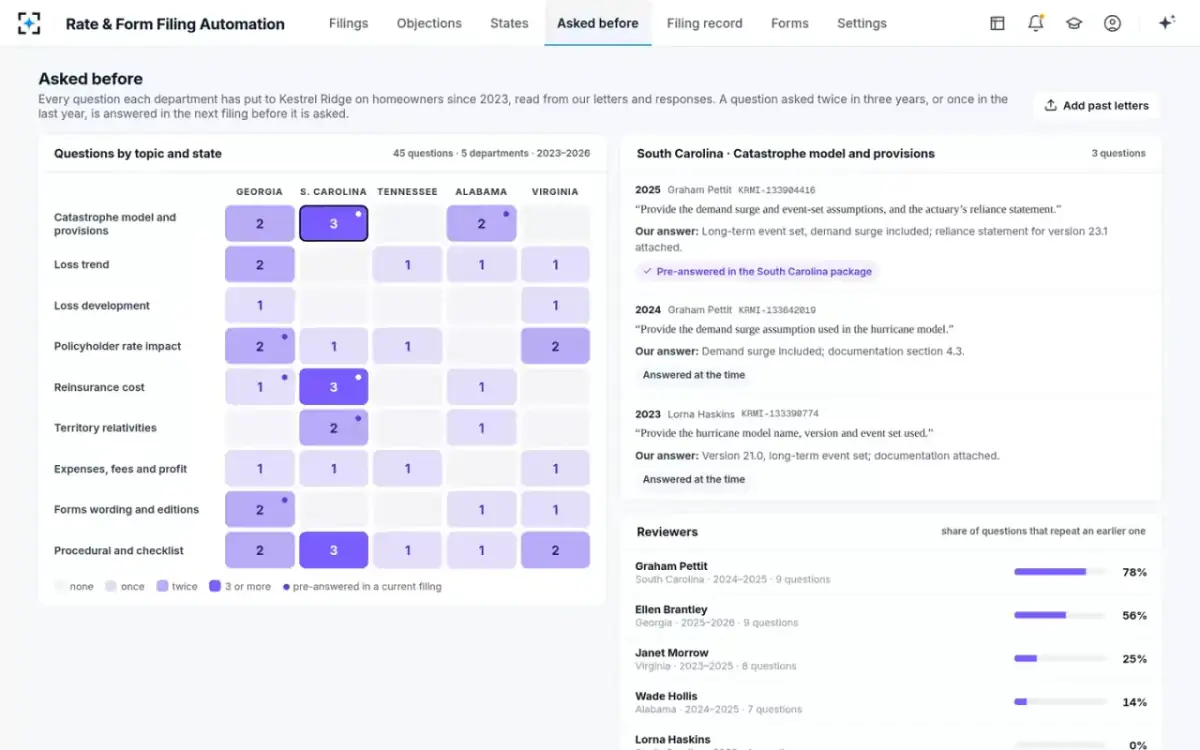
On a homeowners rate filing, the questions tend to fall into a short list of families: catastrophe provisions and the models behind them, loss and premium trend, loss development, the net cost of reinsurance, territory relativities, the distribution of the change across policyholders, expenses and profit, and procedural items such as a SERFF field that does not match the memorandum. The NAIC handbook's chapter on property and casualty rates treats most of them as review topics in their own right. In the sample, the reviewer history reader sorts 45 questions from five departments since 2023 into exactly those topics.
Every question each department asked, by topic and state
SERFF objection response time: whose clock is running?
The response time is the date the reviewer sets in the letter, but the clock that matters is the state's review clock, and states treat a pending question differently. In Texas, the time between a request for more information and the answer "is not included in the computation" of the 30-day disapproval period (Tex. Ins. Code §2251.1031(b)). In Florida the opposite holds for a file and use filing: "Requests for supporting information, requests for mathematical or mechanical corrections, or notification to the insurer by the office of its preliminary findings does not toll the 90-day period" (Fla. Stat. §627.062(2)(a)1.).
What a pending objection does to the review clock, in four states
| State | The clock | What an open question does |
|---|---|---|
| Texas (file and use) | Disapproval by the earlier of the effective date or day 30; one further 30 days for good cause | The days waiting for the insurer's answer are excluded from the 30-day count |
| Florida ("file and use") | Notice of intent to approve or disapprove within 90 days, or deemed approved | Requests for supporting information do not toll the 90 days |
| California (prior approval, Bulletin 2024-7 path) | Review within 60 days of public notice, then up to two 30-day extensions | Each extension needs the Department's written status of resolved and unresolved issues |
| South Carolina (homeowners above the 7% band) | 60-day waiting period, extendable once by up to 60 days on written notice | The director can take the extension to consider the filing |
The practical rule follows. Where an open question stops the state's clock, a slow answer delays approval day for day. Where it does not, a slow answer risks a disapproval the insurer must then contest. Either way, the reply belongs in the first days of the window, not the last. The rate filing approval timeline prices those days for one homeowners filing.
A rate filing objection response example, line by line
A good rate filing objection response restates the question, answers it in the first sentence, shows the arithmetic, names the exhibit and page, and says what did and did not change. The sample's Georgia letter has two objections from the department's property and casualty rate analyst. The annotated draft below is the first, as the objection responder wrote it four minutes after the letter arrived.
One objection and its drafted answer, annotated
Objection 1 · Georgia
"Please provide support for the non-modeled wind and hail catastrophe provision of 18.4% of non-catastrophe losses, including the years of experience used and the basis for the selection."
Drafted response
1 The provision is calculated in Exhibit 4, page 3. It is the ratio of wind and hail losses from events above the company's catastrophe threshold of $1.5 million to non-catastrophe losses, over 20 accident years, 2006–2025.
2 The 20-year average is 17.9% and the 10-year average is 19.9%. The selection of 18.4% gives 75% weight to the 20-year average and 25% to the 10-year average,
3 the method in the company's 2025 filing, approved on 3 December 2025 (memorandum §5.2).
4 The provision rises from 16.2% because accident years 2023–2025 were above the long-run average.
- Answers the question in the first sentence and names the page where the reviewer can check it.
- Shows the arithmetic: 0.75 × 17.9% + 0.25 × 19.9% = 18.4%. The reviewer can recompute it without a call.
- Ties the method to an approval the same department already gave, by date and filing.
- Explains the movement before the reviewer asks the follow-up, and offers no change to the rate.
Two details make the answer hold. The first is the count of years. The NAIC handbook describes the traditional catastrophe factor as built "from 20 or more years of catastrophe loss experience," and adds that "for some insurers at least 30 years of data" may be needed (NAIC, 2024). An answer that says 20 years and shows the weighting is inside that practice; an answer that leaves the count out invites the next question.
The second is the reference to the earlier approval. A reviewer is entitled to question a method twice, but an answer that shows the method is unchanged moves the conversation to the one thing that did change, the recent years. The sample's second objection, on trend, works the same way: the selected +6.5% annual loss trend sits between a 20-point fit of +6.8% and a 12-point fit of +6.2%, and the draft states that keeping the 2025 trend of +5.0% would have made the indication +10.9% rather than +12.6%. The handbook allows that kind of judgement in plain terms: "The selection of the trend should be reasonable and justifiable but should not have to match a formula calculation."
Drafting from the filing: what the objection responder does and does not do
The objection responder matches each question in the letter to the memorandum section and exhibit page that answer it, checks what the company told the same reviewer before, and drafts a plain answer that quotes the figures and names the page. Its limits are written into the product, not left to judgement: it never sends, it never offers a concession, rate change or withdrawal, and every sentence cites its page.
From the letter to the sent response, with a person at every decision
Agent
Read the letterPairs each numbered objection with a draft to come, and files it by topic, state and reviewer: catastrophe, trend, reinsurance, territories, procedure.
Agent
Find the supportMatches each objection to the memorandum section and exhibit page that answer it, and to earlier answers to the same reviewer.
Never: uses anything but the filing, the company's own correspondence and public filings
Agent
Draft each answerWrites a plain answer that quotes the figures and names the page; every sentence carries a citation.
Never: offers a concession, rate change or withdrawal
A person decides
Pricing actuary signsReads each answer beside the page it cites, edits or approves. Any answer that cites an exhibit waits for this signature.
A person decides
Analyst sends in SERFFSends the response with any revised documents attached to their schedule tabs, marked and clean.
Speed is the visible gain, and it is real in the sample: a four-minute draft against a 30-day window. The less visible gain is that a cited answer is easier to sign. Without a citation, the actuary has to find the page behind each figure before signing; with one, review is reading. Botminds' estimate puts drafting answers to one objection letter at about four working days by hand and half a day with the solution, while the actuary's own review stays at a day. That is an estimate from the sample's steps, not a measured result.
An answer rebuilt from email against an answer built from the filing
Rebuilt from email and old filings: Last year's response, a spreadsheet attachment, the actuary's memory of the selection
Built from the filing, cited by page: The exhibit page in the filing as submitted, quoted exactly
Rebuilt from email and old filings: The statement, and a follow-up question if the number cannot be traced
Built from the filing, cited by page: The page named in the answer, and the arithmetic shown
Rebuilt from email and old filings: A paragraph they must re-verify line by line
Built from the filing, cited by page: A paragraph with its source beside it
Rebuilt from email and old filings: Easy to slip in under deadline: "we will revise to…"
Built from the filing, cited by page: Not offered by the draft; only the product manager can approve one
Rebuilt from email and old filings: The same question, asked again, answered again from scratch
Built from the filing, cited by page: A recurring question pre-answered in the next filing
Pre-answering the questions a reviewer asked before
The best response to an objection is the one never needed. Reviewers repeat themselves because the same issues recur in every filing: the catastrophe model's event set, the net cost of reinsurance, territories that move more than a threshold. In the sample, the South Carolina reviewer's questions repeat an earlier question 78% of the time, the Georgia reviewer's 56%.
The solution's reviewer history reader reads the department's past objection letters and the company's responses, and where a question was asked twice in three years or once in the last year, it drafts an answer from the new exhibits into a supporting document called Anticipated questions. It never claims a question will be asked, and it uses only the company's own correspondence and public filings. In the sample, three questions the Georgia reviewer asked in 2025 were pre-answered and not asked in 2026: 2025 brought two letters and seven questions, 2026 one letter and two.
Pre-answering has a limit worth stating. A department reads what the filing says, not what the insurer guessed it would ask, and a pre-answer that contradicts an exhibit is worse than none. That is why each pre-answer is drafted from the new exhibits and passes the same consistency check as the rest of the package before submission.
What the actuary still signs, and why the model version matters
Every answer that cites an exhibit or the memorandum is an actuarial communication and needs the pricing actuary's approval before the analyst can send it. That is the solution's setting and also the professional standard. When a catastrophe model sits behind an answer, ASOP No. 38 asks the actuary to disclose "the catastrophe model used and the intended purpose" and "the extent of reliance on experts" (ASOP No. 38, revised 2021, §4.1).
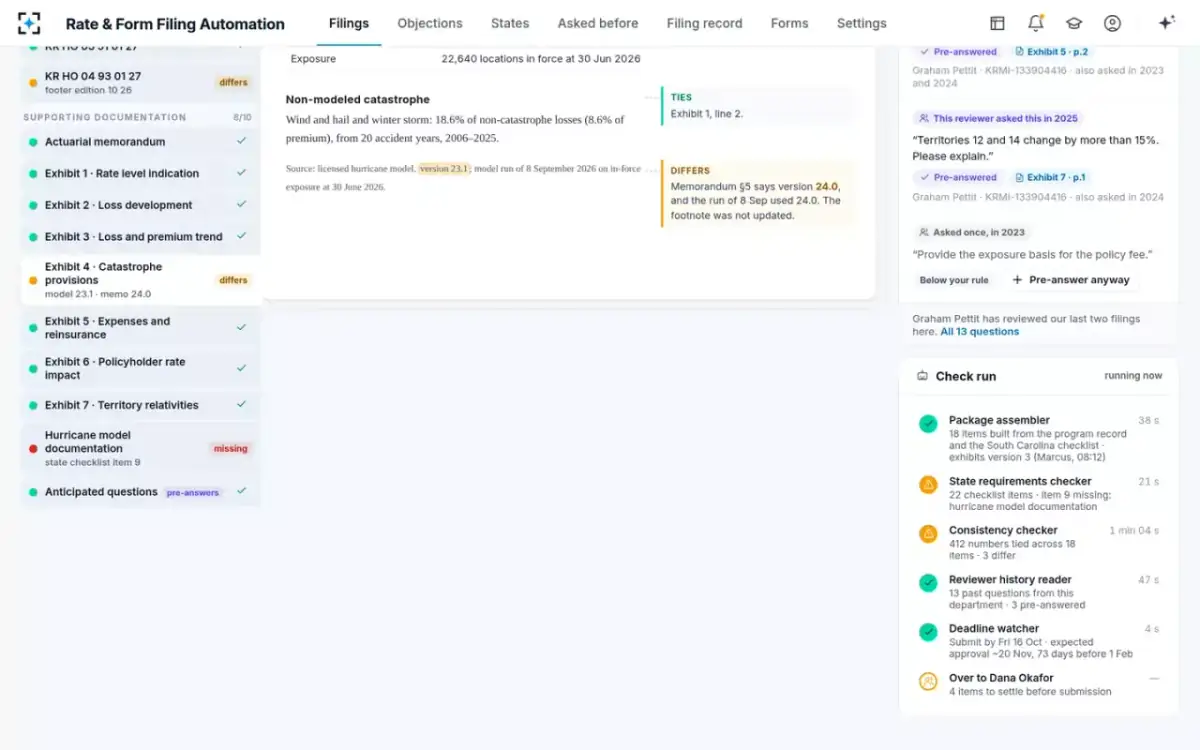
That is why the version in a footnote is not a clerical detail. In the sample's South Carolina package, Exhibit 4 named hurricane model version 23.1 while the memorandum and the model run used 24.0, and the reliance statement on file was for 23.1. An objection answer that cited that exhibit would have cited the wrong model. The consistency check found it before submission and routed it to the actuary, who alone can change an exhibit.
The check that runs before the package, or a response, leaves
When the honest answer is a correction
When an objection exposes a real error, the response should say so plainly, attach the corrected document marked and clean, and leave any rate consequence to the people who own it. Hiding a correction inside a longer answer does not work: Utah requires "an explanation identifying each change made," and every state's reviewer compares the new attachment with the old one.
The stakes of an uncorrected error outlast the approval. Florida's statute lets the Office disapprove as excessive a rate it has approved, or one deemed approved, within a year of its effective date only where it "finds that a material misrepresentation or material error was made by the insurer or was contained in the filing" (Fla. Stat. §627.062(2)(g)). An error caught in the response is a revision; an error caught after approval reopens the rate.
Some letters end in a filing that cannot be saved as submitted. Utah's rule makes an order to prohibit use final 15 days after its date and requires a new filing that references the prohibited one (Utah R590-225-13(2)). California lets an insurer ask to withdraw a pending application "via a SERFF filing note," subject to the reviewer's questions (CDI instructions, section II.L). Withdrawal is a decision for the product manager and the head of pricing, which is why the solution's drafts can never propose it.
A filing that disagrees with itself is the commonest source of corrections; one number in five places shows where those disagreements start. To see the objection workflow on the sample filing, start from Rate & Form Filing Automation.
Questions people ask
What is a SERFF objection letter?
It is the department reviewer's written request, sent through SERFF on the filing, listing what must be supplied or fixed before the filing can be approved or accepted. The NAIC handbook describes it as communication "explaining filing deficiencies," and notes that some states set the time within which they must be remedied.
How long do you have to respond to a SERFF objection?
The letter sets the response date, and it varies by state and by reviewer; the sample filing team works to 30 days in every state. What happens if you are late also varies: New York's instructions treat a filing "closed due to lack of company response" as a reason for resubmission, so a missed date can mean starting again.
Is there a SERFF objection response form?
No separate form is needed; the response is entered on the filing in SERFF, with revised documents attached to their schedule tabs. Some states prescribe its content, such as Utah's requirement of an explanation of each change, an underline and strikeout version, and a clean final version.
Can a response to an objection change the rate?
Yes, if the insurer chooses to revise the filing, but that is a pricing decision, not a drafting one. Rate & Form Filing Automation's drafts never offer a rate change, concession or withdrawal; any such change needs the product manager's approval.
What makes a rate filing objection response example a good one?
It answers in the first sentence, shows the arithmetic, names the exhibit and page, ties the method to any earlier approval, and explains why a figure moved. The sample answer above does all five in under a hundred words.